

Quick Summary
AI is changing how people search for lawyers—moving from traditional link-based results to instant, conversational answers from tools like ChatGPT, Google AI Overviews, and Perplexity. To stay visible, law firms must optimize for three areas: GEO (Generative Engine Optimization) to make legal content clear, structured, jurisdiction-specific, and trustworthy so AI tools can reference it; AEO (Answer Engine Optimization) to structure pages with concise answers, lists, FAQs, and schema so they appear in featured snippets, People Also Ask, and voice results; and AI SEO, which uses AI tools to speed up research, content planning, and optimization. Combined, these strategies help law firms show up inside AI-driven answers—not just in traditional rankings—ensuring potential clients see, trust, and contact the firm even in a zero-click search world.
Introduction
AI is changing how people search for lawyers. Instead of just scrolling through traditional search results, potential clients are asking tools like ChatGPT, Google’s AI summaries, Perplexity, and voice assistants to “find me the best personal injury lawyer near me” or “explain what happens after a DUI in my state.”
To win in this new environment, law firms need a strategy that combines three complementary disciplines:
- Generative Engine Optimization (GEO) – optimizing your content so generative AI systems can understand it, trust it, and reuse it in their answers.
- Answer Engine Optimization (AEO) – structuring content so it appears in featured snippets, “People Also Ask” boxes, knowledge panels, and voice responses.
- AI SEO – using artificial intelligence tools to plan, create, and optimize content more efficiently across traditional search and AI-driven experiences.

How AI Is Reshaping Legal Search Behavior
From “ten blue links” to AI-generated answers
Search is rapidly shifting from list-style results to conversational answers. AI-powered experiences now summarize information, compare options, and recommend providers directly inside the interface. That means users often get what they need without clicking through to a website.
For law firms, this creates both a risk and an opportunity. The risk is obvious: if AI answers legal questions without mentioning your firm, you lose visibility. The opportunity is that if AI tools repeatedly surface your brand, your attorneys can become the default recommendation in your practice area or location.
Zero-click and low-click searches are the new normal
Answer boxes, AI overviews, and chat-style responses lead to more “zero-click” behavior, where users get answers directly on the platform instead of visiting a site. Traditional SEO alone is no longer enough. You must optimize for visibility inside the AI answers themselves, not just for rankings in organic results.
GEO and AEO are designed specifically to address this problem, while AI SEO helps you adapt your processes so you can deliver more high-quality content, faster.
Why this matters more in the legal industry
Legal queries are often:
- High intent (“best car accident lawyer near me”)
- High risk (“what happens if I refuse a breathalyzer”)
- Highly regulated (ethics, disclaimers, jurisdiction-specific rules)
This combination makes trust and clarity critical. Generative and answer engines favor content that is accurate, easy to interpret, jurisdictionally clear, and strongly tied to entities like attorney names, law firms, cities, and practice areas.
Generative Engine Optimization (GEO) for Law Firms
What is GEO in practical terms?
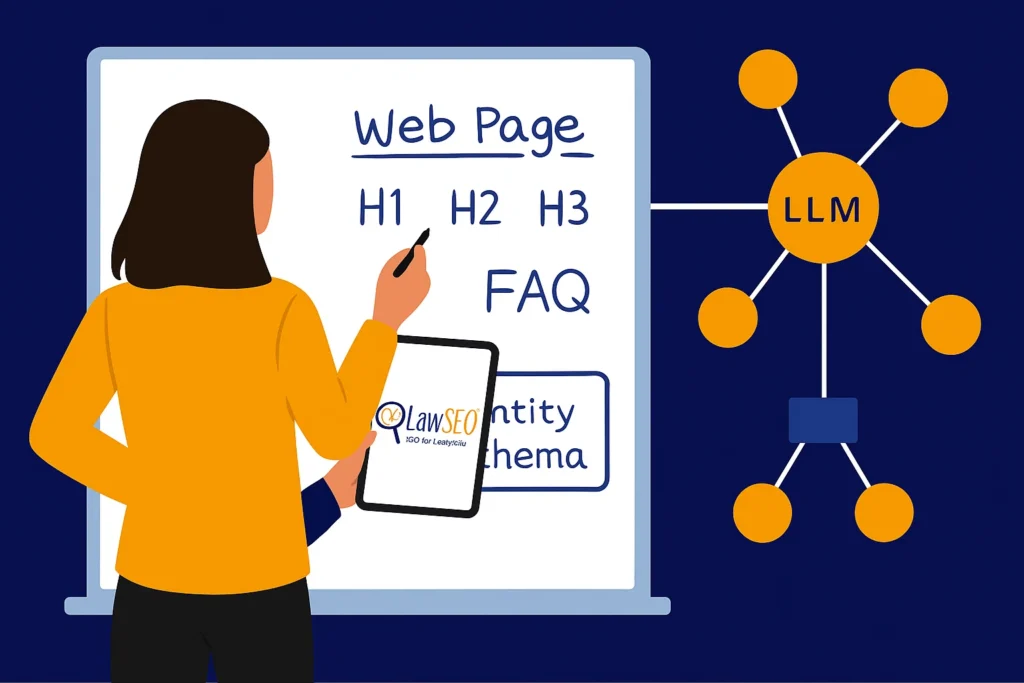
Generative Engine Optimization (GEO) is the practice of shaping your online presence so that AI systems can easily ingest, understand, and reuse your content in their answers. Instead of just chasing rankings, you are making your firm more “legible” to large language models and AI-powered search assistants.
For a law firm, GEO means:
- Publishing content that directly answers natural-language legal questions.
- Using clear structure, headings, and definitions so AI can parse your pages.
- Clarifying location, practice area, and key entities (attorneys, courts, statutes).
- Building enough authority and consistency that AI systems treat you as trusted.
Core GEO ranking factors for generative engines
While each AI platform is different, most look for similar signals when deciding which sources to reference:
- Clarity and structure – short paragraphs, descriptive headings, bullet lists, and FAQ sections make it easier for models to extract precise snippets.
- Topical depth – comprehensive coverage of a topic (for example, a 3,000-word guide to “what to do after a truck accident in [State]”) instead of thin content.
- Entity optimization – consistent naming of your firm, attorneys, locations, and practice areas, reinforced with schema and on-site profiles.
- Source trust – authority signals such as high-quality backlinks, positive reviews, mentions in reputable publications, and consistent NAP (name, address, phone) data.
- Freshness – up-to-date explanations of laws, deadlines, and procedures, with clear dates and versioning when rules change.
GEO content tactics for legal websites
To improve your firm’s performance in generative engines, consider the following GEO-focused tactics:
- Build “definitive guides” around each core practice area – for example, “Complete Guide to Car Accident Claims in [State]” with sections on timelines, fault, insurance, settlement ranges, and common mistakes.
- Use natural-language questions as headings – structure pages around questions like “Do I need a lawyer after a minor car accident?” or “How long do I have to file a claim in [State]?” so AI can map queries directly to answers.
- Add structured FAQs – include 5–20 FAQs per key page, each with a concise answer followed by optional depth for users and models.
- Clarify jurisdiction on every page – reference the state, city, and relevant courts in the copy to help AI avoid mixing laws from different locations.
- Publish plain-language explanations of legal concepts – explain complex terms like “comparative negligence” or “statute of limitations” at an 8th–10th grade reading level.
Advanced GEO steps for agencies and in-house teams
Once the basics are in place, you can move into more advanced GEO work:
- Entity mapping and schema – use structured data to describe attorneys, practice areas, locations, and reviews so models have a machine-readable map of your firm.
- AI visibility testing – regularly ask multiple AI tools common legal and commercial queries (for example, “who are the best injury lawyers in [City]?”) and document whether your firm appears.
- Content clustering – group related topics (for example, truck accidents, motorcycle accidents, pedestrian accidents) and interlink them to reinforce topical authority.
- Answer pattern analysis – study how AI tools phrase answers for your target queries and mirror that structure in your own content, while maintaining originality and compliance.
Answer Engine Optimization (AEO) for Legal Search
What is AEO and where do “answers” appear?
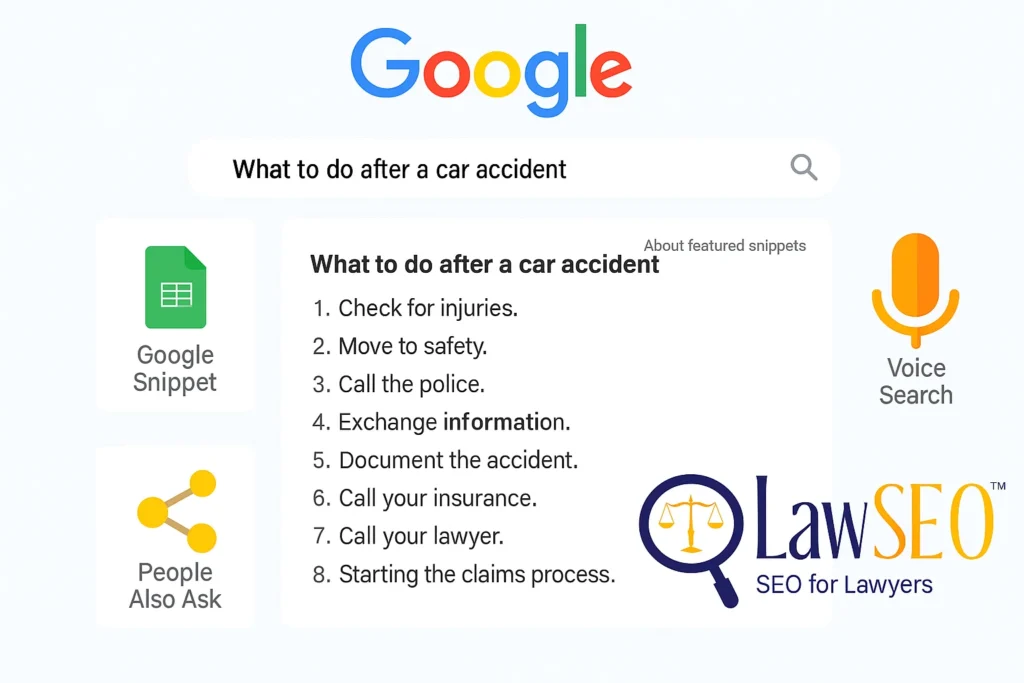
Answer Engine Optimization (AEO) focuses on placing your content wherever users see a direct answer instead of a standard search listing. These placements include:
- Featured snippets (the “position zero” box at the top of search results).
- “People Also Ask” question boxes.
- Knowledge panels for entities like law firms and attorneys.
- Voice assistant responses from phones, smart speakers, and cars.
- Short-form AI summaries embedded into search results.
When AEO is done well, your content becomes the answer that users see first, even if they never click through to your site.
AEO content patterns that work for law firms
AEO is highly tactical. You are designing pieces of content to be “answer-shaped,” not just readable. For legal websites, effective patterns include:
- Direct definitions – opening a section with a one–two sentence definition before deeper explanation.
- Step-by-step processes – clear lists describing what to do after an accident, how to hire a lawyer, or how a lawsuit works.
- Numbered and bulleted lists – search and answer engines favor lists when summarizing key points.
- Question-and-answer blocks – each question as a heading, followed by a tight answer of one short paragraph.
- Tables for comparisons – simple tables explaining differences (for example, “settlement vs. trial,” or “misdemeanor vs. felony DUI”).
On-page AEO optimization checklist
For each important page or article, use this AEO checklist:
- Include at least one clear, concise paragraph that directly answers the main query.
- Use the exact or very similar question as an
<h2>or<h3>heading. - Break long explanations into short paragraphs and lists to encourage snippet extraction.
- Add FAQ-style schema where appropriate to help search engines understand your questions and answers.
- Ensure the page is technically sound: fast, mobile-friendly, and easy to crawl.
Local and branded AEO for law firms
Answer engines also surface local and branded information. To improve your visibility:
- Keep your Google Business Profile and other directories fully updated.
- Encourage real, detailed reviews that mention practice areas and locations.
- Ensure your name, address, and phone number are consistent across the web.
- Create dedicated pages for each office, city, and key practice area combination.
The stronger and more consistent your local signals, the more likely answer engines are to reference your firm when users ask location-based legal questions.
AI SEO: Using AI to Supercharge Your Legal Marketing
What is AI SEO?
AI SEO is the use of artificial intelligence tools and models to improve traditional SEO tasks. Instead of optimizing only for AI platforms, you are using AI to work smarter on research, content, and technical improvements across your entire search strategy.
For law firms and agencies, AI SEO can:
- Speed up keyword and topic research.
- Generate content outlines, briefs, and first drafts.
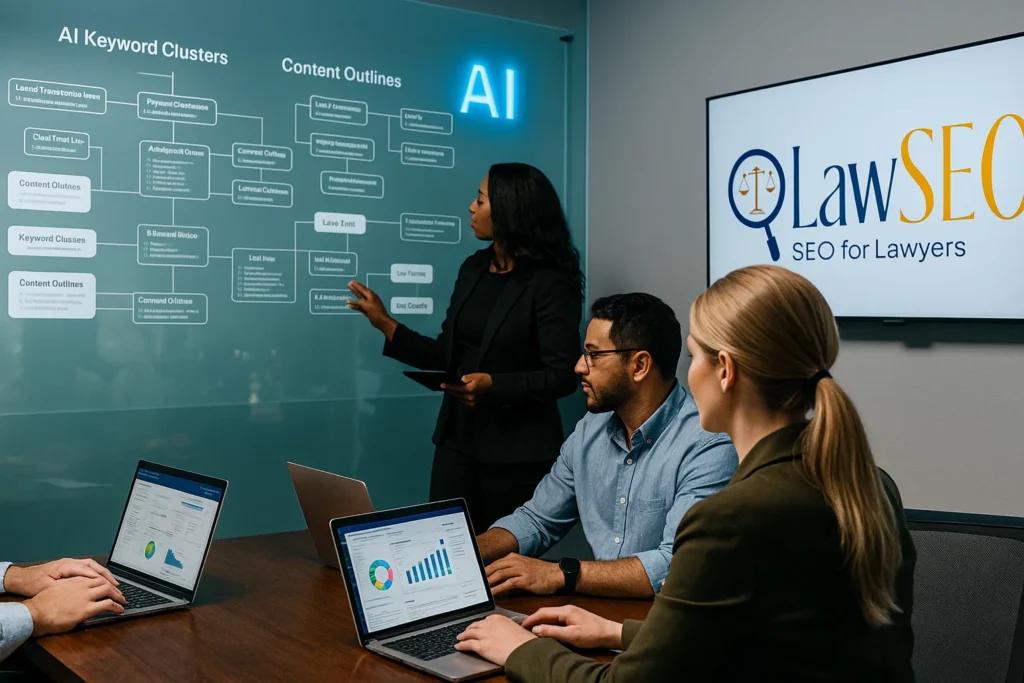
- Cluster related keywords into logical content hubs.
- Analyze competitor content at scale.
- Identify technical issues and optimization opportunities.
Practical AI SEO workflows for legal content
Here are examples of how you can use AI in a controlled, high-quality way:
- Topic discovery – feed seed keywords like “car accident lawyer [city]” into AI tools to discover long-tail queries and related legal topics.
- Search intent analysis – group queries by intent (informational, commercial, local, navigational) to decide which deserve practice area pages versus blog posts or FAQs.
- Outline generation – use AI to propose outlines for complex guides, then refine them manually to ensure legal accuracy and compliance.
- Draft improvement – have AI suggest clarity edits, readability improvements, and structural enhancements to human-written drafts.
- Technical audits – use AI-enabled tools to spot common technical SEO issues and prioritize fixes.
Quality, compliance, and human oversight
In the legal industry, you cannot publish raw AI output. Every piece of content must be:
- Fact-checked by a human who understands the law.
- Reviewed by an attorney where required by firm policy or regulation.
- Adjusted for jurisdictional nuances and local rules.
- Aligned with your firm’s tone, ethics rules, and disclaimers.
Think of AI as a powerful assistant, not a replacement for legal knowledge or editorial judgment.
A Unified Framework: Combining GEO, AEO, and AI SEO
Why you should treat them as one integrated system
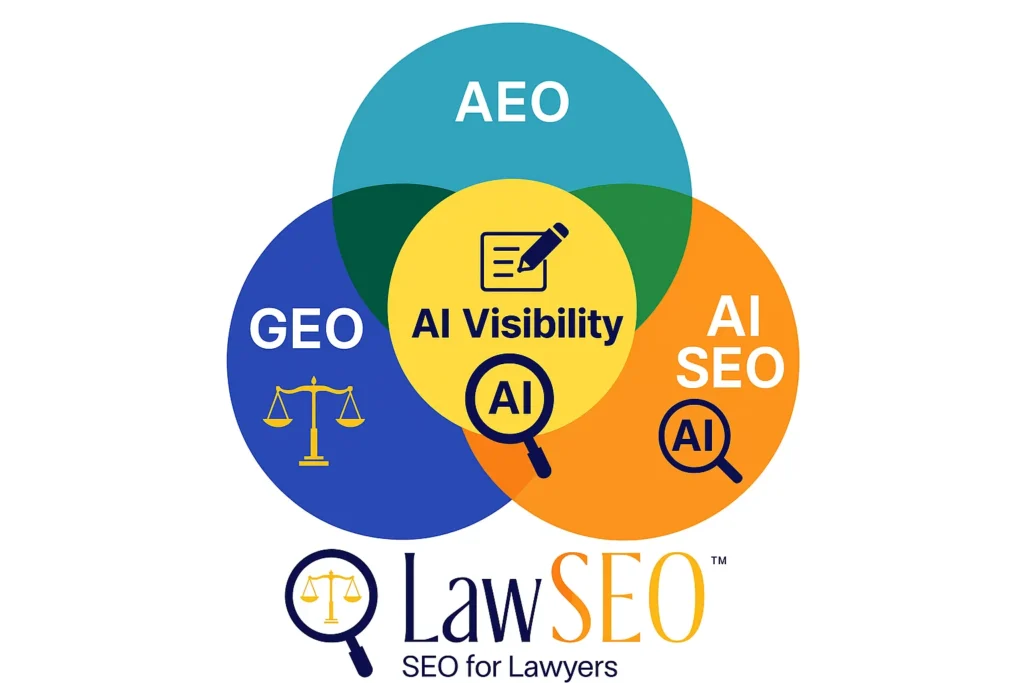
Although GEO, AEO, and AI SEO have different focuses, they overlap heavily in practice. The same piece of content can:
- Be structured for featured snippets (AEO).
- Serve as a training-quality resource for generative engines (GEO).
- Be planned, briefed, and improved using AI tools (AI SEO).
Instead of treating them as separate services, think in terms of a unified “AI search optimization” program anchored in high-quality content and clear technical foundations.
The three-layer model
You can visualize the combined strategy as three layers:
- Foundation: Traditional SEO – fast, crawlable site; logical architecture; optimized titles and meta descriptions; strong local presence.
- Middle layer: AEO – answer-shaped on-page content, FAQ structures, snippet-friendly paragraphs, and voice-ready language.
- Top layer: GEO – entity-focused, AI-ready content clusters designed to be reused and cited by generative engines, supported by AI-driven workflows.
Each layer supports the others. When all three are aligned, your firm is more visible in both classic search results and emerging AI-driven environments.
Implementation Roadmap for Law Firms and Agencies
Step 1: Discovery and baseline assessment
Start by understanding where you stand today:
- Audit your current organic traffic, rankings, and conversions.
- List your existing practice area pages, blogs, and resource content.
- Document your local presence: offices, cities served, and current profiles.
- Test AI tools by asking important queries and recording where your firm appears (if at all).
Step 2: Information architecture and content mapping
Next, plan the structure of your site and content around real user needs:
- Define core practice area “pillars” and related subtopics for each.
- Map queries to the right content type (service page, guide, FAQ, blog, location page).
- Ensure every high-value topic has a dedicated, high-quality page.
- Plan internal links so users (and AI systems) can easily navigate between related topics.
Step 3: Content creation and optimization
Build or rebuild content with GEO and AEO principles in mind:
- Create deep, authoritative guides for each core practice area in each key jurisdiction.
- Use questions as headings and provide direct, concise answers under each one.
- Add FAQ sections to key pages and consider implementing FAQ schema.
- Use AI tools to support research and outline creation, then write and review content with human experts.
Step 4: Technical and entity optimization
Strengthen technical foundations and entity clarity:
- Ensure fast page loads, mobile responsiveness, and clean URL structures.
- Implement schema for local businesses, organizations, attorneys, and FAQs where appropriate.
- Standardize naming conventions for your firm and attorneys across the site.
- Update and correct citations, directories, and profiles to match your canonical NAP data.
Step 5: AI visibility monitoring and refinement
Finally, treat AI visibility as an ongoing metric:
- Maintain a list of target questions (both informational and commercial) for each practice area and location.
- Check how AI platforms answer those questions on a regular schedule.
- Note when your firm is mentioned, how you are described, and which pages seem to drive those mentions.
- Refine and expand content based on gaps in coverage or incorrect descriptions.
Measurement: KPIs for GEO, AEO, and AI SEO
Classic SEO and traffic metrics
You should continue tracking the usual metrics:
- Organic traffic by practice area and location.
- Rankings for key service and location keywords.
- Form submissions, calls, and chat leads from organic sources.
- Conversion rates by page type and practice area.
AEO-specific indicators
For AEO, focus on:
- Number of keywords where you own the featured snippet.
- Presence in “People Also Ask” boxes for important questions.
- Impressions and clicks from rich results, where available in analytics.
- Voice search performance where you can test queries on devices.
GEO and AI visibility metrics
For GEO and AI visibility, track:
- How often AI tools mention your firm when asked commercial-intent questions.
- How accurately they describe your practice areas and locations.
- Whether they pull information that appears to come from your site or from competitors.
- Changes over time as you publish and optimize more content.
You can turn this into a simple internal scorecard, grading each priority query from “not visible” to “visible and accurately represented.”
Common Mistakes and How to Avoid Them
Over-relying on AI-generated content
One of the biggest risks is letting AI write entire articles without human oversight. This can lead to:
- Inaccurate or outdated legal information.
- Generic, low-value content that fails to stand out.
- Compliance issues with local bar rules or advertising guidelines.
Always keep attorneys and experienced editors in the loop.
Ignoring local and entity signals
AI systems need clear signals about who you are and where you operate. If your site is vague or inconsistent about locations, attorney names, and practice areas, generative engines are more likely to overlook or misrepresent you.
Make sure entity and local optimization are prioritized alongside content creation.
Chasing trends instead of building durable assets
New AI features will continue to roll out, but the fundamentals remain the same: high-quality, accurate, well-structured content that clearly answers real questions from real people. Focus on building durable resources, not just chasing buzzwords or temporary hacks.

90-Day Implementation Roadmap for Law Firms
To make the strategy concrete, here is a simple 90-day roadmap we use when rolling out GEO, AEO, and AI SEO for law firms.
Days 1–30: Audit and Foundation
- Conduct a full site and content audit with an AI-first lens.
- Identify your most important practice areas and locations.
- Document inconsistencies in messaging, entities, and business information.
- Prioritize a short list of pages to become “flagship” GEO and AEO assets.
- Set up baseline metrics and reporting.
Days 31–60: Content and Experience
- Rewrite or expand flagship pages using LLM-ready, AEO-focused structures.
- Add FAQs and question-based headings that reflect real client queries.
- Implement or refine schema markup for key practice, location, and FAQ pages.
- Strengthen attorney bios and firm overview pages with clear credentials and experience.
- Begin addressing off-site consistency in major directories and profiles.
Days 61–90: Scale and Optimization
- Publish new educational content based on gaps identified in research.
- Expand internal linking between related topics and practice areas.
- Review performance data to see which pages are gaining visibility and engagement.
- Iterate on content and structure for pages with strong impressions but weak clicks.
- Refine your monthly execution plan based on what is working best.
By the end of 90 days, your firm has a solid AI search foundation, a set of optimized flagship pages, and a repeatable process for ongoing GEO, AEO, and AI SEO work.
Conclusion: Future of Legal Marketing in an AI-First World
Generative Engine Optimization, Answer Engine Optimization, and AI-driven SEO are no longer optional for law firms that want to compete in modern search. Together, they create a framework that ensures your firm is not just visible in rankings, but present in the AI-driven answers and recommendations that shape client decisions.
By combining strategic research, structured content, legal expertise, and intelligent tools, we help law firms build lasting authority across search engines and generative platforms alike—so that when prospects ask important legal questions, your firm is the one they see, trust, and ultimately call.
Frequently Asked Question
1. What is Generative Engine Optimization (GEO) for law firms?
Generative Engine Optimization (GEO) helps law firms make their content easy for AI tools to read, understand, and reuse in their answers. In practice, GEO focuses on clear structure, defined legal concepts, jurisdiction-specific information, and strong entity signals so AI tools feel confident referencing your firm in their recommendations.
2. How does Answer Engine Optimization (AEO) help lawyers get more cases?
AEO helps law firms appear directly inside answer boxes and AI summaries, making the firm visible even when users don’t click a website. By structuring content around questions, short answers, lists, and definitions, firms increase their chances of owning featured snippets, People Also Ask results, and voice search responses.
3. What is AI SEO and why is it important for law firms?
AI SEO uses artificial intelligence to research, plan, and optimize legal content faster and more accurately. It helps law firms uncover topics, analyze competitors, build outlines, identify gaps, and scale content production while maintaining legal accuracy and compliance.
4. How is AI changing legal search behavior?
AI is shifting legal search from “list-style results” to conversational answers that summarize solutions and recommend providers. This means clients get answers faster—and law firms must optimize for visibility inside AI answers, not just traditional rankings.
5. Why do law firms need GEO and AEO in addition to traditional SEO?
Traditional SEO helps pages rank; GEO and AEO help your firm appear inside AI-generated answers even when users don’t click. As zero-click searches rise, appearing inside answers is now as important as ranking in organic results.
6. How can a law firm appear in ChatGPT, Google AI Overviews, and Perplexity?
Law firms appear in AI answers when their content is authoritative, clearly structured, and rich in entity signals like locations, attorney names, and practice areas. Adding FAQs, definitions, schema Markup, and long-form guides improves AI visibility dramatically.
7. What signals do AI systems look for when recommending a law firm?
AI platforms look for trust signals: clear content structure, topical depth, accurate legal explanations, consistent NAP data, reviews, citations, and strong attorney profiles. Entity authority and jurisdiction clarity are especially important for legal topics.
8. What types of legal content work best for generative AI platforms?
Content that directly answers natural-language questions performs best, including guides, FAQs, step-by-step instructions, and case-specific explanations. AI models prefer structured, simple, updated content tied to a specific jurisdiction.
9. Why is jurisdiction clarity important in AI-optimized legal content?
Legal information changes by state, so AI tools prioritize content that clearly states the jurisdiction and relevant laws. This accuracy reduces model confusion and increases the chance of your firm being referenced.
10. How does schema markup help law firms in AI search?
Schema markup gives AI systems a machine-readable map of your attorneys, practice areas, locations, and reviews. This increases entity clarity and improves inclusion in AI-generated answers.