

Quick Summary
AI is transforming law firm SEO, enabling smarter keyword research, automated SERP analysis, content drafting, and voice search optimization. By combining AI tools with human expertise, law firms can enhance visibility, drive leads, and maintain compliance with E-E-A-T and legal standards. This guide shows how to leverage AI safely to future-proof SEO strategies.

Introduction
The SEO landscape for law firms is rapidly evolving—and AI for law firms is driving that transformation. If you haven’t started rethinking your legal SEO strategy to incorporate AI tools and machine-learning tactics, you’re already falling behind. The good news? There’s still time to harness AI strategically and dominate your local and practice-specific search results.
This guide breaks down exactly how law firms can use AI (and guard against its misuse) to scale rankings, drive leads, and future-proof their SEO strategy.
🚀 Why AI is Reshaping Law Firm SEO (and Fast)
Google’s recent algorithmic shifts (Helpful Content Updates, SGE) prioritize:
- Conversational content
- Authoritativeness
- User intent and UX signals
- Contextual search over keyword stuffing
AI enables smart firms to adapt to all of the above—but only if it’s implemented strategically.
🔑 Key Opportunities for AI-Enhanced Law Firm SEO
1. AI-Driven Keyword Intelligence
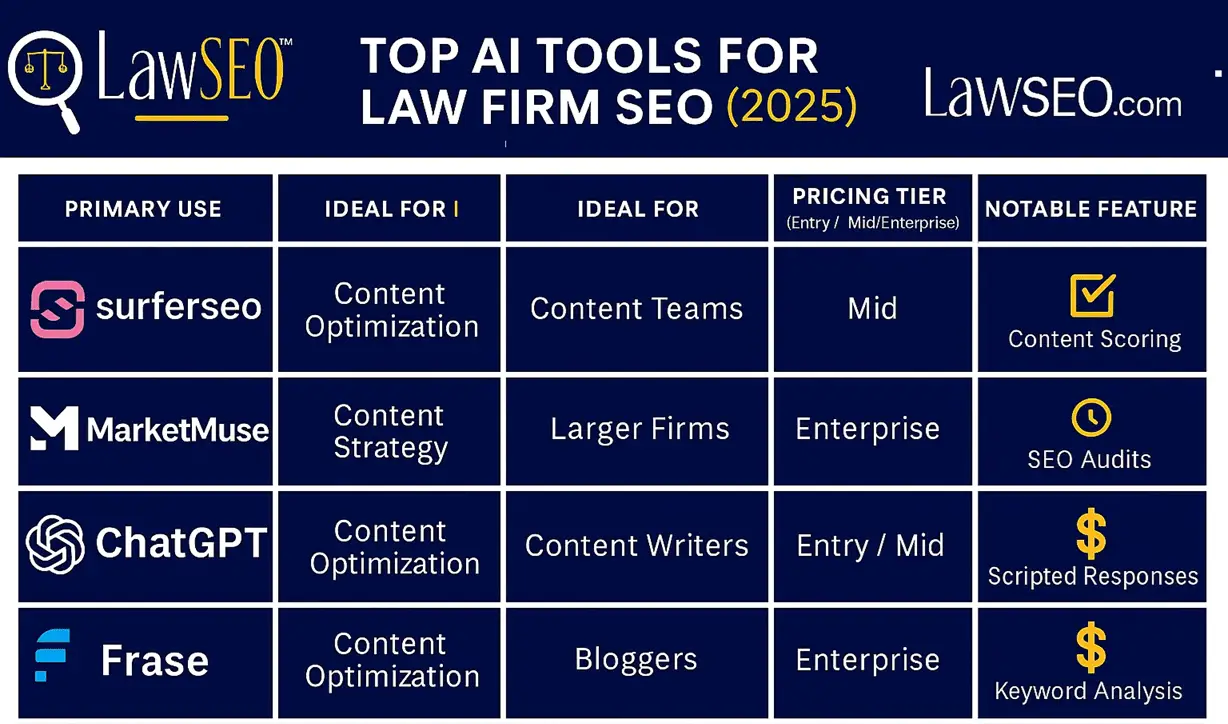
One of the most powerful applications of AI in law firm SEO is uncovering and organizing the right keywords—those that match real-world client queries with high conversion potential. AI tools like SurferSEO, MarketMuse, and ChatGPT are transforming how keyword research is done, turning what used to be a manual grind into a precise, strategic operation.
Here’s how AI elevates your keyword strategy:
- Cluster keywords by search intent: Instead of relying on broad keywords like “car accident lawyer,” AI tools can identify nuanced variations like “what to do after a rear-end collision in Houston” (informational intent) versus “free consultation car accident attorney near me” (transactional intent).
- Expose content gaps your competitors ignore: MarketMuse and SurferSEO analyze your site against top-ranking pages to reveal missing subtopics, questions, or angles. These are opportunities to out-write and outrank.
- Prioritize high-value long-tail queries: ChatGPT and MarketMuse can surface queries with buyer intent that tools like Keyword Planner may underreport (e.g., “can I sue Uber for a minor accident in New Jersey?”).
Advanced Tip: Use ChatGPT to simulate client questions or court-related search behaviors. Prompt it with: "List 10 questions someone might search after being injured in a hit-and-run accident in Georgia." Then plug these into Ahrefs or SEMrush to assess volume and difficulty.
Pro Tip: After generating 50–100 related keywords, feed them into clustering tools like Keyword Insights or Cluster.ai to group them by semantic topic. This forms the backbone of your content hub strategy—perfect for building practice-area landing pages with supporting blog content that interlinks naturally.
Validation Step: Before committing content resources, cross-check your clusters with Ahrefs’ Keyword Difficulty and Traffic Potential metrics. Prioritize keywords with commercial intent, low competition, and clear mapping to your service offerings.
Remember, the real value of AI keyword intelligence isn’t in volume—it’s in precision. By aligning your law firm’s content strategy with real user intent, you maximize your chances of ranking AND converting that searcher into a case.

2. Automated SERP Analysis
Ranking well in Google isn’t just about what you write—it’s about understanding why Google is ranking your competitors. This is where automated SERP analysis tools like Clearscope, Frase, and SurferSEO come in. These platforms don’t just suggest keywords—they dissect the SERP anatomy to reverse-engineer what works.
Here’s what they reveal:
- Schema Types: Discover whether competitors are using
FAQPage,LegalService, orReviewschema. If top-ranking injury lawyer pages include review-rich snippets or client testimonials, you should too. - Content Length and Structure: Learn the average word count, use of lists, heading density, and media (images, videos) that appear on page one. Tools like Frase show how deep your article needs to go to be competitive.
- Common Questions Answered: These tools extract “People Also Ask” results, Quora threads, and Reddit questions related to the topic—providing goldmine content for headings or FAQ sections that increase time on page and match searcher intent.
Advanced Tip: Use Frase to crawl your top five SERP competitors and generate a “Gap Report.” This will show which topics and subtopics you’re not covering compared to others. Address those directly in your blog or practice page to close the gap and potentially leapfrog competitors.
Pro Tip: Create an SEO brief for every new piece of content using Clearscope or Frase. Include:
- Primary keyword and related LSI terms
- Top 10 questions from SERP + “People Also Ask”
- Suggested title, meta description, and URL slug
- Schema recommendations based on SERP trends
This turns your content from a guess into a Google-aligned asset.
Legal SEO is too competitive to rely on assumptions. Let SERP analysis tools do the reconnaissance for you—so every blog post, FAQ, or landing page is engineered to outrank, not just compete.
3. Smart Content Drafting—But Human Refinement
AI content tools are revolutionizing how law firms can scale their marketing—but using them correctly is critical. Tools like ChatGPT, Jasper, and Writesonic can generate drafts in seconds—but they lack the legal nuance, ethical oversight, and brand tone your firm must maintain.
Here’s how smart firms use AI to speed up content creation without sacrificing integrity or trust.
✅ What AI Can Draft (When Guided Properly)
- Blog Outlines: Use AI to structure posts based on keyword input, current trends, or “People Also Ask” questions. For example, “5 Steps to Take After a Truck Accident in Arizona.”
- FAQ Sections: Prompt AI to generate question-and-answer sets based on client behavior or search intent. These are excellent for schema and quick answers.
- Attorney Bios: Feed AI with a resume or interview transcript and get a polished first draft emphasizing qualifications and personality.
- Practice Page Summaries: Generate copy blocks that explain services like “Wrongful Death” or “Premises Liability” using clear, client-friendly language.
⚖️ Where Human Review is Non-Negotiable
- E-E-A-T Compliance: Google values experience, expertise, authoritativeness, and trust. AI can mimic tone, but only you can supply real-world stories, credentials, and citations that prove credibility.
- Accuracy: AI models can hallucinate or blend laws between states. A human must verify statutes, filing deadlines, and terminology—especially for regulated topics like personal injury, DUI, or workers’ compensation.
- State Bar Compliance: Many states restrict certain claims (e.g., “best lawyer” or “guaranteed results”). AI won’t catch this—you must edit for ethical and legal accuracy.
🔐 Reinforce Trust with Structured Authority Signals
After refining AI content, always enhance it with the following:
- Attorney Bylines: Add the lawyer’s name, bar number (if allowed), and credentials to every page. This signals authority to both users and Google.
- Author Schema: Mark up author information with schema.org/Person to show legal expertise in structured data.
- LegalService Schema: Wrap practice area pages with LegalService markup to help Google categorize your offerings correctly.
Pro Tip: If your attorney is active on AVVO, LinkedIn, or Martindale-Hubbell, link to those profiles for added legitimacy and third-party validation.
AI speeds up production—but it’s human expertise that wins trust, rankings, and conversions. Combine the two for scalable, ethical, high-impact SEO content.
4. Schema, Structured Data, and AI SEO
🧠 Top AI SEO Platforms & How Law Firms Can Leverage Them
AI platforms are more than just tools—they’re also distribution engines that can surface your content, case studies, or data when used strategically. Here are the best platforms for AI-powered SEO and how you can go beyond basic usage:
🔹 SurferSEO
SurferSEO helps you optimize content with real-time SERP data and NLP-based scoring.
Hidden tactic: Submit case studies via their partner success stories. Law firms using SurferSEO to grow traffic have been featured. Reach out with screenshots and specific ranking boosts—they love niche legal SEO wins.
🔹 MarketMuse
MarketMuse builds content briefs using AI for depth, authority, and topic modeling.
Hidden tactic: Mention them in a blog or legal SEO roundup, then tag them on LinkedIn. They often reshare industry-specific workflows—especially for law or healthcare SEO.
🔹 Frase
Frase uses AI to create and optimize SEO content for specific queries and user intent.
Hidden tactic: Contribute to their use case forums or pitch a tutorial via email. Law firms showcasing FAQ automation or schema integrations get invited to community features.
🔹 Clearscope
Clearscope guides content creation with data-driven topic and keyword scoring.
Hidden tactic: Create a post like “How We Ranked for [Keyword] Using Clearscope,” then share in legal SEO forums or Slack groups. Clearscope watches for original vertical use cases to cite on their blog.
🔹 ChatGPT (OpenAI)
While not an SEO tool by default, ChatGPT powers scalable legal content planning, FAQ generation, and schema formatting.
Hidden tactic: Share unique prompt use-cases like AI-powered schema builders for law firms. These go viral on X (Twitter), and OpenAI often features strong examples in blogs and newsletters.
Pro Tip: Want a backlink from these AI platforms? Use this sequence:
- Create a case study using the platform.
- Publish it on your blog with visuals or charts.
- Tag them on LinkedIn or X (Twitter) with results.
- Email their content or marketing team with: “Use Case for Your Blog – [Tool Name] Helped Us Rank for [Keyword].”
The more specific and data-driven, the better. These platforms crave authentic, verticalized proof—and law firms are a perfect fit.
Use RankMath or Schema.org generators to add:
- LegalService schema
- FAQPage and HowTo schema
- Author/Review markup
This improves crawlability and supports voice and AI-generated search formats.
5. Voice Search Optimization
With the rise of smart speakers, in-car voice assistants, and mobile search, voice queries are now a dominant force in how people seek legal help. Over 50% of mobile users conduct voice searches daily—and when they do, they’re often in urgent, decision-making moments. AI tools like ChatGPT, AnswerThePublic, and SEMrush Topic Research can surface the kinds of natural, question-based phrases that power voice search.
Examples of real-world queries:
- “Who is the best personal injury attorney near me?”
- “How long after an accident can I sue in New York?”
- “Do I need a lawyer if I’m not at fault in a car crash?”
- “Can I sue Uber after a minor accident in California?”
📌 How to Optimize for Voice Search
- Use Natural Language Questions as H2s: Place full voice-style questions directly in your subheadings (H2 or H3 tags). Voice search algorithms prioritize direct answers to user-spoken queries.
- Provide Clear, Direct Answers in the First Sentence: Aim for 30–40 word answers immediately under the H2. This increases your chance of earning a featured snippet—Google’s source for voice responses.
- Use Structured Data: Wrap your answers with FAQPage schema or HowTo schema where appropriate to enhance discoverability in Google’s Search Generative Experience (SGE) and Assistant responses.
🎯 Pro Tip: Use AI to Simulate Voice Intent
Prompt ChatGPT with: “List the top 15 legal questions someone might ask a voice assistant after a car accident in Florida.”
Then build FAQ sections, blog posts, or landing page blocks that answer each question using the above format.
💡 Bonus: Voice-Optimized Pages You Should Prioritize
- Practice Area FAQs (e.g., “What to do after a hit-and-run in Georgia?”)
- City-specific Landing Pages (e.g., “Do I need a lawyer for a rear-end crash in Austin?”)
- Service Comparison Pages (e.g., “Lawyer vs. Insurance Adjuster: Who to Call First?”)
Voice search is changing how—and when—people hire lawyers. By formatting for voice and using schema, you position your firm to be the one Google speaks aloud in response to those crucial client moments.
⚠️ Where AI Can Hurt SEO for Law Firms
Avoid these AI pitfalls:
- Publishing duplicate AI-generated content
- Giving legal advice without disclaimers or vetting
- Neglecting UX, formatting, or accessibility
AI should serve your strategy—not replace your expertise.
📊 How to Measure AI’s Impact on SEO
Use GA4, Ahrefs, or SEMrush to track:
- Keyword rankings
- User engagement (time-on-page, bounce rate)
- Conversions (form fills, calls, chat)
Benchmark AI-assisted content before and after publication to measure effectiveness.
🧠 Real-World Use Case
A personal injury law firm in Florida used AI to plan topic clusters, write schema-supported content, and deploy FAQs sitewide.
- +168% organic traffic
- +41% Google Business clicks
- +32% case inquiries
- +65% keywords in Top 10
All with just 4 targeted content pieces and strong technical SEO.

✅ Final Take: The Hybrid SEO Model Wins
Winning in 2025 means using AI to scale insights and content creation—but relying on real legal experience for E-E-A-T and conversions.
Think of AI as your paralegal—it does the research, but your attorneys close the case.
🔗 Next Steps
- Use AI to generate a content cluster brief for your top practice area
- Audit your current content for schema and E-E-A-T signals
- Launch a blog or FAQ article within 72 hours using this framework
🤖 FAQ: AI and SEO for Law Firms
1. How can law firms use AI to improve their SEO?
Law firms can use AI to perform advanced keyword research, generate content outlines, analyze SERPs, automate FAQs, and identify SEO gaps. Tools like ChatGPT, MarketMuse, and Clearscope help firms scale SEO content while maintaining focus on user intent and authority.
2. Is AI-generated content compliant with Google’s SEO guidelines?
Yes, but with caution. Google does not penalize AI-generated content as long as it’s useful, original, and aligns with its Helpful Content and E-E-A-T guidelines. Human editing is essential to ensure legal accuracy and avoid ethical violations in law-related topics.
3. What’s the best AI tool for keyword research in the legal industry?
SurferSEO, MarketMuse, and SEMrush integrate AI to identify long-tail, intent-rich keywords specific to law firm services. These tools help uncover client-driven queries like “how much to sue for whiplash in Illinois,” which are crucial for targeted content creation.
4. Can AI help law firms get featured in Google snippets or voice search?
Absolutely. AI tools help format content for voice queries by structuring questions as H2s and writing concise answers. Using schema markup like FAQPage and structuring content in snippet-friendly formats increases the chance of voice search visibility.
5. What’s the biggest SEO mistake law firms make with AI tools?
The most common mistake is publishing unedited AI content. Law firms must validate all content for legal accuracy, user intent, and bar compliance. AI is a powerful assistant—but human expertise, review, and optimization are essential to avoid SEO penalties or legal risk.