


TL;DR:
- An AI content optimization checklist helps legal marketers ensure their content is structured, schema-marked, accessible, and fresh to maximize AI citations. Proper answer-first structure, accurate schema, crawler access, and substantive updates are key to enhancing AI visibility and rankings. Consistently applying this process to all content improves citation opportunities and outranks competitors still relying on traditional SEO practices.
An AI content optimization checklist is a structured set of targeted actions that legal marketers must apply to align their content’s structure, authority signals, and technical accessibility with the requirements of AI-driven search engines. The industry term for this practice is Generative Engine Optimization (GEO), and it extends well beyond traditional SEO. AI content optimization involves multiple layers: content substance, extractable structure, crawlability, and authority signals. Google’s own guidance confirms that unique, valuable content and foundational SEO remain the baseline. For legal content to be cited by ChatGPT, Perplexity, or Google’s AI Overviews, every layer must be addressed deliberately.
1. What are the critical structural checklist items for AI content optimization?
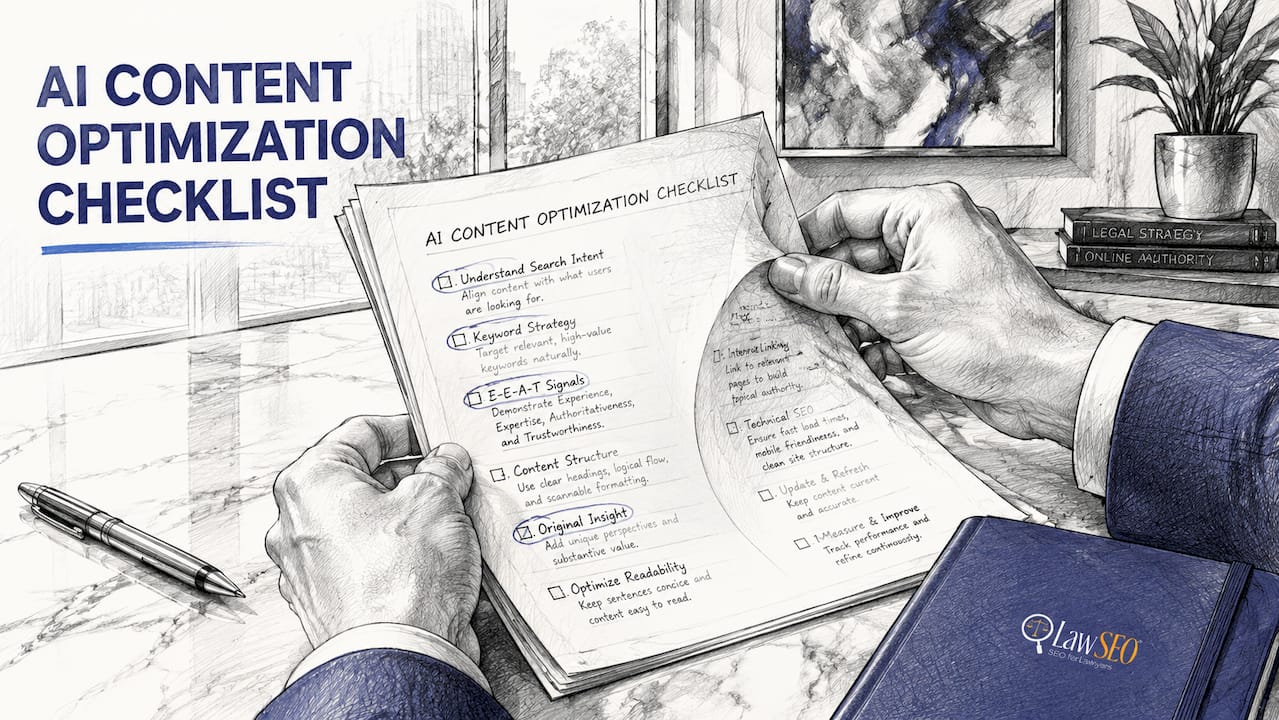
Content structure is the first thing AI systems evaluate when deciding whether to extract and cite a passage. Legal content that buries its main point three paragraphs in will not be cited. Structure it for extraction from the first sentence.
Answer-first openings are the single most important structural technique. Answer-first openings within 25 words help AI systems parse and cite content efficiently. Every section of your legal content should open with a direct, concise answer before providing context or qualifications.
Question-based headings signal to AI systems exactly what a section answers. Question-based H2/H3s and FAQ schema are key signals for AI search algorithms. Use headings like “What damages are available in a personal injury claim?” rather than “Damages Overview.”
Here is the core structural checklist for AI-ready legal content:
- Open every section with a direct answer in 25 words or fewer
- Use question-based H2 and H3 headings that mirror actual client search queries
- Keep paragraphs to 3–5 sentences, each focused on one idea
- Use numbered lists for procedures and bullet points for grouped facts
- Include an FAQ block with 6–10 quality question-and-answer pairs per page
- Write each content block as a self-contained answer unit that makes sense without surrounding context
Pro Tip: Write each FAQ answer as if it will appear alone in an AI response. If it requires the surrounding paragraph to make sense, rewrite it.
Legal content that follows this structure becomes what Lawseo calls “chunked” content. Each chunk is a discrete, citable unit. AI systems extract chunks, not full articles. The more your content is organized into clean, self-contained blocks, the more citation opportunities you create per page.
2. How does authoritative schema markup boost AI content visibility?
Schema markup is the technical layer that tells AI systems what type of content they are reading. Accurate schema accelerates extraction and increases citation probability. Inaccurate schema creates confusion and reduces it.
The most relevant schema types for legal content are:
- Article or BlogPosting: Use for standard legal articles and blog posts. Always include
datePublishedanddateModifiedfields with accurate ISO 8601 dates. - FAQPage: Use only when the page contains genuine question-and-answer content. FAQPage schema should only be used for real Q&A content; mixing schema types causes extraction errors.
- HowTo: Reserve for pages that walk users through a genuine step-by-step process, such as filing a small claims court complaint.
- Organization and Person/Author: Add these to signal entity authority and expertise, which AI systems use to evaluate source credibility.
| Schema type | When to use it | Common mistake |
|---|---|---|
| Article / BlogPosting | Standard legal articles and guides | Missing or stale dateModified |
| FAQPage | Pages with real Q&A blocks | Applying to pages without genuine Q&A |
| HowTo | Step-by-step legal procedures | Using for general advice articles |
| Organization | Firm-level entity signals | Omitting sameAs links to authoritative profiles |
| Author / Person | Attorney bio and byline pages | No connection to Organization schema |
Structured data must be accurate and consistent with visible content to enhance AI citations. A page that displays three FAQ pairs but has ten FAQPage schema entries will trigger a credibility mismatch. AI systems cross-reference schema against visible content.
Pro Tip: After adding schema, paste your URL into Google’s Rich Results Test and Schema.org’s validator. Confirm every schema field matches exactly what a reader sees on the page.
3. Why is crawlability and technical accessibility vital for AI content optimization?
AI systems cannot cite content they cannot access. Technical accessibility is the prerequisite for every other optimization effort. A perfectly structured, schema-rich legal article is invisible to AI if your server blocks the crawler.
Allowing specific AI crawlers like GPTBot via robots.txt at the domain root is critical for AI systems to crawl and cite content. OpenAI’s GPTBot, Google’s Googlebot, and Anthropic’s ClaudeBot each use separate user-agent strings. Blocking one does not block the others. You must verify each individually.
The technical accessibility checklist for legal content includes:
- Confirm GPTBot, ClaudeBot, and Googlebot are allowed in your robots.txt file at the domain root
- Achieve Core Web Vitals compliance, particularly Largest Contentful Paint under 2.5 seconds
- Use self-referencing canonical URLs on every page to prevent duplicate content signals
- Submit an XML sitemap with accurate
lastmoddates reflecting real content updates - Avoid placing key legal content inside JavaScript-rendered components that crawlers cannot parse
- Test crawler behavior by reviewing server access logs filtered by AI crawler user-agent strings
Different AI crawlers respect different robots.txt rules, so verifying access via server logs is best practice. A robots.txt audit takes less than 30 minutes and is the highest-leverage technical fix most legal sites have not completed.
Pro Tip: Search your server logs for “GPTBot” and “ClaudeBot” user-agent strings. If you see no entries, your content is either blocked or not being crawled. Fix the robots.txt file first, then recheck within two weeks.
4. How do freshness and citation-worthiness affect AI content citations?
AI systems treat content freshness as a credibility signal. Legal content that references outdated statutes, superseded case law, or expired regulations signals unreliability. Freshness is not about publishing frequency. It is about substantive accuracy.
The rules for managing content freshness in legal marketing are specific:
- Update
dateModifiedonly when you make substantive changes, such as adding a new court ruling, updating a statute reference, or revising a procedure based on new regulations. - Never update
dateModifiedsimply to appear current. Stale dateModified metadata harms AI citation probability more than having nodateModifiedfield at all. - Add corroborating mentions from trusted third-party sources. Citation-worthiness is enhanced by adding corroborating mentions from trusted external sources.
- Include specific, dated, sourced facts in each major section. Vague claims without attribution are ignored by AI systems.
- Track which pages receive AI citations using tools like Perplexity’s citation tracker or manual queries. Adjust content strategy based on what is and is not being cited.
Only update dateModified with substantive new evidence in legal content to maintain citation trust. Superficial changes can harm visibility rather than improve it.
The practical implication for legal marketers is a quarterly content audit. Review your top 20 pages, check for outdated legal references, update with sourced facts, and adjust dateModified only when the update is material. This discipline separates cited content from ignored content in AI search results.
5. What tools and practical tips can legal marketers use to implement this checklist?
Executing a content quality assessment checklist requires the right tools and a repeatable workflow. Legal marketing teams do not need to build this from scratch. Several established tools cover each layer of the checklist.
For schema generation and validation:
- Google’s Rich Results Test for schema accuracy checks
- Schema.org’s Structured Data Markup Helper for generating compliant JSON-LD
- Merkle’s Schema Markup Generator for Article, FAQPage, and HowTo types
For crawlability and technical audits:
- Screaming Frog SEO Spider for crawl simulation and canonical URL verification
- Google Search Console for Core Web Vitals reporting and indexing status
- Server log analyzers such as Splunk or GoAccess for AI crawler access verification
For freshness and content monitoring:
- ContentKing for real-time content change monitoring
- Ahrefs Content Explorer for identifying pages with declining organic visibility
- Manual Perplexity and ChatGPT queries to test whether your content is being cited
Pro Tip: Build your AI content improvement guide into your existing editorial calendar. Add a column for “schema type,” “answer-first opening confirmed,” and “dateModified status” to every content brief. This takes five minutes per article and prevents the most common optimization failures.
The AI optimization guide for law firms published by Lawseo provides a detailed workflow for integrating these tools into a legal marketing operation. The key principle is that this checklist is not a one-time audit. It is a standing operating procedure applied to every new piece of content and every quarterly review cycle.
Key takeaways
An AI content optimization checklist for legal marketers requires accurate schema, answer-first structure, open crawler access, and substantive freshness updates to generate consistent AI citations.
| Point | Details |
|---|---|
| Answer-first structure | Open every section within 25 words to maximize AI extractability and citation chances. |
| Schema accuracy | Match every schema type to visible content; mismatches reduce citation probability. |
| Crawler access | Verify GPTBot and ClaudeBot are allowed in robots.txt before any other optimization. |
| Freshness discipline | Update dateModified only for substantive legal changes, not cosmetic edits. |
| Repeatable workflow | Embed checklist items into every content brief and quarterly audit cycle. |
My take on AI optimization for legal content
I have been doing SEO for law firms for nearly three decades. The arrival of AI-driven search is the most significant shift I have seen since Google replaced directory-based search. But I want to be direct about something most articles in this space get wrong.
Legal marketers are being told to treat GEO as a completely separate discipline from SEO. It is not. John Mueller confirmed that generative AI optimization is an extension of great SEO, not a replacement. The firms that will win in AI search are the ones that have been doing foundational SEO correctly for years: authoritative content, clean technical infrastructure, and genuine expertise signals.
What is genuinely new is the precision required. Traditional SEO rewarded broad topical coverage. AI search rewards precise, citable answers. A legal article that covers “personal injury law” broadly will lose to a page that answers “what is the statute of limitations for a car accident in Texas” with a direct, sourced, schema-marked answer block.
The checklist in this article is not theoretical. Every item reflects a real failure mode I have seen in legal content audits. Blocked crawlers, stale schema dates, answer-buried-in-paragraph-three. These are not edge cases. They are the norm. Fix them systematically, and your legal content will outperform competitors who are still writing for the ten blue links era.
— TODD
How Lawseo helps legal marketers optimize for AI search
Lawseo specializes exclusively in SEO and AI search visibility for law firms. The firm’s law firm SEO services cover every layer of the AI content optimization checklist: technical audits, schema implementation, content structuring, and authority building. Todd R. Stager, with over 29 years of SEO experience, personally reviews strategy for every client campaign. For legal marketers ready to move beyond traditional SEO and build a presence in AI-driven search, Lawseo’s 2026 AI optimization guide and the advanced SEO strategy guide for lawyers provide the tactical depth your firm needs to compete where clients are now searching.
FAQ
What is an AI content optimization checklist?
An AI content optimization checklist is a structured set of actions covering content structure, schema markup, crawlability, and freshness that legal marketers apply to make content extractable and citable by AI search engines like ChatGPT and Perplexity.
Why do legal marketers need a separate checklist for AI search?
AI systems evaluate content differently than traditional search engines, prioritizing direct answers, accurate schema, and verified authority signals. Legal content must be structured into self-contained answer blocks to be cited correctly by generative AI tools.
Which schema types matter most for legal content AI optimization?
Article, FAQPage, HowTo, Organization, and Author schemas are the most relevant for legal content. Each schema type must match the visible content exactly to avoid extraction errors and credibility mismatches.
How often should legal content be updated for AI citation purposes?
Update content only when substantive changes occur, such as new case law, statute revisions, or regulatory updates. Updating dateModified without real content changes harms citation probability rather than improving it.
Does blocking AI crawlers affect search visibility?
Blocking crawlers like GPTBot via robots.txt prevents AI systems from accessing and citing your content entirely. Verify that all major AI crawlers are allowed at the domain root and confirm access through server log analysis.