


Yes, attorneys may advertise in the United States, but ABA Model Rules 7.1 through 7.4 and state bar rules tightly limit what you can say and how you use vendors or AI-generated content. Every state has adopted some version of these rules. The single biggest risk isn’t a flashy billboard claim. It’s a false or misleading statement, especially one buried in AI-drafted marketing copy nobody on your team reviewed before it went live.
TL;DR:
- Firms must thoroughly verify all AI-generated claims, references, and statistics before publication to avoid misleading or false advertising under Rule 7.1.
- State-specific guidance on AI in advertising varies, with Florida and New York explicitly requiring disclosure and oversight, making compliance across multiple states complex.
- Campaigns should include documented human review sign-offs, retain all ad records, and enforce regular audits to ensure ongoing compliance with evolving rules.
- Attorneys are fully responsible for any misleading content, regardless of whether an ad is created by humans or AI, emphasizing rigorous disclosure and review processes.
- Avoid unqualified superlatives, guarantee claims, or testimonials without context, and always have supporting documentation ready for any advertising claim.
Key Attorney Advertising Rules: What Model Rules 7.1–7.4 Require
Four rules do most of the work in the ABA’s framework, and each one governs a different piece of your marketing pipeline.
Rule 7.1 bans false or misleading communications about a lawyer or the lawyer’s services. This sounds obvious, but the trap is subtler than outright lies. ABA commentary warns that a truthful statistic, like a high settlement figure or win count, can still mislead if it creates an unjustified expectation that every case gets similar results. The fix is qualifying language: state the number, then note that results vary by case.
Rule 7.2 governs the media lawyers can use to advertise, from print to search ads to television, and it addresses who you can pay. Attorneys may pay the reasonable costs of advertising and pay a qualified referral service for its services. What you cannot do is compensate someone specifically for recommending you, outside a few narrow exceptions like reciprocal referral agreements between lawyers. That distinction, paying for advertising versus paying for a recommendation, trips up more firms than any other part of Rule 7.2.
Rule 7.3 addresses solicitation, particularly targeted, real-time contact with someone who has a specific legal problem, which carries heightened restrictions because of the coercion risk. Rule 7.4 covers claims of specialization or certification, requiring disclosure of the certifying organization when a lawyer claims to be a specialist.
Permitted content under ABA commentary includes:
- Names of lawyers and staff, office locations, and contact information
- Practice areas and fee structures, including contingency terms
- Foreign language capability and jurisdictions of admission
- Public statements the lawyer or firm has made in other contexts
How Do State Bar Advertising Rules Differ by Jurisdiction?
The ABA Model Rules are a template, not a statute. Every state bar adapts them, and the gaps between states show up most in filing requirements, retention timelines, and how aggressively regulators police AI-generated content.
Some states require nothing beyond compliance with the base rules. Others add procedural layers. Florida has historically required certain advertisements to be filed with the bar for review, and its Ethics Opinion 24-1 extends existing advertising duties to AI-assisted content, treating AI output as attorney speech that still must be truthful and substantiated. New York’s bar task force issued a 2024 report urging attorneys to disclose and supervise AI use in client-facing materials rather than waiting for a rule change. California has published practical guidance steering firms toward applying its existing rules of professional conduct to AI tools rather than treating AI as a regulatory blind spot.
A 50-state review of AI advertising guidance found that many states remain silent on AI specifically, but silence isn’t a safe harbor. Existing duties around truthfulness, supervision, and confidentiality still apply whether or not a state has issued AI-specific commentary.
If your firm advertises across multiple states, build a simple compliance map before your next campaign launches:
- List every state where you advertise or where clients could reasonably view the content
- Note each state’s filing or retention obligations next to the base ABA rule
- Flag any state with published AI-specific guidance, like Florida or New York
- Route every ad through the strictest applicable state’s requirements, not the loosest
Common Attorney Advertising Pitfalls You Need to Avoid
Most disciplinary complaints don’t come from a lawyer deliberately lying. They come from marketing language that sounded fine in a conference room and read very differently to a regulator or a struggling client.
Here’s where firms typically get into trouble:
- Unjustified expectation claims. “We win every case” or “guaranteed results” statements violate Rule 7.1 even when the underlying track record is strong, because they promise an outcome no lawyer can control. Qualify any performance claim with “results vary” or attach the specific case context.
- Testimonials without context or consent. A client endorsement isn’t automatically prohibited, but it needs the client’s informed consent, and if the endorsement implies a likely outcome for future clients, it inherits the same unjustified-expectation problem as a bare statistical claim.
- Direct solicitation dressed up as outreach. Sending a personalized letter to someone named in an accident report, timed right after the incident, reads as solicitation under Rule 7.3, not general advertising, and many states restrict or ban that kind of targeted, real-time contact.
- Comparative superiority claims. “Best personal injury firm in the state” or “top-rated” claims need substantiation the firm can produce on request. An unsupported superlative is a misleading statement waiting for a bar complaint.
Pro Tip: Before publishing any claim with a number, a superlative, or an implied outcome, ask whether you could hand a regulator the documentation behind it in five minutes. If you can’t, rewrite the claim or qualify it until you can.
Advertising With AI: Who’s Responsible When a Chatbot Gets It Wrong?
The attorney is responsible, full stop. ABA guidance and the state opinions issued so far treat AI-generated marketing content as attorney speech, meaning the same Rule 7.1 truthfulness standard and the same Rule 7.4 specialization limits apply whether a paralegal wrote the ad copy or a language model did.
Florida’s Opinion 24-1 and New York’s task force report both push firms toward disclosure and active oversight rather than passive trust in the tool’s output. Neither treats “the AI wrote it” as a defense.
In practice, that means building specific controls into your marketing workflow:
- Require human review and sign-off on every AI-drafted advertisement before it publishes
- Fact-check every statistic, claim, or case reference the AI generates against actual firm records
- Disclose AI involvement where a state opinion calls for it, and build clear handoff points into any client-facing chatbot
- Run confidentiality checks on AI tools that touch case details, since prompt inputs can leak protected information
An American Bar Association analysis of bar guidance issued between 2023 and 2025 found that state opinions consistently frame AI output as the attorney’s own speech rather than a third-party product, which closes off the “the tool made the mistake” defense before it starts. Firms building AI into their generative marketing workflows need a reviewer who signs off, in writing, that every claim in an AI draft is substantiated.
Firm Compliance Checklist: Auditing Every Ad Before It Publishes
Run every advertisement, from a Google ad to a social post to an AI-drafted email, through the same sequence before it goes live.
- Verify truth and documentation. Confirm every factual claim, statistic, and outcome reference has backup you could produce if a bar inquiry arrived tomorrow.
- Check required contact information. Confirm the ad includes the information your state requires, typically a responsible attorney’s name and office location.
- Review vendor contract language. Make sure lead-generator and directory agreements don’t imply an independent recommendation, since paying for a listing is fine but paying for an endorsement isn’t.
- Set a retention period. Keep copies of published ads, along with AI prompt histories and reviewer sign-offs, for the retention period your state requires, often two to three years.
- Schedule recurring audits. Put a quarterly review on the calendar to catch drift in AI-generated content and confirm nothing stale is still running.
Pro Tip: Store your AI prompt history and reviewer notes in the same file as the published ad itself. If a complaint ever surfaces, you want the whole compliance trail in one place, not scattered across three tools.
Why Advertising Compliance Is a Governance Problem, Not a One-Time Review
Treating ad compliance as a single sign-off before launch misses the point. Rules change, AI tools evolve, and a campaign that was clean in January can drift by June if nobody’s watching. The firms that stay out of trouble build a standing policy: a fixed review cadence, a written AI-use policy, clear vendor oversight language, and training that gets refreshed when a new state opinion drops. That’s a model some firms apply across client campaigns, because compliance built into the process beats compliance bolted on after a complaint.
— TODD
LawSEO’s Compliance-Aware Approach to Law Firm Marketing
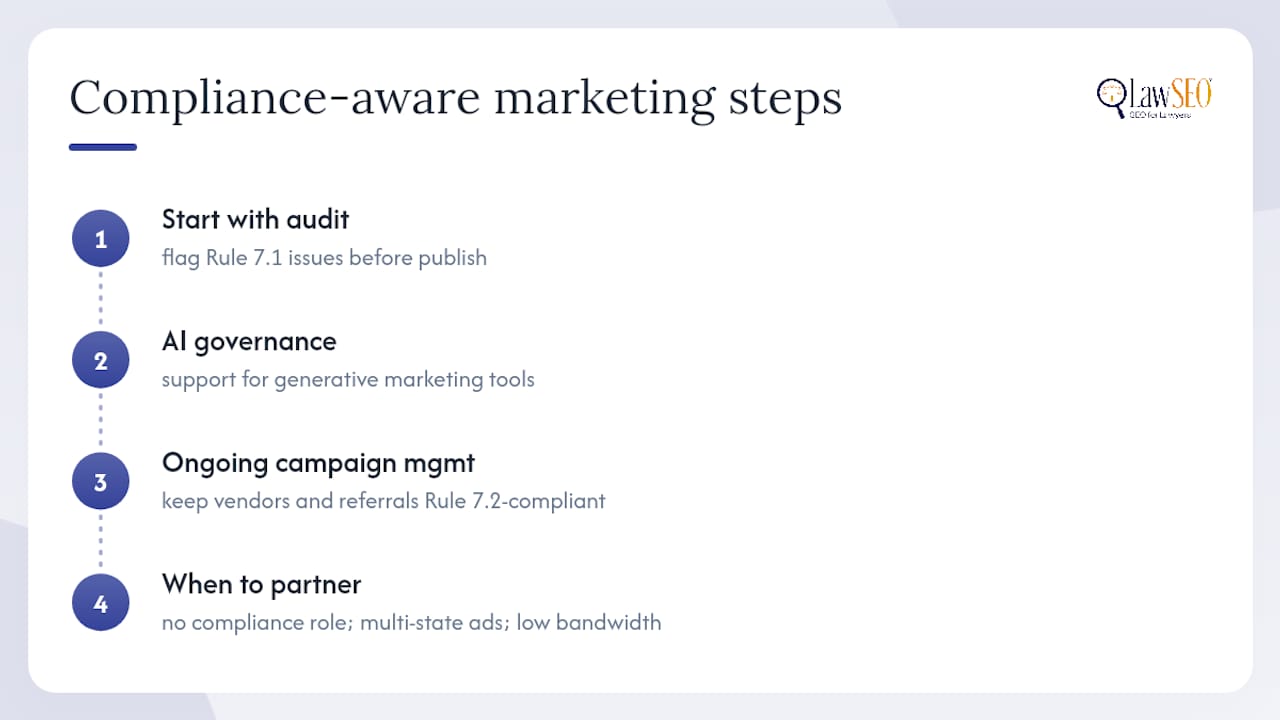
Building and maintaining an in-house compliance program takes time most firms would rather spend on cases. Some marketing providers offer a managed alternative for firms that want marketing built with these rules in mind from the start rather than checked afterward: ad and content audits that flag Rule 7.1 exposure before publication, AI governance support for firms using generative tools in their marketing, and ongoing campaign management that keeps vendor relationships and referral language on the right side of Rule 7.2.
A managed partner makes the most sense when your firm lacks a dedicated marketing compliance role or advertises across several states with different filing rules. If you’re running campaigns solo with limited bandwidth for regulatory tracking, that risk compounds fast. Start with a compliance-focused SEO audit to see where your current advertising stands before your next campaign goes live.
Where to Read the Actual Rules
Skip the secondhand summaries when the primary sources are this accessible:
- Rule 7.2 text covers permitted advertising media and referral-payment limits
- ABA commentary on Rule 7.2 explains what content qualifies as permitted and where truthful claims can still mislead
- Cornell Law School’s Wex overview gives the historical and doctrinal background, including Bates v. State Bar of Arizona
- The ABA’s AI marketing ethics analysis walks through state guidance on AI-generated advertising
This article is general information, not a substitute for advice from a qualified lawyer. Consult a qualified legal professional about your own circumstances before acting on anything here.
Sources
- Rule 7.2: Communications Concerning a Lawyer’s Services (American Bar Association)
- legal advertising (Wex, Cornell Law School)
