


TL;DR:
- Attorney press release SEO involves creating optimized news releases to earn backlinks and improve search rankings. It requires targeted keyword research, schema markup, and linking to specific practice pages for maximum SEO benefit. Proper distribution and measurable KPIs are essential for sustained law firm visibility online.
Attorney press release SEO is the practice of crafting and distributing optimized news releases to improve a law firm’s search engine rankings, earn authoritative backlinks, and generate qualified client leads. This guide to attorney press release SEO covers every stage of the process, from keyword research and schema markup to distribution platforms and performance tracking. Firms that treat press releases as pure public relations tools miss the SEO value entirely. When done correctly, a single well-placed release on PR Newswire or through HARO can earn backlinks from regional news outlets, boost practice area page rankings, and put your firm in front of prospective clients at the exact moment they are searching for legal help.
What foundational elements does attorney press release SEO require?
Effective attorney press release SEO starts before you write a single word. Three foundational elements must be in place: targeted keyword research, attorney schema markup, and dedicated practice area pages that releases can link back to.
Keyword research for legal press releases differs from standard blog SEO. You are not just targeting informational queries. You are targeting transactional and local queries such as “personal injury attorney Chicago” or “estate planning lawyer Dallas.” Each press release should support one primary practice area page and use that page’s target keywords naturally in the headline and lead paragraph.
Attorney schema markup using Schema.org Person markup with credentials, certifications, and practice areas sends direct trust signals to Google. This matters because Google’s ranking systems reward pages that clearly demonstrate expertise and authority. Schema markup is not optional for competitive legal markets in 2026.
The tools you need fall into three categories:
- PR distribution platforms: PR Newswire, Business Wire, and local newswire services for broad and targeted syndication
- Journalist outreach tools: HARO (Help a Reporter Out) for connecting with reporters who need legal expert quotes
- SEO auditing platforms: Ahrefs, Google Search Console, and Semrush for tracking keyword rankings and backlink acquisition
Original research is the most underused asset in legal press release strategy. Firms publishing data analyses or community legal trend reports earn significantly more independent media coverage and backlinks than firms issuing standard announcements. A personal injury firm that publishes annual accident data for its metro area gives local journalists a reason to cite the firm repeatedly.
Pro Tip: Implement attorney-specific Person schema on every attorney bio page before you launch any press release campaign. Reporters and Google both evaluate author credibility, and schema markup makes your attorneys’ credentials machine-readable.
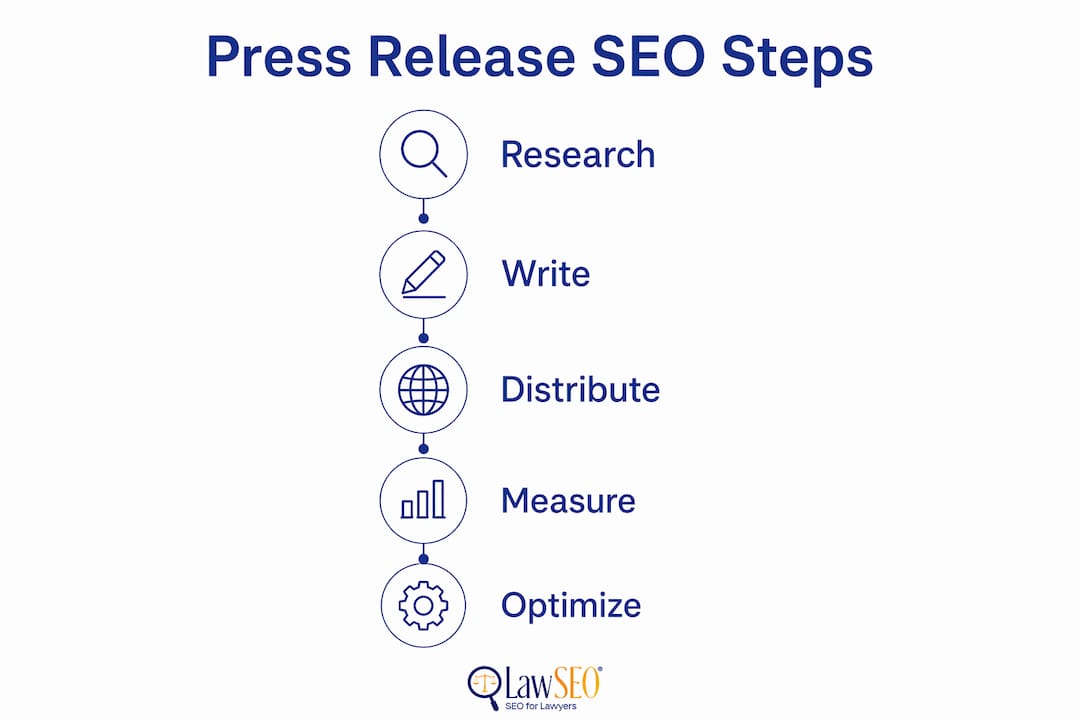
How to write attorney press releases for SEO success
The headline is the single most important SEO element in any press release. It must include your primary target keyword, name the attorney or firm, and communicate a clear news hook in under 100 characters. A headline like “Chicago Personal Injury Attorney John Smith Releases 2026 Metro Accident Report” satisfies all three requirements.

Writing in journalistic third-person voice is not a stylistic preference. It is a practical requirement. Reporters who pick up your release need to quote it or republish it without rewriting. First-person promotional language gets ignored. Third-person factual language gets cited.
Follow this structure for every release:
- Headline: Primary keyword plus news hook, under 100 characters
- Dateline and lead paragraph: Who, what, where, when, and why in the first two sentences, with the target keyword appearing naturally
- Body paragraphs: Supporting facts, quotes from the named attorney, and any original data or research findings
- Boilerplate: Firm name, practice areas, location, and website URL with a link to the relevant practice area page
- Media contact: Named contact person, phone number, and email address
Release length should fall between 400 and 600 words. Shorter releases lack the substance journalists need. Longer releases lose pickup because editors will not read past the first screen. Multimedia elements, specifically one high-resolution headshot and one data chart if you are releasing research, increase pickup rates measurably.
Backlink placement within the release body requires discipline. Place one contextual link to your target practice area page within the first three paragraphs. Do not link to your homepage. Do not place more than two links in the body. Excessive linking signals promotional intent and reduces the chance of organic media pickup.
Pro Tip: Use exact-match anchor text sparingly. Vary your anchor text between branded phrases like “Smith Law Group’s personal injury practice” and descriptive phrases like “Chicago personal injury representation” to build a natural backlink profile.
What are the best distribution strategies for attorney press releases?
Distribution strategy determines whether your press release earns real SEO value or simply generates syndicated copies that Google largely ignores. Press release backlinks provide indirect SEO value primarily through earned media coverage rather than syndicated releases alone. Syndication creates visibility. Earned coverage creates authority.
| Platform | Best Use | Backlink Quality | Cost Range |
|---|---|---|---|
| PR Newswire | National and regional reach | Moderate (syndicated) | $350–$800 per release |
| Business Wire | Financial and legal verticals | Moderate (syndicated) | $400–$900 per release |
| Local newswire services | City and metro targeting | Moderate (syndicated) | $50–$200 per release |
| HARO (journalist outreach) | Expert quote placement | High (earned editorial) | Free to low cost |
| Direct reporter outreach | Relationship-based coverage | Highest (earned editorial) | Time investment only |
Tools like PR Newswire and HARO reach journalists who are actively seeking legal expert sources. That active demand is what separates these platforms from generic press release directories. A reporter filing a story on local DUI trends who finds your release through HARO is far more likely to link to your DUI defense page than a reporter who stumbles across a syndicated copy.
Timing and frequency of press release issuance directly affect journalist interest and SEO traction. Releases aligned with news cycles, such as new legislation, local court decisions, or seasonal legal trends, earn more pickup than evergreen announcements. A consistent cadence of one to two releases per month sustains backlink flow without overwhelming your media contacts.
Key distribution best practices:
- Send releases on tuesday through thursday mornings for highest journalist open rates
- Target local and regional outlets before national ones for practice area relevance
- Follow up personally with reporters who cover legal topics in your market
- Track which outlets pick up each release and build direct relationships with those journalists
Pro Tip: When a journalist covers your release, email them directly and ask that any links in their article point to your specific practice area page rather than your homepage. Contextual backlinks to practice pages have a significantly stronger impact on localized keyword rankings.
How to measure press release SEO performance and avoid common pitfalls
Performance measurement for press release SEO requires tracking four distinct KPIs: backlink quality, media mentions, referral traffic, and keyword ranking changes for the targeted practice area pages. Tracking only media mentions without connecting them to ranking data gives you an incomplete picture.
Use Google Search Console to monitor ranking changes for the keywords your press release targeted. Use Ahrefs or a comparable tool to track new backlinks, their domain authority, and the anchor text used. Use Google Analytics to measure referral traffic from outlets that covered your release.
The most common mistakes that reduce press release SEO effectiveness:
- Keyword stuffing: Forcing the target keyword into every paragraph reads as spam to both journalists and Google
- Homepage-only linking: Linking exclusively to your homepage wastes the contextual authority a practice-specific backlink would deliver
- Over-reliance on syndication: Distributing to 200 low-authority directories creates noise, not authority
- No news hook: Releases that announce firm milestones without a public-interest angle get ignored by reporters
Pro Tip: Repurpose every press release into a blog post within 48 hours of distribution. The blog version can be longer, include more internal links, and target long-tail keyword variants. This doubles the organic reach of your original research or announcement without additional production cost.
What legal-specific SEO strategies complement press release campaigns?
Press release SEO performs best when it operates inside a broader legal SEO framework that includes schema markup, local citations, and Google Business Profile optimization. Each element reinforces the others.
Google’s E-E-A-T framework, which stands for Experience, Expertise, Authoritativeness, and Trustworthiness, requires law firms to demonstrate quality content, local citations, and verified reviews across multiple signals. A press release that earns a backlink from a local news outlet contributes directly to the Authoritativeness and Trustworthiness components of that framework.
Four legal SEO strategies that amplify press release results:
- Attorney schema markup: Deploy Schema.org Person markup on every attorney bio page with bar admission dates, practice areas, and certifications
- Citation consistency: Maintain identical name, address, and phone number data across Avvo, Martindale-Hubbell, Justia, and Google Business Profile
- Original legal research: Publish annual or quarterly data reports on local legal trends to give journalists a recurring reason to cite your firm
- Local SEO integration: Align press release topics with the geographic keywords your Google Business Profile targets
Sustaining four to six new five-star reviews monthly for 90 days can move a firm from positions 4–6 in the local pack to position 1 within two months. Reviews and press release backlinks work together. Reviews build trust signals locally. Press release backlinks build domain authority broadly. Together, they accelerate both local and organic rankings faster than either tactic alone.
Attorneys who want a deeper look at how these tactics fit together can review proven law firm SEO strategies that cover content, backlinks, and local optimization in detail.
Key Takeaways
Attorney press release SEO generates lasting search visibility when it combines earned media backlinks, schema markup, and targeted practice area page linking rather than relying on syndication alone.
| Point | Details |
|---|---|
| Earned media beats syndication | Organic journalist pickups create high-authority backlinks that outperform mass syndication for SEO value. |
| Schema markup is non-negotiable | Attorney Person schema with credentials and practice areas strengthens Google’s trust signals on attorney pages. |
| Link to practice pages, not homepage | Backlinks pointing to specific practice area pages drive localized keyword rankings more effectively. |
| Original research earns more coverage | Firms that publish legal data or trend reports attract significantly more independent media citations. |
| Measure four KPIs | Track backlink quality, media mentions, referral traffic, and keyword rankings to assess true press release SEO impact. |
Todd’s take on press release SEO for law firms
After nearly three decades working in SEO, I have watched press releases cycle in and out of fashion as a tactic. What has not changed is this: a well-placed editorial backlink from a credible local news outlet is still one of the most powerful ranking signals a law firm can earn. The attorneys who dismiss press releases as old-school PR are leaving real search equity on the table.
The firms I have seen gain the most from press release SEO are not the ones with the biggest distribution budgets. They are the ones that invest in original research, build real relationships with local reporters, and make sure every earned link points to a practice area page rather than a generic homepage. That specificity is what converts a media mention into a ranking improvement.
My honest recommendation is to treat press releases as one component of a broader content and link-building strategy, not a standalone tactic. Pair them with consistent schema markup, a clean Google Business Profile, and a steady review generation program. That combination compounds over time in ways that no single tactic can match on its own.
— TODD
How Lawseo helps attorneys get more from press release SEO
Lawseo works exclusively with law firms, which means every press release strategy we build is designed around legal industry search behavior, bar compliance considerations, and the competitive dynamics of local legal markets. Our team handles keyword research, press release drafting, distribution platform selection, and backlink monitoring so your firm captures SEO value from every release. We also manage the follow-up outreach that turns syndicated placements into genuine earned media coverage. If you are ready to make press releases a consistent source of law firm SEO results, Lawseo provides the full-service execution that most firms cannot build in-house.
FAQ
What is attorney press release SEO?
Attorney press release SEO is the practice of writing and distributing optimized news releases to earn backlinks, improve search rankings, and attract client inquiries for a law firm. It combines journalistic writing with targeted keyword placement and strategic distribution.
Do press release backlinks actually help law firm SEO?
Press release backlinks provide indirect SEO value primarily through earned media coverage rather than syndicated copies alone. When a credible news outlet independently covers your release and links to your practice area page, that backlink carries real ranking authority.
How often should a law firm issue press releases for SEO?
A cadence of one to two press releases per month aligns with journalist expectations and sustains a steady backlink flow. Releases tied to news cycles, such as new legislation or local legal trends, earn higher pickup rates than evergreen announcements.
Which platforms are best for distributing legal press releases?
PR Newswire and Business Wire provide broad syndication reach, while HARO connects your firm directly with journalists seeking legal expert sources. For local SEO impact, regional newswire services and direct reporter outreach produce the highest-quality backlinks.
What should a law firm press release link to?
Every press release should include at least one contextual link pointing to a specific practice area page, not the firm’s homepage. Contextual backlinks to practice pages have a significantly stronger impact on localized keyword rankings than generic homepage links.