


TL;DR:
- Attorney testimonial SEO leverages authentic client reviews to improve law firm rankings, visibility, and credibility.
- Proper solicitation, strategic placement, and ongoing management of reviews are essential for maximizing SEO and trust signals.
Attorney testimonial SEO is the practice of using client reviews and testimonials strategically to improve your law firm’s search engine rankings, local visibility, and online credibility. This guide to attorney testimonial SEO covers every stage of the process: what makes a testimonial SEO-ready, when and how to ask for one ethically, where to display it for maximum impact, and how to track results over time. About 87% of consumers check online reviews before selecting an attorney. That single statistic defines the stakes. Testimonials are not a nice-to-have. They are a core ranking and conversion asset.
What are the critical elements of effective attorney testimonials for SEO?

The most effective attorney testimonials combine authentic client language with the specific signals Google uses to evaluate trust and authority. In SEO terms, this falls under E-E-A-T: Experience, Expertise, Authoritativeness, and Trustworthiness. Reviews are the strongest trust signals in local search for law firms. Understanding E-E-A-T in SEO helps you see exactly why testimonials carry so much algorithmic weight.
Length and format
- Written testimonials: The recommended length is approximately 60 words. Short enough to read quickly, long enough to include a specific outcome and a practice area reference.
- Video testimonials: Aim for 60 seconds to 3 minutes. Under 60 seconds feels thin. Over 3 minutes loses most viewers before the key message lands.
- Keyword inclusion: The testimonial should naturally mention the practice area (“divorce attorney,” “personal injury lawyer”) and the city or region. Clients rarely do this unprompted, which is why the solicitation process matters.
- Specificity: Vague praise (“great lawyer, highly recommend”) adds no SEO value and minimal trust value. Specific outcomes (“settled my case in four months and recovered full medical costs”) signal authenticity to both Google and prospective clients.
- Compliance: Every testimonial must comply with your state bar’s advertising rules. Most states prohibit language that implies guaranteed results. Review your state’s Rules of Professional Conduct before publishing any testimonial.
Pro Tip: Ask clients to describe the problem they came to you with, not just the outcome. That problem language often matches the exact search queries prospective clients type into Google.
How should attorneys ethically solicit testimonials to optimize SEO?
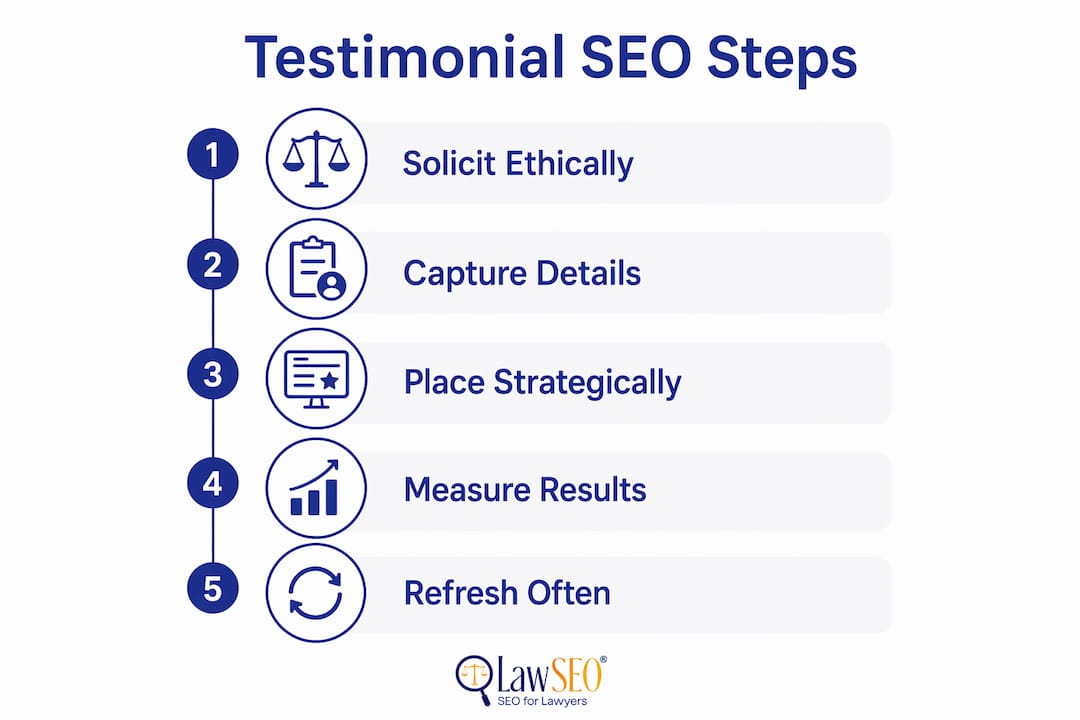
Timing and method determine whether your testimonial request produces a genuine, detailed review or silence. Most attorneys ask too early or too late. The best timing is 1–2 weeks after case resolution, during what practitioners call the “gratitude window.” That is when emotional satisfaction peaks and clients are most motivated to share their experience publicly.
Here is a proven solicitation sequence:
- Send a personalized follow-up email within 7–14 days of case resolution. Reference the specific matter briefly (without disclosing privileged details) to show the message is not automated.
- Include a direct link to your Google Business Profile review page. Friction kills response rates. One click to the review form is the standard.
- Add a secondary option such as Avvo or FindLaw for clients who prefer those platforms. Multiple review sources diversify your SEO footprint.
- Send one reminder after 5–7 days if no response. Two touchpoints is the ethical ceiling. Repeated requests cross into pressure.
- Follow up with a client satisfaction survey for clients who do not leave public reviews. Survey responses can inform your service quality and occasionally surface quotes you can request permission to use.
Ethical guidelines require no incentives or coaching in reviews. No gift cards, no discounts, no suggested language. Coached reviews violate bar rules in most states and are detectable by Google’s spam filters. A professional, ethical approach to solicitation builds sustained SEO benefits that paid or manufactured reviews never can.
Pro Tip: If your state requires a disclaimer on attorney advertising, include it in your solicitation email footer. This protects you and signals to clients that you take compliance seriously, which itself builds trust.
Where should law firms display testimonials for SEO benefits?
Placement determines whether testimonials contribute to your SEO or simply exist on your site. The goal is to put testimonials where Google crawls them, where users see them, and where they reinforce the specific practice area or location you want to rank for.
On-site placement
| Location | SEO Benefit | Best Format |
|---|---|---|
| Homepage | Broad trust signal, reduces bounce rate | Pull quote with client name and case type |
| Practice area pages | Reinforces topical relevance for that keyword | Short written testimonial with outcome detail |
| Dedicated testimonials page | Aggregates review signals, supports schema markup | Full written and video testimonials |
| Attorney bio pages | Builds individual attorney authority | 1–2 targeted testimonials per attorney |
Video testimonials deserve special attention. Video testimonials can increase conversion rates by 20–30% and videos are 53 times more likely to appear on Google’s first search page than text alone. That is a compounding advantage: video improves both organic rankings and the percentage of visitors who contact your firm.
Key display principles:
- Never bury testimonials below the fold on practice area pages. Place at least one within the first screen of content.
- Add transcripts to all video testimonials. Transcripts make the content crawlable by Google and accessible to users who cannot play video.
- Use schema markup (specifically
RevieworAggregateRatingschema) on your testimonials page. This enables rich snippets in search results, which increases click-through rates. - Embed reviews on your Google Business Profile. The top three Google Map Pack positions capture about 42% of all search-driven traffic for law firms. Your Google Business Profile is the single highest-leverage placement for reviews.
Learn more about how reviews impact local SEO for law firms and which placement decisions move the needle most.
How do you measure and maintain testimonial SEO effectiveness?
Collecting testimonials is not a one-time project. Google prioritizes law firms with consistent, recent reviews when determining Map Pack rankings. A firm with 200 reviews from three years ago ranks below a firm with 40 reviews collected steadily over the past six months. Recency signals active client relationships and current relevance.
Track these metrics to measure testimonial SEO performance:
- Time on page for pages featuring testimonials versus those without. Longer time on page signals content quality to Google.
- Conversion rate on practice area pages before and after adding testimonials. This is your clearest indicator of business impact.
- Google Business Profile insights: Track review count, average rating, and the number of profile views and direction requests monthly.
- Keyword rankings for practice area and location terms on pages where testimonials are placed. Rank improvements on those specific pages confirm the SEO contribution.
- Review velocity: Monitor how many new reviews you receive per month. A declining rate signals a broken solicitation process.
A/B testing is underused in legal marketing. Test a text testimonial against a video testimonial on the same practice area page and measure which format produces more contact form submissions over 30 days. The result will tell you where to invest your testimonial production budget.
Pro Tip: Refresh your testimonials page every 6 months. Archive older reviews rather than deleting them, and feature the most recent ones prominently. This signals to Google that your client satisfaction is current, not historical.
Responding to reviews is also a ranking factor. Reply to every Google review, positive or negative, within 48 hours. Keep responses professional and never reveal case details. Responses must protect attorney-client privilege at all times. A firm that responds consistently demonstrates active reputation management, which Google treats as a trust signal.
Key takeaways
Attorney testimonial SEO produces the strongest results when ethical solicitation, strategic placement, and consistent review management work together as a system.
| Point | Details |
|---|---|
| Timing is the key variable | Request testimonials 1–2 weeks post-resolution, during the client’s peak gratitude window. |
| Format and length matter | Written testimonials should be approximately 60 words; video testimonials should run 60 seconds to 3 minutes. |
| Placement drives SEO impact | Display testimonials on practice area pages, your homepage, and your Google Business Profile for maximum ranking benefit. |
| Recency outranks volume | Google favors firms with steady, recent reviews over those with large but dated review counts. |
| Ethics protect your license | Never incentivize, coach, or pressure reviews; always respond without disclosing privileged information. |
What i’ve learned after 29 years of law firm SEO
The attorneys who get the most from testimonials are not the ones with the most reviews. They are the ones who treat testimonial collection as a client service process, not a marketing task.
The biggest mistake I see consistently is asking for a review in the same conversation where you hand the client their final invoice. That moment is the wrong emotional context entirely. The client is thinking about the cost, not the outcome. Wait 10 days. Let the relief and gratitude settle. Then reach out with a personal note. The quality of the review you receive will be categorically different.
I have also watched firms spend significant budget on website redesigns while ignoring their Google Business Profile. The Map Pack drives 42% of search traffic for law firms. That is not a secondary channel. It is often the primary one, especially for personal injury, family law, and criminal defense practices where clients are searching locally under emotional pressure.
The ethical dimension is not just a compliance issue. It is a strategic one. Authentic testimonials written in a client’s own words contain the exact language that prospective clients search for. No keyword researcher can replicate that. When you optimize attorney testimonials ethically, you get SEO value and genuine trust signals simultaneously. That combination is what separates firms that dominate local search from those that compete for scraps.
One more observation: testimonials work best when they are integrated with your broader content strategy. A testimonial that mentions “truck accident settlement in Dallas” belongs on your truck accident practice area page, not buried on a generic reviews page. Placement specificity is what converts a trust signal into a ranking signal.
— TODD
How Lawseo helps attorneys turn testimonials into rankings
Lawseo works exclusively with law firms, which means every strategy we build accounts for bar compliance, local search dynamics, and the specific competitive pressures attorneys face. Our law firm SEO services include full testimonial optimization: placement strategy, schema markup implementation, Google Business Profile management, and review solicitation system design. We also integrate testimonial SEO into your broader advanced SEO strategy, connecting review signals with content, link building, and AI search optimization. If your firm is collecting reviews but not ranking, the problem is almost always placement and recency, and both are fixable. Contact Lawseo to find out exactly where your testimonial strategy is leaving rankings on the table.
FAQ
How many reviews does a law firm need to rank in the map pack?
There is no fixed number, but consistency and recency matter more than volume. Google favors firms that receive steady new reviews over those with large but dated review counts.
Can attorneys offer incentives for client reviews?
No. Offering incentives for reviews violates bar advertising rules in most states and Google’s review policies. Incentivized reviews can result in penalties from both regulators and search engines.
What is the best platform for attorney reviews?
Google Business Profile is the highest-priority platform because reviews there directly influence Map Pack rankings. Avvo, FindLaw, and Yelp provide secondary SEO value through citation diversity.
Should attorneys respond to negative reviews?
Yes. Respond professionally within 48 hours, acknowledge the concern without confirming the person was a client, and never disclose case details. A measured response protects attorney-client privilege and demonstrates professionalism to prospective clients reading the exchange.
Does adding schema markup to testimonials improve rankings?
Schema markup using Review or AggregateRating structured data enables rich snippets in search results, which increases click-through rates. Higher click-through rates are a confirmed ranking signal for Google.