


TL;DR:
- Most U.S. law firms rely on Google Analytics 4 for website traffic analysis because of its integration with Google Ads and zero cost. Data privacy concerns lead many firms to supplement GA4 with privacy-first tools like Matomo or Plausible for compliant traffic verification. A hybrid setup of GA4 and a privacy-focused tracker best addresses acquisition needs while ensuring regulatory compliance.
For most U.S. law firms, Google Analytics 4 (GA4) is the practical default. It runs on a large majority of websites that report a known traffic tool, integrates natively with Google Ads, and costs nothing for most firms. When client confidentiality or data residency is a hard requirement, Matomo or Plausible are the right answer. The recommended setup for most practices: run GA4 for acquisition and ad performance, then layer in a privacy-first tracker for compliant reporting and data ownership verification.
Here is the shortlist at a glance:
- GA4 — best for firms running Google Ads and needing deep acquisition attribution; free entry tier
- Matomo — best when GDPR/CCPA compliance or full data ownership is non-negotiable; self-hosted or cloud
- Plausible — best for small- to mid-size firms that want cookie-free simplicity with minimal maintenance
- Fathom — best when site speed and privacy matter more than reporting depth
- Piwik PRO — best for large or regulated firms needing enterprise governance and hybrid deployment
- Adobe Analytics — best for multi-office networks with complex cross-channel attribution needs
- Mixpanel / Heap — best for firms treating a client portal or rich website as a product
- Hotjar — best as a UX complement for session replay and heatmap-driven conversion work
- Lawseo (managed analytics) — best for firms that prefer outsourcing measurement entirely to a legal-industry specialist
The legal-tech tools appearing in SERP consensus, including Aline, Evisort, CoCounsel, Ironclad, LEGALFLY, Fastcase, and LinkSquares, serve contract intelligence, legal research, and workflow automation rather than website traffic analysis. They belong in a legal operations stack, not a web analytics comparison, though firms evaluating their broader tech ecosystem will encounter them alongside the tools above.
How the top analytics tools stack up for U.S. law firms
Specialized analytics budgets are growing annually even as GA4 holds installation dominance. That split reflects a real tension: GA4 wins on convenience and ad integration, while privacy-first tools win on data ownership and regulatory defensibility. Most enterprise organizations run multiple analytics tools simultaneously, and law firms are following the same pattern.
Statistic callout: Only about 34% of GA4 users leverage predictive metrics, and most accounts never use Exploration reports or BigQuery exports. Optimizing what you already have in GA4 often delivers more value than switching platforms.
| Tool | Best for | Pricing | Data ownership & privacy | Key features | Integrations | Ease of setup |
|---|---|---|---|---|---|---|
| Lawseo | Law firms outsourcing analytics & reporting | Monthly retainer | Managed compliance checks; legal-industry data handling | Monthly business-outcome reports, conversion tracking, campaign attribution | Google Ads, CRM, CMS | Fully managed; no internal lift |
| GA4 | Firms running Google Ads; acquisition attribution | Free; GA4 360 enterprise pricing | Data sent to Google servers; consent mode required for GDPR/CCPA | Event model, funnels, predictive metrics, BigQuery export | Google Ads, Search Console, CRM | Moderate; consent config required |
| Matomo | Firms needing data residency or strict compliance | Free (self-hosted); cloud plans from ~$23/mo | Full data ownership; self-hosted or EU cloud; GDPR-friendly defaults | Heatmaps, funnels, goals, cookieless measurement | Google Ads, CRM, WordPress | Moderate; hosting overhead if self-hosted |
| Piwik PRO | Large/regulated firms with complex compliance | Free core; enterprise pricing on request | Hybrid cloud/on-prem; enterprise governance | Tag manager, consent manager, customer data platform | Google Ads, CRM, DMP | Moderate to complex; enterprise onboarding |
| Adobe Analytics | Multi-office networks; cross-channel attribution | Enterprise (custom quote) | Configurable; enterprise data agreements | Custom attribution, cross-channel reporting, advanced segmentation | Full marketing stack | Complex; requires implementation team |
| Mixpanel | Firms with rich portals or product-style interactions | Free tier; paid plans available | Cloud; EU data residency available | Event funnels, cohort analysis, retention reports | CRM, Segment, Zapier | Moderate; event schema planning needed |
| Heap | Teams wanting fast instrumentation without tagging | Free tier; paid plans (custom) | Cloud; SOC 2 certified | Auto-capture events, funnels, session analysis | Salesforce, HubSpot, Segment | Low upfront; retroactive analysis |
| Hotjar | UX testing and conversion optimization | Free tier; paid from ~$32/mo | EU-hosted; GDPR tools included | Session recordings, heatmaps, feedback polls | GA4, Segment, Slack | Low; script install only |
| Plausible | Small to mid-size firms; cookie-free simplicity | Starting from low monthly price | EU-hosted; no cookies; no personal data collected | Pageviews, referrers, goals, real-time dashboard | WordPress, Ghost, Next.js | Very low; one-line script |
| Fathom | Firms prioritizing speed and privacy; minimal reporting | Starting at a low monthly price | EU-isolated; no cookies; GDPR/CCPA compliant by design | Core traffic metrics, uptime, simple goals | WordPress, Webflow, Zapier | Very low; one-line script |
Recommended hybrid stack for most U.S. law firms: GA4 for Google Ads attribution and acquisition reporting, plus Matomo (self-hosted) or Plausible for compliant, cookieless traffic verification. This combination covers ad performance without sacrificing data ownership.
What GA4 does well for law firms (and where it falls short)
GA4 is the starting point for most law firm marketers because the Google Ads integration alone justifies the setup cost. Conversion data flows directly from your website into campaign bidding, which means every call or contact form submission can feed Smart Bidding without a manual export step. The event-based data model also makes it straightforward to track intent-heavy actions, such as phone number clicks, live chat initiations, and consultation booking completions, which are the metrics that actually predict case revenue.
Where GA4 delivers for law firms:
- Native Google Ads integration with auto-imported conversion events
- Cross-device tracking via Google Signals (when users are signed in)
- BigQuery export for firms that want raw data in a data warehouse
- Predictive metrics (purchase probability, churn probability) that can be adapted to consult-booking likelihood
- Free for most firms; GA4 360 adds SLA-backed support and higher data limits for enterprise needs
Where GA4 creates friction:
- Consent mode configuration is required for GDPR/CCPA compliance; misconfigured consent mode can expose the firm to regulatory risk
- Data is processed on Google’s servers, which some clients and bar associations view as a third-party data-sharing arrangement
- The interface is less intuitive than legacy Universal Analytics; exploration reports and custom funnels require training
- Default data retention is 14 months; longer retention requires manual configuration
Pro Tip: Focus GA4 setup on three conversion events from day one: phone call clicks, contact form submissions, and consultation booking completions. Everything else is secondary. Firms that track these three consistently can project case pipeline from traffic data within 90 days. However, only about 34% of GA4 users currently leverage predictive metrics to fully enable this capability.
For a practical implementation guide on conversion tracking for legal websites, Lawseo’s dedicated guide covers phone call tracking, form submission events, and the schema implementation that ties it all together.
Why Matomo is the right choice when data ownership matters
Matomo’s core advantage is straightforward: your data stays yours. When you self-host Matomo on your own server, no third party processes your visitors’ data. That distinction matters for law firms handling sensitive practice areas, from criminal defense to family law, where even aggregate browsing behavior could be considered sensitive if tied to identifiable users.
Matomo strengths for law firms:
- Full data ownership with self-hosted deployment; no data leaves your infrastructure
- Cookieless measurement option that tracks aggregate behavior without individual cookies
- GDPR and CCPA-friendly defaults out of the box, reducing consent management overhead
- Heatmaps, session recordings, and goal funnels included in the core platform (no separate tool needed)
- Matomo Cloud offers EU-hosted managed deployment for firms that want privacy without server maintenance
Deployment trade-offs:
- Self-hosted: Free software license, but your team manages hosting, updates, backups, and security patches. Realistic for firms with a technical contact or IT vendor.
- Matomo Cloud: Managed hosting starting around $23/month; removes server overhead but adds a recurring cost and shifts data to Matomo’s EU infrastructure.
Comparative analyses position Matomo as the stronger choice on data ownership and GDPR-friendly defaults when measured against GA4, particularly for firms in regulated environments or those with clients who ask about data handling practices.
Pro Tip: If you run Google Ads, do not replace GA4 with Matomo entirely. Run Matomo alongside GA4 as your compliant, first-party source of truth for traffic verification. Use GA4 exclusively for ad attribution, and rely on Matomo for everything else.
Piwik PRO, Adobe Analytics, Mixpanel, and Heap: when to consider them
These platforms serve specific firm profiles. None of them is the right default for a solo practitioner or small firm, but each fills a real gap at the enterprise or product-analytics level.
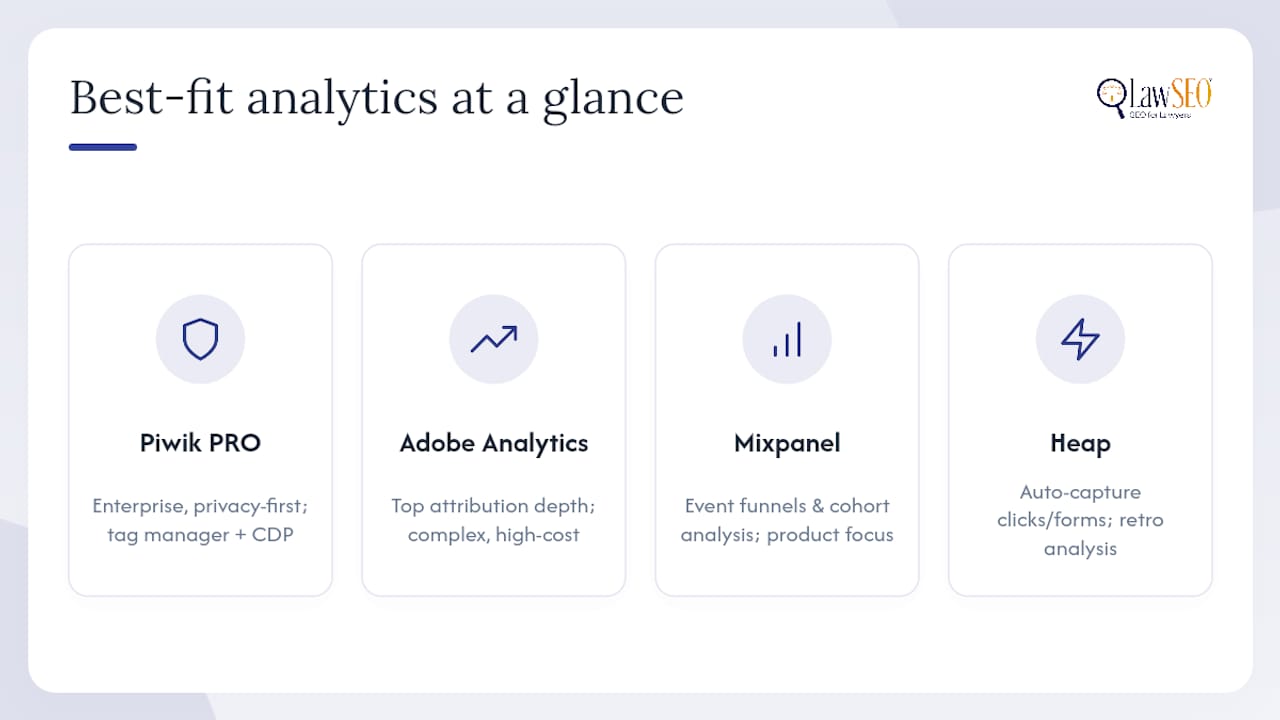
Piwik PRO is the enterprise version of the privacy-first approach. It combines a tag management system, consent manager, and customer data platform in one stack, with hybrid cloud and on-premises deployment options. Large law firms or multi-practice networks operating under strict data governance policies, particularly those with EU client bases, will find Piwik PRO’s compliance tooling more complete than Matomo’s. Pricing is tiered: a free core plan covers basic needs, and enterprise pricing is available on request.
Adobe Analytics sits at the top of the market on attribution depth and cross-channel reporting. It can model the full client journey across paid search, organic, referral, and email touchpoints, with custom attribution windows and advanced segmentation. The trade-off is cost and complexity: Adobe Analytics requires a dedicated implementation team and carries enterprise-level pricing that most law firms cannot justify unless they operate at the scale of a national network or legal services company. For those that qualify, the reporting depth is unmatched.
Mixpanel and Heap both shift the focus from traffic to behavior. Mixpanel excels at event funnels and cohort analysis, making it the right tool when a firm wants to understand how users move through a client portal, a multi-step intake form, or a gated resource library. Heap’s auto-capture model is its distinguishing feature: it records every click, form interaction, and page transition from the moment the script is installed, so you can analyze behavior retroactively without pre-planning a tracking schema. Both tools are better suited to firms treating their website as a product than to firms primarily focused on acquisition attribution.
Hotjar, Plausible, and Fathom: complementary tools that fill real gaps
These three tools are not replacements for GA4 or Matomo. They are complements, each filling a specific gap that primary analytics platforms leave open.
Hotjar provides session recordings and heatmaps that show exactly where visitors click, scroll, and abandon. For law firm marketers trying to understand why a practice area page has a high bounce rate or why a contact form converts poorly, a Hotjar session recording delivers answers that no traffic report can. Session replay and heatmap tools are consistently listed among the top complementary analytics features for conversion optimization. Hotjar’s free tier covers basic recording needs; paid plans start around $32/month and add advanced filtering and feedback polls.
Plausible is the right choice for small to mid-size firms that want a clean, honest traffic picture without cookies, consent banners, or GDPR complexity. Coverage of Plausible positions it as a low-overhead analytics option that avoids cookies and reduces setup complexity for practices that lack a dedicated technical resource. The dashboard is intentionally simple: pageviews, referrers, top pages, and goal completions. Nothing more. Plans start at a low monthly price.
Fathom occupies a similar space to Plausible but places even greater emphasis on speed and simplicity. The tracking script is lightweight, the dashboard shows core metrics without configuration, and the platform is GDPR/CCPA compliant by design because it collects no personal data and sets no cookies. Firms that prioritize site speed and want a privacy-first audit trail alongside GA4 will find Fathom the lower-friction option of the two.
Pairing recommendations:
- GA4 + Plausible or Fathom: Run GA4 for ad attribution; use Plausible or Fathom as a cookieless verification layer and for reporting to partners who do not need ad-level detail
- GA4 + Hotjar: Use GA4 for acquisition data and Hotjar for UX diagnosis on high-traffic practice area pages and intake forms
- Matomo + Hotjar: For firms that have moved away from GA4 entirely, Hotjar fills the session replay gap that Matomo’s built-in recordings may not cover at scale
How to choose the right analytics setup for your law firm
The right tool depends on four variables: firm size and budget, primary KPIs, privacy constraints, and in-house technical capacity. Getting this decision wrong costs more in wasted setup time than the tool subscriptions themselves.
Evaluation criteria:
- Primary KPIs: If your goal is to reduce cost per consultation booking, you need GA4’s ad attribution. If your goal is to understand why intake forms convert poorly, you need Hotjar. Define the question before selecting the tool.
- Privacy and regulatory constraints: Firms in states with aggressive CCPA enforcement, or those with EU-based clients, should treat data residency as a non-negotiable requirement, not a nice-to-have.
- Integrations: Confirm that the tool connects to your CRM (Clio, Lawmatics, Salesforce), your CMS (WordPress, Webflow), and your ad platforms before committing.
- In-house technical capacity: A self-hosted Matomo installation requires someone who can manage a server. If that person does not exist, choose Matomo Cloud, Plausible, or a managed service.
Vendor question checklist:
- Where is my data stored, and which country’s laws govern it?
- Can I export raw data to BigQuery, SFTP, or a data warehouse?
- What is your SLA for uptime and support response time?
- Do you offer a sample report showing law-firm–relevant metrics?
- What does onboarding include, and are there additional implementation fees?
- How do you handle consent management and cookie compliance?
Red flags to avoid:
- Vendors that lock raw data behind proprietary formats with no export option
- Contracts with opaque data-processing clauses that do not specify data residency
- Solutions that require third-party cookies with no cookieless alternative
- Platforms that report only vanity metrics (sessions, pageviews) without conversion-level data
Recommended stacks by firm size:
- Solo or small firm (under 10 attorneys): Plausible or Fathom for privacy-first traffic reporting; add GA4 only if running Google Ads. Total cost: $0–$25/month.
- Mid-size firm (10–50 attorneys): GA4 plus Matomo Cloud or Plausible; Hotjar on key landing pages. Total cost: $50–$100/month.
- Enterprise or multi-office network: GA4 360 or Adobe Analytics for attribution; Piwik PRO for compliance governance; Hotjar for UX optimization. Budget: enterprise pricing at a high monthly cost.
Pro Tip: Before evaluating any new tool, audit what you already have. Most firms have GA4 installed but use fewer than 20% of its features, and only about 34% leverage predictive metrics. Configuring GA4’s conversion events and enabling Exploration reports often delivers more insight than adding a second platform.
Why a hybrid GA4 + privacy-first setup works for most U.S. law firms
AI-driven market analyses show growing institutional sensitivity to over-collection of visitor data, and law firms are at the front of that shift. Clients who search for a criminal defense attorney or a family law practice are not browsing casually. The nature of the query itself can be sensitive, and firms that process that data through a third-party analytics platform without proper consent configuration carry real reputational and regulatory risk.
The hybrid pattern addresses this directly. GA4 handles what it does best: connecting ad spend to conversion events and feeding Google’s bidding algorithms with first-party signal. A privacy-first tool, whether Matomo self-hosted, Plausible, or Fathom, runs in parallel as the firm’s compliant source of truth. It confirms traffic trends without cookies, satisfies CCPA and GDPR obligations without a complex consent banner, and gives partners a clean monthly report that does not depend on Google’s data-processing terms.
“Law-firm analytics success is less about the tool itself and more about tracking intent-based conversions, such as calls, form submissions, and consult bookings, and translating those metrics into projected case revenue for partners.” — Trakkr AI Consensus Report
Lawseo implements this hybrid pattern across its U.S. law firm engagements. The monthly reporting workflow looks like this:
- Partner-facing one-pager: Total consultations booked, cost per consultation from paid search, organic traffic trend, and top-performing practice area pages. No jargon, no vanity metrics.
- Technical appendix for analysts: Event-level data, funnel drop-off points, page speed scores, and crawl health summary.
- Compliance checkpoint: Monthly review of consent mode configuration, data retention settings, and any regulatory changes affecting analytics data collection.
For a deeper look at which SEO metrics matter most for law firm client acquisition, Lawseo’s guide covers the specific KPIs that translate traffic data into business outcomes.
How we picked and evaluated these tools
Transparency about the evaluation process matters, particularly when the shortlist will influence a firm’s data infrastructure decisions.
Selection steps:
- Market share verification: GA4’s installation dominance was confirmed against BuiltWith distribution data and 2026 adoption analyses. Tools with negligible law-firm adoption were excluded from detailed review.
- Privacy posture assessment: Each tool was evaluated against GDPR/CCPA compliance requirements, data residency options, and cookie dependency. Sources included Searchlab’s GA4 vs. Matomo comparison and Trakkr’s AI consensus report for law firms.
- Law-firm use-case mapping: Tools were matched to specific law-firm scenarios: acquisition attribution, UX optimization, compliance reporting, and contract intelligence. SERP consensus from industry guides and legal marketing sources validated the inclusion of each tool.
- Expert review: Lawseo’s team, led by Todd R. Stager with over 29 years of SEO experience in the legal sector, reviewed tool fit against real client engagements.
Weighting logic:
- Privacy and data ownership weighted highest, given the sensitivity of legal website visitors
- Ease of use for small firms without dedicated technical staff weighted second
- Integration with Google Ads and CRM platforms weighted third
- Cost and pricing transparency weighted fourth
Acknowledged limitations:
- Pricing figures reflect publicly listed rates at time of writing and may change; confirm with vendors before committing
- Product capabilities evolve rapidly; GA4 in particular receives frequent feature updates
- Regional differences in GDPR enforcement mean that compliance posture assessments are general guidance, not legal advice
This article covers general information about analytics tools and is not legal or compliance advice. Confirm data-handling requirements with a qualified privacy attorney or your firm’s compliance officer.
Key Takeaways
For most U.S. law firms, the strongest analytics setup combines GA4 for ad attribution with a privacy-first tool like Matomo or Plausible for compliant, cookieless traffic verification.
| Point | Details |
|---|---|
| GA4 is the practical default | GA4 runs on roughly 83–85% of tracked websites and integrates natively with Google Ads for acquisition attribution. |
| Privacy-first tools are not optional | GDPR/CCPA compliance and client data sensitivity make Matomo, Plausible, or Fathom a necessary complement for most law firms. |
| Hybrid stacks are standard practice | Enterprises average 3.4 analytics tools simultaneously; a GA4 plus privacy-first pairing is the law-firm equivalent. |
| Track conversions, not vanity metrics | Phone calls, form submissions, and consultation bookings are the only metrics that predict case revenue for partners. |
| Lawseo manages this for law firms | Lawseo’s managed analytics service handles onboarding, monthly business-outcome reports, and compliance checks for firms that prefer to outsource measurement. |
The tool you use consistently beats the tool you use perfectly
Most law firms do not have an analytics problem. They have a consistency problem. GA4 is installed, a few goals are configured, and then the data sits untouched for months while partners ask whether the website is “working.” The tool is not the bottleneck. The reporting cadence and the clarity of the metrics are.
The firms that get the most value from their analytics setup are not the ones running the most sophisticated platform. They are the ones that have agreed on three conversion metrics, review them monthly, and connect the numbers to business decisions. A solo practitioner using Plausible who checks their consultation booking rate every month will outperform a 50-attorney firm with GA4 360 that nobody looks at.
Privacy-first tools have also crossed a threshold where they are no longer a compromise. Plausible and Fathom deliver accurate, actionable traffic data without cookies, without consent banners, and without the regulatory exposure that comes with sending visitor data to Google’s servers. For many law firms, that trade-off now favors the privacy-first option even when Google Ads is not in the picture.
The hybrid stack recommendation in this article is not theoretical. It reflects what actually works in practice for law firms that need to satisfy both their marketing team and their compliance obligations at the same time.
Lawseo’s managed analytics service for law firms
For firms that want the benefits of a well-configured analytics stack without the internal overhead of managing it, Lawseo offers a fully managed analytics and reporting service built specifically for law practices. The service covers onboarding and tool configuration, monthly one-page business-outcome reports for partners, compliance checks on consent mode and data retention settings, and campaign attribution connecting ad spend to consultation bookings.
This is a direct alternative to self-implementation. Rather than allocating internal time to configuring GA4, managing a Matomo server, or interpreting funnel data, your firm receives a monthly report that answers one question: is the website generating qualified consultations, and at what cost?
Lawseo works exclusively with law firms and attorneys, which means the reporting framework is built around legal KPIs, not generic e-commerce metrics. Todd R. Stager personally reviews strategy for every client engagement, and the firm’s exclusivity model means your local competitors will not receive the same service.
To learn more about how Lawseo’s SEO and analytics services work for law firms, or to discuss whether managed analytics fits your practice’s current needs, visit the Lawseo website and request a consultation.
Useful sources and vendor documentation
- Google Analytics 4 vs. Matomo (2026): Which Analytics Tool Is Right for You? — Side-by-side privacy and data ownership comparison; core source for the hybrid stack rationale
- Plausible Analytics: A Lightweight, Simple Alternative for Law Firms Facing GA4’s Challenges — Legal-industry coverage of Plausible as a low-overhead GA4 alternative
- The 12+ Best Web Analytics Tools to Improve Your Site — Industry shortlist validation for the tools featured in this comparison
- Analytics and Tracking Web Usage Distribution — BuiltWith real-time data on analytics tool installation across the web