


TL;DR:
- Consistent branding law requires law firms to present their identities accurately across all channels to avoid legal sanctions and protect trademark rights.
- Firms must adhere to professional conduct rules and trademark standards by maintaining uniform naming, messaging, and visual elements, especially across multiple jurisdictions.
Consistent branding law is the body of professional conduct rules, trademark statutes, and advertising regulations that govern how law firms present their identity across every public touchpoint. The importance of consistent branding law goes beyond logo design. It determines whether your firm can enforce its trademark, avoid disciplinary sanctions, and build the client trust that drives referrals. Attorneys who treat branding as a purely visual exercise miss the legal exposure that comes with inconsistent naming, misleading claims, and unprotected brand assets. This guide covers the regulatory framework, trademark requirements, and practical steps every attorney needs to protect and strengthen firm identity.
Why consistent branding law matters for law firms
Two distinct legal frameworks govern how attorneys brand their practices: professional conduct rules and trademark law. Both demand consistency, and both carry serious consequences for failure.
ABA Model Rule 7.1 prohibits false or misleading communications about a lawyer or legal services. ABA Model Rule 8.4© treats misrepresentation as professional misconduct. Together, these rules mean that misleading firm names violate professional conduct standards and can result in sanctions ranging from formal reprimand to suspension. A firm calling itself “The Nation’s Best Injury Lawyers” without substantiation risks exactly that outcome.
Trademark law adds a second layer. Courts assess brand use across all marketing channels. Inconsistent spelling, capitalization, or presentation of your firm name weakens your legal claim to that name and can, over time, erode your exclusive rights entirely. The two frameworks reinforce each other: what professional rules require for honesty, trademark law requires for enforceability.
Attorneys managing law firm branding need to treat these frameworks as one integrated compliance obligation, not two separate concerns.
How regulatory and ethical rules govern branding consistency
State bar advertising rules vary significantly, but the underlying principle is uniform: every public communication about your firm must be accurate, non-deceptive, and consistent with your actual credentials and services.
Key regulatory requirements include:
- Firm name accuracy: Names must not imply a partnership where none exists, suggest government affiliation, or use terms like “legal aid” in ways that mislead the public.
- Substantiated claims only: Superlatives such as “best,” “top-rated,” or “most experienced” require objective verification or must be avoided entirely.
- Consistent representation of credentials: If a partner’s name appears in the firm name, that partner must remain active or the name must change.
- Advertising disclosures: Many states require specific disclaimers on attorney advertising, including digital content and social media profiles.
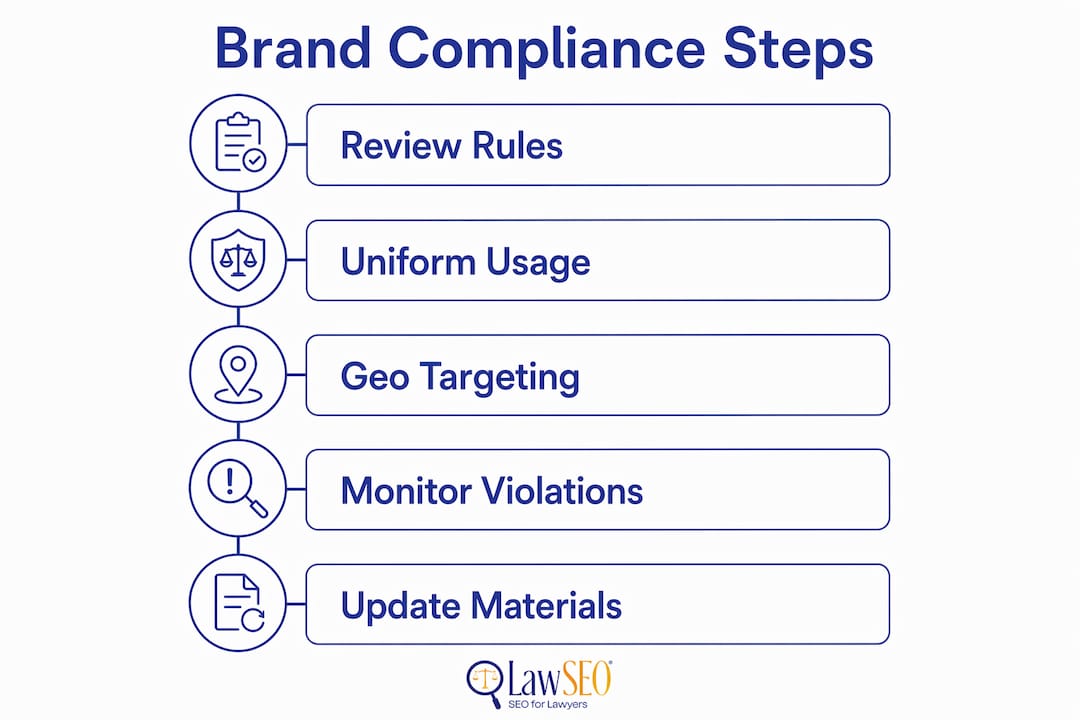
Multi-state law firms must adopt the strictest advertising compliance standard across all jurisdictions or use geo-targeting technology to customize messaging by state. A firm licensed in New York and California cannot simply pick the more permissive state’s rules and apply them everywhere.
Pro Tip: Build a compliance matrix that maps each state bar’s advertising rules against your current branding materials. Update it annually and after any rebrand.
Disciplinary exposure from branding violations is not theoretical. Rule 8.4© violations for misrepresentation carry sanctions that can include forced rebranding, public censure, and suspension. The cost of a compliance review before launch is a fraction of the cost of a disciplinary proceeding after.
What is brand name normalization and why does it affect trademark rights?
Brand name normalization is the legal requirement to use your trademark with identical spelling, capitalization, and presentation every time it appears in public communications. This is not a style preference. It is a condition of trademark enforceability.
Courts reviewing trademark disputes examine brand use across websites, social media profiles, business cards, email signatures, court filings, and advertising. Inconsistent trademark use weakens your legal claim and can be cited by a challenger as evidence that the mark has not been properly maintained. In extreme cases, inconsistency contributes to genericide, where a brand name loses its protected status because it has been used so loosely it no longer identifies a single source.
For law firms, the practical risks include:
- A competitor registering a confusingly similar name because your inconsistent use left gaps in your trademark record.
- Losing an infringement action because you cannot demonstrate continuous, consistent use of the mark as registered.
- Failing to qualify for federal trademark registration due to specimen submissions that show different versions of the name.
Pro Tip: Before adopting any firm name, run searches through the USPTO trademark database and your state bar’s name registry. Conflicts discovered after launch cost far more to resolve than conflicts caught before.
Trademark enforceability depends on consistent presentation. Minor variations in capitalization or punctuation, repeated across years of marketing materials, can be fatal in litigation. Treat your firm name as a legal instrument, not a design element.
How consistent brand messaging builds client trust and competitive advantage
Branding is not a logo or a color palette. It is the sum of every experience a client has with your firm, from the first Google search to the final invoice. Brand strategy must precede visual identity; a clear position and consistent experience form the foundation for effective legal marketing.
The most common mistake attorneys make is confusing “professional” with “formal.” Stiff, impersonal language on a website followed by warm, conversational intake calls creates a disconnect that clients notice. That disconnect signals inconsistency, and inconsistency signals unreliability.
“Successful law firm brands sound smart, confident, and approachable consistently. They avoid switching between jargon-heavy formalism and casual informality depending on the channel. The tone a client encounters on your website should match what they hear on the phone and read in your emails.”
— Law Firm Branding: Beyond the Logo, Legal Practice Marketing
Positioning is the strategic core of branding. Your firm needs a clear answer to two questions: who do you serve, and how do you differ from every other firm that serves the same clients? Without clear positioning, branding is decoration. With it, every touchpoint reinforces a specific, credible promise.
Consistent brand messaging also affects your online visibility. Search engines and AI platforms reward content that presents a coherent, authoritative identity. A firm whose website, Google Business Profile, and social media profiles all describe the practice differently sends conflicting signals that reduce search ranking and AI citation frequency.
Pro Tip: Write a one-paragraph brand statement that defines your firm’s focus, client type, and differentiator. Distribute it internally and require every team member to use it as the foundation for any public communication.
Practical steps to maintain compliant and consistent branding
Attorneys can protect their brand and stay compliant by following a structured approach. The steps below address both the legal and marketing dimensions of brand consistency.
-
Conduct a naming compliance review. Before finalizing any firm name, verify it against ABA Model Rules 7.1 and 8.4©, your state bar’s specific naming rules, and the USPTO trademark database. Confirm the name is available as a domain and on major social platforms.
-
Secure IP ownership in writing. Attorneys who do not secure IP rights from marketing vendors risk losing control of logos, websites, and other brand assets. Every contract with a designer or developer must include an explicit work-for-hire clause transferring all intellectual property rights to the firm upon final payment.
-
Commission original logo design. Stock graphics prevent trademark exclusivity because the same image can be licensed to multiple parties. A custom logo is a prerequisite for federal trademark registration and meaningful brand protection.
-
Create a brand standards document. Specify exact firm name spelling, capitalization, approved color values, logo usage rules, and tone of voice guidelines. Distribute this document to all staff, vendors, and co-counsel who produce public-facing materials.
-
Standardize across all digital channels. Your website, Google Business Profile, LinkedIn page, and any directory listings must display identical firm name, address, phone number, and practice area descriptions. Inconsistencies across these platforms harm both compliance and local search ranking.
-
Schedule periodic brand audits. Review all public-facing materials at least once per year. Check for name variations, outdated credentials, expired advertising disclosures, and any messaging that no longer reflects the firm’s current positioning.
The table below shows how compliance and marketing goals align at each stage of brand management.
| Brand activity | Compliance goal | Marketing goal |
|---|---|---|
| Naming review | Avoid Rule 7.1 and 8.4© violations | Secure a distinctive, memorable name |
| IP ownership contracts | Retain control of brand assets | Protect investment in logo and web design |
| Original logo design | Enable trademark registration | Create an exclusive visual identity |
| Brand standards document | Ensure consistent advertising disclosures | Maintain uniform client experience |
| Annual brand audit | Identify compliance gaps before sanctions | Catch messaging drift before it erodes trust |
Key Takeaways
Consistent branding law protects law firms on two fronts: it satisfies professional conduct rules that prohibit misleading communications, and it preserves the trademark rights that give a firm’s name legal force.
| Point | Details |
|---|---|
| Regulatory compliance is non-negotiable | ABA Model Rules 7.1 and 8.4© require accurate, consistent firm communications or risk disciplinary sanctions. |
| Trademark consistency is a legal requirement | Identical spelling and capitalization across all channels preserves trademark enforceability and prevents rights erosion. |
| Brand strategy precedes visual identity | Define your firm’s position and client focus before designing logos or writing website copy. |
| IP ownership must be contractual | Work-for-hire agreements with vendors are the only way to guarantee the firm owns its logos and digital assets. |
| Multi-state firms need geo-targeted compliance | Apply the strictest state advertising standard or use geo-targeting to meet each jurisdiction’s rules. |
Todd’s take: branding is a legal asset, not a marketing expense
After nearly three decades working with law firms on their digital presence, I have seen the same pattern repeat. A firm invests in a new website, a polished logo, and a social media presence. Six months later, the firm name appears three different ways across their profiles, the logo on the business card does not match the website version, and nobody has checked whether the tagline complies with the state bar’s advertising rules. The brand looks good at a glance and falls apart under scrutiny.
The attorneys I see succeed treat their brand the way they treat a client’s contract. They define the terms precisely, document everything, and review it regularly. They understand that building brand authority is not a one-time project. It is an ongoing obligation that sits at the intersection of marketing and professional responsibility.
The firms that get this right do not just avoid disciplinary problems. They build reputations that generate referrals, command premium fees, and rank well in both traditional search and AI-driven platforms. The firms that get it wrong spend money on marketing that actively undermines their legal standing.
Branding consistency is not a soft skill. For attorneys, it is a compliance requirement with real consequences. Treat it accordingly.
— TODD
How Lawseo helps law firms build compliant, consistent brands online
Lawseo works exclusively with attorneys and law firms, which means every recommendation accounts for the professional conduct rules and trademark requirements that general marketing agencies routinely overlook. The firm’s founder, Todd R. Stager, brings over 29 years of SEO experience to every client campaign, personally reviewing strategy to confirm it aligns with both search best practices and legal advertising standards. From law firm digital marketing to local SEO and AI-driven search optimization, Lawseo builds the kind of consistent, authoritative online presence that satisfies state bar requirements and attracts qualified clients. Contact Lawseo to put your firm’s brand on a foundation that holds up legally and competitively.
FAQ
What is consistent branding law for attorneys?
Consistent branding law refers to the professional conduct rules, trademark statutes, and advertising regulations that require law firms to present their identity accurately and uniformly across all public communications. Violations can result in disciplinary sanctions or loss of trademark rights.
Which ABA rules govern law firm branding?
ABA Model Rule 7.1 prohibits false or misleading communications about legal services, and ABA Model Rule 8.4© classifies misrepresentation as professional misconduct. Both rules apply directly to firm names, advertising claims, and all public-facing brand materials.
How does inconsistent trademark use harm a law firm?
Courts assess brand use across all marketing channels, and inconsistent spelling or capitalization weakens a firm’s legal claim to its name. Over time, inconsistent use can erode exclusive trademark rights and make infringement claims harder to win.
Do multi-state law firms need different branding for each state?
Multi-state firms must either adopt the strictest advertising compliance standard across all jurisdictions or use geo-targeting technology to customize messaging by state. Applying a single, less restrictive standard to all markets creates regulatory exposure in stricter jurisdictions.
Why does logo design affect trademark protection?
Stock graphics cannot be trademarked exclusively because the same image is licensed to multiple parties. A custom logo design is a prerequisite for federal trademark registration and the only way to prevent competitors from using identical visual elements.