


Many law firms invest heavily in digital marketing while unknowingly following SEO advice that was outdated years ago. Outdated tactics like keyword stuffing, chasing bulk backlinks, and ignoring Google Business Profile optimization are not just ineffective. They actively damage your firm’s search visibility and credibility. The legal sector is particularly vulnerable to SEO misinformation because the stakes are high, the competition is fierce, and the regulatory environment adds complexity that generic marketing advice never accounts for. This guide exposes the five most costly SEO myths circulating in legal marketing today and replaces them with evidence-based strategies your firm can act on immediately.
Key Takeaways
| Point | Details |
|---|---|
| SEO myths slow growth | Believing false SEO tactics can limit your law firm’s online visibility. |
| Quality beats quantity | Effective legal SEO relies on authoritative content and relevant backlinks over volume. |
| Ethics guide legal SEO | ABA rules and E-E-A-T principles shape what works in law firm SEO strategies. |
| Practical strategies win | Implementing evidence-based, actionable SEO steps achieves better results than following old myths. |
Why SEO myths persist in the legal industry
Legal marketing has historically lagged behind other industries when it comes to adopting current SEO best practices. The reasons are structural. Law firms operate under strict professional conduct rules, billing pressures, and a culture that prioritizes billable work over marketing innovation. This creates a knowledge gap that aggressive vendors and outdated consultants are quick to fill with oversimplified or flat-out wrong advice.
Several factors keep SEO myths alive in the legal sector:
- Vendor misinformation: Some SEO vendors promise guaranteed rankings using tactics that violate Google’s guidelines. Firms without internal SEO expertise cannot easily identify the difference between legitimate strategy and manipulation.
- Outdated industry publications: Legal marketing trade content often recycles advice from several years ago without acknowledging algorithm changes.
- High professional stakes: Attorneys are trained to be risk-averse. When an SEO tactic appears to be working short-term, firms are reluctant to abandon it even when the evidence turns against it.
- Ethical complexity: Legal SEO ethics intersect with ABA advertising rules, state bar regulations, and consumer protection standards. This complexity makes it harder to distinguish between what is ethically permitted and what is strategically sound.
- Lack of legal-specific SEO education: Most SEO training resources are built for e-commerce or general business, not law firms with YMYL (Your Money or Your Life) content requirements.
One of the most persistent myths, keyword stuffing, is a perfect example. Keyword stuffing harms rankings; Google penalizes over-optimization and rewards semantic SEO and natural language instead. Yet many law firm websites still load practice area pages with repetitive keyword phrases, believing volume signals relevance.

Pro Tip: The American Bar Association’s Model Rules on advertising directly influence what constitutes ethical legal SEO for attorneys. Before implementing any SEO tactic, verify it does not conflict with your state bar’s advertising guidelines. Misleading title tags or unverifiable superlatives in meta descriptions can trigger disciplinary review.
Understanding why myths persist is the first step. The next is knowing exactly which myths are costing your firm the most.
The top five SEO myths law firms must stop believing
Now that you know why myths take hold, here are the specific misconceptions holding legal marketers back, along with what the evidence actually shows.
-
Keyword stuffing boosts rankings. Repeating your target keyword dozens of times on a page does not signal relevance to Google. It signals manipulation. Modern search algorithms use natural language processing to understand context and intent. A page that reads naturally and covers a topic thoroughly will consistently outrank one crammed with repetitive phrases. Focus on topical depth, not keyword density.
-
More backlinks always mean better SEO. This is one of the most expensive myths in legal marketing. Firms spend thousands acquiring links from low-quality directories and irrelevant websites, believing volume drives authority. Quality and relevance matter over quantity. A single link from a respected legal publication or local news outlet carries more weight than fifty links from generic link farms. Reviewing your SEO trends for lawyers in 2026 will confirm that link quality has only grown more important.
-
Any content is good content. Publishing thin, generic blog posts does not build authority. Google’s Helpful Content system actively demotes content that lacks genuine expertise or fails to serve user intent. Law firms need content that demonstrates real experience, answers specific client questions, and reflects the attorney’s actual knowledge.
-
SEO results are instant in legal marketing. Some vendors promise first-page rankings within weeks. Sustainable SEO for law firms typically takes three to six months before meaningful movement appears, and competitive markets can take longer. Firms that expect overnight results often abandon ethical strategies too early and turn to risky shortcuts.
-
Google My Business is optional for law firms. An unoptimized or unclaimed Google Business Profile is one of the most common and costly oversights in legal marketing. For any firm targeting local clients, the map pack is often the first result a potential client sees. Your legal website design and Google Business Profile must work together to capture local intent.
“The firms that dominate local search are not the ones spending the most. They are the ones applying the right strategies consistently over time.”
Evidence-based legal SEO: What actually works
With common misconceptions debunked, here is what successful legal SEO actually looks like in 2026.
The foundation is E-E-A-T: Experience, Expertise, Authoritativeness, and Trustworthiness. Google applies this framework with particular rigor to YMYL content, which includes legal topics. Every page on your firm’s website should demonstrate the attorney’s credentials, real-world experience, and reliable sourcing.
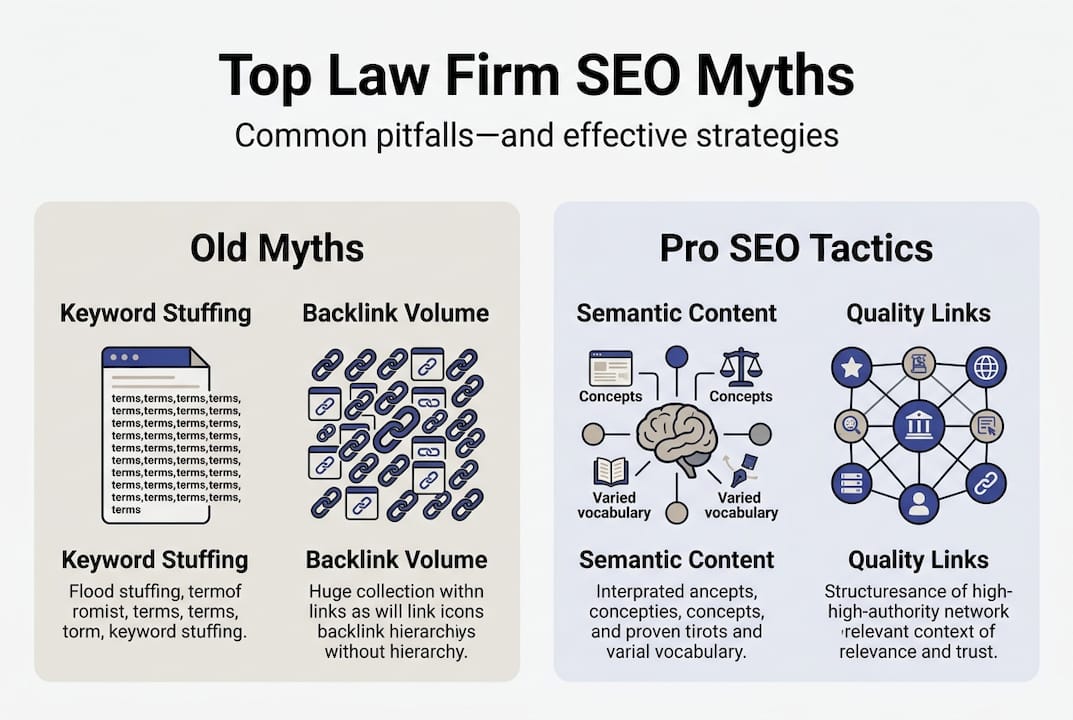
| Myth-driven tactic | Evidence-based alternative |
|---|---|
| Keyword stuffing practice pages | Semantic content covering full topic clusters |
| Bulk backlink purchases | Earned links from legal directories and press |
| Generic blog posts | In-depth guides authored by named attorneys |
| Ignoring Google Business Profile | Fully optimized local listing with reviews |
| Set-and-forget SEO | Ongoing audits aligned with algorithm updates |
Statistic callout: Keyword stuffing harms rankings and can trigger manual penalties from Google, meaning your site may be removed from search results entirely until the issue is resolved. Recovery from a manual action can take months and requires a formal reconsideration request.
Recent Google algorithm updates, including the Helpful Content system and core updates targeting low-quality legal content, have made it clear that thin pages and manipulative link profiles are liabilities, not assets. Firms that invested in quality content and authoritative backlinks before these updates saw their rankings hold or improve. Those relying on outdated tactics saw significant drops.
Local SEO is equally non-negotiable. Consistent NAP (Name, Address, Phone) data across all directories, a verified Google Business Profile with active review management, and location-specific content are the pillars of local visibility. Explore the full range of legal SEO strategies that align with these current standards.
How to apply SEO truths: A practical action plan for law firms
Knowing what works is not enough. Here is how your firm can shift from myth-driven habits to a sustainable, ethical SEO program.
-
Conduct a full SEO audit. Identify keyword-stuffed pages, toxic backlinks, thin content, and technical issues like slow page speed or missing schema markup. Use tools like Google Search Console and Screaming Frog to surface problems systematically.
-
Rewrite or consolidate thin content. Merge low-quality pages covering similar topics into single, authoritative resources. Add attorney bylines, credentials, and real case insights to satisfy E-E-A-T requirements. Prioritizing E-E-A-T for YMYL content is not optional for legal websites.
-
Disavow toxic backlinks. Use Google’s Disavow Tool to neutralize harmful links from link farms or irrelevant sources. Then build a proactive outreach strategy targeting legal publications, bar association directories, and local media.
-
Optimize your Google Business Profile. Add accurate categories, upload photos, respond to every review, and post regular updates. This directly influences your map pack visibility for high-intent local searches.
-
Build a content calendar around client questions. Identify the questions your clients ask during consultations and create content that answers them thoroughly. This aligns your content strategy with actual search intent.
| Action | Expected outcome | Timeline |
|---|---|---|
| Technical SEO audit | Identify and fix ranking blockers | 2 to 4 weeks |
| Content rewrite for E-E-A-T | Improved authority signals | 1 to 3 months |
| Toxic link disavowal | Reduced penalty risk | 4 to 8 weeks |
| Google Business Profile optimization | Local map pack visibility | 2 to 6 weeks |
| Content calendar launch | Sustained organic traffic growth | 3 to 6 months |
Pro Tip: Subscribe to Google’s Search Central Blog and your state bar’s ethics updates simultaneously. Algorithm changes and advertising rule revisions often happen on overlapping timelines. Staying current on both protects your rankings and your license. Explore legal marketing strategies that integrate ethical compliance from the start.
Why the biggest SEO myth is the idea there’s a one-size-fits-all formula
Before you start implementing an action plan, keep this perspective in mind. The most dangerous myth in legal SEO is not keyword stuffing or backlink obsession. It is the belief that a standardized SEO template will work for every law firm.
A personal injury firm in a mid-size Midwestern city faces a completely different competitive landscape than a corporate litigation firm in Manhattan. Practice area, geographic market, firm size, reputation, and even the specific judges and courts a firm works with all shape what an effective SEO strategy looks like. Regulatory dynamics vary by state bar. Reputational risks differ by practice area.
Firms that buy into plug-and-play SEO packages often see short-term movement followed by stagnation or penalties. The firms that consistently dominate search results treat SEO as a living strategy, not a one-time project. They adapt to algorithm changes, monitor local competitor behavior, and align their content with how their specific clients actually search.
The legal SEO fundamentals remain consistent: quality content, ethical backlinks, strong local presence, and technical health. But how you apply those fundamentals must reflect your firm’s unique context. Skepticism toward universal solutions is not pessimism. It is professional judgment applied to marketing.
Take your firm’s SEO further with expert help
Debunking SEO myths is the starting point, but replacing them with a disciplined, firm-specific strategy requires ongoing expertise and attention. LawSEO.com works exclusively with attorneys and law firms, which means every recommendation we make is grounded in the realities of legal marketing, not generic digital marketing theory. Our approach integrates proven legal SEO strategies with ethical compliance, local market intelligence, and content built to satisfy E-E-A-T standards. If your firm is ready to move past outdated tactics and build a search presence that actually converts, visit LawSEO.com to explore how we can help you outrank the competition and attract the clients you want.
Frequently asked questions
Why is keyword stuffing especially harmful for law firm websites?
Keyword stuffing harms rankings through Google penalties and also signals unprofessionalism to potential clients who are evaluating your firm’s credibility before making a high-stakes legal decision.
How does E-E-A-T affect legal SEO results?
Because legal content falls under YMYL categories, Google applies heightened scrutiny to Experience, Expertise, Authoritativeness, and Trustworthiness signals. Prioritizing E-E-A-T directly influences whether your pages rank or get filtered out in favor of more credible sources.
Are more backlinks always better for legal SEO?
No. Quality and relevance matter far more than volume, and a large number of low-quality backlinks can trigger algorithmic or manual penalties that suppress your entire site’s rankings.
How often should my law firm update its SEO approach?
At minimum, conduct a thorough SEO review annually, but monitor Google algorithm announcements and state bar advertising guidance on an ongoing basis to catch issues before they affect your rankings.
Does Google My Business really matter for law firms?
Yes. An optimized Google Business Profile is one of the highest-impact actions a law firm can take for local search visibility, directly influencing map pack placement and client first impressions.