


Domain Authority (DA) is Moz’s proprietary 1–100 score that estimates how likely a domain is to rank competitively in search results. The scale is logarithmic, meaning the difference between DA 20 and DA 30 is far smaller than the effort required to move from DA 70 to DA 80. For most SEO practitioners, DA serves three immediate purposes:
- Competitive benchmarking: Compare your domain’s authority against direct competitors to gauge where you stand.
- Link outreach prioritization: Identify which prospective linking domains carry enough authority to be worth pursuing.
- Trend tracking: Monitor whether your authority-building efforts are moving the needle over months and quarters.
Key Takeaways
Domain Authority is a directional, comparative metric from Moz, most valuable when tracked consistently within a defined competitor set and paired with organic traffic and conversion data.
| Point | Details |
|---|---|
| DA is a third-party score | Moz’s 1–100 DA predicts ranking likelihood; Google does not use it as a ranking input. |
| Logarithmic scale matters | Moving from DA 20 to DA 30 is far easier than from DA 70 to DA 80; plan effort accordingly. |
| Improve through unique referring domains | Acquiring links from new, topically relevant domains moves DA more than adding more links from existing ones. |
| Compare within one tool | DA and DR are not equivalent; use the same metric consistently and cross-check with organic traffic. |
| Law firms: weight local signals too | Google Business Profile and local citation consistency often outweigh raw DA in local legal search results. |
What is domain authority, and where did it come from?
The phrase “domain authority” carries two meanings that are easy to conflate. The general concept refers to a website’s perceived relevance and importance in a subject area, shaped by backlinks, content topicality, and overall reputation. Moz’s branded Domain Authority metric is a specific, proprietary score built to quantify that concept numerically.
Moz created DA as a third-party predictive score, not as a signal Google itself uses. The score is relative and comparative by design. A DA of 45 means nothing in isolation; it only becomes useful when you compare it to a competitor’s DA of 38 or a link prospect’s DA of 72.
Two misconceptions come up repeatedly in practice. First, many site owners treat DA as a direct Google ranking factor. It is not. Google does not receive or process Moz’s DA score. Second, practitioners sometimes set hard score thresholds (“we only pursue links from DA 50+”) as if those numbers were absolute quality gates. Because each tool vendor uses a different index and methodology, a DA 50 from Moz and a Domain Rating 50 from Ahrefs are not equivalent, and neither threshold is universally meaningful.
How does Moz calculate the DA score?
Moz does not publish a step-by-step formula, but it discloses the primary inputs and the modeling approach. The main signals are:
| Signal | What Moz evaluates |
|---|---|
| Linking root domains | Number of unique domains pointing to your site |
| Backlink quality | Authority and relevance of those linking domains |
| Mozscape index data | Moz’s own web crawl and link index |
The current methodology, DA 2.0, applies a machine-learning model that maps these link-based signals to real-world ranking outcomes rather than applying a fixed arithmetic formula. Think of it as a predictive model trained on observed ranking behavior, not a simple weighted sum.
The logarithmic scale has a practical implication: early gains come relatively quickly. Moving a new domain from DA 1 to DA 20 typically requires far fewer high-quality backlinks than moving an established domain from DA 60 to DA 70. At the upper end of the scale, each incremental point demands exponentially more link equity and site reputation. DA also updates when Moz refreshes its Mozscape index and retrains its model, so scores can shift independent of anything Google has changed.
Why does DA matter for your SEO strategy?
DA is most useful as a comparative tool, not an absolute predictor. The primary use cases where it genuinely earns its place in an SEO workflow are:
- Competitive benchmarking: Plotting your DA against a defined competitor set reveals whether your authority-building program is keeping pace or falling behind.
- Link prospecting triage: When evaluating hundreds of potential linking domains, DA provides a fast first filter to separate high-value targets from low-value ones.
- Outreach prioritization: A prospect with DA 65 and topical relevance to your practice area is almost always worth more than ten DA 20 sites with no thematic connection.
- Reporting authority trends: Showing clients or partners a DA trend line over 12 months communicates progress in a format non-technical stakeholders can follow.
DA is less useful as an absolute ranking predictor. A page on a DA 30 site can outrank a page on a DA 70 site when the former has stronger on-page relevance, better content depth, and more targeted anchor text. Similarweb’s analysis confirms that Google runs its own internal sitewide authority signals, separate from any third-party score, and that third-party metrics are proxies, not inputs.
Pro Tip: Never set DA as a campaign goal. Use it as a directional proxy alongside organic traffic and qualified lead volume. A rising DA paired with flat traffic is a warning sign, not a win.
Where can you check and track DA?
Several tools report domain-level authority scores, each drawing from a different index and weighting different signals:
Moz Link Explorer and the free MozBar browser extension are the canonical places to check DA directly. For a reliable reporting stack, combine one backlink-focused metric (DA or DR) with organic traffic data from Google Search Console and a conversion metric from your CRM or analytics platform. No single authority score tells the full story.
How can you improve your domain authority over time?
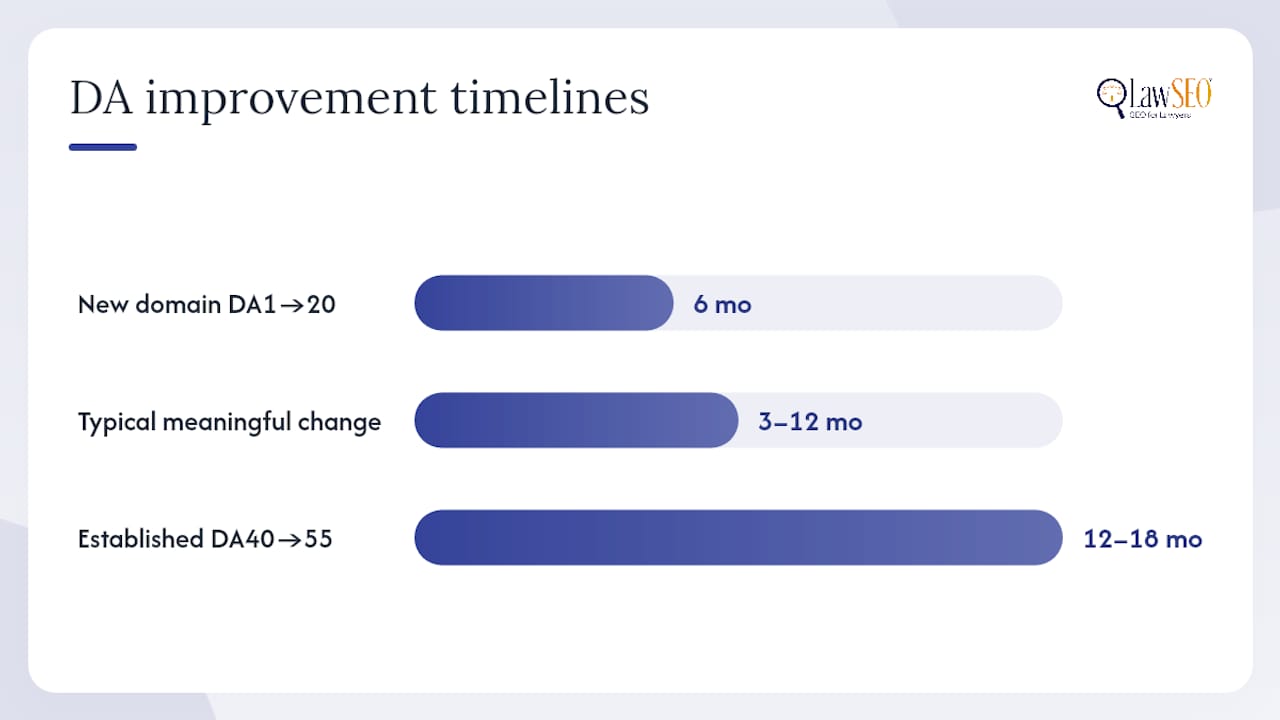
Improving DA is a byproduct of improving your site’s actual link profile and content quality. Consistent backlink acquisition, content quality, and site health are the core levers, and outcomes typically take 3–12 months to register meaningfully in DA. Here is a prioritized sequence:
- Audit and remove toxic links. Use Moz Link Explorer or Google Search Console to identify spammy or irrelevant backlinks. Disavow links that could suppress your score.
- Fix technical site issues. Crawl errors, broken internal links, and slow page speed undermine the authority signals that DA rewards. Resolve these before building new links.
- Publish link-worthy content. Original research, detailed practice-area guides, and data-driven resources attract natural backlinks. Generic content rarely earns them.
- Run link acquisition campaigns targeting unique referring domains. DA rewards breadth of linking domains, not just volume of links. One link from a new DA 60 domain outweighs ten more links from a domain already in your profile.
- Strengthen internal linking. Distribute link equity across your site by connecting related pages deliberately. This also improves crawlability and topical relevance signals.
- Measure and iterate. Track unique linking root domains and organic traffic monthly. If linking domains grow but traffic stays flat, the issue is likely content relevance, not authority.
Timeline expectations should be realistic. A new domain can move from DA 1 to DA 20 within six months of focused outreach. Moving from DA 40 to DA 55 on an established site may take 12–18 months of sustained effort. Large, sudden DA drops often reflect a Mozscape index refresh rather than a real loss of link equity.
Pro Tip: For outreach, prioritize topically relevant domains over raw DA numbers. A DA 45 legal publication linking to your personal injury page delivers more ranking signal than a DA 70 lifestyle blog with no legal content.
How does DA compare to DR, Authority Score, and Majestic metrics?
Scores from different tools are not interchangeable. Each vendor uses a different crawl index, different signal weighting, and a different distribution curve, so a site’s DA and DR will rarely match, and neither should be expected to.
| Dimension | Moz DA | Ahrefs DR | SEMrush Authority Score | Majestic TF / CF |
|---|---|---|---|---|
| What it measures | Backlink signals predicting ranking likelihood | Strength of linking domain profile | Composite: links, traffic, spam signals | Link quality (TF) and link volume (CF) separately |
| Data index | Mozscape | Ahrefs index | SEMrush index | Majestic index |
| Scale | 1–100 | 1–100 | 1–100 | 1–100 each |
| Primary use case | Benchmarking, outreach triage, trend reporting | Link prospecting, competitor analysis | Holistic site health reporting | Link quality auditing |
| Key limitation | Backlink-only; no traffic signal | Backlink-only; scores skew high for large sites | Composite weighting is proprietary | Two separate scores require interpretation together |
The practical guidance: pick one metric and use it consistently for trend analysis within your own reporting. Vendor scores differ in methodology and index, so comparing a competitor’s Ahrefs DR to your Moz DA produces a meaningless number. Cross-check whichever authority metric you track with organic traffic from Google Search Console to confirm the signal is real.
What DA does not tell you, and common mistakes to avoid
DA has real limits, and misunderstanding them leads to wasted budget and misaligned strategy.
- DA is a third-party proxy, not a Google input. Search Engine Journal’s analysis is direct: Google does not use Moz’s DA score in its ranking algorithms. Treating DA as a Google signal is the single most common misuse of the metric.
- DA scores are index-dependent. Moz’s Mozscape index does not crawl the entire web. A link that Google has indexed may not appear in Mozscape, and vice versa, which means DA can undercount or overcount your actual link equity.
- DA updates independently of Google. A DA drop does not mean Google penalized your site. It may simply reflect a Mozscape recrawl or a model update.
- DA cannot substitute for page-level relevance. A high DA domain with thin, off-topic content on a specific page will not outrank a lower-DA domain with a deeply relevant, well-structured page.
- Common misuses to avoid: chasing DA increases as a standalone KPI; buying links specifically to inflate DA; comparing scores across tools as if they were equivalent; and reporting DA to clients as a Google ranking metric.
The right framing is correlation, not causation. Sites with high DA tend to rank well because they have strong link profiles and good content, not because DA itself causes rankings.
How law firms should interpret and act on DA
For law firms, domain authority in legal SEO carries additional nuance. The legal vertical is competitive, locally concentrated, and subject to bar association advertising rules that limit certain outreach tactics. That context changes how you should prioritize authority-building.
Todd R. Stager, founder of Lawseo and an SEO practitioner with over 29 years of experience working exclusively in the legal sector, has authored multiple books on legal SEO and personally reviews strategy for every client campaign. His approach to DA in legal contexts reflects the vertical’s specific constraints and opportunities.
Law firms competing in local markets should weigh DA alongside Google Business Profile signals and local citation consistency. A personal injury firm in Dallas with a DA of 32 but a fully optimized Google Business Profile, consistent NAP citations, and strong reviews will often outperform a DA 45 competitor that has neglected local signals entirely.
Effective authority-building tactics for lawyers in the legal vertical include:
- Local and regional legal publications: Links from state bar association websites, local legal journals, and regional news outlets carry both authority and topical relevance.
- Lawyer-author bylines: Publishing signed articles on legal information sites and local media builds both backlinks and E-E-A-T signals that Google’s quality raters assess.
- Practice-area content hubs: Organizing content into tightly themed silos (e.g., a personal injury hub with pages on car accidents, slip and fall, and wrongful death) concentrates topical authority and earns more relevant inbound links.
- Case-study and resource link assets: Detailed, data-backed resources attract links from law schools, legal aid organizations, and journalism outlets covering legal topics.
Pro Tip: For law firms, prioritize outreach to local bar associations, community foundations, and regional legal publications over generic high-DA directories. A link from your state bar’s website is worth more than ten links from unrelated DA 60 sites.
How Lawseo uses DA in client strategy
At Lawseo, DA is one data point inside a broader, conversion-focused measurement framework. For every law firm client, the team tracks DA alongside organic traffic from Google Search Console, Google Business Profile engagement, and qualified lead volume from the firm’s intake system. Authority scores provide directional context; signed retainer agreements measure actual success.
The firm’s ethical stance is straightforward: vanity metrics do not pay attorney salaries. Every authority-building program Lawseo runs is designed to produce measurable outcomes, whether that is a first-page ranking for a high-intent practice-area keyword, an increase in phone calls from organic search, or a reduction in cost-per-lead compared to paid advertising. DA trends inform the strategy; client outcomes validate it.
If your firm is ready to move beyond tracking a number and start building authority that converts, Lawseo’s legal SEO strategies are built specifically for the competitive, ethically constrained environment law firms operate in.
An editorial perspective on what DA actually tells you
The metric most law firm marketers obsess over is the one that matters least on its own.
DA is a useful tool when used correctly, and a misleading one when used as a primary KPI. The practitioners who get the most value from it are those who treat it as a relative signal within a defined competitor set, check it quarterly rather than weekly, and immediately cross-reference any movement with organic traffic data.
What the metric cannot tell you is whether your content answers the questions a prospective client is actually typing into Google. A law firm can build a DA of 50 through aggressive link acquisition and still lose to a DA 35 competitor whose practice-area pages are more specific, more credible, and more clearly written. The link profile gets you into the conversation; the content quality determines whether you win it.

The most underappreciated insight about DA’s logarithmic scale is what it implies about strategy at different stages. Early-stage law firm sites should invest heavily in link acquisition because the returns are steep and fast. Established firms with DA above 45 will find that marginal DA gains require disproportionate effort, and their time is better spent on content depth, local signal optimization, and conversion rate improvements. Chasing DA points at that stage is diminishing-returns territory.
Use DA to orient your strategy. Do not let it run it.
Sources
The following primary sources and tool documentation informed this guide:
- Domain Authority: What is it and how is it calculated – Moz
- Website Authority: How It Works and How to Improve It | Similarweb
- Domain Authority: Is It A Google Ranking Factor?
- What Is Domain Authority and How to Improve It