


TL;DR:
- Paid search provides immediate traffic through an auction-based ad system, while organic search builds lasting visibility over time through SEO efforts. Most effective marketing programs combine both channels with unified tracking to optimize cost per client acquisition and adapt to different growth stages.
Paid search buys immediate placement at the top of search results through an auction-based ad system. Organic search earns placement over time through SEO, content authority, and technical signals. The practical consequence: these two channels serve different goals, operate on different timelines, and require different budgets. Most winning programs use both.
TL;DR:
- Need leads within 30 days? Paid search via Google Ads or Microsoft Advertising gets you in front of high-intent buyers immediately.
- Building a 12-month pipeline? Organic search compounds over time, lowers your long-term cost per lead, and produces traffic you own rather than rent.
- Launching a new product, market, or practice area? Run paid to seed demand and test messaging, then scale the winners through organic content.
The difference between organic and paid search is not just a budget question. It is a strategic question about where your business is in its growth cycle and how quickly you need results.
How organic search and paid search actually work
Understanding the mechanics of each channel makes every downstream decision clearer.
Organic search (SEO) produces the unpaid listings that search engines generate by ranking pages based on relevance, authority, and technical quality. Google’s algorithm weighs hundreds of signals: on-page content, backlink profile, page speed, schema markup, and entity relationships, among others. You do not pay Google per click. You invest in the assets, such as content, links, and technical infrastructure, that earn the ranking. Google Search Console (GSC) and GA4 are the primary tools for measuring organic performance, tracking impressions, clicks, keyword positions, and conversion paths.
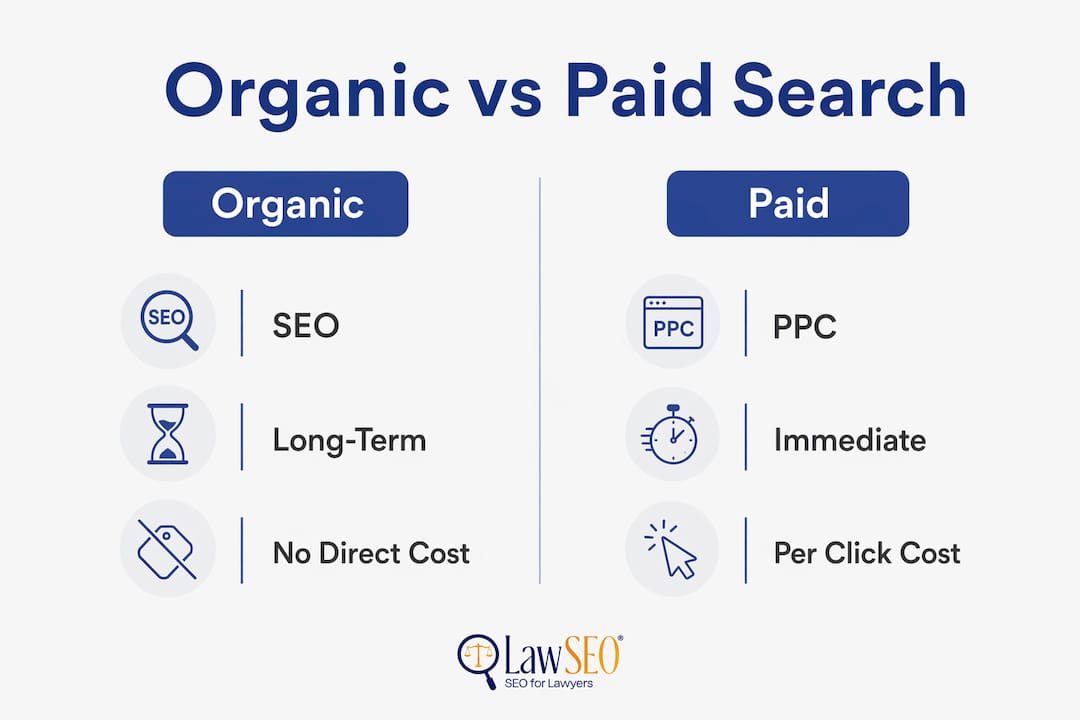
Paid search (PPC) is an auction-driven ad system where advertisers bid on keywords and pay when users click. Google Ads dominates the U.S. market; Microsoft Advertising (Bing Ads) covers a smaller but often less competitive slice of search volume. Campaign setup involves keyword selection, match types, ad copy, bid strategy, and landing page configuration. An ad can go live within hours of setup. The moment you stop spending, the traffic stops.
Where each appears on a modern SERP: A modern search results page is no longer a simple list of ten blue links. It combines paid ads (up to four positions above organic results for commercial queries), a Local Pack (Map Pack), Featured Snippets, People Also Ask boxes, image carousels, and organic listings. Each element competes for the same screen real estate. Paid ads occupy the top of the page for high-commercial-intent queries; organic listings appear below, sometimes well below the fold.
Short workflow comparison:
- Organic: Publish content → earn backlinks → build domain authority → climb rankings → accumulate traffic over months
- Paid: Set up campaign → define bids and targeting → write ad copy → launch → optimize based on click and conversion data → results within days
The difference between organic and paid search, side by side
| Dimension | Organic Search (SEO) | Paid Search (PPC/Ads) |
|---|---|---|
| Cost | No per-click fee; investment in content, links, and technical work | Direct ad spend; pay per click (CPC model) |
| Time to results | several months for meaningful rankings; Map Pack often faster (several weeks to a few months) | Immediate; ads can appear within hours of launch |
| Targeting precision | Limited to keyword and content relevance; no demographic filters | Precise: keyword, location, device, audience, time of day, income bracket |
| Sustainability | Rankings persist after investment stops (with maintenance) | Traffic stops the moment spend stops |
| Measurability | GSC + GA4; attribution requires multi-touch modeling | Google Ads reporting; direct click-to-conversion tracking |
| Intent alignment | Strong for research-driven, informational, and local queries | Strong for urgent, transactional, and high-commercial-intent queries |
| Typical KPIs | Organic impressions, clicks, keyword rank, conversion rate | CPC, CTR, conversion rate, CPA, ROAS |
| Best use cases | Brand building, long-term lead gen, local authority, content marketing | Lead capture, product launches, seasonal promos, testing |
The most consequential difference is timing. Paid search delivers traffic on day one. Organic search takes months to build but then compounds: a well-ranked page continues generating leads without additional spend. Over a 24-month horizon, the cost per lead from organic typically falls well below what paid channels sustain.
SERP feature effects on organic CTR:
- SERP features like the Local Pack, Featured Snippets, and People Also Ask boxes frequently push standard organic listings below the fold.
- A Featured Snippet can increase clicks for the featured page but reduce clicks for all other organic results.
- Paid ads may occupy up to four positions above organic results on commercial queries, compressing organic click-through rates significantly.
- Winning organic visibility today means optimizing for features, not just position 1.
Pros and cons of each channel
Organic search
Pros:
- Traffic compounds over time; a strong content asset can generate leads for years
- Higher perceived trust: organic results are earned, and users know it
- Lower long-term cost per lead compared to sustained paid campaigns
- Owned asset: rankings do not disappear the moment you stop paying
- Supports brand authority, E-E-A-T signals, and AI-driven answer engine visibility
Cons:
- Slow ramp: meaningful results typically take 3–12 months
- Algorithm changes can shift rankings without warning
- Requires ongoing investment in content, links, and technical maintenance
- Difficult to target specific audience segments or demographics directly
Paid search
Pros:
- Immediate visibility for any keyword you can afford to bid on
- Precise targeting by location, device, audience list, and intent signal
- Ideal for testing: run an ad, measure conversion rate, kill what does not work
- Scales quickly when a campaign performs well
Cons:
- No residual value: traffic stops when the budget runs out
- Competitive practice areas and commercial keywords carry high CPCs
- Click fraud and low-quality traffic can inflate spend without producing leads
- Requires continuous optimization to maintain efficiency
Pro Tip: Never run paid search without a parallel organic strategy. Firms that rely solely on PPC are paying rent indefinitely. Firms that rely solely on SEO leave immediate, high-intent demand uncaptured. The two channels are not competitors; they are complements.
Which channel should you use, and when?
The right answer depends on your timeline, budget, and business goal.

1. You need leads within the next 30 days
Paid search is the only channel that delivers at this speed. Set up a Google Ads campaign targeting high-intent keywords in your practice area or product category, define a tight geographic radius, and send traffic to a dedicated landing page. Budget for enough clicks to generate statistically meaningful conversion data before drawing conclusions.
2. You are building a 12-month pipeline
Organic search is the right primary investment. Publish authoritative content targeting the queries your prospective clients use during their research phase. Build backlinks from credible sources. Optimize your Google Business Profile for local queries. The compounding effect means that content published in month one is still generating leads in month twelve and beyond.
3. You are launching a new product or entering a new market
Use both channels together. Paid search seeds demand and tests which messaging converts. Organic content sustains the traffic once you have identified the winning angles. This paid-to-organic handoff is one of the most efficient growth patterns available to marketers.
4. You are running a seasonal promotion
Paid search wins here. Organic rankings take too long to build for a campaign with a defined end date. Allocate budget to Google Ads for the promotion window, then let any organic content you have built continue working after the campaign ends.
5. You are a local service business (including law firms)
Both channels matter, but local SEO and the Map Pack deserve priority investment. Map Pack visibility often moves faster than broader organic rankings, typically within several weeks to a few months of consistent Google Business Profile optimization and review generation. Supplement with paid ads for urgent, high-intent queries where you need immediate coverage.
Budget allocation starting points:
- Small business (a smaller monthly budget): a majority paid, with substantial SEO investment; shift toward organic as rankings build
- Midsize firm (a mid-range monthly budget): an even split with dedicated tracking to measure CPL by channel
- Enterprise or high-competition market: a greater share of investment in organic and content; use paid for competitive gaps and new initiatives
What organic and paid search actually cost
Paid search costs
CPCs vary widely by industry and keyword competitiveness. Legal keywords are among the most expensive in Google Ads, with personal injury, criminal defense, and mass tort terms regularly reaching very high cost per click in major U.S. markets. General commercial keywords outside legal typically range from moderate cost per click, though competitive categories like insurance, finance, and home services push higher. Microsoft Advertising generally carries lower CPCs than Google Ads for comparable keywords, making it a useful supplementary channel for budget-conscious campaigns.
A realistic paid search test budget for a law firm in a mid-size U.S. market starts at a reasonable monthly budget to generate enough clicks for meaningful conversion data. High-competition metros require more.
Organic search (SEO) investment
Monthly SEO retainers for law firms typically vary depending on market competitiveness, scope of work, and the agency’s specialization. Generalist agencies sit at the lower end; specialized legal SEO firms with dedicated content, link building, and technical capabilities command higher fees.
Timeline expectations:
| Milestone | Typical Timeframe |
|---|---|
| Google Business Profile / Map Pack improvement | several weeks to a few months |
| First page rankings for lower-competition keywords | a few months |
| Competitive keyword rankings in major markets | several months to about a year |
| Compounding organic traffic and CPL reduction | over a year |
Organic leads in legal contexts often convert at higher rates than PPC leads, and the long-term SEO ROI outperforms paid in many firm use cases once rankings are established. The key variable is patience: SEO requires sustained investment before the compounding effect becomes visible.
Benchmark: Law firm SEO is a long-term asset. Firms that maintain consistent investment for over a year typically see their cost per lead from organic fall well below what they pay per lead through paid search alone.
How to measure success in each channel
Tracking performance accurately requires different metrics and different tools depending on the channel.
Core KPIs by channel
Paid search KPIs:
- CPC (cost per click): what you pay each time someone clicks your ad
- CTR (click-through rate): percentage of impressions that result in a click
- Conversion rate: percentage of clicks that complete a target action (form fill, call, chat)
- CPA (cost per acquisition): total spend divided by conversions
- ROAS (return on ad spend): revenue generated per dollar spent on ads
Organic search KPIs:
- Impressions: how often your pages appear in search results
- Organic clicks: actual visits from unpaid search results
- Keyword rankings: position for target queries, tracked over time
- Organic conversion rate: percentage of organic visitors who convert
- Assisted conversions: organic touchpoints that contributed to a conversion even when another channel got the last click
Attribution and unified tracking
Last-click attribution, the default in many platforms, systematically undervalues organic search because organic often influences early research stages while paid captures the final click. Data-driven attribution in GA4 distributes credit more accurately across touchpoints. For law firms, the most important attribution question is which channel produced a signed retainer, not just a form submission.
The recommended tracking stack: link Google Search Console to GA4 for organic data, connect Google Ads to GA4 for paid data, and build a unified view that shows CPL by channel. This setup lets you compare the true cost of a signed client from paid versus organic over a 12-month window, which is where organic’s compounding advantage becomes measurable.
Pro Tip: Set up conversion tracking in Google Ads before you spend a dollar. Without it, you are flying blind on which keywords and ads are actually producing leads.
Running paid and organic together: hybrid tactics that work
The channels are most powerful when they reinforce each other rather than compete for budget.
Tactical approaches:
- Test copy in paid, scale in organic: Run Google Ads for 30–60 days to identify which headlines and value propositions generate the highest CTR and conversion rate. Use those winning messages as the foundation for organic content, meta titles, and page headers.
- Use organic content to improve paid Quality Scores: Google Ads rewards landing pages that are relevant, fast, and authoritative. A well-optimized organic page repurposed as a paid landing page often achieves a higher Quality Score, which lowers your CPC and improves ad position.
- Retargeting with organic traffic: Build remarketing audiences in Google Ads from users who visited your site through organic search. These visitors already know your brand; retargeting them with a specific offer or consultation CTA typically converts at a higher rate than cold paid traffic.
- Fill organic gaps with paid: For high-value keywords where your organic rankings are not yet competitive, run paid ads to capture that traffic while your SEO investment matures. As organic rankings improve, reduce paid spend on those terms and reallocate to new gaps.
- Paid-to-organic handoff: A firm launching in a new practice area might run paid ads for six months to generate immediate leads and revenue. That revenue funds the SEO investment. By month 12, organic rankings begin producing leads at a lower CPL, and paid spend can be reduced or redirected.
This kind of coordinated strategy is where law firm digital marketing produces its strongest returns. Neither channel alone captures the full opportunity.
What law firms specifically need to know
The organic vs. paid decision looks different for attorneys than for most other businesses, for two reasons: CPCs are exceptionally high, and client intent varies sharply by practice area.
Urgency-driven vs. research-driven practice areas
Urgency-driven areas (personal injury, criminal defense, DUI, workers’ compensation) attract clients who need help immediately and search with high commercial intent. Paid search captures this demand on day one. A well-structured Google Ads campaign targeting “car accident attorney [city]” or “DUI lawyer near me” can generate signed retainers within days of launch. Paid search is essential for these practice areas, particularly in competitive markets where organic rankings take months to build.
Research-driven areas (family law, estate planning, immigration, business law) involve longer decision cycles. Prospective clients research extensively before contacting an attorney. Organic content that answers their questions, builds trust, and demonstrates expertise performs well here. A well-ranked blog post or practice area page can generate consistent leads for years.
Local SEO and the Map Pack
For most law firms, the Map Pack is the highest-priority organic asset. It appears above standard organic listings for local queries, and Map Pack visibility is governed by proximity, Google Business Profile completeness, and review velocity rather than domain authority alone. This means a newer firm with a well-optimized GBP and consistent reviews can outrank established competitors in the Map Pack faster than in standard organic results.
Law firm search checklist:
- Verify and fully complete your Google Business Profile (categories, services, photos, hours, Q&A)
- Generate reviews consistently; velocity and recency both matter
- Build location-specific practice area pages optimized for local intent
- Run targeted PPC campaigns for urgent practice areas where organic rankings are not yet competitive
- Link GSC, GA4, and Google Ads to track CPL from each channel back to signed retainers
- Invest in local SEO as a long-term asset alongside any paid campaigns
Todd R. Stager, founder of Lawseo with over 29 years of SEO experience, has authored multiple books on legal SEO and built the firm’s methodology around exactly this kind of channel-specific, practice-area-aware strategy. The firm works exclusively with law firms and offers exclusivity agreements per geographic region, meaning your local competitors cannot use the same playbook.
This article is general information about search marketing strategy, not legal or financial advice. Consult a qualified professional for guidance specific to your firm’s situation.
Key Takeaways
Paid search delivers immediate traffic; organic search builds compounding, lower-cost visibility over time, and the strongest law firm marketing programs run both channels with unified tracking to measure true cost per signed client.
| Point | Details |
|---|---|
| Channel timing | Paid search produces results within days; organic rankings typically take 3–12 months to build. |
| Cost structure | Paid search charges per click with no residual value; SEO investment builds owned assets that persist. |
| Law firm priority | Urgent practice areas (PI, criminal) favor paid; research-driven areas (estate, family) favor organic over time. |
| Measurement stack | Link GSC, GA4, and Google Ads to compare true CPL by channel and attribute value to signed retainers. |
| Lawseo’s approach | Lawseo builds founder-led, law-firm-exclusive campaigns that integrate local SEO, paid search, and unified tracking. |
The channel split most firms get wrong
Most law firms treat paid search and organic SEO as competing budget lines rather than complementary systems. The result is predictable: firms that go all-in on PPC face escalating CPCs with no long-term asset to show for it, while firms that invest only in SEO leave urgent, high-intent demand uncaptured for months.
The smarter frame is sequencing. Paid search funds the firm while organic builds. Once organic rankings mature, they lower the blended cost per lead across the entire program. The firms that win in competitive markets are not the ones with the biggest ad budgets; they are the ones that built organic authority while running paid efficiently enough to stay profitable during the ramp.
There is also a measurement problem that compounds the strategic error. Most firms track leads by channel in isolation, which makes organic look slow and paid look efficient. When you measure cost per signed client over over a year, the picture reverses. Organic leads in legal contexts tend to close at higher rates, and the cost per acquisition falls as rankings compound. That is the number that should drive budget allocation decisions, not monthly click volume.
How Lawseo helps law firms win on both channels
Law firms that want to compete on search need more than a generic agency. Lawseo works exclusively with attorneys and law firms, which means every strategy is built around the specific dynamics of legal search: high CPCs, urgency-driven practice areas, local Map Pack competition, and the ethical constraints that govern attorney advertising.
The firm’s services cover the full channel mix: local SEO and Google Business Profile optimization, authority link building, targeted PPC campaign management, content production, technical audits, and unified tracking that ties spend to signed retainers. Todd R. Stager personally oversees strategy for every client, and the firm’s exclusivity model means your local competitors cannot access the same approach. If you are ready to build a search program that produces measurable client acquisition results, contact Lawseo to schedule a consultation.
Further reading and authoritative sources
The sources and tools below support the claims in this article and provide deeper guidance depending on your next step.
Foundational references:
- Google Search Central: Visual Elements Gallery — official documentation on how SERP features are structured and how they affect organic visibility
- Nielsen Norman Group: Anatomy of a Search Results Page — UX research on how users interact with organic vs. paid results
- Digital Marketing Institute: Paid vs. Organic Search — clear explanation of the auction model and organic ranking model
- GoDaddy: Organic vs. Paid Search Listings — plain-language definitions for readers new to the distinction
- GeeksforGeeks: Difference Between Organic Search and Paid Search — technical overview of how each channel works
Measurement tools to set up first:
- Google Search Console — track organic impressions, clicks, and keyword positions; free and essential
- GA4 (Google Analytics 4) — monitor organic traffic and conversion paths across channels
- Google Ads — manage paid campaigns, track CPC and conversion data, link to GA4 for unified reporting
- Microsoft Advertising — supplementary paid channel with lower CPCs for many legal keywords
- Google Business Profile — manage your Map Pack presence; the highest-priority local asset for law firms
Recommended starting point by goal:
- Running a paid search audit: Start with Google Ads reporting and GA4 conversion tracking setup.
- Starting local SEO: Verify your Google Business Profile and review the local SEO checklist for law firms.
- Building an organic content strategy: Review Google Search Central documentation and set up GSC before publishing.