


TL;DR:
- The best legal SEO alternatives focus on agencies with legal expertise, signed-case attribution, and flexible month-to-month contracts. Lawseo stands out with founder-led strategies, exclusive legal focus, and comprehensive services, including AI optimization and transparent reporting. Reputable firms prioritize specialization, clear ROI, and realistic budgeting when selecting a trusted legal marketing partner.
What are the top legal SEO alternatives to dmddigitalseomarketingagency.com?
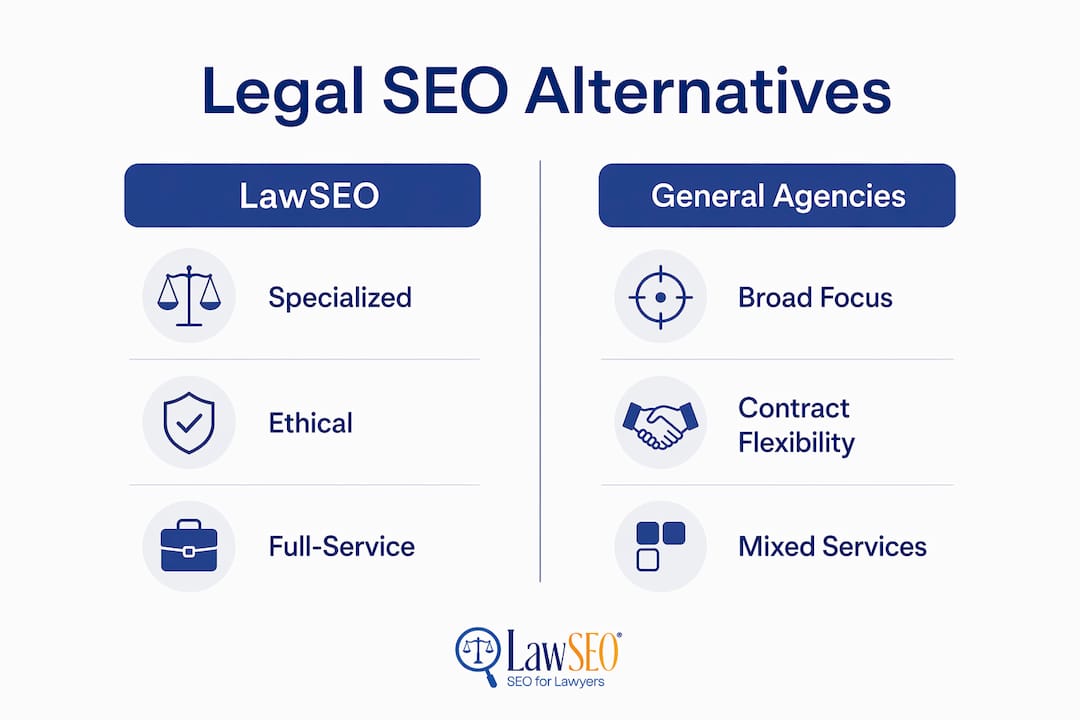
The best alternatives to dmddigitalseomarketingagency.com for attorneys and law firms are agencies that specialize exclusively in legal marketing, tie their reporting to signed cases rather than traffic, and offer flexible month-to-month contracts. Lawseo stands out among them, led by founder Todd R. Stager with over 29 years of SEO experience and a practice built entirely around law firm growth.
Choosing the right legal SEO partner comes down to six criteria that separate accountable agencies from vanity-metric vendors:
| Evaluation criterion | What to look for | Red flag |
|---|---|---|
| Legal specialization | Exclusive or deep legal vertical experience | Generalist agency with no legal track record |
| Contract flexibility | Month-to-month or 30-day exit terms | Long lock-ins with no milestone protections |
| Performance attribution | SEO tied to signed cases, not just rankings | Reports only sessions, impressions, or rankings |
| Ethical compliance | Bar advertising rules, YMYL standards | No mention of legal advertising compliance |
| Services offered | SEO, content, PPC, AI optimization, web design | Single-channel or templated deliverables |
| Asset ownership | Client retains domain, content, GA4, GBP | Agency holds your accounts and assets |
Agencies worth considering fall into two structural models: those that operate as external vendors delivering monthly reports, and those that embed inside your growth function and report on intake volume. The embedded model, where SEO is connected directly to your intake funnel and CRM, consistently produces better attribution clarity. Whatever model you choose, the agency must demonstrate legal vertical expertise, not just general digital marketing credentials.
- Lawseo: founder-led, exclusively legal, covers SEO, PPC, AI optimization, content, and web design
- Boutique legal SEO consultancies: direct senior access, lower overhead, strong for firms under 20 attorneys
- Embedded RevOps-aligned agencies: tie organic search to signed-case data, suited for high-volume practices
- Hybrid in-house plus agency models: best coverage but require coordination investment
How do you choose the right legal SEO agency for your law firm?
The single most revealing question you can ask a prospective agency is: “How do you connect SEO to signed cases, not just traffic?” Agencies that report only vanity metrics cannot prove ROI, and in a vertical where a single signed personal injury case can be worth five figures, that gap matters.
Start every evaluation with these questions:
- How do you handle YMYL content standards and state bar advertising rules?
- Which metrics do you report, and how often?
- What does your audit process look like before you propose a strategy?
- Do we retain ownership of our domain, content, and analytics if we leave?
- What are the exact exit terms?
Contract structure is where many firms get burned. Reputable agencies in 2026 offer month-to-month arrangements or clear exit clauses, not 12-month or 24-month lock-ins with no off-ramp. If an agency resists discussing exit terms early, that tells you something about how they expect the relationship to go.
Pricing is another signal. Legal SEO retainers typically range between $3,000 and $15,000 per month depending on practice area competitiveness and market size. An agency quoting $500 to $1,000 per month for legal SEO is either running templated work or offshore production that will not compete in your market. Personal injury firms in major metro areas often sit at the higher end of that range, given Google Ads costs of $50 to $200+ per click for competitive terms.
Red flags to walk away from immediately:
- Guaranteed rankings promises (no credible agency makes them, and agencies that do are either misleading you or using tactics that risk your site)
- Generic proposals that could apply to any firm in any state
- Link-building packages presented before any site audit has been conducted
- Refusal to give you logins to your own accounts
Pro Tip: Demand written confirmation that you own your Google Business Profile, GA4, and Search Console access before signing anything. Agencies that refuse these logins are often hiding poor performance behind opaque dashboards.
Why does legal SEO require specialized marketing expertise?

Legal SEO is one of the most technically demanding and compliance-sensitive verticals in digital marketing. Three factors make it categorically different from general SEO work: bar advertising rules, the cost of competitive keywords, and the trust threshold clients require before hiring an attorney.
Agencies without legal experience consistently underestimate all three. A generalist agency may produce content that violates your state bar’s advertising guidelines, exposing your firm to disciplinary action. Beyond bar rules, law firm marketing also touches federal regulations. The TCPA governs text message marketing, and violations carry penalties of $500 to $1,500 per unsolicited message. CAN-SPAM sets requirements for email marketing that most generalist agencies do not apply correctly to legal outreach.
Compliance necessities every legal SEO agency must address:
- State bar advertising rules and required disclosures
- YMYL (Your Money or Your Life) content standards that affect how Google evaluates legal pages
- TCPA compliance for any text or SMS marketing campaigns
- CAN-SPAM requirements for email sequences and newsletters
- Accurate attorney credentials and case result disclaimers in content
The right agency conducts a thorough audit of your site health, keyword gaps, and local presence before proposing anything. An agency that opens with a link-building package or a templated content plan has already told you they are not doing diagnostic work. Legal SEO requires custom strategy built on your firm’s specific competitive position, practice areas, and geographic market.
Timeline expectations matter too. SEO in the legal niche typically compounds over 6–12 months before producing consistent lead volume. Firms that expect page-one rankings in 30 days will be disappointed, and agencies that promise otherwise are selling something they cannot deliver.
Statistic callout: Most law firms generating consistent leads invest thousands per month on marketing, split between agency fees and media spend. Practice areas like estate planning can see meaningful results starting at lower marketing investment levels.
Understanding ethical SEO for attorneys is not optional. It is the foundation every compliant legal marketing campaign must be built on, and it is where generalist agencies most often fall short.
Lawseo: specialized legal SEO built for attorneys
Lawseo is the alternative for law firms that want legal SEO handled by someone who has spent their entire career in this vertical. The firm works exclusively with attorneys and law firms, never taking on clients outside the legal sector. That exclusivity means every strategy, every content framework, and every reporting structure is built around how law firms actually acquire clients.
Founder Todd R. Stager brings more than 29 years of SEO experience to every client engagement, personally reviewing strategy rather than delegating it to junior account managers. He has authored several top-rated books on legal SEO, which positions Lawseo as a genuine authority rather than a generalist shop that added a “legal” page to its website. For firms that want proven legal SEO strategies, that depth of experience shows up in the work.
Why law firms choose Lawseo:
- Exclusive legal focus: no e-commerce clients, no restaurants, no healthcare diluting the team’s attention
- Founder-led strategy: Todd reviews every campaign, so senior expertise is not reserved for the largest accounts
- Full service coverage: local SEO, content production, link building, PPC, TV advertising, and web design under one roof
- AI search optimization: Lawseo prepares law firm content to appear in generative AI responses, the emerging front door for client acquisition
- Exclusivity agreements: Lawseo will not work with your direct local competitors
- Transparent attribution: reporting connects SEO activity to consultations and case acquisition, not just traffic
Lawseo also covers digital marketing for lawyers beyond organic search, including paid advertising and web design, so firms do not need to manage multiple vendors for different channels. Schedule a consultation at lawseo.com to see how your firm’s current search visibility maps to actual client intake.
Key Takeaways
Attorneys evaluating legal SEO agencies in 2026 should prioritize legal specialization, signed-case attribution, and contract flexibility above all other criteria, with Lawseo representing the founder-led, exclusively legal option among the available alternatives.
| Point | Details |
|---|---|
| Prioritize legal specialization | Generalist agencies miss bar compliance, YMYL standards, and vertical-specific content requirements. |
| Demand signed-case attribution | Agencies reporting only traffic and rankings cannot prove ROI for your firm. |
| Insist on flexible contracts | Month-to-month terms or 30-day exit clauses are standard with reputable agencies in 2026. |
| Budget realistically | Legal SEO retainers typically range between $3,000 and $15,000 per month depending on practice area and market. |
| Consider Lawseo | Founder Todd R. Stager’s 29+ years of exclusive legal SEO experience and full-service coverage make Lawseo a leading choice among dmddigitalseomarketingagency.com alternatives. |