


What is duplicate content, and why does it threaten your law firm’s search rankings?
Duplicate content on legal websites is identical or substantially similar text accessible through multiple URLs, either within your own domain or across different domains. Google does not issue a manual penalty for most cases, but the SEO damage is real: link equity splits across competing URLs, crawl budget drains on redundant pages, and search engines grow uncertain about which version to rank. Law firm sites face this problem at a higher rate than most industries, because practice area pages naturally overlap in subject matter, boilerplate disclaimers appear site-wide, and multi-location firms often publish nearly identical city pages.
The core SEO impacts on a legal website include:
- Link equity dilution: Backlinks pointing to duplicate URLs split their authority instead of consolidating it behind one authoritative page.
- Crawl budget waste: Googlebot spends time re-crawling duplicate pages instead of discovering new practice area content or updated attorney profiles.
- Ranking uncertainty: When Google cannot identify the canonical page, it may surface a weaker URL in search results, costing you clicks and clients.
- Syndication risk: Content republished on partner sites or legal directories can outrank your original if those sites carry more domain authority.
- Traffic loss: Sites that resolve duplicate content issues have reported up to 20% organic traffic increases after remediation.
Common causes of duplicate content in legal websites
Around 25–30% of online content is duplicate, and law firm sites contribute to that figure through a predictable set of technical and editorial patterns.
Technical sources are the most common culprits:
- URL parameter variants: Session IDs, tracking codes, and filter parameters generate separate URLs for the same page content.
- HTTP vs. HTTPS and www vs. non-www: If both versions resolve without a redirect, Google sees two copies of every page on your site.
- Print-friendly and mobile URLs: Older WordPress themes and some legal CMS platforms create separate print or mobile versions that duplicate the main page.
- Pagination: Blog archives, attorney directory pages, and case result listings paginated across multiple URLs often share near-identical introductory content.
- Attachment pages: WordPress auto-generates a page for every uploaded document or image, producing thin pages with no unique content.
- Staging environments: A development site accidentally left crawlable creates a full duplicate of your live site.
Content-related sources are equally common in legal marketing:
- Thin practice area pages: A firm with offices in ten cities may publish nearly identical “Personal Injury Attorney in [City]” pages, swapping only the city name.
- Boilerplate legal disclaimers: Attorney advertising disclaimers, confidentiality notices, and bar compliance language appear verbatim across dozens of pages.
- Syndicated articles: Legal content distributed to bar association newsletters, legal directories, or partner blogs creates cross-domain duplication.
- Scraped content: Third-party aggregators copy attorney bios and practice descriptions without permission, sometimes outranking the original source.
Pro Tip: Check your site’s URL structure in Google Search Console’s Coverage report. Filter for “Duplicate, submitted URL not selected as canonical” to find the exact pages Google is already treating as redundant.
How duplicate content damages SEO performance for law firms

The most direct harm is link equity dilution. When a personal injury page exists at both /practice-areas/personal-injury/ and /personal-injury-attorney/, any backlink earned by either URL strengthens neither fully. The authority that should consolidate behind one page fragments instead, weakening your ability to rank against competing firms.

Crawl budget is the less-discussed but equally serious consequence. Googlebot allocates a finite crawl budget to each site based on authority and server performance. Duplicate pages consume that budget without contributing new indexable content, which means your freshly updated attorney bio or a new practice area page may go unindexed for days longer than it should. For technical SEO on law firm sites, managing crawl efficiency is one of the highest-leverage improvements available.
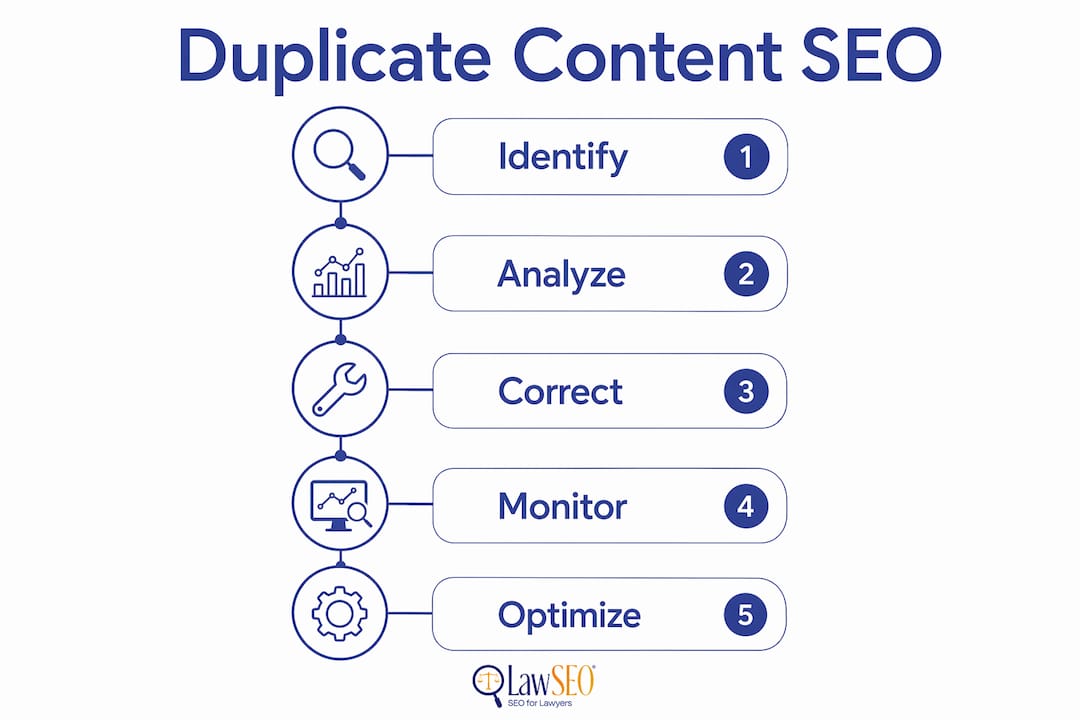
Search engine uncertainty about the canonical page creates a third problem. Google’s canonicalization process selects the “most representative” URL from a cluster of duplicates, but its choice may not match yours. If Google picks a parameter-laden URL over your clean practice area page, that messy URL appears in search results, reducing click-through rates and undermining the professional image your firm works to project.
The user experience dimension matters too. Prospective clients who land on a thin, city-swapped practice page with no substantive local information will leave quickly, sending negative engagement signals that compound the ranking damage already caused by the duplication itself.
How to prevent and fix duplicate content on your law firm’s website
Resolving content duplication requires layering several technical signals rather than relying on any single fix. Google’s own guidance confirms that combining redirects, canonical tags, and sitemap signals stacks their influence and increases the likelihood that your preferred URL is selected.
Canonical tags:
- Add a
rel="canonical"element in the<head>of every page, including a self-referential canonical on the preferred URL itself. - Point all duplicate or near-duplicate URLs to the single authoritative version.
- Remember that canonical tags are a hint, not a directive. Google may override your preference if it finds a more authoritative version elsewhere, so unique, high-quality content must accompany the technical signal.
301 redirects:
- Implement permanent 301 redirects from deprecated URLs, HTTP versions, non-www variants, and trailing-slash inconsistencies to your canonical URL.
- For multi-location pages that are too thin to stand alone, redirect them to a consolidated regional practice page rather than leaving them as duplicate stubs.
XML sitemaps:
- List only canonical URLs in your sitemap. Submitting duplicate URLs signals confusion to Google and undermines the canonicalization process.
- Resubmit your sitemap in Google Search Console after any major site restructure.
Content consolidation:
- Replace multiple thin city-specific practice pages with one comprehensive, location-rich page that addresses the full geographic area. Authoritative long-form content consistently outperforms a cluster of thin pages targeting the same topic.
- Merge overlapping practice area pages (for example, separate “Car Accident Lawyer” and “Auto Accident Attorney” pages) into a single definitive resource.
Syndicated content:
- When your articles appear on legal directories or partner sites, require those partners to apply a
noindextag to their version. Blocking indexing on partner sites is more reliable than asking them to add a canonical tag, because canonical tags between structurally different pages are frequently ignored by Google.
Internal linking discipline:
- Always link internally to the canonical URL. Inconsistent internal links pointing to both a canonical and a duplicate send conflicting signals that weaken your canonicalization strategy.
Pro Tip: Use Screaming Frog SEO Spider or Sitebulb to crawl your entire site and export a list of pages flagged as duplicate or near-duplicate. Cross-reference that list with Google Search Console’s Index Coverage report to prioritize which duplicates are actively harming your rankings.
Expert perspective: what legal SEO specialists know about duplicate content
Duplicate content on a law firm’s website is fundamentally a crawl efficiency and user experience problem, not a penalty waiting to happen. The firms that suffer most are those running dozens of thin, city-swapped practice pages or syndicating content to directories without controlling how it gets indexed. The fix is always the same: consolidate authority behind fewer, better pages, and use technical signals consistently. A law firm that does this correctly will see Google spend its crawl budget on the pages that actually win clients.
That perspective reflects the approach Lawseo applies across every client engagement. Todd R. Stager, who has worked in SEO for over 29 years and focuses exclusively on the legal sector, reviews every campaign strategy personally. The legal industry presents duplication challenges that generic SEO firms rarely encounter: mandatory bar compliance language, multi-jurisdictional practice descriptions, and the ethical constraints around attorney advertising all create content patterns that require specialist handling.
Copyright is a separate but related concern. Copying content from another website without explicit permission violates U.S. copyright law, and copyright protection is automatic upon creation. The fair use doctrine permits limited quotation for commentary or criticism but does not cover commercial reproduction of another firm’s legal content. Law firms that scrape competitor pages or republish third-party articles without authorization face both SEO damage and legal exposure.
Legal websites also benefit from working with an SEO professional who understands both the technical and compliance dimensions. Lawseo’s exclusive focus on attorney SEO means the firm’s strategies account for bar advertising rules, ethical content standards, and the competitive dynamics of local legal search simultaneously.
Real-world examples of duplicate content issues in legal sites
The multi-location page problem. A mid-size personal injury firm operating in 15 cities across Texas published a separate practice page for each location. Every page used the same body copy, swapping only the city name in the title and first paragraph. Google identified the pages as near-duplicates, selected one version as canonical, and largely ignored the rest. The firm’s city-specific pages disappeared from local search results. After consolidating the content into five regional hub pages with genuinely localized information, including courthouse details, local statutes, and city-specific case context, rankings recovered within three months.
The syndication outranking problem. A solo estate planning attorney contributed monthly articles to a state bar association newsletter. The newsletter published the full articles on its website without a noindex tag. Because the bar association’s domain carried significantly more authority than the attorney’s site, Google consistently ranked the bar’s version above the original. The attorney’s site received no credit for content it had written and published first. The resolution required contacting the bar association to add noindex tags to the syndicated versions and submitting a DMCA takedown request for one article that the bar declined to modify.
The CMS parameter problem. A large litigation firm migrated to a new website platform that appended session tracking parameters to every URL. Within weeks, Google Search Console showed hundreds of duplicate URLs being crawled. The firm’s crawl budget was consumed almost entirely by parameter variants, and several newly published practice pages went unindexed for over a month. Configuring URL parameter handling in Search Console and implementing server-side redirects resolved the issue and restored normal indexing within six weeks.
Why legal websites face duplicate content differently than other industries
Most industries deal with duplicate content as a technical problem. Law firms deal with it as a structural one. The legal profession’s content naturally repeats: every personal injury attorney must describe negligence, damages, and the statute of limitations. Every estate planning firm must explain wills, trusts, and probate. That topical overlap is unavoidable, which means the differentiation has to come from depth, local specificity, and authoritative perspective rather than from choosing entirely different subjects.
Bar association compliance requirements add another layer. Attorney advertising rules in many states mandate specific disclaimers, confidentiality notices, and “results may vary” language. Those phrases appear verbatim across every page of a firm’s site, creating boilerplate duplication that Google’s systems generally tolerate in small amounts but that compounds quickly on large sites. A firm with 200 practice and location pages carries that boilerplate 200 times.
The competitive stakes in legal search are also higher than in most verticals. A single first-page ranking for “DUI attorney [city]” or “medical malpractice lawyer [state]” can be worth tens of thousands of dollars in annual revenue. That pressure leads some firms to publish thin, keyword-targeted pages at scale, which is precisely the behavior that generates the most damaging technical duplication. A well-structured content silo approach addresses both the duplication risk and the topical authority problem simultaneously, making it the preferred architecture for competitive legal SEO in 2026.
E-commerce sites face similar parameter-driven duplication, but their fix is largely technical. Law firms need both the technical fix and a content strategy that produces genuinely differentiated pages. That combination is what separates firms that dominate local search from those that remain invisible despite publishing large volumes of content. A solid SEO content strategy built around topical authority and content consolidation applies directly to legal marketing, where depth and credibility carry more weight than volume.
If your firm is ready to address content duplication and build a search presence that compounds over time, Lawseo’s legal SEO services are built exclusively for attorneys. Every strategy is reviewed by Todd R. Stager personally, and the firm’s exclusivity model means your local competitors will not benefit from the same work.
Key Takeaways
Duplicate content on legal websites primarily harms SEO by splitting link equity, wasting crawl budget, and forcing Google to guess which URL deserves to rank, making technical consolidation and content differentiation the two non-negotiable fixes.
| Point | Details |
|---|---|
| No penalty, but real SEO damage | Duplicate content rarely triggers a manual penalty, but sites fixing it have reported up to 20% organic traffic increases. |
| Legal sites face structural duplication | Boilerplate disclaimers, multi-location pages, and overlapping practice topics create duplication patterns unique to law firms. |
| Stack canonicalization signals | Combining 301 redirects, rel=canonical tags, and sitemap inclusion gives Google the strongest possible signal for your preferred URL. |
| Syndication requires noindex, not just canonical | Requiring partner sites to apply noindex tags is more reliable than canonical tags for preventing syndicated content from outranking the original. |
| Content depth beats page volume | Consolidating thin city or practice pages into authoritative long-form resources improves rankings and eliminates duplication simultaneously. |