


Meta ads work for many consumer-facing legal practices when compliant creative meets solid intake plumbing and accurate conversion tracking. The prerequisite that determines success isn’t budget or creative talent. It’s whether your firm has wired Pixel data, Conversions API, and CRM tracking together before you spend a single dollar on media. Firms lacking that infrastructure should fix it before scaling ad spend, not after.
TL;DR:
- Effective Facebook ad campaigns for law firms require proper infrastructure, including Pixel, Conversions API, and CRM tracking, before increasing ad spend.
- Campaigns should be structured into cold, retargeting, and lookalike layers, each with tailored creative and audience strategies to maximize conversions.
- Compliance with state bar advertising rules must be verified for all ad copy and forms, especially when targeting sensitive practice areas under Special Ad Category restrictions.
- Accurate tracking of offline conversion events from form submission to retained client is essential to measure true cost per case closed.
- Start with a budget that sustains at least 50 conversions per week per ad set to avoid unpredictable results and optimize for high-value outcomes.
Why Facebook Ads Work for Many Law Firms
Facebook and Instagram excel at reaching people before they know they need a lawyer. Search ads capture demand that already exists. Meta creates it, surfacing a personal injury firm’s ad in someone’s Feed the week after a car accident, or a family law message in front of someone quietly researching divorce at 11 p.m. That’s a fundamentally different job than Google Ads performs, and it’s why the two channels complement each other rather than compete directly.
Certain practice areas consistently outperform others on Meta. Practitioner data from Meta Ads for Lawyers: The 2026 Playbook shows the platform performs best for emotionally urgent, consumer-facing matters, while narrow B2B legal services tend to underperform badly.
The strongest practice-area fits include:
- Personal injury — urgent need, high emotional stakes, broad audience
- Family law — divorce, custody, and support searches often start with social scrolling, not Google
- Criminal defense — time-sensitive and often triggered by a specific event
- Immigration — long consideration windows that reward retargeting
- Bankruptcy — financial stress creates receptive, if cautious, audiences
- Elder law and estate planning — strong performance when age-based interest targeting is layered in
Meta also distributes creative across Feed, Stories, Reels, Messenger, and the Audience Network from a single campaign, which stretches a modest budget across more touchpoints than a single-placement channel ever could.
What You Need Before Launching Facebook Ads for Lawyers
Most failed law firm Facebook campaigns die from operational gaps, not bad targeting. Fix the plumbing first.
- Set up Business Manager properly. Verify your Business Account and confirm your Facebook Page reflects your actual practice name, address, and licensing information. Unverified accounts get flagged more often during review.
- Build a compliance review workflow. Every ad, headline, and lead form question should pass through a review step checking language against your state bar’s advertising rules before it ever reaches Meta’s ad review queue.
- Staff your intake before you spend a dollar. Someone needs to call or text new leads within the first hour, not the next business day. Map every lead field to your CRM so nothing lands in an inbox no one checks.
- Install the Pixel and plan your Conversions API rollout. Decide now which offline events you’ll send back, booked consultation, consultation attended, retained client, so Meta has real signal to optimize against from day one.
Pro Tip: Run a dry test of your intake process before launch. Submit a fake lead through your own form and time how long it takes for a human to respond. If it’s more than 60 minutes, fix that before you touch the ad account.
Building a Facebook Ad Campaign Structure That Converts
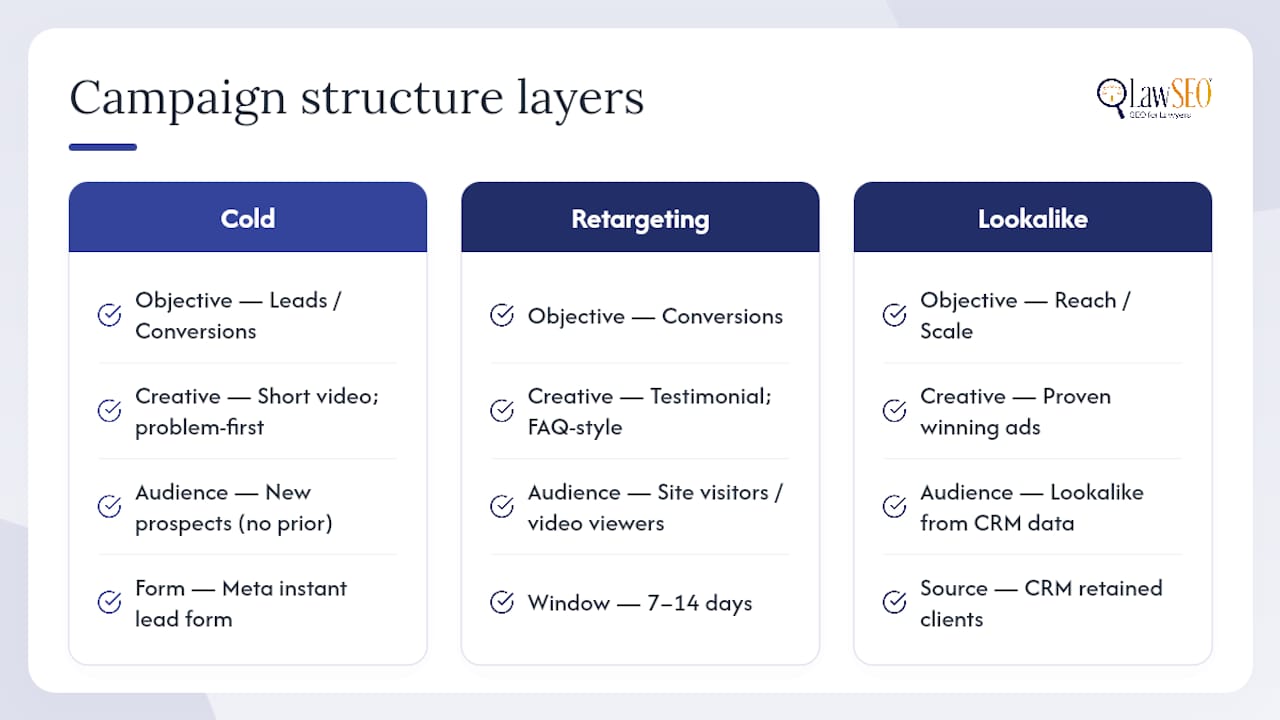
A working law firm Facebook campaign structure has three distinct layers, each with a different job. Treating all traffic the same is one of the most common reasons budgets get wasted.
Cold campaigns introduce your firm to people who’ve never heard of you. Set the campaign objective to Leads or Conversions, and lean on short video or problem-first static creative, something that names the legal problem directly rather than describing your firm. Pair this with Meta’s native lead form rather than a landing page. Practitioner data from Admanage shows instant lead forms often outperform click-to-landing-page approaches for legal services because they eliminate the load-time and friction that kill mobile conversions.
Retargeting campaigns re-engage people who visited your site or watched a meaningful chunk of a video ad without converting. This is where testimonial content (compliance-checked) and FAQ-style creative earn their keep, since these viewers already know who you are and need reassurance, not introduction. Set the objective to Conversions and keep the audience window tight, seven to fourteen days tends to work well for urgent practice areas.
Lookalike campaigns extend your reach using audiences modeled from your best outcomes, ideally CRM-confirmed retained clients or completed intake forms rather than raw page visitors. Build these once you have enough offline conversion data flowing back into Meta, then scale budgets gradually and preserve your winning ad sets rather than restarting from scratch.
Here’s the number that should guide your funnel design: Meta and Facebook’s massive active user base means even a tightly geo-fenced legal campaign reaches far more prospects than most local firms can meaningfully serve, which is exactly why audience precision matters more than audience size.
How Special Ad Category Rules Affect Legal Targeting
Meta classifies certain ad categories, including many tied to housing, employment, and credit, under Special Ad Category rules that restrict targeting options. Most legal advertising doesn’t fall under these restrictions outright, but the safest approach treats sensitive practice areas (housing disputes, employment law, credit and debt matters) as though the restrictions apply, since misclassification risks account-level penalties.
When Special Ad Category rules do apply, expect these constraints:
- No detailed age or gender targeting beyond broad legally required minimums
- No zip-code-level radius targeting below a set minimum radius
- No lookalike audiences built from certain sensitive data categories
- Limited interest-based targeting options compared to standard campaigns
Beyond category rules, geographic precision matters for a reason specific to legal advertising: your targeting radius should match where you’re actually licensed to practice. Broad national targeting for a state-licensed personal injury attorney doesn’t just waste budget on unqualified leads, it invites intake calls from people you legally cannot represent.
Where category restrictions don’t apply, you still have solid options. Content-based signals (people who’ve engaged with legal or financial content), behavioral interest layers, and lookalikes built from offline CRM events all remain fair game. The University of Florida Law Scholarship review of ad tech ethics notes that behavioral advertising raises genuine privacy and fiduciary questions for attorneys specifically, since the lawyer-client relationship carries duties that generic advertisers don’t have to consider. Documenting your targeting choices and keeping them conservative where client autonomy could be implicated isn’t just good practice. It’s a defensible position if a bar complaint ever surfaces.
Writing Facebook Ad Creative That Converts and Passes Review
The creative that performs best for legal ads names the problem before it names the firm. “Injured in a crash and don’t know what to do next?” outperforms “Smith & Associates: 30 Years of Experience” almost every time, because it matches the emotional state of someone scrolling Facebook, not searching Google with intent already formed.
- Lead with the legal problem, not personal characteristics. Describe the situation (“facing a DUI charge,” “going through a contested divorce”) rather than implying anything about the viewer’s health, finances, or personal life, which risks both compliance issues and Meta ad rejections.
- Test video openers against static problem-first creative. Short vertical video (15 to 30 seconds) tends to outperform static images for cold audiences, but static creative with strong copy often wins on cost per lead once retargeting kicks in.
- Use compliance-checked testimonials sparingly. Client testimonials can be powerful, but they need sign-off against your state bar’s rules on client endorsements before they ever reach an ad account.
- Build educational carousel cards for warmer audiences. Cards addressing “what happens after you call a lawyer” or “what to expect at your first consultation” reduce anxiety and work well for retargeting.
- Keep lead forms short but not empty. Capture name, phone number, best time to call, and one qualifying question (case type or incident date, for instance) so your intake team can prioritize calls without demanding so much information that people abandon the form.
Pro Tip: Write three completely different hooks for every campaign, one that names the legal problem, one that names the outcome the reader wants, and one that asks a direct question. Let the data decide which register your audience responds to, because it varies more by practice area than most firms expect.
Tracking That Ties Facebook Leads to Retained Clients
Raw cost per lead is close to meaningless in legal advertising. A $40 lead that never becomes a client costs more than a $150 lead that signs a retainer, and the only way to know which is which is by tracking the full path from ad click to retained client.
The event chain that matters looks like this: form submission, booked consultation, consultation attended, retained client. Each step should fire back to Meta as either a standard conversion event or an offline conversion event, giving the algorithm real signal about what actually matters instead of just what generates clicks.
This is where Conversions API (CAPI) earns its place in the setup, not as an optional technical upgrade but as core infrastructure. Guidance from AdTaxi on CAPI implementation shows that feeding CRM-confirmed events back to Meta materially improves optimization for high-value outcomes, particularly for complex practice areas where the gap between “lead” and “client” is wide. Browser-based Pixel tracking alone misses a growing share of conversions due to ad blockers, iOS privacy changes, and cross-device behavior. CAPI, sent server-side from your CRM, closes that gap.
Layer UTM parameters on every campaign and ad set as a verification check against Meta’s own reporting. When your CRM and Meta’s dashboard tell noticeably different stories about lead volume, the discrepancy usually points to a tracking gap worth fixing immediately.
| Funnel Stage | Event Type Sent to Meta | Why It Matters |
|---|---|---|
| Form submitted | Standard Pixel event (Lead) | Confirms basic ad-to-form conversion |
| Consultation booked | Offline/CAPI event | Filters out low-intent form fills |
| Consultation attended | Offline/CAPI event | Signals real buying intent |
| Client retained | Offline/CAPI event | Trains Meta toward your actual revenue outcome |
How Much to Spend Before Facebook Ads Actually Work
Meta’s algorithm needs roughly 50 conversions per ad set within about seven days to exit the learning phase and reach stable performance. Below that threshold, delivery stays unpredictable and cost per result swings wildly from day to day.
Work backward from that number using your practice area’s typical cost per lead. If personal injury leads run $60 to $120 depending on your market, hitting 50 conversions in a week means budgeting roughly $3,000 to $6,000 per ad set during that initial window. Immigration and bankruptcy campaigns often run lower per-lead costs but need longer nurture sequences before conversion.
Here’s the number that should reshape how you read your own reports: guidance from AdManage.ai suggests Meta-reported cost per lead typically understates true cost per retained client by a factor of five to ten times, depending on your qualification and case-acceptance rates. A $75 lead can easily become a $500 to $750 cost per retained client once you account for unqualified inquiries and cases you decline.
Scale carefully once an ad set proves itself:
- Increase budgets in increments of 20% to 30%, not sudden doubling, to avoid resetting the learning phase
- Clone winning ad sets into new campaigns rather than editing them heavily
- Preserve top-performing creative even as you introduce new variants around it
Staying Compliant While Running Facebook Ads for Lawyers
Every piece of ad copy needs a pass against your state bar’s advertising rules before it reaches Meta’s review queue, not after a complaint arrives. Guidance from the San Francisco Bar Association points to Model Rules 7.1 through 7.3 as the framework most state rules echo: content must be truthful, non-misleading, and free of language implying a guaranteed outcome.
Practical compliance steps that reduce risk:
- Include a disclaimer on every lead form stating that submission does not create an attorney-client relationship
- Link to your firm’s privacy policy directly on the form, not buried three clicks away
- Avoid superlatives like “best” or “guaranteed results” that most state bars flag as misleading
- Keep records of every ad’s copy and targeting decisions in case a bar inquiry ever asks for them
Platform enforcement adds a second layer of risk beyond bar compliance. Meta’s advertising standards confirm that ads and entire ad accounts can be restricted or removed for policy violations, and enforcement isn’t always predictable. In April 2026, Meta removed a wave of attorney ads recruiting plaintiffs for social-media-addiction lawsuits, a reminder that certain plaintiff-recruitment campaigns carry elevated platform risk regardless of their legal merit.
Pro Tip: Keep a search or programmatic channel active even while Meta performs well. Firms that depend entirely on Facebook for lead flow have the least room to maneuver when enforcement actions hit without warning.
A Simple Testing Plan for Facebook Ad Campaigns
Test one variable at a time, hook, creative format, call to action, or form length, and resist the urge to change three things at once because you’re impatient for results.
- Isolate the variable. Run identical audiences and budgets against two versions of a single ad element, then let the difference in performance tell you something real.
- Fund each variant to at least 50 to 100 leads before judging it. Anything less and you’re reading noise, not signal.
- Track qualified-case rate, not just raw lead volume. A variant generating cheaper leads that convert to retained clients at half the rate of your control isn’t actually winning.
- Apply clear decision rules. If a variant beats your control on qualified-case cost by a meaningful margin after adequate volume, scale it. If it underperforms, kill it. If results are close, run it longer before deciding.
Common Facebook Ad Mistakes That Waste Legal Marketing Budgets
Mixing multiple practice areas inside one ad set is the fastest way to confuse Meta’s algorithm and your own intake team. Split campaigns by offer and by geography instead, even if it means running more ad sets with smaller individual budgets.
Slow lead response kills conversion rates faster than almost any creative or targeting problem. A lead that sits unanswered for four hours has often already called a competing firm. Staff or automate a response within the first hour, every time.
Finally, firms that never connect CRM outcomes back to Meta through CAPI and offline events are training the algorithm on incomplete information. Without that signal, Meta optimizes toward cheap clicks and form fills, not retained clients, which defeats the entire purpose of running ads for a law practice in the first place.
LawSEO’s Experience Running Meta Ads for Law Firms
Todd R. Stager has spent more than 29 years in SEO and digital marketing, and personally reviews strategy on every client campaign LawSEO runs, including Meta ad programs. That founder-level involvement matters in legal advertising specifically, where a single compliance misstep or a poorly wired tracking setup can waste months of ad spend before anyone notices the problem.
LawSEO’s process for legal Meta campaigns runs compliance review against state bar advertising rules before launch, builds CAPI integration alongside standard Pixel tracking, and tests creative variants against qualified-case outcomes rather than raw lead volume. That combination, compliance discipline plus measurement rigor, is what separates campaigns that generate retained clients from campaigns that just generate cheap leads.
How We Approach Meta Ads Differently for Law Firms
Most agencies treat Facebook ads as a volume game: more leads, lower cost per click, declare victory. We don’t build campaigns that way. Every strategy gets founder-level review before launch, and every client operates under an exclusivity agreement, meaning we’re not running the same playbook against a firm’s direct local competitor.
The bigger shift is treating intake and measurement as inseparable from the media buy itself. A campaign optimized for clicks without CAPI wiring back to retained-client data is optimized for the wrong outcome. We also build in enforcement-risk awareness from day one, because a platform that removes ads overnight rewards firms that never depended on a single channel to begin with.
— TODD
Ready to Launch a Compliant Meta Ad Program
Running Facebook ads for a law firm without compliance review and conversion tracking wired in advance is how firms burn budget without ever knowing why. LawSEO builds legal Meta ad programs the way this playbook describes: campaign strategy matched to your practice area, Pixel and CAPI integration wired to your CRM before launch, compliance review against your state bar’s rules on every ad, and monthly reporting that tracks cost per retained client, not just cost per lead.
That operational discipline is the same approach LawSEO brings to legal SEO strategy more broadly: founder-reviewed, measurement-first, and built around what actually grows a practice rather than what looks good on a vanity metric dashboard. If your firm is ready to run Meta ads with real intake plumbing behind them, book a consult through LawSEO’s team and get a campaign structure built around your practice area and licensing footprint.
Sources
Meta’s own advertising standards documentation is the first stop for understanding ad review and enforcement mechanics before you launch. Pair that with the University of Florida Law Scholarship review of ad tech ethics for a deeper look at the fiduciary questions targeted advertising raises for attorneys specifically.
For implementation detail on tracking, the AdTaxi guide to CAPI and offline events walks through the technical setup, while LawSEO’s own guide on lead generation tactics for law firms covers the intake side of the same equation.
- Meta advertising standards / Ad Standards — Meta
- Ad Tech & the Future of Legal Ethics — University of Florida Law Scholarship
- Meta Ads for Lawyers: The 2026 Playbook — AdLibrary
- Admanage
- Get better performance out of Meta with CAPI and offline events — AdTaxi