


The fastest way to attract clients online is to pick two or three high-conversion channels, instrument them properly, and run a 90-day test before you touch anything else. Most businesses do the opposite: they scatter thin budgets across six channels, measure nothing, and conclude “marketing doesn’t work” after eight weeks. It isn’t the channels that fail. It’s the lack of a system.
Before you spend a dollar or write a single post, do these things in order:
- Define your target client persona in one paragraph, not a vague demographic sketch.
- Choose your top two channels based on where that persona already spends time.
- Build one dedicated landing page matched to the offer, not your homepage.
- Set up basic tracking (a phone number, a UTM structure, a CRM field) before launch day.
- Start outreach, ads, or content on a fixed weekly cadence and don’t stop at week three.
Speed matters more than most people budget for. When a stranger fills out your form or calls your number, they’re often comparing you to two or three competitors in real time. Pro Tip: Respond to a new inquiry within 15 minutes during business hours. Prospects who wait longer frequently book with whoever answers first, regardless of who’s actually better.
Key Takeaways
Attracting clients online works when you pick two or three matched channels, instrument every one of them for real attribution, and run a disciplined 90-day test before scaling.
| Point | Details |
|---|---|
| Pick channels deliberately | Score options on audience fit, cost, time to close, and existing assets before committing budget. |
| Build one dedicated landing page | Match the page’s message to the exact offer, not your general homepage. |
| Respond within 15 minutes | Fast acknowledgment and a short intake script convert far more inquiries into booked clients. |
| Track to signed clients, not leads | Use UTMs, call tracking, and CRM integration to follow revenue back to its source. |
| Set kill and scale rules in advance | Decide at day 30 and day 60 what gets cut and what gets doubled, before results come in. |
Ways to Gain Clients Online: The Channel-by-Channel Playbook
Every channel below can produce clients. The mistake isn’t picking a “bad” channel. It’s picking too many at once, or picking one that doesn’t match how your buyer actually shops. Treat the following as a menu, not a checklist to complete in full.
Search engine optimization (SEO)
SEO is best for businesses selling considered purchases: services, high-ticket products, anything a buyer researches before committing. It’s slow to start and durable once it works.
- Identify 10 to 20 specific, narrow-intent search phrases your buyer actually types, not broad category terms.
- Build or rewrite pages that answer each phrase directly in the first two sentences, then support the answer with detail.
- Add basic technical fixes: page speed, mobile responsiveness, and a clean site structure.
- Cost: $500 to $3,000 per month if outsourced; primarily time if done in house.
- Time to results: 3 to 6 months for meaningful traffic, longer in competitive categories.
- KPIs: organic sessions to service pages, keyword rankings for buyer-intent phrases, conversion rate from organic visits to inquiries.
- Troubleshooting: If traffic grows but leads don’t, your pages are ranking for the wrong intent. If nothing moves after 90 days, check for a technical block first (indexing errors, missing sitemaps) before blaming content.
Service businesses that invest in SEO tend to see higher conversion rates than paid channels over time, because organic visitors arrive already searching for a solution rather than being interrupted by an ad. Narrow, specific content beats generic pages here too. A guide built around one precise scenario captures a more motivated searcher than a broad overview ever will. If you want a structural starting point, this on-page SEO guide walks through the exact page elements that move rankings fastest for service businesses.
Content marketing
Content is the engine behind SEO and social, but it also works as a trust builder on its own, especially long-form guides that answer a specific question a buyer would ask before hiring someone.
- List the 10 questions your best clients ask before they buy.
- Write one thorough answer per question, published on your own site.
- Repurpose each piece into a short video, an email, and two social posts.
- Cost: Free if self-written; $200 to $800 per piece if outsourced to a freelance writer.
- Time to results: 2 to 4 months for organic pickup; immediate if you already have an audience to send it to.
- KPIs: time on page, email signups from content, assisted conversions (visitors who read content before booking).
- Troubleshooting: If nobody reads it, distribution is the problem, not the writing. If they read it but don’t convert, the piece lacks a clear next step.
Content built around a specific practice area or scenario, like this practice-area page framework, consistently outperforms generic “about us” style pages because it matches exactly what the searcher typed.
Email marketing
Email is the highest-leverage channel you already own. It’s cheap, it compounds, and it’s the best tool for turning “not ready yet” leads into paying clients months later.
- Capture email at every touchpoint: content downloads, quote requests, even abandoned bookings.
- Send a five-email welcome sequence introducing your process, proof, and a low-friction next step.
- Follow with a monthly or biweekly send that mixes education and soft offers.
- Cost: $0 to $50 per month for most small business email tools.
- Time to results: Immediate for warm leads; 1 to 3 months to build a list worth automating.
- KPIs: open rate, click rate, and revenue per email sent.
- Troubleshooting: Low opens usually mean a weak subject line or a cold list. Low clicks usually mean the email talks about you instead of the reader’s problem.
Paid advertising
Paid ads (search, social, or Local Service Ads) work fastest when you need leads now and can afford to pay for them while organic channels build. Google’s Local Service Ads run on a pay-per-lead structure and often deliver strong ROI for local, consumer-facing businesses specifically.
- Pick one platform where your buyer already searches or scrolls, not every platform at once.
- Build a landing page that matches the ad’s exact promise, word for word.
- Start with a small daily budget, run for two weeks minimum, then cut what isn’t converting.
- Cost: $500 to $5,000 per month depending on competition and market.
- Time to results: Days for traffic, 2 to 4 weeks for a reliable conversion read.
- KPIs: cost per lead, cost per consultation, click-through rate.
- Troubleshooting: High clicks but no conversions means your landing page, not your ad, is the problem. High cost per lead early on is normal; give the algorithm at least a week to optimize before panicking.
Social media
Social works differently for B2B and B2C. For consumer-facing sellers, it’s often a direct sales channel. For service businesses, it’s usually a trust builder that supports other channels rather than replacing them.
- Post consistently on the one or two platforms your buyer actually uses, not all five.
- Use short video over static images wherever the platform rewards it.
- Engage in comments and DMs daily. Social algorithms reward accounts that generate conversation, not just posts.
KPIs: engagement rate, profile visits, and click-throughs to your site or booking page.
Partnerships and referrals
Referrals convert better than almost any other channel because trust is pre-built. Yet most businesses never formalize the process, leaving it to chance.
- List 10 businesses or professionals who serve your same client before or after you do.
- Offer a simple reciprocal arrangement: you send clients their way, they send clients yours.
- Ask every satisfied client directly for a referral within a week of a good outcome, don’t wait for them to think of it.
Cost: Low, mostly time. Time to results: 1 to 2 months to see the first referral flow through. Guidance on finding clients online consistently points back to referrals and diligent follow-up with lost leads as an underused source of new business.
Influencer and creator partnerships
Most useful for online sellers and consumer brands. A mix of creator partnerships, optimized social bios, and targeted advertising is a standard recommendation for driving qualified traffic to an online store.
- Identify micro-creators (5,000 to 50,000 followers) whose audience matches your buyer more precisely than a big-name influencer would.
- Offer product plus a flat fee or commission, not just free product.
- Track results with a unique discount code or link per creator.
Cost: $100 to $2,000 per creator for micro-influencers. Time to results: Immediate spike, but one post rarely sustains; look for repeat partnerships.
Outbound and video
Outbound (cold email, LinkedIn outreach, direct calls) still works when it’s targeted and personal rather than mass-blasted. Video, especially YouTube, is one of the most underused channels available: prospects spend minutes watching video compared to seconds on a typical website visit, and some AI answer engines now surface YouTube content directly in results.
- Build a list of 50 to 100 tightly qualified prospects, not a mass-purchased list.
- Send a short, specific message referencing something real about their business.
- Publish one video per week answering a real client question, even filmed on a phone.
KPIs: reply rate for outreach, watch time and subscriber growth for video. Video content both builds trust and increases your odds of being surfaced by AI systems, which matters more every quarter as buyers ask chatbots for recommendations instead of typing search queries.
How to Choose the Right Two or Three Channels
Running every channel at once guarantees mediocrity in all of them. Firms that grow predictably tend to pick two or three channels and go deep rather than spreading a thin budget everywhere.
Score each candidate channel against four questions:
- Audience fit: Does your buyer actually spend time here, or are you guessing?
- Time to close: Can this channel produce a client fast enough to fund itself?
- Cost realism: Can you sustain the spend for 90 days without cutting it short at week three?
- Existing assets: Do you already have content, reviews, or relationships you can leverage here?
Once you’ve scored your options, run a small pilot before committing real budget:
- Write a one-sentence hypothesis (“Local Service Ads will produce a consultation for under $150”).
- Set a fixed budget and duration, typically 2 to 4 weeks.
- Define your KPI in advance, not after you see the results.
- Set a decision rule ahead of time: scale, adjust, or kill.
Pro Tip: Depth beats breadth almost every time. A channel you run consistently for six months compounds; a channel you touch for two weeks and abandon never gets the chance to prove itself. Treat client acquisition as a system you’re building, not a series of one-off experiments, since multiple integrated lead channels tracked back to signed clients consistently outperform scattered tactics.
What Makes a Landing Page Convert Visitors Into Clients?
Traffic without conversion is just a bigger number on a dashboard. A landing page built for one specific offer, not your general homepage, is where most of the conversion gains actually live.
- Message match: the headline repeats the exact promise from your ad, email, or search result.
- Social proof: reviews, client counts, or recognizable logos placed above the fold.
- One call to action: a single button or form, not five competing options.
- Fast form or booking widget: three fields maximum for a first inquiry.
- A short FAQ: three to five questions that remove the objections stopping someone from booking.
Because most visitors will be on a phone, test every page on mobile first, not last.
Once someone submits a form, speed decides whether they become a client or someone else’s client. Standardized intake scripts and fast acknowledgment dramatically improve conversion from inquiry to signed business. Use this three-step intake flow:
- Acknowledge within 15 minutes: a text or call confirming you received their request.
- Qualify with two or three quick questions to confirm fit and urgency.
- Book or advance immediately, offering a specific time rather than “let’s find a time that works.”
Pro Tip: Set up an automatic SMS and email alert the moment a form submits, routed to a phone, not just an inbox someone checks twice a day. A missed lead at 6 PM on a Friday is a lead your competitor answers instead.
What Should You Track to Know a Channel Is Working?
Vanity metrics like impressions and likes tell you nothing about revenue. Track these instead:
- Cost per consultation: total spend divided by booked calls or meetings.
- Conversion rate by landing page: visitors to submitted forms, broken out per page, not site-wide.
- Cost per signed client: the number that actually determines whether a channel is profitable.
- Lifetime value (LTV): average revenue per client over the full relationship, where you can calculate it.
Build this before you spend a single ad dollar:
- A dedicated landing page per campaign, never one generic page for everything.
- A consistent UTM structure so every click is traceable back to its source.
- Call tracking so phone inquiries get credited to the right channel.
- CRM integration so leads, not just clicks, get tracked through to signed business.
SEO tends to convert website visitors at a higher rate than most paid channels, which is exactly why tracking matters. Without attribution, a channel that looks expensive on the surface might actually be your cheapest source of signed clients once you follow the numbers all the way through. This kind of end-to-end tracking is what separates businesses that scale a channel deliberately from those still guessing at what’s working.
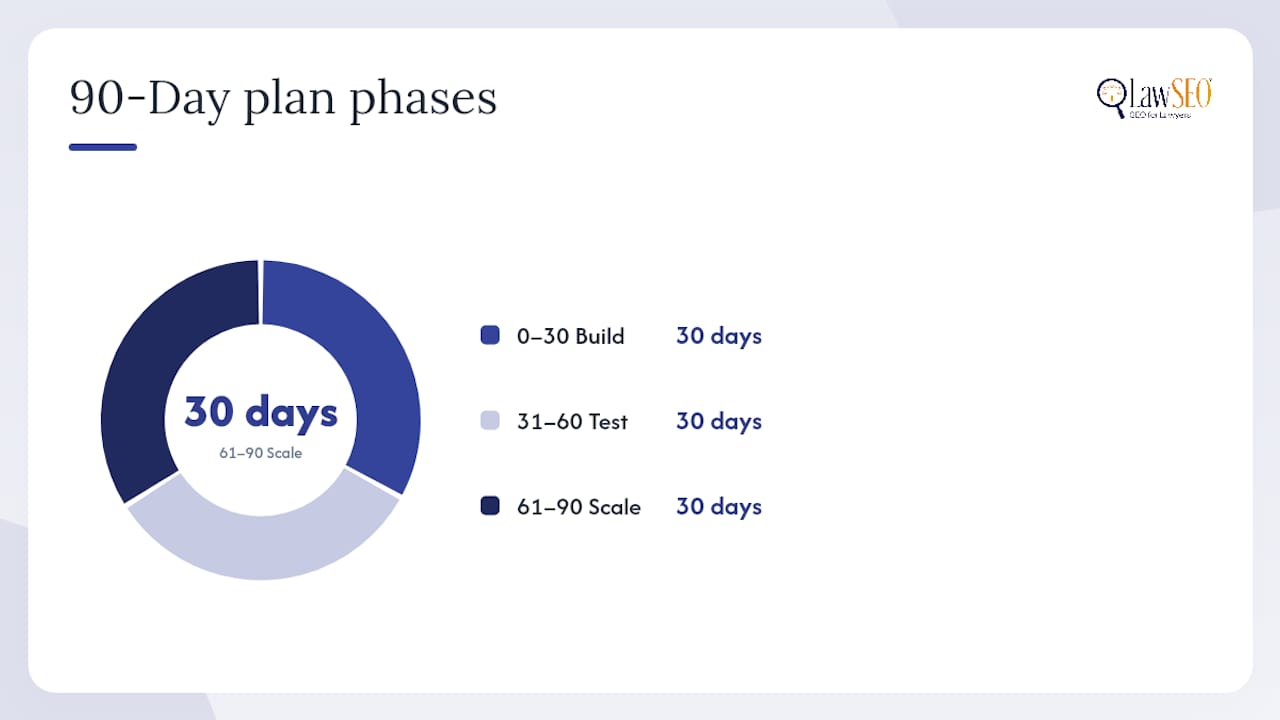
Your 90-Day Plan to Attract Clients Online
Days 0 to 30: Build the foundation.
- Define your persona and write your value proposition in one clear sentence.
- Choose your top two channels using the scoring framework above.
- Build one dedicated landing page and set up tracking (UTMs, call tracking, CRM field).
- Publish your first three pieces of content or launch your first ad campaign.
- Draft your intake script and set up the speed-to-lead alert system.
Days 31 to 60: Test and adjust.
- Review cost per lead and cost per consultation weekly.
- Send a short outreach sequence to your referral list: one email introducing what you do, a follow-up with a specific ask, and a final check-in two weeks later.
- Kill anything that hasn’t produced a single qualified lead by day 45.
Days 61 to 90: Scale what works.
- Double the budget or time investment on your strongest channel.
- Add a second content format (video, if you started with written content, or vice versa).
- Calculate cost per signed client, not just cost per lead, and decide what to fund next quarter.
Decision checkpoints: at day 30, cut anything with zero traction and reallocate that budget.
Pro Tip: Write your campaign brief before you launch anything: one page listing the offer, the channel, the budget, the KPI, and the kill/scale decision date. It takes 20 minutes and prevents the most common failure mode, which is running a channel indefinitely because nobody set a deadline to evaluate it.
Tools to Run the Playbook Without Overbuilding Your Stack
You don’t need an expensive stack to run this system well. You need one tool per job, chosen for simplicity over features you’ll never use.
- Tracking and analytics: Google Analytics and Google Search Console (free) to see what’s driving traffic and conversions.
- Landing pages and forms: a simple page builder or your website’s native page editor, paired with a short form tool.
- Email automation: any standard small-business email platform with automated sequences (low cost).
- Paid ads management: the native ad managers for Google and Meta; no third-party platform needed at this budget level.
- CRM and intake: any CRM that supports custom fields for lead source, so attribution survives past the first click.
- Creative: a phone camera and free editing app are enough for early video content; upgrade only once volume justifies it.
Paste your campaign brief, landing page checklist, and intake script directly into the Days 0 to 30 block of your 90-day plan so nothing launches without them.
Grow With a System, Not a Scramble
The businesses that get this right treat online client acquisition the way a lawyer treats a case: build the record before you argue it. That means committing to two or three channels long enough to see real signal, not judging a campaign at week two because the phone didn’t ring on day three.

Where most advice falls short is the assumption that more channels equal more clients. In practice, splitting a modest budget six ways guarantees you’ll never generate the volume needed to know if any single channel actually works. The businesses that scale predictably are the ones that pick fewer channels and go deeper, then reinvest what they learn into the next 90-day cycle.
If there’s one thing to prioritize first, it’s tracking. Without knowing your cost per signed client, you’re optimizing for guesses. Set up attribution before you spend the first dollar, not after the campaign ends and you’re trying to reconstruct what happened.
Law firms weighing whether to build this system in house or bring in outside help can find a deeper breakdown of channel-specific ROI at Lawseo.
Frequently Asked Questions
What is the fastest way to attract clients online?
Pick two channels that already match where your buyer spends time, build one dedicated landing page for the offer, and run a focused 90-day test with tracking in place from day one.
How many marketing channels should a small business run at once?
Two or three, run consistently, outperform five or six run thinly. Depth on a matched channel compounds; shallow coverage across many channels rarely does.
How quickly should I respond to a new lead?
Within 15 minutes during business hours whenever possible. Prospects frequently choose whoever responds first, not necessarily whoever is the best fit.
Is SEO or paid advertising better for finding clients online?
SEO tends to produce higher long-term conversion rates and compounds over months, while paid ads produce faster results at a steady cost. Most businesses benefit from running both, with SEO as the durable base.
What should I track to know if a channel is actually working?
Cost per consultation, conversion rate by landing page, and cost per signed client matter far more than clicks or impressions. Set up UTM tracking and call tracking before you launch anything.
Sources
- Lead Generation for Lawyers: What Actually Works
- Digital Marketing for Lawyers: Strategy & Budget Guide – Scale Growth Digital
- Best Marketing Channels for Law Firms in 2026 | Guide
- How To Attract Customers to Your Online Store: 17 Ways – Shopify