


How improving query intent alignment transforms law firm SEO
Aligning your website content to the precise intent behind client searches is the single most effective way to reduce bounce rates, increase qualified leads, and outperform competing firms in 2026. The concept is called search intent mapping, and it means matching every page you publish to one of four distinct query types: Informational, Commercial Investigation, Transactional, and Navigational.
Legal search intent divides cleanly across these four categories, each demanding a different content format and conversion strategy. Informational queries (“what is premises liability”) call for educational guides. Commercial Investigation queries (“best personal injury attorney in Dallas”) require case results and credentials. Transactional queries (“schedule free consultation”) need frictionless contact pages. Navigational queries (“Smith Law Firm client portal”) demand fast-loading, clearly labeled access points.
Why does this matter so much? Mismatched content, a service page ranking for an informational query, drives visitors away immediately. That bounce signal tells Google your page did not satisfy the search, which suppresses rankings over time. Accurate intent mapping keeps visitors engaged and moves them toward a consultation.
Key strategies that follow from this foundation:
- Conduct focused keyword research organized by intent type and client decision stage
- Optimize practice area pages with semantic content, attorney credentials, and strong calls to action
- Strengthen local SEO with complete Google Business Profiles and location-specific pages
- Build authoritative backlinks through case studies, legal associations, and ethical content marketing
- Implement schema markup for FAQs, legal services, and attorney profiles to capture AI-generated answers
- Monitor intent shifts using Google Search Console to close content gaps before competitors do
Schema markup and technical SEO are not optional extras. They are the trust signals that tell both Google and AI answer engines that your content is authoritative, structured, and worth surfacing.
How to conduct keyword research that actually matches client intent
Keyword research for law firms fails when it chases volume without considering where a searcher sits in the decision process. A person typing “what is a contingency fee” is weeks away from hiring anyone. Someone searching “car accident lawyer consultation Chicago” is ready to call today. Your content strategy must treat those two queries as entirely different problems.
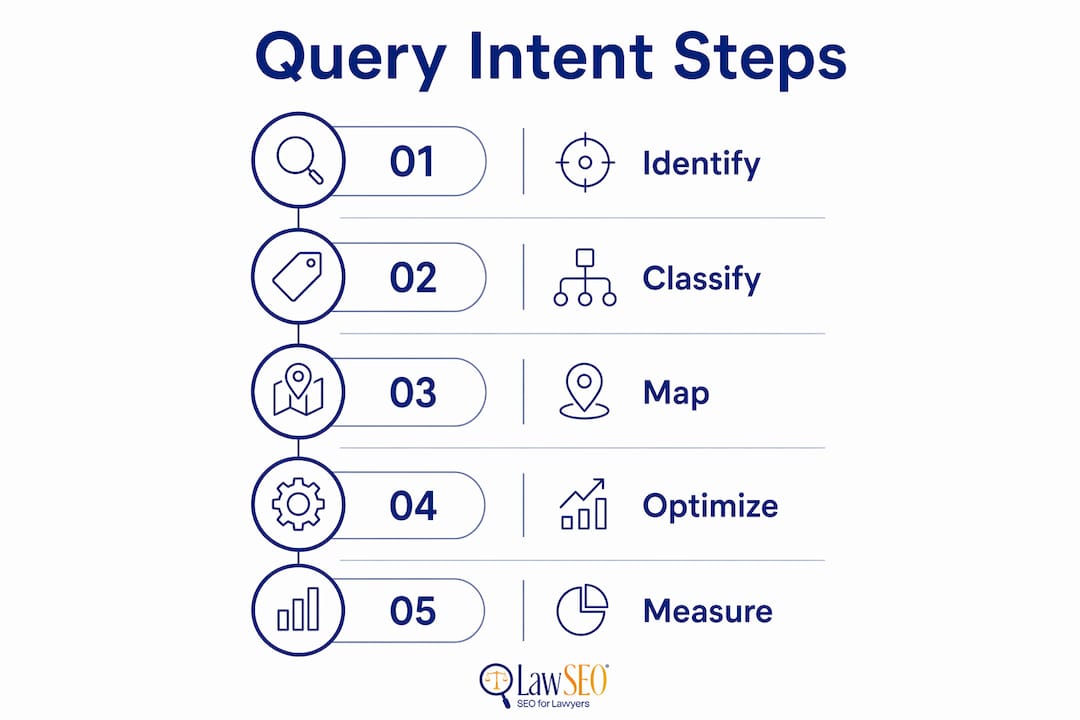
Classify every keyword by intent and decision stage first. Transactional and local intent keywords deserve priority placement on service pages and location pages, where strong calls to action can convert the visit. Informational keywords belong on blog posts and guides that build authority and feed readers into your funnel over time. Keyword clusters aligned by intent prevent the common mistake of targeting a transactional keyword with a blog post, or an informational query with a service page.
Practical techniques for discovery:
- Use Google Search Console to find queries where your pages earn impressions but few clicks. Those are intent gaps you can close with dedicated content or page restructuring.
- Target long-tail, location-specific phrases: “Manhattan workplace injury attorney,” “how long to file accident claim in Texas,” “maximum settlement for truck accident.”
- Apply wildcard filters in keyword tools (e.g., “law*” to capture “lawyer,” “lawyers,” “law firm,” “law firms”) to surface variations efficiently.
- Prioritize keywords with difficulty scores under 30–40 for near-term wins, then build toward higher-competition terms as your domain authority grows.
Pro Tip: Low-volume queries like “[competitor] legal services alternative” often convert at a far higher rate than broad informational terms, because those searchers are already committed to hiring and simply choosing between options.
One structural discipline separates strong keyword strategies from weak ones: map every cluster to a specific page type before writing a word. Service pages for transactional clusters. Blog posts for informational clusters. Comparison content for commercial investigation clusters. Location pages for geo-specific clusters. Google reads the content type as a relevance signal, and your format must match what already ranks.
How to optimize your website pages and technical SEO for legal queries
Practice area pages are the backbone of any law firm’s SEO strategy, and most firms underuse them. A weak practice area page lists services. A strong one answers the exact questions a potential client has at the moment they land on it, then moves them toward a consultation.
Strong practice area pages include a plain-English explanation of the legal issue, a step-by-step overview of the process, common client mistakes and how your firm prevents them, realistic outcome expectations, attorney credentials specific to that area, and a visible call to action with a phone number or form. Semantic SEO reinforces all of this: a page about car accident cases should naturally mention insurance claims, fault determination, medical bills, and settlement timelines, because Google reads those connected concepts as evidence of genuine expertise.
Technical SEO health directly affects whether high-intent visitors stay or leave. The table below tracks the core elements to audit:
| Technical Element | What to Check | Why It Matters |
|---|---|---|
| Page speed | Core Web Vitals scores in Google Search Console | Slow pages lose transactional visitors before they convert |
| Mobile usability | Google’s Mobile-Friendly Test | Most legal searches happen on mobile devices |
| Schema markup | FAQ, LegalService, and Attorney schema present | Enables AI snippet eligibility and rich results |
| Crawlability | No orphaned pages; clean XML sitemap | Ensures all practice area pages get indexed |
| Internal linking | Intent-matched anchor text between related pages | Guides visitors through the decision funnel |
Technical SEO improvements correlate directly with lead generation effectiveness, particularly for transactional queries where any friction, a slow load, a broken form, an unclear CTA, results in a lost client. Semantic content clusters, where a main practice area page links to supporting blog posts and FAQ pages on related subtopics, demonstrate topic depth to Google and improve rankings across the entire cluster.
Structured content formatting matters too. Use clear H2 and H3 headings, short paragraphs, and numbered steps wherever a process is involved. AI tools like Google’s AI Overviews pull answers from content that is clearly organized, not from pages that bury the answer in dense paragraphs.
How to strengthen local SEO and build online trust for your firm
Local SEO is where law firms capture the highest-intent traffic available. When someone searches “personal injury lawyer near me,” they are ready to call. Your local presence determines whether that call reaches you or a competing firm.
Complete, active Google Business Profiles generate up to 7x more engagement than incomplete listings. That means posting weekly updates, answering questions in the Q&A section, responding to every review, and adding current photos of your office and team. Firms that treat their profile as a static directory listing leave a significant volume of qualified traffic on the table.
Location-specific pages require genuine local content, not copy-pasted service descriptions with a city name swapped in. Each page should:
- Reference local courts, applicable state statutes, and county-specific filing procedures
- Include a local phone number and address
- Feature attorney bios that mention local bar memberships or specific regional case experience
- Address the questions clients in that area actually ask
Trust signals reinforce every local SEO effort. Verified attorney credentials, state bar memberships, professional association affiliations, and published case outcomes all tell both Google and prospective clients that your firm is legitimate and experienced. FAQ sections that answer the real questions your intake team hears on first calls, structured with direct answers followed by two to three sentences of context, build credibility and feed the answer engine optimization pipeline simultaneously.
Pro Tip: Reputation management is not a one-time task. Firms that respond to reviews consistently, both positive and negative, signal active client engagement to Google and prospective clients alike.
How to build authoritative backlinks and demonstrate EEAT
Google’s EEAT framework, which stands for Experience, Expertise, Authority, and Trustworthiness, carries particular weight in legal search because the stakes of bad advice are high. Law firms that demonstrate real EEAT through their content and link profile rank more sustainably than those chasing volume alone.
Ethical link acquisition through case studies, client testimonials, and authoritative legal associations builds the kind of trust that sustains rankings over time. Practical sources for quality backlinks include:
- State and local bar association directories
- Legal aid organizations and court websites
- Local news outlets covering cases your firm has handled
- Law school publications and continuing legal education resources
- Chamber of commerce and community organization pages
Attorney bios deserve more attention than most firms give them. A bio that lists law school, bar admissions, years of practice, published articles, and specific case types handled is a direct EEAT signal. Pair that with a legal content strategy that publishes genuine case studies in the four-part format (situation, challenge, approach, result) and you give Google verifiable proof of expertise, not just claims.
Video content reinforces all of this. Short attorney Q&A videos, process explainers, and verdict announcements placed on practice area pages increase the time visitors spend on your site. That dwell-time signal tells Google your content is worth ranking. Combining video with concise Q&A schema and detailed case studies sends strong positive signals to algorithms that prioritize expertise and trust.
Content marketing earns natural links when it answers questions no other source answers well. Jurisdiction-specific guides, state statute explainers, and step-by-step procedural walkthroughs attract links from other legal publishers, local journalists, and bar association resources without any outreach required.
How AI and emerging search technologies are reshaping law firm SEO
The search results page has changed fundamentally. AI Overviews, zero-click answers, and generative engine results now appear above the traditional ten blue links for many legal queries. Law firms that optimize only for traditional rankings are missing a growing share of client visibility.
FAQ schema and structured data are the primary tools for winning AI-generated answers. When your FAQ page answers “Can I sue my landlord for mold?” with a direct, jurisdiction-specific response, Google and AI tools are far more likely to surface your answer than a page that buries the response in paragraphs. The structure matters as much as the content: start with a direct answer, then expand with two to three sentences of context.
Zero-click searches are not lost traffic. They are brand-building opportunities. A firm whose answer appears in an AI snippet for “court rules for [jurisdiction]” builds recognition and authority with every impression, even when the user never clicks. That recognition influences the next search, which is often a transactional one. Optimizing for AI-driven answers means writing content that answers questions precisely, uses expert-verified terminology, and structures information so AI tools can extract and attribute it cleanly.
Low-volume, high-value bottom-of-funnel queries deserve a dedicated content investment. Such narrowly specific queries often represent more conversion potential than broad informational queries, because those searchers are already committed to hiring and are choosing between specific options. Glossary-style content with expert-defined terms also performs well in answer engine optimization, positioning your firm as the authoritative source during the early research phase before a potential client actively seeks counsel.
Intent-matched internal linking ties the entire strategy together. A query about “filing deadlines” can evolve rapidly into a search for “emergency legal representation.” Internal links that anticipate that progression, connecting informational content to commercial investigation pages to transactional contact pages, guide potential clients through the decision funnel without overt sales pressure. Monitor Google Search Console regularly for queries where your practice area pages surface for informational intent. Those are signals that a dedicated middle-funnel resource is missing, and filling that gap is often faster than building new authority from scratch.
For a deeper look at how search intent foundations apply across your full digital strategy, the principles that govern legal queries align closely with broader SEO intent mapping frameworks.
Key Takeaways
Improving law firm query intent requires matching every page to a specific client decision stage, from informational guides through transactional contact pages, while using schema markup and local SEO to capture both traditional rankings and AI-generated answers.
| Point | Details |
|---|---|
| Map intent before writing | Classify every keyword as Informational, Commercial, Transactional, or Navigational before assigning it to a page type. |
| Local profiles drive high-intent traffic | Complete Google Business Profiles generate up to 7x more engagement than incomplete listings. |
| Schema markup enables AI visibility | FAQ and LegalService schema are the primary tools for appearing in zero-click and AI-generated answers. |
| Low-volume queries convert higher | Bottom-of-funnel queries with narrow specificity often outperform broad informational terms in client acquisition. |
| EEAT signals sustain rankings | Attorney credentials, case studies, and ethical link building build the trust Google requires for long-term legal SEO authority. |
Ready to put this into practice?
Lawseo works exclusively with law firms and attorneys, applying over 29 years of legal SEO expertise to every campaign. From intent-mapped content and local SEO to AI answer optimization and ethical link building, every strategy is built around the specific competitive and ethical demands of legal marketing. Explore Lawseo’s legal SEO services to see how a firm-specific approach translates into measurable client acquisition.