


TL;DR:
- Monitoring SEO KPIs helps law firms measure organic search effectiveness and client acquisition success. They should focus on business results, conversion metrics, and leading indicators to improve strategies and ROI. Using consistent tracking tools and schedules ensures accurate measurement and growth.
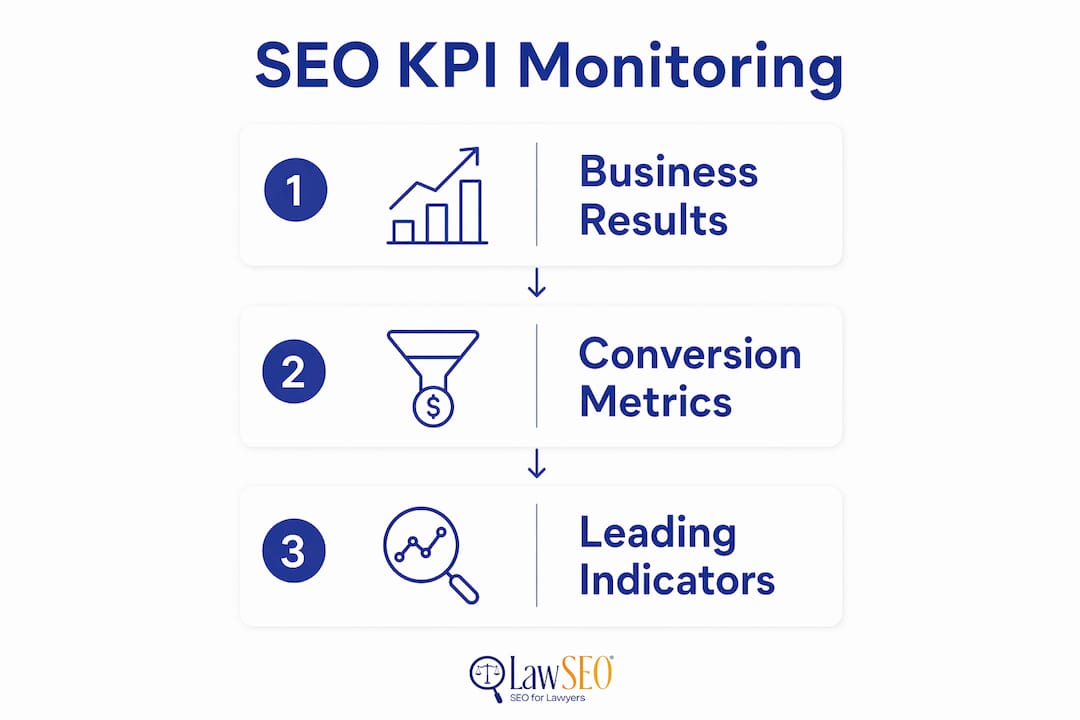
Monitoring SEO KPIs for lawyers is the process of tracking targeted performance indicators that reveal your law firm’s organic search effectiveness and client acquisition success. Law firms that actively track these indicators increase qualified leads by 58% on average. The industry term for this discipline is SEO performance measurement, and it covers three distinct layers: business results, conversion metrics, and leading indicators. This guide gives law firm marketing managers and attorneys a practical, 2026-ready framework for building that measurement system from the ground up.
How to monitor SEO KPIs for lawyers: the core metrics that matter
The most important SEO performance indicators for law firms fall into three categories. Each category answers a different question, and confusing them is the single most common tracking mistake.
Business results answer: “Is SEO generating revenue?” The key metrics here are qualified leads, client acquisition cost (CAC), and return on investment. CAC is calculated by dividing total SEO spend by the number of new clients attributed to organic search within the same period. Knowing your CAC tells you whether your SEO budget is profitable or just busy.
Conversion metrics answer: “Is our website turning visitors into prospects?” Consultation booking rate is the primary metric. Conversion rates for consultation requests range from 2–5% for average performers, with top law firm websites reaching 7–10%. Track every conversion type: contact forms, phone calls, and live chat sessions. Missing any one of them understates your true conversion rate.
Leading indicators answer: “Is our SEO foundation getting stronger?” Keyword rankings, organic traffic volume, and Google Map Pack visibility belong here. Organic traffic accounts for 65–80% of law firm website visits on average. These metrics predict future business results, but they do not replace them.
| KPI category | Key metrics | Primary impact |
|---|---|---|
| Business results | Qualified leads, CAC, ROI | Revenue and budget decisions |
| Conversion metrics | Consultation rate, form fills, call volume | Client acquisition efficiency |
| Leading indicators | Keyword rankings, organic sessions | Forecasting and SEO health |
| Local visibility | Map Pack position, Google Business reviews | Geographic lead generation |
| Technical health | Core Web Vitals, page speed, crawl errors | Rankings and user experience |
The KPIs you prioritize shift by firm size and practice area. A solo personal injury attorney needs to watch Map Pack rankings and call volume daily. A multi-office corporate law firm needs CAC and organic conversion rate segmented by office location and service line.
Which tools are essential for tracking SEO KPIs effectively?
Google Analytics 4 and Google Search Console are the non-negotiable starting points. Google Analytics 4 tracks organic sessions, goal completions, and user behavior on your site. Google Search Console shows which queries drive clicks, your average position for target keywords, and any indexing issues Google has flagged.

Call tracking software fills the gap that Analytics alone cannot. A tool like CallRail assigns unique phone numbers to different traffic sources, so you know exactly how many calls came from organic search versus paid ads versus a directory listing. Without call tracking, law firms routinely misattribute 30–40% of their leads.
For keyword rank tracking and backlink analysis, SEO platforms like SEMrush or Ahrefs provide daily ranking updates, competitor gap analysis, and content opportunity reports. For local SEO specifically, a tool like BrightLocal tracks your Map Pack position across multiple zip codes and monitors your Google Business Profile performance. These tools answer questions that Google’s free suite cannot.
Pro Tip: Set up UTM parameters on every marketing campaign URL. Accurate source tracking with UTM parameters separates organic SEO performance from paid traffic, email campaigns, and referral sources in your Analytics reports. Without UTMs, your data is a blended estimate, not a measurement.
| Tool | Primary function | Best for |
|---|---|---|
| Google Analytics 4 | Traffic, behavior, goal tracking | All firms |
| Google Search Console | Queries, rankings, indexing | All firms |
| CallRail | Call attribution and recording | High call-volume practices |
| SEMrush or Ahrefs | Keyword rankings, backlinks | Competitive markets |
| BrightLocal | Local Map Pack tracking | Multi-location firms |
Integrate your intake or case management system with your analytics stack. When a lead from organic search converts to a signed client, that data should flow back into your reporting. Integrating call tracking with Google Analytics and intake data enables precise measurement of where qualified leads originate, which is the foundation of accurate ROI calculation. You can also explore how SEO metrics connect to business outcomes to sharpen your reporting framework.
How to execute a consistent SEO KPI monitoring process
Consistency beats sophistication every time. A simple review schedule you actually follow outperforms a complex dashboard you check once a quarter.
Weekly KPI reviews identify opportunities faster than monthly or quarterly schedules. Use this cadence as your baseline:
- Weekly: Review organic sessions, consultation form submissions, and call volume. Flag any week-over-week drops above 15% for immediate investigation.
- Bi-weekly: Check keyword ranking movements for your top 20 target terms. Identify pages that dropped more than five positions and audit them for content or technical issues.
- Monthly: Run a full performance dashboard covering all five KPI categories. Compare against your baseline and prior month. Calculate CAC and organic conversion rate.
- Quarterly: Conduct a deep-dive competitive benchmarking session. Set new growth targets, typically 10–15% improvement per quarter for firms in growth mode.
Establish baselines before you set targets. Pull 90 days of historical data from Google Analytics 4 and your rank tracker. That baseline is your starting point, not your goal. Growth targets without baselines are guesses.
Multi-touch attribution is the most underused tool in law firm SEO measurement. Legal prospects typically require 7–13 touchpoints before retaining counsel. A client might find your firm through an organic blog post, return via a branded search, then convert after reading your Google reviews. Single-touch models credit only the last click, which systematically undervalues SEO’s role as the initial discovery channel.
Pro Tip: Build one dashboard that separates diagnostic metrics from outcome metrics. Diagnostic metrics (rankings, crawl errors, page speed) tell you what to fix. Outcome metrics (leads, CAC, conversion rate) tell you whether fixing it worked. Mixing them in the same view leads to vanity metric traps where you celebrate ranking improvements that never produce a single consultation.
What common mistakes undermine SEO KPI monitoring in law firms?
Most law firm SEO tracking failures trace back to a small set of repeatable errors. Recognizing them is the first step to correcting them.
- Treating all metrics as equal. Rankings and traffic are diagnostic. Leads and CAC are outcomes. Marketing leaders focus on ROI and cost per case for business decisions and use leading indicators only to explain why outcomes changed.
- Using single-touch attribution. If your reporting credits only the last click before a form submission, you are misreading your data. Multi-touch models reveal the full client journey and give SEO its proper credit.
- Ignoring local search and mobile variances. A firm ranking third on desktop may rank eighth on mobile in the same city. Track rankings separately by device and by geographic area, especially for firms serving multiple counties or metro areas.
- Skipping page speed monitoring. Law firm websites should achieve Largest Contentful Paint (LCP) under 2.5 seconds to meet Core Web Vitals standards. Sites that load under three seconds reduce bounce rates by 32%. A slow site loses rankings and clients simultaneously. Review website speed fundamentals to understand how load time directly affects conversion rates.
- Omitting call tracking from your data stack. Phone calls are the primary conversion action for most legal practices. Without call attribution, your conversion data is incomplete and your CAC calculation is wrong.
- Failing to segment by practice area. A family law page and a business litigation page serve different audiences with different search behaviors. Aggregate traffic numbers hide which practice areas are performing and which need attention.
Key Takeaways
Effective SEO KPI monitoring for law firms requires a layered framework that separates business outcome metrics from diagnostic indicators, supported by integrated tracking tools and a consistent review schedule.
| Point | Details |
|---|---|
| Prioritize outcome metrics | Track qualified leads, CAC, and organic conversion rate before rankings or traffic. |
| Use a three-layer KPI framework | Separate business results, conversion metrics, and leading indicators in every report. |
| Build the right tool stack | Google Analytics 4, Google Search Console, call tracking, and a rank tracker are the minimum. |
| Review on a fixed cadence | Weekly conversion checks, bi-weekly ranking reviews, and monthly full dashboards drive faster decisions. |
| Apply multi-touch attribution | Legal clients need 7–13 touchpoints before hiring; single-touch models undervalue SEO’s contribution. |
Why most law firms are measuring SEO the wrong way
After nearly three decades working in SEO, the pattern I see most often is this: a law firm invests in SEO, watches their rankings climb, and then wonders why their caseload has not changed. The problem is almost never the SEO itself. The problem is what they chose to measure.
Rankings are a means to an end. They tell you that Google considers your page relevant. They do not tell you whether the people clicking through are the clients you actually want. I have seen firms rank on page one for high-volume terms and generate zero qualified consultations because the keyword intent did not match the practice area. Measuring SEO success for lawyers requires connecting every metric back to a signed case or a consultation with a qualified prospect.
The firms that get this right build what I call a layered KPI framework. They track diagnostic metrics weekly to catch technical problems early. They track outcome metrics monthly to evaluate whether their SEO investment is producing revenue. And they review the relationship between the two quarterly to adjust strategy. That separation between “what is happening technically” and “what is happening commercially” is the single biggest shift that moves a law firm from guessing to knowing.
The other shift coming fast in 2026 is AI-driven search. Generative Engine Optimization, or GEO, is becoming a parallel measurement discipline. If your firm is not tracking how often AI tools cite or recommend you in response to legal queries, you are missing an emerging lead source. The firms building that measurement capability now will have a significant advantage within 18 months.
— TODD
How Lawseo helps law firms track and improve SEO performance
Lawseo works exclusively with attorneys and law firms, which means every analytics framework and reporting dashboard is built for the legal sector, not adapted from a generic marketing template. The firm’s founder, Todd R. Stager, personally reviews strategy for every client campaign, with over 29 years of SEO experience informing each decision. Lawseo’s approach integrates call tracking, intake system data, and organic search analytics into a single reporting view, so attorneys see exactly which SEO activities produce signed clients. For firms ready to move from tracking to growth, Lawseo’s legal SEO strategies for 2026 and full-service law firm SEO programs provide the structure and execution to make it happen.
FAQ
What are the most important SEO KPIs for law firms?
The most important SEO KPIs for law firms are qualified leads, client acquisition cost, organic conversion rate, keyword rankings for practice-area terms, and Google Map Pack visibility. Business outcome metrics take priority over traffic or ranking metrics alone.
How often should a law firm review its SEO KPIs?
Law firms should review conversion and traffic metrics weekly, keyword rankings bi-weekly, and run a full performance dashboard monthly. Quarterly deep-dives with competitive benchmarking complete the cycle.
What is a good organic conversion rate for a law firm website?
Average law firm websites convert 2–5% of organic visitors into consultation requests. Top-performing sites achieve 7–10% by combining strong calls to action, fast load times, and practice-area-specific landing pages.
Why does call tracking matter for law firm SEO measurement?
Most legal clients call rather than submit a form. Without call tracking software, those conversions are invisible in your analytics, which understates your true conversion rate and produces an inaccurate CAC calculation.
What is multi-touch attribution and why do law firms need it?
Multi-touch attribution assigns credit to every marketing touchpoint a prospect interacted with before converting, rather than only the last one. Because legal prospects require 7–13 touchpoints before hiring an attorney, single-touch models systematically undervalue SEO’s role in client acquisition.