


TL;DR:
- Proper technical SEO, content structure, and link architecture are essential for legal blog visibility.
- Structured data, entity focus, and topic clusters enhance AI citations and search rankings.
- Consistent, strategic content creation and avoiding common SEO mistakes improve long-term blog performance.
Many law firms invest significant resources into blog content, only to watch those posts disappear into page two or three of search results where potential clients never find them. The gap between publishing and ranking is not accidental. It is the result of missing technical elements, weak content structure, and no coherent strategy connecting each post to a larger topical framework. This guide covers exactly what you need to fix: the on-page SEO fundamentals, AI-ready content structure, internal linking architecture, and the common mistakes that quietly undermine your visibility before a post ever gets its first impression.
Key Takeaways
| Point | Details |
|---|---|
| Prioritize technical SEO essentials | Optimized meta tags, URLs, alt text, and schema are non-negotiable for legal blogs to perform. |
| Organize for authority and AI | Structured content and topic clusters help build trust and boost citations from search platforms and AI. |
| Internal linking pays off | Clear, descriptive anchors and intelligent linking build site authority and boost post rankings. |
| Avoid common SEO mistakes | Steer clear of keyword stuffing, content cannibalization, and fake updates for sustainable growth. |
| Expert support accelerates results | Professional SEO audits and tools help law firms quickly elevate blog performance. |
Essential SEO elements for legal blog posts
Once you understand why optimization matters, the critical next step is knowing which technical details create the biggest impact on search performance. Skipping even one of these elements can suppress rankings across your entire blog.
The foundation of any well-optimized legal blog post begins with the basics: meta titles, meta descriptions, URL structure, image alt text, schema markup, mobile performance, and HTTPS security. According to SEO elements for legal blogs, you must optimize meta titles to 50 to 60 characters with your primary keyword, write meta descriptions under 155 characters, and implement schema types including FAQ, LegalService, and Attorney to improve both traditional and AI-driven search visibility. These requirements are not suggestions. They are minimum standards for competitive legal content.
| Element | Best practice | Why it matters |
|---|---|---|
| Meta title | 50 to 60 characters, primary keyword first | Controls click-through rates from search results |
| Meta description | Under 155 characters, includes call to action | Improves click-through rates even when not a ranking factor |
| URL structure | Short, keyword-rich, no stop words | Aids both user comprehension and crawler indexing |
| Alt text | Descriptive, keyword-relevant for each image | Supports image search and accessibility compliance |
| Schema markup | FAQ, LegalService, Attorney types | Enables rich results and AI citation eligibility |
| Mobile optimization | Responsive design, no intrusive interstitials | Google uses mobile-first indexing for all sites |
| Page speed | Core Web Vitals passing, under 2.5s LCP | Directly impacts rankings and user retention |
| HTTPS | SSL certificate active | Required for trust signals and ranking consideration |
Schema markup deserves special attention for legal blogs. FAQ schema, when applied correctly, allows Google to display your questions and answers directly in search results, producing rich snippets that can dramatically increase your visible real estate on the page. LegalService and Attorney schema help AI platforms recognize the entity type of your content, making it more likely your posts get cited in AI-generated legal summaries.
Writing strong meta descriptions for lawyers is one of the most consistently overlooked opportunities. A clear, action-oriented description does not directly change your ranking position, but it significantly influences whether a searcher clicks your result over a competitor’s. Similarly, optimizing law firm URLs to be short and descriptive signals content relevance to both users and crawlers.
Pro Tip: Draft your meta title and meta description before you write the post body. This forces you to clarify your primary keyword and the exact value promise of the article, which keeps the entire post focused and prevents scope creep.
Studies suggest that pages with structured schema markup earn noticeably higher click-through rates than equivalent pages without it, particularly in competitive practice areas like personal injury, family law, and immigration. For deeper guidance on all these elements together, the on-page SEO for lawyers framework offers a complete walkthrough.
Structuring content for authority, AI, and user trust
After ensuring technical and on-page best practices are in place, structuring your content for trust and AI discoverability is the next step in the process.

Content structure is the part most legal marketers underestimate. It is not just about readability. It is about giving AI platforms, like Google’s AI Overviews and ChatGPT search, the right signals to treat your content as a credible source worth referencing. As AI legal search strategies from Clio confirm, Generative Engine Optimization (GEO) requires that you use structured data, entity optimization, clear content hierarchies, and authoritative sources to earn citations in AI responses.
Here is a direct comparison of what a well-structured post looks like versus a poorly structured one:
| Feature | Well-structured post | Poorly structured post |
|---|---|---|
| Headings | Logical H1, H2, H3 hierarchy | Random heading levels or none at all |
| Paragraph length | 3 to 4 sentences maximum | Dense 8 to 10 sentence blocks |
| Lists and tables | Used for scannable facts and comparisons | All information written in prose |
| Internal links | Contextual links to related pillar content | No links or only footer navigation |
| Sources | Authoritative legal and government citations | No citations or anonymous blog links |
| Entity focus | Named attorneys, firm location, practice areas | Generic legal advice with no identifying context |
To build a content structure that earns both human trust and AI citations, follow this process:
- Identify your primary entity. Name the practice area, jurisdiction, and attorney expertise clearly within the first 150 words. AI systems look for entity signals early.
- Use a clear H1, then H2 sections. Each H2 should represent a distinct subtopic. Use H3 headings for supporting details under each H2.
- Write for scanning first. Front-load each paragraph with the most important claim. Support it in the following two to three sentences.
- Cite credible sources inline. Link to state bar guidance, court decisions, or government resources. These citations are entity signals for AI systems.
- Close each section with a transition. A single sentence connecting one section to the next keeps readers engaged and signals logical content flow to crawlers.
“For AI platforms, use structured data, entity optimization, clear hierarchies, and authoritative sources to earn citations in AI responses.” GEO for Law Firms, Clio
Building legal blog SEO basics into every post from the start is far more efficient than retrofitting structure after publication. The firms that rank consistently are those that treat structure as a non-negotiable element of content production, not an afterthought.
Internal linking and topic clusters: building topical authority
With your content well-structured, you can amplify its reach and authority using internal links and topic clusters. This is where individual blog posts stop working in isolation and start reinforcing each other.
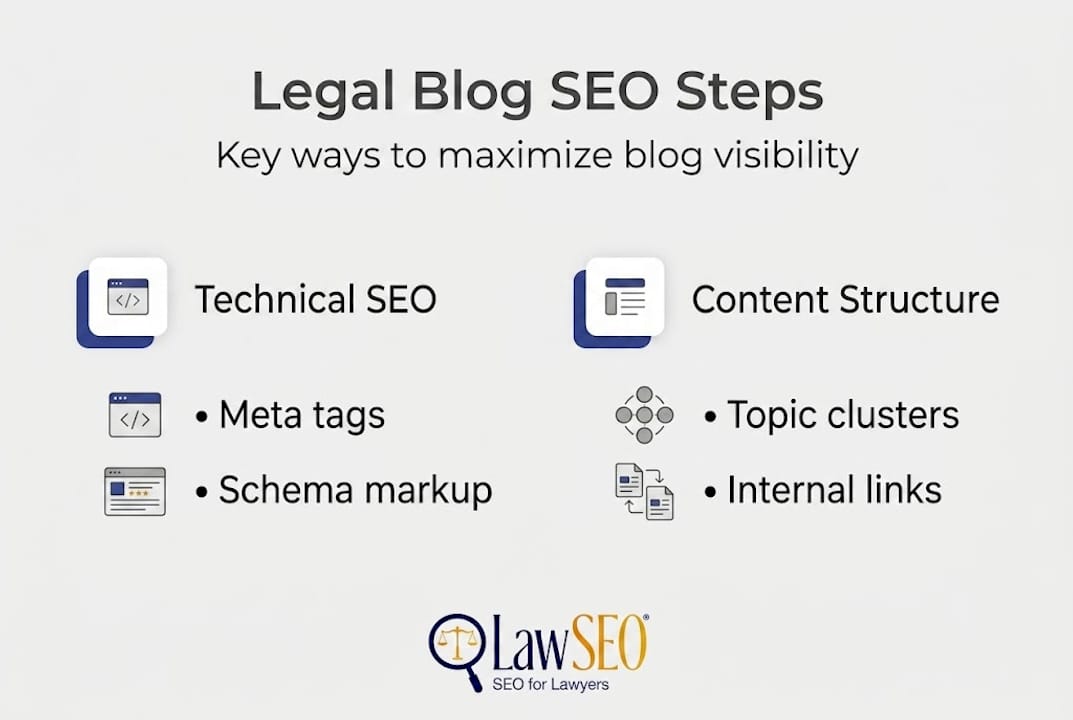
A topic cluster is a group of related content pieces organized around a single pillar page. The pillar page covers a broad practice area topic at a high level. Supporting cluster posts cover specific subtopics in depth and link back to the pillar. For example, a pillar page titled “Complete Guide to Personal Injury Claims in Texas” could anchor cluster posts on car accident settlements, medical malpractice timelines, and premises liability evidence requirements. Each cluster post links back to the pillar, and the pillar links out to relevant cluster posts.
Pillar page topic clusters consistently outperform standalone long-form posts because they distribute link equity across the cluster and signal broad topical expertise to search engines. Google’s ranking systems reward sites that demonstrate deep, organized knowledge of a subject, not just individual pages with high word counts.
Here are the core internal linking strategies that build topical authority for law firms:
- Link cluster posts to the pillar page using descriptive anchor text that includes the primary keyword of the destination page.
- Link the pillar page back to cluster posts so crawlers can map the full topic structure bidirectionally.
- Use variation in anchor text. Avoid linking every post with the exact same phrase, which can look manipulative. Rotate natural variations of your target keyword.
- Link to practice area pages from blog posts. Every relevant blog post should have at least one contextual link to a money page, using anchor text like “Texas personal injury attorney” rather than “click here.”
- Audit broken links regularly. A dead internal link wastes link equity and damages user experience.
- Avoid orphan pages. Every new blog post should be linked to from at least one existing page at publication.
For a complete breakdown of internal linking for legal blogs, the strategies that apply specifically to legal content differ from general blogging advice because practice area pages function both as conversion pages and as topical anchors. Your legal SEO strategies must account for that dual role.
Pro Tip: Assign one and only one primary keyword per blog post. When two posts target the same keyword, they compete against each other in search results, a problem called keyword cannibalization. This splits your ranking potential and often results in neither post ranking well.
Common legal blog SEO mistakes and how to avoid them
Taking proactive steps with structure and linking is essential, but what about the pitfalls that quietly sabotage your hard work after you publish?
The most damaging legal blog SEO mistakes are often invisible until rankings drop. Knowing them in advance is the best defense. Here are the most frequent errors and the specific fix for each:
-
Keyword stuffing. Forcing a keyword into every other sentence reads as unnatural and triggers algorithmic penalties. Write for the reader first. Aim for a keyword density of 1.5 to 2 percent, which means roughly one instance per 50 to 75 words in a natural, contextual placement.
-
Thin content. A 300-word blog post covering a complex legal topic signals low expertise. Google’s Helpful Content system rewards depth and firsthand experience. Aim for at least 800 to 1,200 words for informational posts, and 1,500 or more for competitive practice area topics.
-
Poor or missing metadata. Leaving the meta title and description to auto-generate means you lose direct control over how your post appears in search results. Always write custom metadata for every post.
-
Keyword cannibalization. Publishing multiple posts targeting “divorce lawyer Chicago” without differentiation creates internal competition. Audit your content map quarterly and redirect or consolidate overlapping posts.
-
Fake freshness updates. Changing a publication date or making superficial edits to signal recency does not work. SEO mistakes to avoid confirms that only substantive content improvements, new data, added sections, or corrected information, justify updating a post’s timestamp. AI systems are increasingly capable of detecting when content has not meaningfully changed.
-
Broken internal and external links. Every broken link signals neglect to both users and crawlers. Run a link audit with tools like Screaming Frog or Ahrefs at least once per quarter.
-
No mobile optimization. Legal clients frequently search from mobile devices, especially in urgent situations. A post that loads slowly or renders poorly on a phone loses both the user and the ranking signal.
“Avoid keyword stuffing. Aim for 1.5 to 2 percent keyword density with natural placement. Prevent cannibalization by assigning one primary keyword per post. Do not make ‘fake freshness’ updates without substantive changes.” SEO for Lawyers
Before publishing any post, run through this quality assurance checklist: meta title and description written, URL shortened and keyword-rich, images have alt text, at least one internal link to a practice page, schema applied, no duplicate keyword targets, content is at least 800 words with original analysis or examples, and mobile preview confirmed. These SEO basics for legal blogs take less than ten minutes per post and prevent the majority of common ranking failures.
Why most legal blogs underperform (and what actually works)
Here is an uncomfortable observation after watching hundreds of law firm content programs over the years: most legal blogs rank poorly not because the attorneys are uninformed, but because their marketing teams optimize for the wrong things. They chase checklist-level tactics, title tags, and meta descriptions, while neglecting the strategic layer that actually determines whether a blog becomes a traffic asset or a liability.
The firms whose blogs generate consistent, measurable leads share a pattern. They invest in entity research before writing a single word. They map content clusters around the questions their actual clients ask, not just keyword volume. They build practical on-page tips into a repeatable production process, not a one-time audit.
The firms that struggle tend to chase quick wins: buying backlinks, stuffing keywords, or publishing ten thin posts per month instead of four authoritative ones. Those tactics produce temporary lifts at best. The firms that win the AI citation game, where ChatGPT, Google AI Overviews, and Perplexity source answers, have done the deeper work of establishing genuine topical authority through organized, entity-rich content clusters.
Invest in planning before production. One well-researched pillar page supported by five focused cluster posts will outperform twenty disconnected blog articles every time. That is not conventional wisdom. It is what the data consistently shows.
Ready to accelerate your legal blog’s results?
If you’re ready to stop guessing and start seeing measurable results, here’s how LawSEO can help. At LawSEO, we work exclusively with law firms, which means every strategy we develop accounts for the ethical constraints, competitive dynamics, and AI-driven shifts that are reshaping legal search. Our team can audit your existing blog content, identify structural and technical gaps, and build a topic cluster plan designed for both traditional rankings and AI citation visibility. Explore advanced SEO for lawyers to see our full service approach, or review the best law firm SEO platforms to understand which tools pair best with your content strategy. Consistent, long-term ranking growth starts with a clear plan and the right partner.
Frequently asked questions
What is the best keyword density for a legal blog post?
Aim for a natural keyword density between 1.5 and 2 percent, which keeps the content readable and avoids algorithmic penalties for overstuffing.
Which schema types should legal blogs implement?
Focus on FAQ, LegalService, and Attorney schema to improve eligibility for rich results and increase the likelihood that AI platforms cite your content directly.
How do topic clusters help a law firm’s SEO?
Topic clusters improve topical authority by linking related content around a pillar page, signaling organized expertise to search engines and earning stronger rankings across an entire practice area.
What is “fake freshness” and why should I avoid it?
Fake freshness is updating a post’s date or making minor edits to appear recently refreshed, which can trigger negative signals from AI systems that detect content that has not genuinely improved.
How do I make my legal blog visible to AI-powered search engines?
Optimize with structured data, entity signals, and clear content hierarchies supported by authoritative sources, which are the primary factors that determine whether AI platforms cite your content in their responses.