


TL;DR:
- SEO A/B testing helps law firms measure the impact of web page elements on search rankings, traffic, and consultations. Proper setup, including traffic volume, relevant tools, and a structured process, ensures reliable results. Focus on local SEO elements and test one variable at a time to improve organic performance over time.
SEO A/B testing for lawyers is the practice of comparing two versions of a web page or page element to determine which one produces better search rankings, more organic traffic, or higher consultation rates. The industry standard term is “split testing,” and it applies directly to legal marketing when you want data, not opinions, driving your decisions. Law firms that run structured split tests on title tags, landing page copy, and schema markup consistently outperform firms that rely on gut instinct. Tools like Google Analytics 4, Google Search Console, and CallRail give you the measurement infrastructure to know exactly what changed and why. This guide covers how to run SEO A/B tests for lawyers from setup through analysis.
What prerequisites and tools do you need before running SEO A/B tests?
Accurate SEO split testing for attorneys starts with a clean data foundation. Before you change a single word on a page, you need Google Analytics 4 and Google Search Console installed and verified. CallRail adds phone call attribution, which matters enormously for law firms where a prospect calls rather than fills out a form.
You also need enough traffic to reach statistical significance. A baseline conversion rate of 2.5% with a target of detecting a 12% lift requires roughly two weeks of data per variant. Running a test on a page that gets 50 visits a month will produce noise, not insight.
Before writing a single hypothesis, gather these inputs:
- Heatmap data from tools like Microsoft Clarity or Hotjar to see where visitors stop scrolling
- CallRail timestamps to identify which pages generate calls and at what time of day
- Intake objections from your front desk staff, which reveal the fears prospects bring to your site
- Google Search Console queries to confirm which keywords actually land people on each page
Pro Tip: Group your pages by template type before testing. A personal injury landing page and a divorce consultation page share structural similarities. Testing one template affects both, so treat them as a group, not as isolated pages.
Which SEO elements should lawyers focus on when running A/B tests?
Law firms should test modular page components including trust bars, headlines, calls to action, testimonials, and FAQ sections. Each element affects both user behavior and how search engines interpret page relevance.
The highest-impact elements to test for legal SEO optimization are:
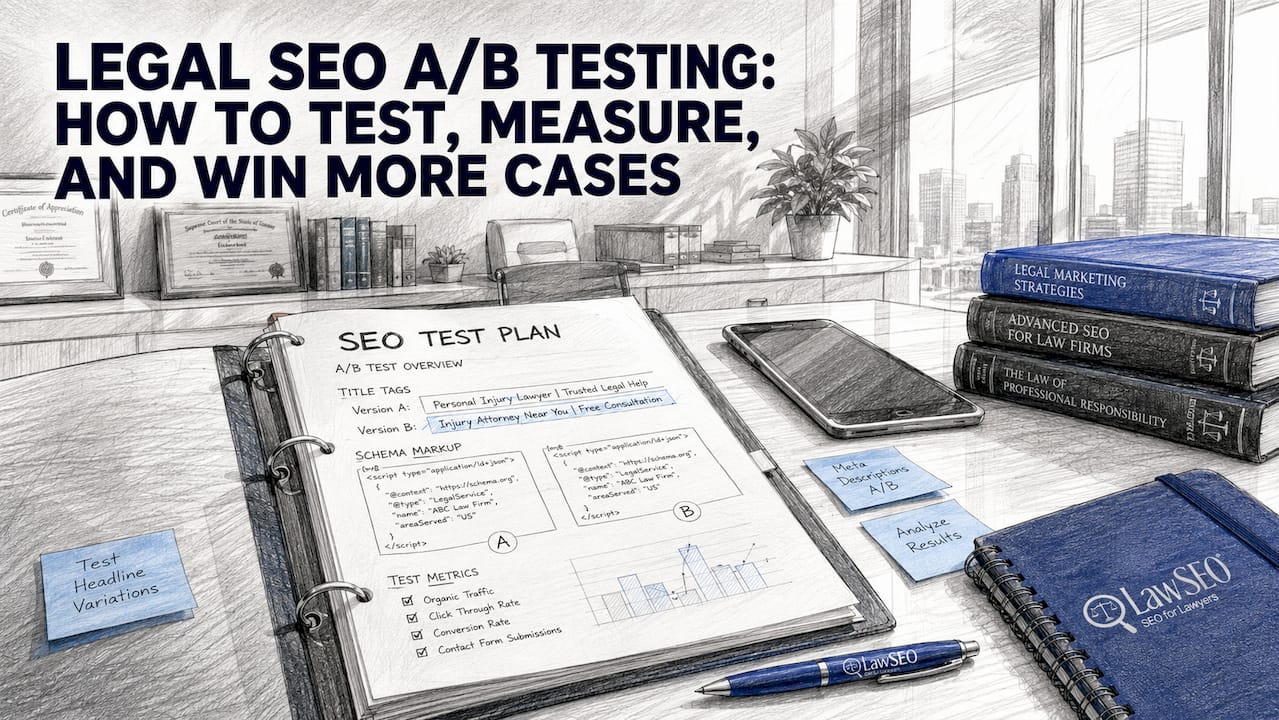
- Title tags: Swap “Chicago Personal Injury Attorney” for “Injured in Chicago? Free Case Review Today” and measure click-through rate changes in Google Search Console
- Meta descriptions: Test urgency-driven copy against credential-driven copy for the same practice area page
- H1 headlines: Compare “Experienced DUI Defense Lawyer” against “Facing a DUI Charge? Here’s What Happens Next”
- CTA copy: Testing CTA text like “Free Case Review” versus “Speak to a Lawyer Now” directly affects consultation request rates
- Schema markup: Implement LegalService, Attorney, and FAQ schemas on variant pages to test their effect on rich result appearances
- Testimonial placement: Move proof blocks above the fold on variant pages and measure scroll depth and form completions
- Form fields: Reduce a five-field intake form to three fields on the variant and track submission rates
Local SEO remains the largest factor for law firms, which means location-specific title tag tests carry more weight than generic keyword swaps. 46% of all Google searches carry local intent. That single statistic explains why “Houston Family Law Attorney” outperforms “Family Law Attorney” in nearly every title tag test for a Houston firm.
Pro Tip: Test schema markup changes on a cluster of five to ten similar pages simultaneously. Schema affects how Google reads your content, and a cluster test gives you enough data points to confirm whether the change lifts impressions across the board.
How to design and execute SEO A/B tests step by step for law firms
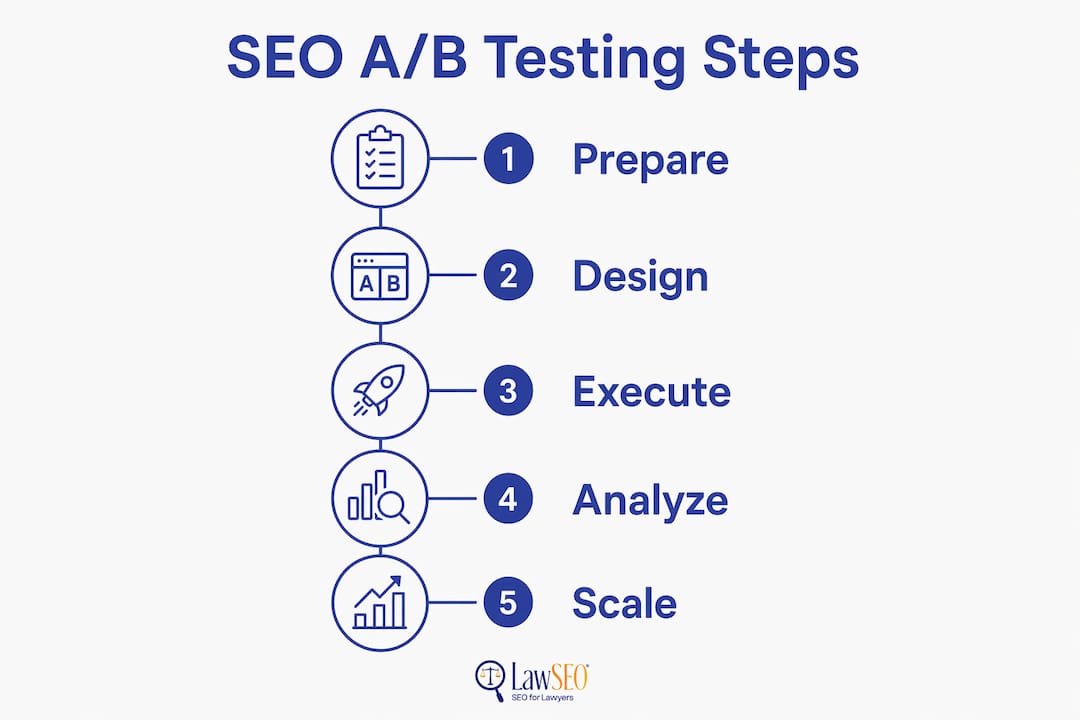
A structured execution process separates tests that produce reliable results from tests that waste months of traffic. Follow this sequence:
- Form a data-backed hypothesis. Start with a specific claim: “Adding a fear-based H1 on our DUI defense page will increase consultation form submissions by at least 10% because intake data shows prospects fear license suspension above all else.”
- Divide pages into control and variant groups. Select pages with similar traffic volume, domain authority, and practice area. Run control and variant groups concurrently so seasonal shifts affect both equally.
- Change one variable only. Changing the headline and the CTA at the same time makes it impossible to know which element drove the result. One change per test is non-negotiable.
- Set your test duration before launch. Commit to a minimum of two full weeks. Legal traffic has weekly cycles because prospects often search after a weekend incident or a Monday court notice.
- Monitor micro-conversions throughout. Track scroll depth, video plays, and time on page as directional signals. Pre-established conversion goals like qualified consultation requests or phone calls are your primary metrics, but micro-conversions tell you whether the test is moving in the right direction.
- Segment results by device, traffic source, and practice area. A headline that converts mobile visitors may underperform on desktop. Using Google Search Console and Google Analytics 4 together gives you both pre-click and post-click data in one reporting cycle.
- Confirm lift sustainability after deployment. Deploy the winner and monitor for four weeks. Some gains evaporate when novelty wears off or when Google re-crawls and re-ranks the updated page.
The most common mistake at this stage is skipping step seven. A page that converts better in a two-week test window does not always hold that advantage at scale. Confirm before you move to the next test.
Pro Tip: Map each micro-conversion to a funnel stage. Scroll depth past 75% signals awareness. A click on your attorney bio signals consideration. A form submission signals intent. Tracking all three tells you where the page loses prospects, not just whether it does.
What common pitfalls should lawyers avoid in SEO A/B testing?
Testing errors in legal SEO are expensive because law firm traffic volumes are lower than e-commerce sites, meaning every wasted test cycle costs weeks of data.
Mistakes such as peeking at data prematurely, running tests with insufficient sample sizes, ignoring segmentation, and overlooking seasonal effects can all invalidate results. Court schedules, tax season, and holiday weekends create traffic spikes and valleys that distort conversion rates if your test window catches only one side of the cycle.
The most damaging errors are:
- Stopping a test early because early results look promising. Statistical significance requires the full sample size you calculated before launch.
- Ignoring device segmentation. A CTA that works on desktop may fail on mobile, where the button sits below the fold.
- Testing during atypical periods. Avoid launching tests the week before major holidays or during local court closures.
- Changing the page mid-test. Any edit to the control or variant outside the test variable contaminates the data.
- Misreading interaction effects. A new testimonial block may lift conversions, but if you also updated your page speed that week, you cannot isolate the cause.
“Objective data from A/B testing helps displace subjective ‘HiPPO’ decisions in law firm marketing, grounding changes in prospect behavioral evidence. Use heatmaps, CallRail timestamps, and intake objections to target prospects’ fears and urgency more effectively.”
The HiPPO problem, where the Highest Paid Person’s Opinion overrides data, is especially common in law firms where the managing partner’s preferences shape the website. A/B testing in legal marketing replaces those opinions with empirical evidence from actual prospects.
How do you measure success and integrate test insights continuously?
Post-test analysis determines whether a result is a one-time win or a repeatable pattern. The metrics that matter most for improving law firm SEO are:
- Organic traffic to practice-area pages tracked week over week in Google Analytics 4
- Keyword rankings by practice area monitored through Google Search Console
- Conversion rate per traffic source to separate organic wins from paid traffic noise
- Cost-per-lead comparisons between SEO and PPC to justify continued investment in organic testing
Law firms should monitor organic traffic, keyword rankings, and cost-per-acquisition as the core measurement triad. Tracking these three together shows whether an SEO change improved visibility, engagement, and business outcome simultaneously.
Build a simple reporting dashboard that segments results by practice area and device. A personal injury page and an estate planning page attract different prospects with different urgency levels. Treating them as one data set hides the real story.
| Metric | What it tells you |
|---|---|
| Organic click-through rate | Whether your title tag or meta description change improved SERP appeal |
| Consultation form submission rate | Whether your on-page copy change converted more visitors |
| Phone call volume via CallRail | Whether your CTA change drove direct contact from mobile visitors |
| Keyword ranking position | Whether your schema or content change improved search visibility |
| Cost-per-lead vs. PPC | Whether organic SEO improvements are reducing paid acquisition costs |
Scale the winners across similar page templates. If a fear-based H1 lifted conversions on your DUI defense page, apply the same framework to your criminal defense and traffic violation pages. Author schema and local business schema help Google establish E-E-A-T for legal content, so winning schema configurations from one page deserve priority rollout across your full site.
Key Takeaways
Effective SEO A/B testing for law firms requires clean data infrastructure, single-variable test design, and post-deployment confirmation to produce results that hold over time.
| Point | Details |
|---|---|
| Set up data tools first | Install Google Analytics 4, Google Search Console, and CallRail before running any test. |
| Test one variable at a time | Changing multiple elements simultaneously makes it impossible to identify what drove the result. |
| Run tests for at least two weeks | Legal traffic has weekly cycles; shorter windows produce unreliable data. |
| Prioritize local SEO elements | Location-specific title tags and schema markup deliver the highest lift for most law firms. |
| Scale winners across templates | Apply proven changes to all similar practice-area pages, not just the original test page. |
What 29 years of legal SEO testing taught me about patience
Law firm partners are not patient people. They want results by the next billing cycle, and that pressure kills more A/B tests than bad hypotheses do. I have watched firms pull tests after eight days because the variant was not winning yet, only to discover months later that a competitor ran the same test to completion and captured the rankings they abandoned.
The legal market has a rhythm that most testing frameworks ignore. Criminal defense searches spike on Monday mornings. Family law inquiries rise in january and after Labor Day. Estate planning queries increase in october. If your test window catches only one phase of that cycle, your data reflects the cycle, not your change.
The other lesson I keep coming back to is context. A headline that converts a personal injury prospect does not convert a business litigation prospect. Those two people carry completely different anxieties. Personal injury prospects fear being blamed or lowballed. Business litigation prospects fear losing a relationship or a contract. Your tests must be built around those specific fears, not around generic “best practices” borrowed from e-commerce playbooks.
The firms that win at legal SEO optimization treat testing as a permanent operating discipline, not a one-time project. They run two or three tests at a time across different page clusters, document every result, and build a library of what works for their specific practice areas and markets. That library becomes a competitive asset that no competitor can replicate quickly.
— TODD
Lawseo’s approach to SEO testing for law firms
Lawseo works exclusively with attorneys and law firms, which means every test framework, every schema configuration, and every conversion hypothesis is built around legal client behavior. Todd R. Stager and the Lawseo team bring over 29 years of legal SEO experience to each campaign, personally reviewing strategy for every client. If you want to move beyond guesswork and run proven legal SEO strategies backed by real split test data, Lawseo builds and manages that entire process for you. The firm also offers exclusivity agreements, so your local competitors will not benefit from the same insights. Contact Lawseo to discuss a testing program built specifically for your practice area and market.
FAQ
What is SEO A/B testing for lawyers?
SEO A/B testing for lawyers is the process of comparing two versions of a web page element, such as a title tag, headline, or CTA, to determine which version produces better search rankings or consultation rates. The goal is to replace opinion-based decisions with data from actual prospect behavior.
How long should a law firm run an SEO A/B test?
A law firm should run each test for a minimum of two full weeks to capture the weekly traffic cycles common in legal search behavior. Tests that end too early produce statistically unreliable results that can mislead future decisions.
Which page elements give law firms the highest SEO testing returns?
Title tags, H1 headlines, CTA copy, schema markup, and testimonial placement consistently produce the most measurable results in legal SEO split testing. Location-specific title tag changes tend to deliver the fastest lift because local intent drives the majority of law firm search traffic.
Can a small law firm with low traffic run valid A/B tests?
A small firm with low traffic can run valid tests, but must extend the test duration significantly to reach statistical significance. Grouping similar page templates together and testing at the template level rather than the individual page level helps accumulate enough data faster.
What tools do lawyers need to run SEO A/B tests?
Google Analytics 4, Google Search Console, and CallRail form the core measurement stack for legal SEO split testing. Heatmap tools like Microsoft Clarity add behavioral data that helps form stronger hypotheses before a test begins.