


Yes, law firm SEO can produce scalable, measurable return on investment, but only if you measure it in signed cases, not rankings. Rankings and traffic are leading indicators; the real ROI number is cost per signed case against the average fee that case generates. Start by running that calculation now, using your current SEO spend and your last 90 days of intake data, rather than waiting for a ranking report to tell you something it can’t; learn more about SEO for small businesses to boost your online visibility effectively.
TL;DR:
- The key metric for law firm SEO ROI is cost per signed case, not search rankings or traffic volume.
- Tracking the entire funnel from impressions to signed cases with specific KPIs is essential for accurate ROI measurement.
- Accurate attribution requires dedicated call tracking, comprehensive form data, and CRM capture of lead sources.
- A typical ROI calculation needs actual visitor, conversion, and fee data to assess whether SEO efforts are profitable.
- Patience and proper funnel fixes, such as optimizing landing pages and speeding lead response, are crucial for long-term success.
What Does Law Firm SEO ROI Actually Mean?
Law firm SEO ROI is the net financial return your firm earns from signed cases attributed to organic search, measured against what you spent to generate them. The formula is straightforward: (revenue from signed cases attributed to organic search minus total SEO cost) divided by total SEO cost. Multiply by 100 and you get a percentage. That number, not your position for a target keyword, is what should drive your budget decisions.
Rankings and traffic matter, but only as leading indicators. A firm that ranks number one for “personal injury attorney [city]” and gets 3,000 monthly visitors has accomplished nothing financially until some of those visitors call, book a consultation, and sign a retainer. Signed cases attributed to organic search are the strongest ROI metric for law firms, and treating rankings as the finish line is the single most common mistake firm leadership makes when evaluating a marketing partner.
Getting the cost side right matters just as much as the revenue side. Your total SEO cost should include:
- Monthly SEO retainer or agency fees
- Content production costs (writers, editors, subject-matter review)
- Technical work: schema implementation, site audits, migrations
- Conversion rate optimization spend tied to organic landing pages
- A reasonable allocation of internal marketing staff time
Set a consistent attribution window, typically 30 to 90 days from first organic touch to signed retainer, and apply it the same way every quarter so your comparisons actually mean something over time.
Which Metrics Should You Track From Click to Signed Case?
A law firm’s SEO funnel has six measurable stages, and each one needs its own KPI or the ROI number at the end becomes guesswork. A practical ROI model tracks impressions through clicks, organic calls and forms, qualified leads, booked consultations, and signed cases, with a cost figure attached at the final stage.
- Impressions — how often your pages appear in search results, pulled from Google Search Console.
- Clicks — visits from organic listings, also from Search Console, cross-referenced with Google Analytics 4 for behavior data.
- Calls and form submissions — tracked through dedicated call tracking numbers and form fields tagged by traffic source, never through your main office line.
- Qualified leads — contacts who meet your intake criteria (case type, jurisdiction, timeline), logged in your CRM.
- Booked consultations — confirmed appointments, not just scheduled ones, since no-shows distort every downstream number.
- Signed cases — the retainer stage, which closes the loop back to revenue.
Pro Tip: Separate branded search traffic (people searching your firm’s name) from non-branded traffic before you calculate ROI. Branded clicks often convert at two or three times the rate of non-branded clicks, and blending them inflates your apparent SEO performance while hiding weak top-of-funnel visibility.
Use Google Search Console for impressions and click data, GA4 for on-site behavior and goal completions, your call tracking platform for phone attribution, and your CRM for everything from qualified lead status through signed case. Clio’s guidance on marketing ROI is blunt about this: firms that track only clicks are measuring activity, not revenue, and it shows up in budget decisions that don’t hold up over a full fiscal year.
How Do You Calculate Law Firm SEO ROI With a Calculator?
The basic formula is (revenue attributed to organic search minus total SEO cost) divided by total SEO cost, times 100. But the number that actually tells you something is signed-case ROI, which requires five inputs: monthly organic visitors, the conversion rate from visitor to contact, the sales conversion rate from contact to signed case, average case fee, and monthly SEO cost.
Here’s how the math runs for a mid-size personal injury firm:
- Monthly organic visitors: 2,000
- Contact conversion rate: 3% → 60 contacts per month
- Sales conversion rate: 20% → 12 signed cases per month
- Average case fee: $4,500
- Monthly revenue: 12 × $4,500 = $54,000
- Monthly SEO cost: $4,000
- ROI: ($54,000 minus $4,000) divided by $4,000 = 1,250%
That’s the conservative baseline.
Tools like the SEO ROI calculator let you plug in your own visitor counts and conversion rates instead of relying on industry averages. Run your firm’s actual numbers before you commit to a new budget, not after.
What Are Realistic CPL, CAC, and Breakeven Benchmarks?
Benchmarks vary sharply by practice area, and using a personal injury number to judge a family law campaign will make a healthy campaign look like it’s failing. Client acquisition costs vary by practice area, being generally higher for criminal defense than for personal injury cases per signed case, reflecting differences in competition and average case value.
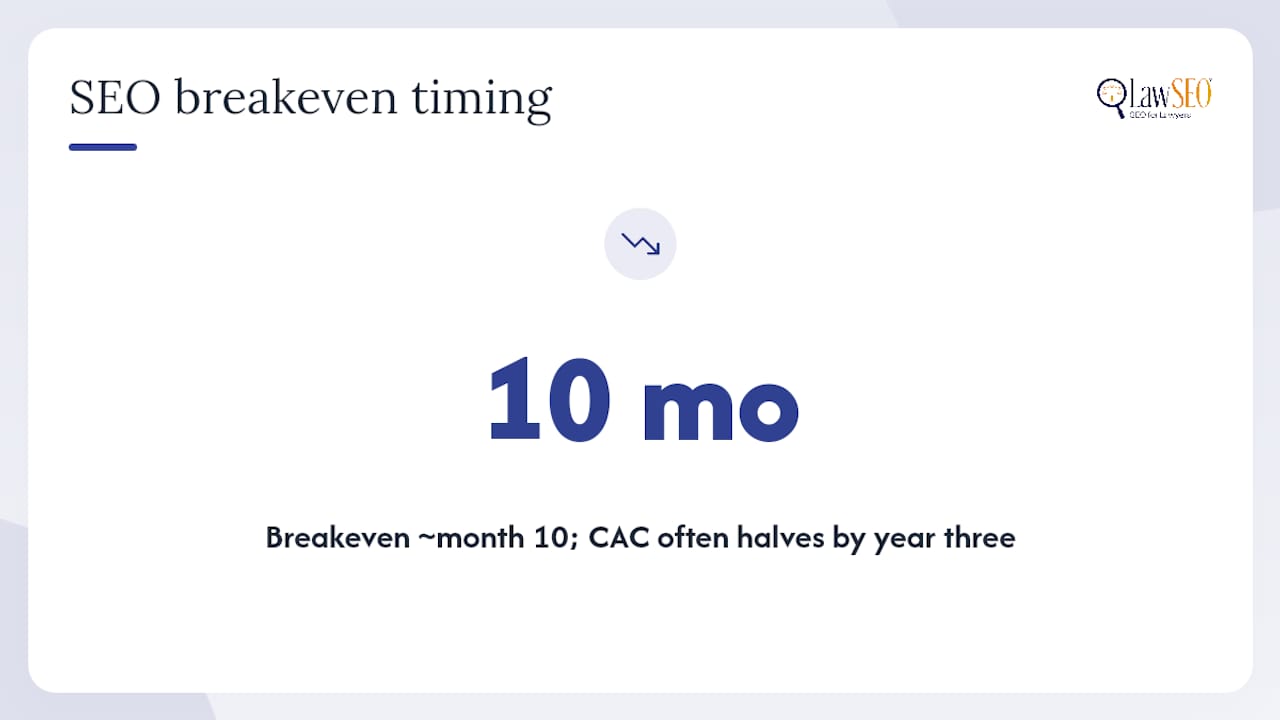
Typical SEO breakeven for law firms generally occurs within a medium-term range, with returns compounding well beyond that window as ranked content keeps generating leads without added spend. A firm that hits breakeven at month ten and stays with the same campaign for three years often sees cost per signed case drop by half or more, simply because the content library keeps working.
Adjust these ranges for your own firm size and case mix. A boutique firm handling only catastrophic injury cases should expect a higher CAC and a higher average case value than a high-volume general practice firm, and benchmarking against the wrong peer group will lead you to cut a campaign that’s actually performing well.
Which Tactics Move the ROI Number Fastest?
Some improvements pay off in weeks. Others take months. Prioritizing the fast ones first is how you shorten your breakeven window instead of just waiting it out.
- Fix landing page conversion basics first. A clear phone number in the header, a short contact form, and a single obvious call to action often lift contact rates by several percentage points with no new traffic required.
- Tighten your intake process. Cutting speed-to-lead from roughly 47 minutes down to under 10 minutes frequently produces an outsized jump in booked consultations, because prospects calling a law firm are usually calling two or three others at the same time.
- Target high-intent, transactional keywords. Phrases like “hire a [practice area] attorney near me” convert at a far higher rate than informational queries, even when the informational content brings in more raw traffic.
- Use PPC or Local Services Ads to bridge the gap. Paid channels can generate signed cases immediately while your organic content matures toward its own breakeven point.
Pro Tip: Run a monthly “lost lead” audit: pull every contact who didn’t book a consultation and call them back within 48 hours. Firms that do this consistently often recover a meaningful share of cases that would otherwise show up as wasted SEO spend, not as an intake problem.
Attorneys focused on conversion rate optimization tend to see the fastest ROI improvement of any single tactic, because it multiplies the value of traffic you’re already generating instead of requiring new content or links.
Why Does Your SEO ROI Look Worse Than It Really Is?
Bad attribution is the most common reason a profitable SEO campaign gets cut. Fix the tracking before you fix the campaign.
- Untracked phone numbers. If your main office line isn’t a dedicated tracking number, every organic call gets attributed to nothing, or worse, to a channel that didn’t earn it.
- Unmapped form fields. Contact forms that don’t capture UTM parameters or referral source make it impossible to credit organic search for a conversion that started there.
- Last-click bias. A prospect who reads three blog posts over two weeks, then finally calls after seeing a paid ad, gets credited entirely to paid unless you’re tracking first touch too.
- Low show rates masking real conversion. A firm booking 40 consultations but only 15 showing up has an intake problem, not an SEO problem, and cutting the SEO budget won’t fix it.
Reconcile call tracking data against your CRM monthly, and implement conversion tracking properly before you draw conclusions from a quarter of noisy data.
What Do Real Firms See When They Fix Their Funnel?
The firms that get this right treat SEO ROI as a measurement discipline first and a marketing tactic second. Rankings tell you almost nothing about revenue. Signed cases, reconciled monthly against CRM records, tell you everything.
Founder-led review matters here. Todd R. Stager has spent more than 29 years in SEO, and every LawSEO campaign gets his direct strategic review, which keeps measurement discipline consistent rather than delegated to whoever happens to be assigned that month. Exclusivity agreements, where LawSEO won’t work with a client’s local competitors, reinforce that same accountability: there’s no split incentive across two firms fighting for the same signed cases.
Where Can You Get the Tools to Start Measuring?
Start with the SEO ROI calculator and plug in your own visitor and conversion numbers rather than industry averages. From there, work through a short validation checklist before you trust any output:
- Confirm Google Search Console and GA4 are both connected and reporting the same traffic totals.
- Verify every phone number on your site routes through call tracking, not a static number.
- Check that your CRM captures lead source at intake, not just contact information.
- Confirm booked consultations are logged separately from scheduled ones.
For implementation, conversion tracking for legal websites walks through the technical setup, and CRO for attorneys covers the landing page side.
What Should Firms Expect From Measuring SEO ROI?
Patience is the discipline most firms lack, not analysis. SEO breakeven takes months, and the firms that quit at month five are usually the same ones that never fixed their call tracking to begin with. Two things matter most: measure signed cases monthly, not quarterly, and fix intake before you fix content. If your numbers still don’t add up after that, a signed-case audit will usually show you exactly where the funnel is leaking.
— TODD
Get an ROI Audit Built Around Signed Cases, Not Rankings
Most agencies report on rankings and traffic because those numbers are easy to show and hard to argue with. Lawseo builds campaigns around the number that actually matters to your partners: cost per signed case. That means call tracking and CRM reconciliation are part of the campaign from day one, not an afterthought bolted on when a client asks where the leads went.
Todd R. Stager brings more than 29 years of SEO experience to every campaign, personally reviewing strategy rather than handing it off to account managers, and his published books on legal SEO reflect the same measurement discipline built into every LawSEO engagement. Exclusivity agreements mean your firm’s competitors in your market don’t get access to the same playbook.
If your current SEO spend isn’t producing a clear signed-case number, request an ROI audit at LawSEO.com and get a real answer on where your funnel is leaking, and what fixing it is worth.