


TL;DR:
- Legal professionals must balance content accuracy and compliance with online engagement and visibility.
- A strategic, workflow-driven approach centered on client personas and thorough sign-offs ensures effective legal content production.
Legal professionals face a genuine tension every time they sit down to produce content: the obligation to be precise and compliant competes directly with the need to be readable, engaging, and visible online. This legal content creation guide exists to resolve that tension. Whether you are managing the attorney content creation process in-house or working with a marketing partner, the difference between content that generates leads and content that disappears is strategic preparation, ethical compliance, and a repeatable production workflow. What follows is a structured, practical framework built specifically for law firms.
Key takeaways
| Point | Details |
|---|---|
| Compliance comes first | Disclose sponsored and AI-assisted content properly before any strategy or production begins. |
| Strategy before format | Build your content plan around client personas and practice areas, not around what is easiest to produce. |
| Attorney sign-off at script stage | Review content for compliance before production starts to avoid costly revisions after the fact. |
| Audience-first architecture wins | Tagging and cross-linking content by audience need outperforms format-first approaches for both SEO and engagement. |
| Amplification is not optional | Published content that lacks a distribution plan effectively does not reach potential clients. |
Understanding legal content requirements before you start
Before you write a single word, you need a clear picture of what governs legal content and what your firm is actually trying to achieve. Skipping this step is how firms end up with polished blog posts that violate bar association rules or videos that attract the wrong clients.
Compliance mandates you must know:
- Disclosure requirements. Ethical marketing standards require clear #Ad labels placed before “read more” breaks on sponsored content, and any AI-generated images used in your content must have edits documented in the file metadata to comply with current transparency laws.
- AI content ethics. Using AI writing tools is acceptable, but presenting AI-generated text as purely original attorney work without disclosure creates both ethical and reputational risk. Document your process.
- Copyright considerations. Court documents and statutory text are typically public domain, but third-party legal analysis, images, and charts are not. Treat them accordingly.
- Jurisdiction-specific rules. Most state bars prohibit superlatives like “best attorney” or “top-rated” unless those claims can be independently verified. Know your jurisdiction before you publish.
Once compliance is mapped, build your content strategy around client personas rather than content formats. A personal injury firm’s potential client searching at 11 p.m. on a mobile device has entirely different needs than a corporate general counsel researching outside employment counsel. Your content should address those specific situations by practice area and buyer stage.
Use your own firm’s data to build a topic backlog. Intake call notes reveal the exact questions clients ask before hiring. Google Search Console shows which queries already send people to your site. These two sources, combined, give you a topic list grounded in real demand rather than guesswork.
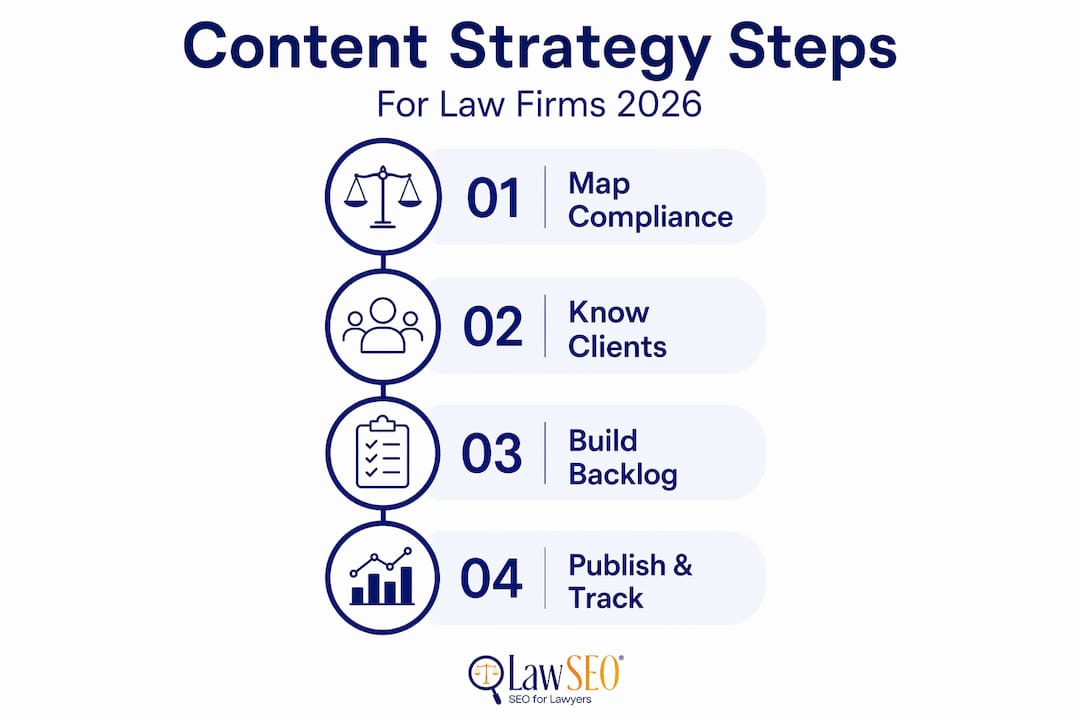
Pro Tip: Mine your intake notes monthly. The questions clients ask before signing a retainer are the questions your content should answer before they ever call.
The attorney content creation process, step by step
A repeatable workflow separates firms that publish consistently from firms that produce content in bursts and then go quiet for months. Here is a production sequence that works.
-
Build a topic cluster by practice area. Group related topics together so that each piece of content supports the others. A family law firm might cluster topics around divorce, child custody, asset division, and post-decree modifications. Each cluster builds topical authority with search engines and guides readers deeper into your site.
-
Create a script template before production. Whether you are writing a blog post, producing a video, or drafting a FAQ page, start with a script or outline that captures the core message, the legal position, and the relevant disclaimers. Templates create consistency and reduce the time each piece takes.
-
Get attorney sign-off at the script stage. Script-level compliance review prevents costly re-renders for video and rewrites for written content. Once a script is approved, store it in a version-controlled document. This protects the firm if a content provider makes unauthorized changes after approval.
-
Batch your production sessions. Dedicated content creation sessions in focused blocks maintain brand voice consistency and let attorneys and content teams produce more without disrupting client work. Record three videos in one afternoon instead of one video on three separate days.
-
Select the right content format for the audience need. Blog posts work for search intent and long-form explanation. Short videos work for social media and emotional connection. FAQs work for both. Match the format to where your client is in the decision process.
-
Use AI tools as a drafting layer, not a final product. AI can generate a first draft or suggest keyword variations, but attorney expertise must shape the legal accuracy and the firm’s voice. Document all AI assistance as part of your compliance record.
The table below shows recommended content volume by production tier:
| Production tier | Blog posts per month | Videos per week |
|---|---|---|
| Minimum viable | 1 long-form post | 1 short video |
| Growth program | 2 to 3 posts | 2 to 3 videos |
| High-volume lead gen | 4 to 5 posts | Up to 5 AI-assisted videos |
Pro Tip: Store every approved script in a shared, access-controlled folder. If a dispute arises about what was approved, that file is your audit trail.
Optimizing legal content for search and engagement
Producing compliant, accurate content is necessary but not sufficient. That content needs to be found. This is where the attorney content creation process intersects with search engine optimization.

Keyword research for legal niches operates differently than for consumer products. People searching for legal help use plain language. “What happens if I get a DUI in Texas” is a more valuable query to target than “DUI defense attorney,” because it signals a specific, urgent need at an early stage in the decision process. Use search console data and tools like Google’s “People Also Ask” boxes to identify these conversational queries.
Once you have your keywords, integrate them where they carry the most weight: the H1 title, the first 100 words of the page, one subheading, and naturally throughout the body. Forcing keywords into every paragraph degrades both readability and ranking.
Content architecture matters as much as individual pages:
- Tag content by practice area and audience type so users can navigate from one relevant piece to another.
- Cross-link related pages within your site, because audience-focused architectures using tagging and cross-linking consistently outperform format-first strategies in both user engagement and SEO authority signals.
- Write headlines that communicate a specific outcome. “How to Contest a Will in California” outperforms “Estate Planning Tips” in click-through rate because it answers a specific question.
- Distribute content across multiple channels after publishing. A blog post can become a LinkedIn article, a short video script, and three social media posts. Content without a distribution strategy effectively does not exist to the clients you are trying to reach.
Measure performance at 60 and 90 days after publication. Track organic impressions, click-through rate, average position, and time on page. These four metrics tell you whether your content is visible, compelling, accurate to the search intent, and genuinely useful to readers.
Common mistakes that undermine legal content
Even well-intentioned law firm content fails when these errors appear. Recognizing them early saves significant time, money, and reputational risk.
- Publishing without proper disclosure. If content is sponsored or AI-assisted, ethical and regulatory frameworks require transparent labeling. Omitting disclosures exposes the firm to bar complaints and potential penalties.
- Skipping attorney review until after production. Video re-renders and full rewrites are expensive. Getting legal sign-off after a video is produced rather than at the script stage is one of the most common and costly mistakes in the attorney video marketing space.
- Overpromising outcomes. Stating or implying that a client will win their case, receive a specific settlement, or achieve a guaranteed result violates bar rules in virtually every jurisdiction. Reject any language that includes outcome guarantees, unverifiable superlatives, or past results presented without proper context.
- Ignoring your own data. Firms that build topic lists from intuition alone miss the specific, high-converting questions that intake calls and search analytics surface. Real client questions produce more relevant content and higher conversion rates.
- Treating publication as the finish line. Amplification is part of the production process, not an afterthought.
“The firms that dominate their markets publish consistently, distribute deliberately, and measure everything. The firms that struggle publish occasionally and hope.” This mindset shift separates legal content that performs from legal content that simply exists.
My perspective on legal content strategy
I have spent nearly three decades working in SEO, with the last many years focused exclusively on law firms. Here is what I have actually seen work versus what sounds good in theory.
The single biggest mistake I see is treating content as a task to check off rather than a long-term asset to build. Firms rush to publish a few blog posts, see no immediate results, and conclude that content does not work. But consistent thought leadership writing does something most attorneys do not expect: it sharpens legal reasoning, improves client communication, and makes you better at your actual job. The marketing benefit is almost secondary.
I also push back on the idea that AI tools are either a miracle or a threat. They are a drafting accelerator. I have seen firms produce three times the content volume by using AI for first drafts, but the ones that skip attorney review of those drafts inevitably publish something that creates a compliance problem or misrepresents a legal standard. The tool is only as good as the oversight behind it.
My honest advice: invest six weeks building a proper content strategy before you produce a single piece. Map your practice areas, identify your client personas, audit what you already have, and build a topic backlog from intake data and search queries. That foundation makes every subsequent piece faster, better, and more likely to convert. Firms that do this work upfront outperform those chasing content volume without direction every single time.
— Todd
How Lawseo can strengthen your content program
Producing compliant, high-performing legal content at consistent volume requires both strategic direction and technical execution. Lawseo works exclusively with law firms to build content programs that rank in traditional search and appear in AI-driven search results, where more potential clients begin their research. From keyword strategy and content architecture to AI-assisted video production and compliance-aware content workflows, Lawseo provides the full production infrastructure that most firms cannot build internally. If you want content that generates real leads rather than just filling a blog, explore Lawseo’s law firm SEO strategies and see what a structured, specialist-led program delivers.
FAQ
What is a legal content creation guide?
A legal content creation guide is a structured framework that helps law firms and legal marketers produce accurate, compliant, and search-optimized content. It covers strategy, workflow, compliance requirements, and distribution.
How often should a law firm publish content?
Law firms should publish at least one long-form post per month at minimum, with high-volume programs reaching four to five blog posts and up to five AI-assisted videos per week.
When should attorneys review content for compliance?
Attorneys should review content at the script or outline stage, before any production begins. Reviewing at the script stage prevents expensive revisions and reduces the risk of publishing non-compliant material.
What disclosures are required for legal content in 2026?
Sponsored content requires a clear #Ad label placed before any “read more” break, and AI-generated images must have edits documented in the file metadata to meet current transparency standards.
Does content architecture affect legal SEO performance?
Yes. Audience-first content architecture using tagging and cross-linking by practice area and client type outperforms format-first approaches in both user engagement and search engine authority signals.