


A repeatable legal directory submission workflow combines continuous matter capture, centralized referee management, and a firm-level QA and repurposing cadence — run year-round, not just at deadline season. Firms that treat submissions as a year-round program capture greater ROI across BD, recruitment, and content reuse.
Your 7-day quick-start checklist:
- Audit your firm’s existing directory entries for NAP consistency and missing profiles
- Identify the three directories most relevant to your top practice areas (Chambers, Legal 500, IFLR as anchors)
- Assign one internal owner for the submissions program
- Pull your recent significant matters from your CRM or billing system
- Draft a matter capture template with the eight core fields (see Section 4)
- Brief one partner per practice group on the year-round tracking expectation
- Set a recurring quarterly matter-review meeting in every practice group calendar
Pro Tip: Capture a publishable matter summary within 48 hours of a deal closing or a verdict landing. Details fade fast, clients move on, and reconstructing a compelling narrative three months later takes three times as long and produces half the quality.
Key Takeaways
A repeatable legal directory submission workflow, run year-round with defined owners and CRM-integrated matter capture, consistently produces stronger rankings and greater BD value than deadline-driven sprints.
| Point | Details |
|---|---|
| Start with an audit | Verify NAP consistency, LegalService schema, and Google Business Profile before touching any submission portal. |
| Capture matters in real time | Log the eight core CRM fields within 48 hours of matter completion to avoid reconstruction at deadline. |
| Brief referees early | Confirm referee willingness at matter close, send briefing notes well in advance, and ask them to whitelist directory domains. |
| Repurpose every submission | Convert matter summaries to case studies, practice overviews to service pages, and bios to pitch profiles each cycle. |
| Lawseo manages the full program | Lawseo provides audit, CRM integration, template drafting, and managed submission operations for U.S. law firms. |
What does a legal directory submission workflow look like end to end?
A well-run submission program moves through seven discrete phases. Each phase has a clear owner, a defined deliverable, and a handoff point. The table below maps those phases; the numbered list that follows explains each one.
| Phase | Primary Owner | Core Deliverable | Handoff To |
|---|---|---|---|
| 1. Audit & directory selection | BD/Marketing | Priority matrix, directory profiles | BD lead |
| 2. Year-round matter capture | Practice group + BD | CRM matter records, publishable summaries | Submissions manager |
| 3. Drafting & approvals | BD writer + partner | Draft submission, practice overview, bios | Partner for sign-off |
| 4. Referee management | BD/Marketing | Briefed referee list, response tracker | Submissions manager |
| 5. QA & upload | Submissions manager | Checked, uploaded submission | BD lead |
| 6. Researcher follow-up | BD/Marketing | Interview prep sheet, feedback log | BD lead |
| 7. Repurpose & measure | Marketing | Case studies, KPI dashboard | Partners/leadership |
- Audit and directory selection. Map the firm’s current directory footprint, verify technical accuracy, and build a prioritized list of target guides.
- Year-round matter capture. Log matters in real time using a standardized CRM template. Quarterly reviews surface the strongest candidates.
- Drafting and approvals. BD writers convert raw matter notes into researcher-ready summaries. Partners review for accuracy and confidentiality before sign-off.
- Referee management. Select, brief, and track referees throughout the year. Avoid concentrating all outreach in the final weeks before a deadline.
- QA and upload. Run a structured checklist against every submission before it enters the portal. Chambers’ submission portal allows edits until the research period begins, so maintain CSV exports as a rollback and audit trail.
- Researcher follow-up. Prepare interview briefing sheets, attend calls with the right lawyers, and log all researcher feedback for future cycles.
- Repurpose and measure. Convert submission content into case studies, pitch materials, and website copy. Track KPIs monthly.
Chambers’ published methodology makes clear that submissions are factual inputs alongside interviews and other research sources. Submitting does not guarantee a ranking, but it ensures researchers receive the information they need to evaluate the firm accurately.
How to audit your firm’s directory footprint and choose the right guides
Start with the technical foundation before touching a single submission form. Verify that your firm’s name, address, and phone number (NAP) are identical across every directory, your website, and your Google Business Profile. Discrepancies in NAP data undermine profile authority and confuse researchers cross-referencing your firm. Implement LegalService schema on your website’s practice area pages; this structured data signals to search engines and AI platforms exactly what your firm does and where. A thorough SEO audit for attorneys covers all three of these technical anchors before any directory work begins.
High-performing firms start with this audit because it exposes gaps that would otherwise produce inconsistent profiles across guides.
Directory selection criteria:
- Researcher weight. Chambers and Partners, Legal 500, and IFLR carry the most weight for transactional and finance practices in the U.S. market. Chambers is the dominant guide for most practice areas; IFLR focuses specifically on capital markets, banking, and financial regulation.
- Geographic relevance. Some guides rank by state or region. Confirm the guide covers your primary markets before investing submission time.
- Practice and sector fit. Legal 500 organizes rankings by practice area and sector; IFLR by financial law specialty. Match your strongest practices to the guides where researchers actively evaluate them.
- Required elements. Each guide specifies what it needs: matter summaries, referee counts, bio formats, and word limits. Confirm you can meet those requirements before committing.
- Referee expectations. Chambers places significant weight on referee interviews. IFLR and Legal 500 also use referees but weight written submissions differently.
Build a simple priority matrix: score each directory as high, medium, or low across researcher weight, practice fit, and your firm’s realistic capacity to submit well. Create a one-page directory profile for each high-priority guide listing its deadline window, template format, referee count, and the BD owner responsible.
Pro Tip: Check the types of legal directories available before finalizing your priority matrix. Peer-review directories, client-review platforms, and specialist sector guides each serve different BD goals and require different submission approaches.
How to capture matters year-round without reconstructing them later
The single biggest efficiency failure in directory submissions is reconstruction. A partner tries to recall deal details from memory six months after closing, produces a vague summary, and the submission suffers. The fix is a standardized CRM matter record completed at the time of the work.
Essential CRM fields for every matter:
| Field | Description | Notes |
|---|---|---|
| Client name | Full legal entity name | Flag as confidential if needed |
| Publishable summary | 2–3 sentence factual description | Draft within 48 hours of completion |
| Confidential flag | Yes/No | Drives what researchers can publish |
| Value drivers | Deal size, complexity, novelty, outcome | Use factual figures where permitted |
| Sector/issue tags | Practice area, industry, legal issue | Enables cross-practice visibility |
| Referee name(s) | Client contact(s) willing to speak | Confirm willingness at matter close |
| Date range | Start and completion dates | Required by most directory templates |
| Directory fit | Which guides this matter suits | BD owner assigns at intake |
Integrate these fields into your existing CRM or matter management system. The field names should match your directory templates exactly so exports map cleanly without manual reformatting. Quarterly matter reviews, run by the BD owner with each practice group, surface the strongest candidates and catch matters that were logged incompletely.
Cross-practice visibility matters more than most firms realize. A capital markets partner may not know that a restructuring colleague handled a matter that strengthens the firm’s IFLR submission. Quarterly reviews with a shared CRM view solve that blind spot.
How to write matter summaries and bios that researchers actually prefer
Researchers read hundreds of submissions. They reward clarity and penalize marketing copy. The most effective submissions are concise factual summaries that fit the directory template, not polished sales narratives.
Core drafting rules:
- Lead with the outcome or the complexity, not the client relationship
- State the legal issue, the challenge, and the result in plain English
- Avoid superlatives (“leading,” “premier,” “best-in-class”) and unexplained acronyms
- Keep matter summaries to 100–150 words unless the guide specifies otherwise
- Practice overviews run 300–500 words for most major guides; bios run 150–250 words
- Every factual claim must be verifiable; researchers cross-check against interviews
Researchers value concise matter descriptions that show complexity, novelty, or strategic significance and explain the outcome. A focused selection of five strong matters consistently outperforms a list of fifteen generic ones.
Before and after example:
Before (partner draft): “We advised our longstanding client on a complex and highly significant cross-border transaction that demonstrated our firm’s exceptional capabilities in international M&A.”
After (researcher-ready): “Advised [Client] on a major acquisition, navigating dual-track regulatory approvals in the U.S. and EU simultaneously. The transaction closed within the original timeline despite a mid-process change in deal structure.”
The rewrite removes the self-promotion, adds the specific facts researchers need, and fits within the word limit.
Pro Tip: Build a two-column rewrite log: partner draft on the left, researcher-ready version on the right. After two or three submission cycles, partners internalize the standard and their first drafts improve significantly.
How to select, brief, and manage referees without burning them out
Referee quality shapes ranking outcomes more than most BD teams acknowledge. A client who responds promptly, speaks specifically to the matter’s complexity, and confirms the firm’s role carries far more weight than a senior contact who gives a vague endorsement.
What makes a strong referee:
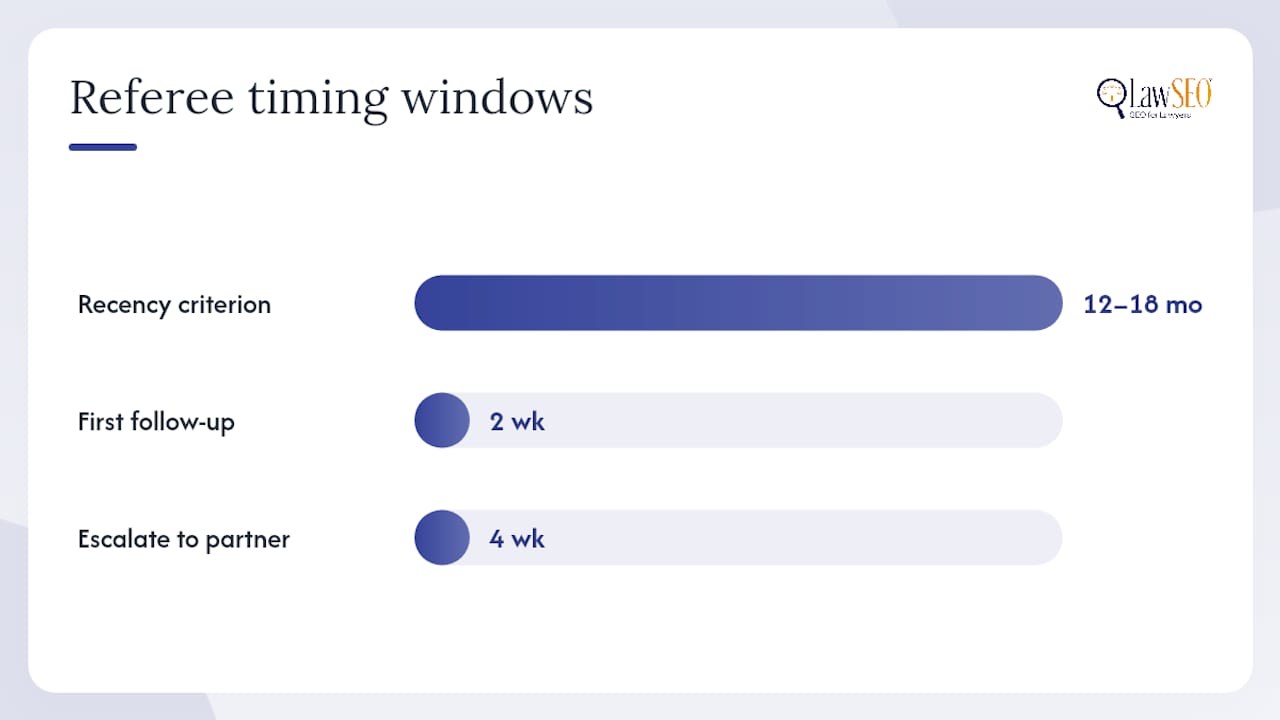
- Recent involvement in a completed matter (within the last 12–18 months)
- Direct knowledge of the legal work, not just the relationship
- Willingness to respond to a researcher call or written questionnaire
- Positioned to speak to outcome, complexity, or strategic significance
- Not already overloaded with referee requests from other firms
Referee briefing and outreach cadence:
- Confirm willingness at matter close, not at submission deadline
- Send a one-page briefing note covering the matter summary, the directory’s purpose, and two or three points the researcher is likely to raise
- Ask referees to whitelist @chambers.com to prevent researcher interview requests from landing in spam filters; Legal 500 and IFLR use similar domain-based outreach
- Follow up once at the two-week mark if no response; escalate to the relationship partner if still no response at four weeks
Referee fatigue is widespread. Firms that ask the same clients to serve as referees across multiple guides in the same cycle risk damaging the client relationship and reducing response rates. Rotate referees across guides and across years where possible.
Referee response tracker:
The most successful firms manage referee relationships year-round, brief referees in advance, and use researcher tools where available to monitor response rates. Some directories provide referee tracking and NPS-style reporting that can feed directly into a firm’s client listening program.
Pro Tip: Add a “referee confirmed” field to your CRM matter record at intake. When submission season arrives, you already have a pre-approved list rather than scrambling to identify and brief contacts under deadline pressure.
What to check before you upload a submission to any portal
Submission portals vary. Chambers uses an online portal with structured fields and an optional Word upload for longer narrative sections. Legal 500 and IFLR use similar web-based systems. Some guides still accept Excel or Word templates for certain practice areas. Know which format your target guide uses before drafting begins.
QA checklist before upload:
- NAP matches the firm’s website and Google Business Profile exactly
- All dates are accurate and consistent with CRM records
- Client names are spelled correctly and confidential flags are applied where required
- Referee names, titles, and contact details are current
- Word counts fall within the guide’s specified limits
- Internal partner sign-off is documented (email or workflow approval)
- Submission has been read by someone other than the drafter
- CSV or Word export saved as a local backup before portal submission
Handling confidentiality:
Mark any matter where the client has not given permission to publish as confidential in the portal. Most guides allow researchers to use confidential matters as background context for ranking decisions without publishing the client name. Confirm the specific guide’s policy before marking a matter confidential, as policies differ between Chambers, Legal 500, and IFLR.
Numbered upload sequence:
- Log in to the portal and verify the submission window is open
- Complete all structured fields before pasting narrative sections
- Upload referee details using the guide’s referee spreadsheet or portal tool
- Review the full submission in preview mode
- Save a local export or screenshot of the completed form
- Submit and record the confirmation number or timestamp
Directory submission portals typically allow edits until the research period begins. Keep that window in your calendar and assign someone to monitor for portal notifications.
How to prepare for researcher calls and follow up after submission
Researcher interviews are where rankings are confirmed or revised. A well-prepared call reinforces the submission; an unprepared one can undermine it.
Interview prep sheet (per practice group):
- Two or three lead matters to reference by name, with the key facts memorized
- The firm’s positioning statement for this practice area in plain English
- Names of the lawyers who should join the call (the lead partner plus one associate who worked the matter directly)
- Guidance on how to handle sensitive or ongoing matters: acknowledge the work exists, state it is confidential, and redirect to a comparable completed matter
- Anticipated researcher questions based on prior feedback logs
Researcher feedback log:
Capture feedback immediately after every researcher interaction. Teams that log this systematically improve their submissions measurably over two or three cycles. When a researcher requests a correction or clarification post-submission, respond within 48 hours. Delays signal disorganization and can affect how the researcher weighs the firm’s responsiveness.
How to turn submission content into BD assets and measure what it’s worth
Every submission cycle produces reusable content. Matter summaries become case studies. Practice overviews become service page copy. Bios become pitch profiles. The marginal cost of repurposing is low; the BD value compounds over time. Treating each submission as a source of reusable marketing assets multiplies the ROI on the effort invested.
Repurposing checklist:
- Matter summaries → anonymized case studies for the website and pitch decks
- Practice overviews → updated service pages with current matter examples
- Bios → refreshed attorney profiles and pitch credentials
- Referee feedback → client testimonials (with permission) and NPS data
- Researcher feedback → internal quality benchmarks for the next cycle
KPIs to track:
- Submission acceptance rate: percentage of submitted matters that appear in the published ranking
- Referee response rate: percentage of briefed referees who respond to researcher outreach
- Referral traffic: sessions from directory profile pages to the firm’s website (track in Google Analytics with UTM parameters)
- Leads attributable to directory referrals: new client inquiries where the directory was the first touchpoint
- Content repurposing velocity: number of case studies or service page updates produced per submission cycle
- Time saved: hours saved per cycle as templates and CRM fields mature
Report these KPIs quarterly to partners. A simple dashboard in Google Sheets or your CRM, showing trend lines across cycles, makes the program’s value visible and secures continued partner engagement. The importance of legal directories for client acquisition extends well beyond the ranking itself when submission content feeds the firm’s broader digital presence.
Which tools and integrations speed up the submission workflow?
The right technical stack reduces manual effort at every phase. No single platform covers the full workflow, so the goal is a connected set of tools with clean data handoffs.
Tool categories and recommended uses:
- CRM/matter trackers: Salesforce, Microsoft Dynamics, or a legal-specific CRM like InterAction. Use these to house the eight core matter fields and trigger quarterly review reminders.
- Workflow engines: tools like Monday.com, Asana, or a legal project management platform to assign tasks, set deadlines, and track approvals across the drafting and QA phases.
- Data standardization: maintain a master CSV export from your CRM with consistent field names that map directly to directory template columns. This eliminates reformatting at upload time.
- Referee management: a shared tracker (Google Sheets or CRM module) with columns for briefing date, response status, and follow-up owner.
- Portal automation helpers: some firms use browser automation or API integrations to pre-populate portal fields from CRM exports. Automation and workflow engines can reduce manual effort but require pilot testing, redundancy, and a human backstop for API failures.
Integration checklist:
- Standardize field names across CRM, tracker, and directory templates before the first submission cycle
- Maintain CSV exports after every portal session as a rollback and audit trail
- Build API fallbacks: if an automated upload fails, a manual submission path must be documented and tested
- Assign a human owner for every automated step; automation handles volume, humans handle exceptions
Pro Tip: Pilot automation with one high-volume practice area before rolling it out firm-wide. Monitor for format drift in target portals, which update their templates periodically, and keep a manual submission checklist current even after automation is running.
Common mistakes that cost firms rankings and how to fix them
The errors that damage submissions are consistent across firms and guides. Most are avoidable with process discipline.
Top mistakes:
- Late matter capture. Reconstructing matters at deadline produces vague summaries. Fix: capture within 48 hours of completion.
- Marketing copy in matter summaries. Phrases like “market-leading” and “exceptional expertise” signal to researchers that the submission is promotional rather than factual. Fix: apply the before/after rewrite standard from Section 5.
- Weak or unresponsive referees. A referee who does not respond is worse than no referee, because it signals to the researcher that the firm’s client relationships are thin. Fix: confirm willingness at matter close and brief early.
- Inconsistent NAP. A firm listed as “Smith & Jones LLP” in one directory and “Smith and Jones” in another creates credibility friction. Fix: run the NAP audit before every submission cycle.
- Missing confidential flags. Submitting a matter without a confidential flag when the client has not consented to publication creates a client relations risk. Fix: make the confidential field mandatory in the CRM template.
- No internal QA. Submissions reviewed only by the drafter miss errors that a second reader catches in minutes. Fix: require a second-reader sign-off in the workflow.
Quick triage for last-minute submissions:
If a deadline is 72 hours away and the submission is incomplete, prioritize in this order: (1) confirm referee details are current and submitted in the portal, (2) ensure at least three strong matters are complete with accurate dates and confidential flags, (3) submit a practice overview even if it is shorter than ideal, (4) note what is missing and log it as a priority for next cycle. A partial but accurate submission outperforms a rushed, error-filled one.
A sample 12-month calendar, tracker columns, and ready-to-use templates
The calendar below reflects a typical U.S.-market submission cycle for Chambers, Legal 500, and IFLR. Exact deadlines shift year to year; verify current windows on each guide’s submission portal before finalizing your internal calendar.
| Month | Activity | Owner | Deliverable |
|---|---|---|---|
| January | Annual audit: NAP, schema, GBP, existing profiles | BD/Marketing | Audit report, priority matrix |
| February | Confirm directory targets; assign practice group owners | BD lead | Directory profile sheets |
| March | Q1 matter review; update CRM records | BD + practice groups | Updated matter tracker |
| April | Begin drafting for IFLR (typical early window) | BD writer | Draft IFLR submission |
| May | IFLR referee outreach and briefing | BD/Marketing | Briefed referee list |
| June | IFLR QA, upload, and confirmation | Submissions manager | Submitted IFLR entry |
| July | Q2 matter review; begin Chambers drafting | BD + practice groups | Draft Chambers submission |
| August | Chambers referee outreach; whitelist @chambers.com | BD/Marketing | Referee tracker updated |
| September | Chambers QA and upload; Legal 500 drafting begins | Submissions manager | Submitted Chambers entry |
| October | Legal 500 referee outreach and briefing | BD/Marketing | Briefed referee list |
| November | Legal 500 QA and upload | Submissions manager | Submitted Legal 500 entry |
| December | Researcher follow-up; repurpose content; log KPIs | BD/Marketing | Feedback log, KPI report |
Recommended CRM tracker columns:
- Matter ID, Client Name, Confidential Flag, Publishable Summary, Value Drivers, Sector Tags, Referee Name, Referee Contact, Date Range, Directory Fit, Submission Status, Researcher Feedback
Sample matter template (drop into your CRM):
Matter: [Short descriptive title]
Client: [Entity name or “Confidential”]
Summary: [2–3 sentences: legal issue, complexity/novelty, outcome]
Value drivers: [Deal size, regulatory complexity, cross-border elements, precedent set]
Sector tags: [M&A / Capital Markets / Restructuring / etc.]
Referee: [Name, Title, Organization, Email]
Dates: [Start month/year – Close month/year]
Directory fit: [Chambers / Legal 500 / IFLR / All]
Directory submissions are resource-intensive, and firms gain the most value when the program feeds BD, recruitment, and content pipelines simultaneously. The calendar above is the operational backbone that makes that possible.
Pro Tip: Todd R. Stager and the Lawseo team apply this 12-month framework when building directory programs for law firm clients, integrating CRM field standardization and legal directory optimization into a single managed workflow.

Why a year-round process is the only approach that produces real ROI
The conventional view of directory submissions treats them as an annual sprint: gather matters in a rush, brief referees at the last minute, upload before the deadline, and wait for results. That model produces mediocre submissions and exhausted BD teams.
The firms that consistently earn top rankings operate differently. They treat the submission program as a continuous process with defined owners, quarterly checkpoints, and a content pipeline that feeds the firm’s broader marketing. The submission itself is almost the easiest part of the workflow when the upstream data capture and referee relationships are already in place.
What most teams underestimate is the governance dimension. A year-round program requires partner buy-in at the practice group level, not just BD enthusiasm. Partners who understand that matter capture feeds pitches, website content, and awards submissions, not just directory rankings, are far more likely to log matters promptly and brief referees proactively. That connection between the submission program and tangible BD outcomes is the argument that moves partners from passive participants to active contributors.
The other underestimated factor is the competitive intelligence value. Researcher feedback, when logged and analyzed across cycles, tells you exactly how your firm is perceived relative to competitors in each practice area. That insight informs lateral hiring decisions, practice development priorities, and pitch positioning in ways that no other research source replicates.
Lawseo builds and manages your firm’s directory submission program
Running a year-round submission program at the standard described in this guide requires consistent execution across audit, CRM integration, drafting, referee management, and measurement. Most BD teams are already stretched. Lawseo handles the operational infrastructure so your team focuses on the legal work.
Lawseo’s engagement model follows the same phased approach outlined here: a technical and directory audit first, then CRM field standardization and template production, followed by a managed pilot for one or two practice areas before full-program rollout. Ongoing support covers drafting, QA, researcher follow-up coordination, and quarterly KPI reporting. The firm works exclusively within the legal sector, and Todd R. Stager personally reviews strategy for every client campaign.
For firms that want the program built and managed without adding headcount, Lawseo’s full-service legal marketing is the direct path. Schedule a consultation to discuss your firm’s current directory footprint and where the highest-value opportunities are.
Sources
The sources below informed the workflow, timelines, and drafting standards in this guide. Each is worth bookmarking for your submissions team.
- Beyond bands and tiers: turning directory submissions into strategic return on investment
- Automating Law Business Directory Listings for ROI