


TL;DR:
- Legal keyword research identifies the specific search terms clients use when seeking legal help and guides targeted SEO strategies. Using tools like Google Search Console and Keyword Planner helps law firms measure demand, evaluate competition, and prioritize keywords for local, client-ready queries. Consistent optimization and periodic reviews are essential for maintaining effective search visibility and attracting qualified clients.
Legal keyword research is the systematic process of identifying and evaluating the exact search phrases potential clients type into Google when looking for legal help. For law firms, this process is the foundation of every effective SEO campaign. Tools like Google Search Console and Google Keyword Planner give attorneys and legal marketers the data needed to target the right queries, attract qualified traffic, and convert searchers into clients. Getting this process right separates firms that dominate local search from those that remain invisible.
What is legal keyword research explained for law firms?
Legal keyword research, known in the SEO industry as keyword analysis or search demand research, is the practice of mapping client search behavior to your firm’s practice areas. The goal is not to rank for every possible legal term. The goal is to rank for the terms that signal hiring intent in your specific market.
A personal injury attorney in Dallas does not need to rank for “what is negligence.” That attorney needs to rank for “Dallas personal injury lawyer” and “car accident attorney Dallas TX.” Those are the queries that bring in clients. The distinction between informational queries and transactional, hire-ready queries is the most important concept in any legal keyword research guide.
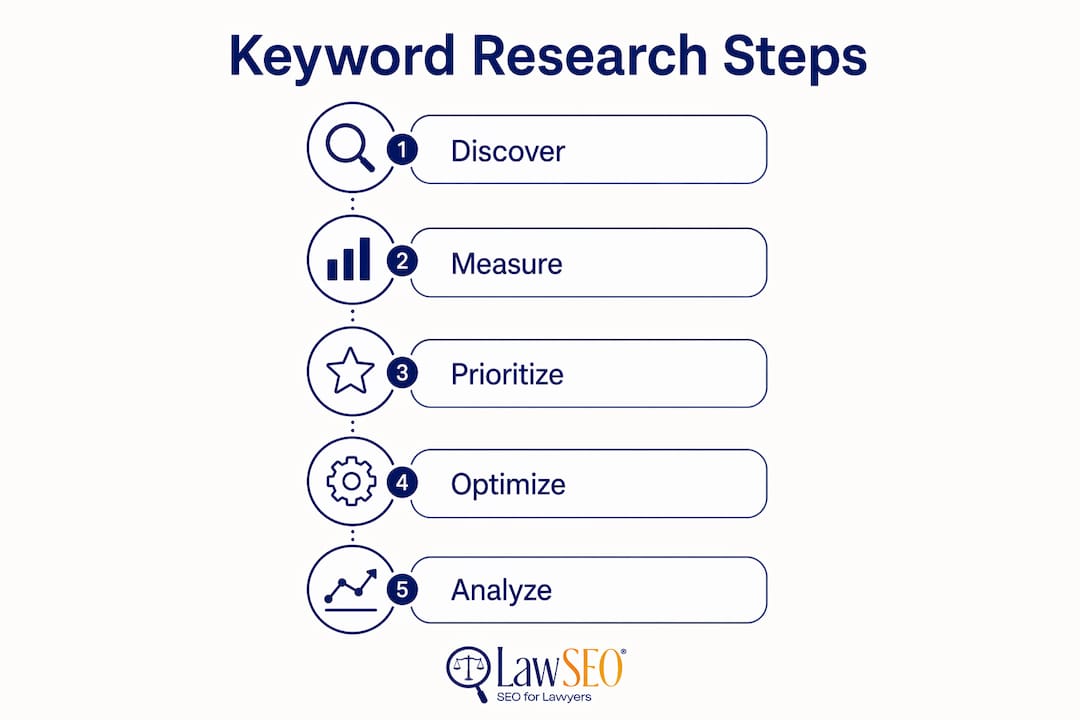
The process covers three core activities: discovering which keywords exist, measuring their demand and competition, and prioritizing which ones your firm should target first. Each activity requires a different tool and a different mindset.
How does Google Search Console enhance legal keyword research?
Google Search Console (GSC) provides first-party performance metrics including clicks, impressions, click-through rate (CTR), and average position. First-party data comes directly from Google’s own systems, which makes it more accurate than any third-party estimate.

CTR is calculated as clicks divided by impressions. A query with 1,000 impressions and 10 clicks has a 1% CTR. That number alone tells you nothing useful. You need to see average position alongside it. A 1% CTR at position 3 signals a title or meta description problem. The same CTR at position 15 signals a ranking problem. GSC metrics form a diagnostic chain, and reading them in isolation leads to the wrong fix.
The most valuable workflow in GSC for legal marketers is filtering for high-impression, low-CTR queries. These are pages your firm already ranks for but fails to attract clicks. Rewriting the page title and meta description to better match search intent often produces fast results without creating new content.
GSC also offers advanced filtering through regex, which uses Google’s RE2 syntax for precise query and page analysis. Most legal marketers never use this feature. Attorneys who do use it can isolate all queries containing a specific practice area or city name in seconds.
Pro Tip: Use GSC’s date comparison feature to measure performance before and after any content update. Set a 90-day window to see whether your title and copy changes improved CTR on targeted legal queries.
Key GSC capabilities for legal keyword research:
- Performance report: Shows every query driving impressions to your site, including queries you did not intentionally target
- Date comparison: Reveals whether keyword performance improved or declined after site changes
- Regex filtering: Isolates specific query patterns, such as all queries containing a city name plus a practice area
- Page-level filtering: Shows which queries drive traffic to a specific practice area page
- CTR benchmarking: Identifies underperforming pages where snippet optimization will have the highest impact
What role does Google Keyword Planner play in legal keyword discovery?
Google Keyword Planner is an advertiser-first tool built for Google Ads campaigns. It provides keyword ideas with estimated search volume ranges and cost-per-click (CPC) data. For legal marketers, it serves as a discovery engine, not a ranking difficulty meter.
The volume ranges Keyword Planner provides are directional. A query listed as “1,000–10,000 monthly searches” could mean 1,100 searches or 9,800 searches. Treat these numbers as signals of relative demand, not exact forecasts. Validate keyword clusters with GSC impression data to confirm actual search activity for your firm’s site.
The most common mistake legal marketers make with Keyword Planner is confusing advertiser competition with organic ranking difficulty. Advertiser competition measures Google Ads bidding density, not how hard it is to rank organically. A keyword with “high” competition in Keyword Planner may be relatively easy to rank for organically, and vice versa.
Pro Tip: Use Keyword Planner’s “Discover new keywords” feature by entering your firm’s homepage URL. Google will suggest queries it associates with your site, often revealing practice area terms you have not yet targeted.
Keyword Planner strengths for legal keyword discovery:
- New keyword ideas: Generates related queries based on seed terms like “divorce attorney” or “DUI lawyer”
- CPC data: High CPC values signal commercial intent, which correlates with hire-ready queries
- Trend data: Shows seasonal search patterns, useful for practice areas like tax law or personal injury
- Geographic filtering: Narrows volume estimates to specific cities, counties, or states
How to categorize and prioritize legal keywords for effective SEO
User intent classification divides legal keywords into three categories: informational, navigational, and transactional. Each category serves a different purpose in your content strategy.
Informational queries include phrases like “how long does a divorce take” or “what is a felony charge.” These queries attract readers who are researching, not yet ready to hire. Navigational queries target a specific firm by name. Transactional queries signal hiring intent: “divorce attorney near me,” “criminal defense lawyer Chicago,” or “personal injury attorney free consultation.” Transactional keywords belong on your money pages. Informational keywords belong in blog content and FAQs.
Local modifiers are the most powerful tool in a law firm’s keyword strategy. Combining a practice area with a city or county name creates a highly specific query with clear geographic intent. “Family law attorney Austin TX” converts at a higher rate than “family law attorney” because the searcher has already defined their market. Long-tail keywords with local modifiers typically face less competition and deliver better conversion rates than broad, national terms.
Competitor keyword analysis reveals content gaps your firm can fill. Use GSC to identify queries where competitors rank in positions 1–3 while your firm ranks in positions 8–15. Those gaps represent pages that need stronger content, better internal linking, or updated titles.
Keyword intent comparison
| Keyword type | Example | Best page type | Primary goal |
|---|---|---|---|
| Transactional | “car accident lawyer Houston” | Practice area page | Drive consultation requests |
| Informational | “how to file a personal injury claim” | Blog post or FAQ | Build authority and trust |
| Local long-tail | “DUI attorney Phoenix AZ free consult” | Landing page | Capture high-intent local traffic |
| Navigational | “Smith Law Firm reviews” | Homepage or review page | Capture branded searches |
Keyword clustering organizes related queries into topic groups. All queries related to “divorce” in a specific city belong in one cluster, mapped to one primary page. This prevents keyword cannibalization, where multiple pages compete for the same query and dilute each other’s rankings.
What are expert strategies to avoid common pitfalls in legal keyword research?
The most effective workflow for law firm keyword research uses a two-layer prioritization system. Start by targeting practice-area plus city modifier keywords for your money pages. These are your highest-value targets. Then use GSC to identify existing pages that already rank in positions 6–20 for relevant queries. Optimizing those pages produces faster results than building new content from scratch.
Avoid treating Keyword Planner volume numbers as absolute. Use volume estimates directionally to validate that a keyword cluster has meaningful demand, then confirm with GSC impression data. This two-tool approach eliminates the guesswork that comes from relying on a single data source.
Match search intent in every page title and meta description. A page titled “Personal Injury Services” does not match the query “personal injury lawyer Dallas.” A title like “Dallas Personal Injury Lawyer | Free Consultation” matches the query and the intent. That alignment directly improves CTR, which GSC will confirm within 30–60 days of the change.
Additional best practices for legal keyword research:
- Update keywords quarterly: Search behavior shifts. Queries that drove traffic last year may have declined. GSC date comparisons catch these shifts early.
- Do not ignore anonymized queries: GSC groups low-volume queries under “other.” These often contain long-tail gems that reveal niche client needs.
- Separate branded from non-branded queries: Filter out your firm’s name in GSC to see how you perform for non-branded legal queries, which represent new client acquisition potential.
- Monitor content performance regularly: Pages that ranked well 12 months ago may have slipped. Refreshing content based on current GSC data recovers lost rankings.
How to practically implement a legal keyword research plan
A structured implementation plan turns keyword data into results. Follow these steps to build and execute a keyword strategy for your law firm.
- Audit your current rankings. Open GSC and export your top 50 queries by impressions. Identify which practice areas already have traction and which have none.
- Build your seed keyword list. Use Google Keyword Planner with your practice areas as seed terms. Generate 50–100 candidate keywords per practice area.
- Apply local modifiers. Combine each practice area keyword with your target cities, counties, and metro areas. A firm in three cities may generate 300+ localized keyword targets from a single practice area.
- Classify by intent. Sort your keyword list into transactional, informational, and navigational buckets. Assign each transactional keyword to an existing or planned money page.
- Prioritize by opportunity. Cross-reference Keyword Planner volume data with GSC position data. Keywords with meaningful volume where your site ranks in positions 6–20 are your highest-priority targets.
- Optimize existing pages first. Update titles, meta descriptions, and page copy for your top-priority keywords. This step costs less than creating new content and often delivers faster ranking improvements.
- Create new content for gaps. For informational keywords with no existing page, build blog posts or FAQ content. Link these pages to your money pages to pass authority.
- Track and refine monthly. Set a monthly GSC review to measure CTR and position changes. Adjust titles and content based on what the data shows.
This process connects directly to broader law firm SEO ranking factors, including site authority, page experience, and content depth. Keyword research is the input. Those factors determine the output.
Key Takeaways
Legal keyword research produces results only when you combine Google Search Console’s first-party data with Google Keyword Planner’s discovery capabilities and apply both to intent-classified, locally modified keyword targets.
| Point | Details |
|---|---|
| GSC is your primary validation tool | Use clicks, impressions, CTR, and position together as a diagnostic chain, not as isolated metrics. |
| Keyword Planner is for discovery, not difficulty | Volume ranges signal demand; they do not measure organic ranking competition. |
| Transactional keywords drive revenue | Prioritize practice-area plus city modifier keywords for money pages above all other targets. |
| Intent classification shapes content type | Transactional queries belong on landing pages; informational queries belong in blog content. |
| Optimization beats creation | Improving existing pages that rank in positions 6–20 produces faster results than building new content. |
What I have learned after 29 years of legal keyword research
Most attorneys I work with come in thinking keyword research means finding the highest-volume terms and building pages around them. That instinct is understandable. It is also the wrong approach for law firms.
The legal market is local by nature. A family law attorney in Phoenix does not compete with one in Boston. That geographic reality means the most valuable keywords are almost always mid-volume, locally modified, and highly specific. “Divorce attorney Scottsdale AZ” will outperform “divorce attorney” every time in terms of actual client acquisition, even if the national term shows ten times the search volume.
The other thing I see constantly is firms ignoring what GSC is already telling them. Your site is probably ranking on page two for a dozen queries right now. Those queries are not bringing in clients because nobody clicks page two results. A title rewrite and a stronger meta description on those pages can move them to page one within weeks. That is not a theory. I have seen it happen repeatedly across practice areas ranging from immigration to estate planning.
The firms that win at legal SEO treat keyword research as an ongoing process, not a one-time task. They check GSC monthly, update content quarterly, and adjust their keyword targets as their market evolves. That discipline, more than any single tactic, is what separates the firms that dominate their local search results from those that wonder why their website does not generate leads.
— TODD
Lawseo’s approach to law firm keyword strategy
Keyword research is one piece of a larger SEO system. Without strong on-page optimization, authoritative content, and technical site health, even the best keyword targets will not produce first-page rankings. Lawseo works exclusively with law firms, applying the same data-driven keyword methodology described here across every client campaign. Todd R. Stager personally reviews strategy for each firm, with over 29 years of legal SEO experience behind every recommendation. For attorneys ready to move beyond guesswork and build a search presence that generates consistent leads, the 7 proven legal SEO strategies at Lawseo provide a direct path forward. You can also review the full range of law firm SEO services to see how keyword research fits into a complete digital marketing plan.
FAQ
What is keyword research for lawyers?
Keyword research for lawyers is the process of identifying the search terms potential clients use when looking for legal services, then prioritizing those terms to guide SEO content and page optimization. The goal is to attract hire-ready traffic, not just general visitors.
How does Google Search Console help with legal keyword research?
Google Search Console provides first-party data on which queries drive impressions and clicks to your site, along with CTR and average position. This data identifies underperforming pages where title and copy changes can improve rankings and traffic.
What is the difference between Keyword Planner competition and organic difficulty?
Google Keyword Planner’s competition metric measures advertiser bidding density in Google Ads, not how hard it is to rank organically. A keyword with high advertiser competition may still be achievable through organic SEO with the right content strategy.
Why are local modifiers important for law firm keywords?
Local modifiers like city and county names narrow a keyword’s geographic intent, which matches how clients actually search for attorneys. Localized keywords also face less competition than broad national terms and convert at higher rates.
How often should a law firm update its keyword strategy?
A law firm should review its keyword performance in Google Search Console at least monthly and refresh its keyword targets quarterly. Search behavior shifts over time, and regular updates prevent rankings from declining without notice.