


TL;DR:
- Google’s local search algorithm ranks law firms based on relevance, distance, and prominence. Optimizing your Google Business Profile, generating consistent reviews, and encouraging user engagement are essential to improve local pack rankings. Sustained effort in these areas helps law firms dominate local search results and attract more clients.
Google’s local search algorithm is an automated ranking system that determines which law firms appear in local search results based on three weighted factors: relevance, distance, and prominence. Understanding what is local search algorithm means understanding that Google evaluates roughly 150 distinct signals across these categories before placing any firm in the local pack. For attorneys, this system is the primary gateway to new client acquisition. A firm that ranks in the top three local results captures the majority of local search clicks. A firm that does not rank there is largely invisible to potential clients searching nearby.
What are the main factors in a local search algorithm?
Google filters every local business through relevance, distance, and prominence before producing local pack rankings. Each factor carries a different weight, and understanding that weight distribution tells you where to focus your effort.
Relevance measures how well your Google Business Profile (GBP) matches what a user is searching for. A personal injury firm that lists “Personal Injury Attorney” as its primary category will rank for personal injury queries far more consistently than a firm that uses a generic “Law Office” label.
Distance measures proximity between your firm’s listed address and the user’s location at the time of the search. Google does not always favor the closest result, but distance remains a significant filter. A firm located outside a searcher’s city faces a structural disadvantage that no amount of profile optimization can fully overcome.
Prominence is the most complex factor. It reflects how well known and trusted your firm is, both online and offline. Prominence draws from several signal categories:
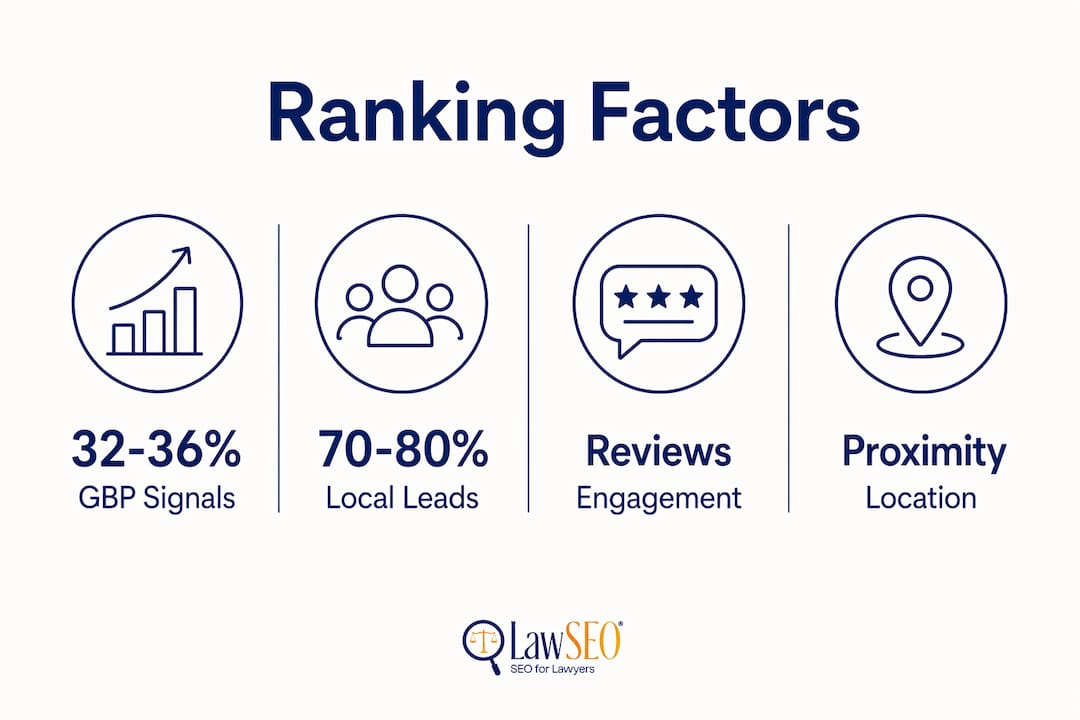
- GBP signals: Account for approximately 32–36% of total local pack ranking weight, making them the single highest factor in the algorithm. This includes category accuracy, profile completeness, and posting activity.
- Review signals: Contribute 16–20% of total local pack ranking weight. Review quantity, velocity, recency, and sentiment all feed the algorithm.
- Behavioral signals: Form approximately 8% of local ranking weight. These include click-through rates, call clicks, and direction requests from your profile.
- Entity recognition: Google increasingly identifies law firms as trusted entities based on consistent name, address, and phone number (NAP) data across the web.
The 32–36% weight assigned to GBP signals is the clearest directive in local search optimization. It tells you that your Google Business Profile is not a secondary concern. It is the primary lever.
How does Google Business Profile optimization affect local search results?
Your Google Business Profile is the single most influential factor in local search rankings for law firms. Think of it as a free storefront that Google evaluates on completeness, accuracy, and activity. Every field you leave empty is a signal that your firm is inactive or unengaged.

Profile completeness is critical. Empty fields do not just look unprofessional. They reduce your ranking potential because Google interprets missing information as a gap in relevance signals. A complete profile includes a detailed business description, service menus with practice area descriptions, high-quality photos of your office and team, and accurate business hours.
The most impactful single action you can take is selecting the correct primary category. A precisely selected primary category can produce 2 to 4 position improvements in Google Maps rankings within 3 to 5 weeks. That is a measurable outcome from a single configuration change.
Follow this sequence to build a high-performing GBP for your law firm:
- Set your primary category to your core practice area (e.g., “Personal Injury Attorney,” “Criminal Justice Attorney,” or “Family Law Attorney”). Do not use a generic label.
- Add secondary categories for each additional practice area your firm handles. Secondary categories expand your relevance footprint without diluting your primary signal.
- Write a complete business description that names your practice areas, geographic service area, and any notable credentials. Avoid keyword stuffing. Write for the reader, not the algorithm.
- Upload photos regularly. Firms with active photo uploads show higher engagement rates than those with static profiles.
- Post updates at least twice per month. Google Posts signal activity and keep your profile fresh in the algorithm’s eyes.
- Enable messaging and maintain response times. Fast response times feed behavioral signals that the algorithm tracks.
Pro Tip: Avoid adding every possible secondary category to your GBP. Selecting categories unrelated to your actual practice areas confuses the relevance signal and can suppress your rankings for your core practice area.
Behavioral signals deserve special attention. The Map Pack drives 70–80% of local leads, and those leads come from users who click, call, or request directions directly from a GBP listing. Google tracks these interactions. A profile that generates consistent clicks and calls tells the algorithm that real users find it useful. A profile with zero interaction, even a complete one, sends a weaker signal.
What role do reviews and behavioral engagement play in local rankings?
Reviews are the second most powerful signal category in the local search algorithm, and most law firms underinvest in them. The algorithm does not just count how many reviews you have. It evaluates velocity, recency, sentiment, and platform diversity.
“Ranking drops when a review stream stops and improves when review generation resumes. Law firms that treat review acquisition as a one-time task will consistently lose ground to competitors who treat it as an ongoing system.”
87% of consumers read online reviews before visiting a local business. For law firms, that number likely skews higher because the stakes of choosing an attorney are significant. A strong review profile does double duty: it improves your algorithm ranking and it converts searchers into callers.
The key review signals the algorithm weighs include:
- Volume: More reviews generally produce stronger ranking signals, but only when paired with recency.
- Velocity: A steady stream of new reviews outperforms a large but stagnant review count. Maintaining a steady stream of new reviews is the single most reliable way to sustain local rankings over time.
- Recency: Reviews older than 90 days carry less weight than recent ones. The algorithm rewards firms that consistently earn new feedback.
- Sentiment: Google’s natural language processing reads review text. Reviews that mention specific practice areas and positive outcomes reinforce your relevance signals.
- Platform diversity: Reviews on Avvo, Martindale-Hubbell, and Yelp contribute to your prominence signals alongside Google reviews.
Behavioral engagement works alongside reviews to complete the picture. Click-through rates from search results, time spent on your website after clicking, and bounce rates all feed back into the local algorithm. A firm that ranks in position four but earns a higher click-through rate than the firm in position two will, over time, see its ranking improve. This is why your GBP listing title, review rating, and photo quality matter even before a user visits your website.
AI-generated Overviews in Google search results now pull entity data from GBP profiles and review content. Law firms with strong entity recognition, consistent NAP data, and detailed review text are more likely to appear in these AI summaries. This is a new dimension of local search optimization that compounds the value of every review you earn.
How do local pack rankings differ from organic SEO for law firms?
Local pack rankings and standard organic rankings operate on different algorithms and reward different signals. Understanding both helps you allocate your effort correctly.
Local pack results are determined primarily by GBP signals, review signals, and proximity. Organic rankings rely more heavily on on-page SEO, domain authority, and backlink profiles. The local pack generates 60–75% of local inquiries. Organic results capture the remaining traffic. Both matter, and neither replaces the other.
| Factor | Local pack algorithm | Organic algorithm |
|---|---|---|
| Primary signal | GBP completeness and category | On-page content and keyword relevance |
| Trust signal | Review volume and recency | Domain authority and backlinks |
| Location signal | Physical address proximity | Location-specific page content |
| Behavioral signal | Clicks, calls, direction requests | Click-through rate, dwell time |
| Citation signal | NAP consistency across directories | Authoritative external links |
The practical implication for law firms is clear. You need a strong Google Maps presence to capture the majority of local search traffic, and you need a well-optimized website to capture the organic traffic that the local pack does not cover. Local backlinks from bar associations, local news outlets, and legal directories strengthen both your organic domain authority and your local prominence signals simultaneously. That overlap is where the most efficient SEO investment lives.
Key Takeaways
The local search algorithm rewards law firms that maintain complete GBP profiles, generate consistent reviews, and produce genuine user engagement signals across all three ranking pillars.
| Point | Details |
|---|---|
| GBP signals dominate | GBP signals account for 32–36% of local pack ranking weight. Prioritize profile completeness and category accuracy first. |
| Reviews require velocity | A steady stream of new reviews outperforms a large but stagnant count. Build a system, not a one-time campaign. |
| Behavioral signals compound | Clicks, calls, and direction requests feed the algorithm. A well-optimized listing earns more engagement, which earns better rankings. |
| Local pack vs. organic | Local pack drives 60–75% of local inquiries. Organic SEO captures the rest. Both require separate, sustained effort. |
| Primary category precision | Selecting the exact right primary category can move your Maps ranking 2 to 4 positions within weeks. |
What I’ve learned after 29 years of watching local algorithms evolve
Most law firms treat local SEO as a setup task. They claim their GBP, fill in the basics, and move on. That approach worked in 2015. It does not work now.
The firms I see consistently dominating local pack results share one trait: they treat local SEO as a compounding system, not a one-time project. GBP completeness, review velocity, and entity recognition do not produce results in isolation. They build on each other. A complete profile earns more clicks. More clicks generate more behavioral signals. Stronger behavioral signals improve rankings. Better rankings produce more reviews. The cycle is predictable once you commit to maintaining it.
The behavioral signal piece is the most underexploited factor I encounter with law firm clients. Attorneys spend significant resources on profile setup and review generation but ignore the interaction data their profiles produce. If your GBP listing is not generating calls and direction requests, the algorithm interprets that as low user interest, regardless of how complete your profile is. Monitoring and responding to that engagement gap is where experienced legal SEO strategy separates itself from basic profile management.
My advice is direct: build a monthly review generation process, audit your GBP for completeness every quarter, and track your behavioral signals in Google Business Profile Insights. The firms that do this consistently do not worry about algorithm updates. They are already doing what the algorithm rewards.
— TODD
How Lawseo helps law firms win in local search
Lawseo works exclusively with attorneys and law firms, which means every local SEO strategy we build is designed for the specific competitive dynamics of legal markets. Our approach covers Google Business Profile optimization, review generation systems, and behavioral signal monitoring, all calibrated to the ranking factors that matter most for law firms. Todd R. Stager, with over 29 years of SEO experience, personally reviews every client campaign. If your firm is not appearing in the local pack for your core practice areas, the gap is fixable with the right system. Explore Lawseo’s law firm SEO services to see how a specialized approach produces consistent, measurable results for legal practices.
FAQ
What is a local search algorithm in simple terms?
A local search algorithm is Google’s automated system for ranking nearby businesses in search results. It evaluates relevance, distance, and prominence to decide which firms appear in the local pack.
How does Google Business Profile affect local rankings?
GBP signals account for 32–36% of local pack ranking weight, making it the highest single factor. Profile completeness, category accuracy, and user engagement all contribute to that signal.
How many reviews does a law firm need to rank locally?
There is no fixed number. Review velocity and recency matter more than total count. A firm earning two to three new reviews per month consistently will outperform a firm with 50 older reviews and no new activity.
What is the difference between local pack and organic search results?
The local pack is the map-based results block driven by GBP signals and proximity. Organic results appear below it and are driven by on-page SEO and domain authority. The local SEO checklist for law firms addresses both.
Do behavioral signals like clicks and calls actually affect rankings?
Yes. Behavioral signals including click-through rates, call clicks, and direction requests form approximately 8% of local ranking weight. Consistent user interaction with your GBP listing is a direct ranking input.