

Most law firm marketers treat Core Web Vitals as a technical afterthought, assuming their impact on SEO is minimal compared to content and backlinks. This misconception costs firms thousands in lost leads monthly. Core Web Vitals are a set of specific factors Google considers essential in a webpage’s overall user experience, directly influencing your rankings and client acquisition. Understanding and optimizing these metrics separates firms that dominate search results from those struggling for visibility. This guide reveals exactly what Core Web Vitals measure, why they matter uniquely for law firms, and how to implement improvements that drive measurable SEO gains.
Key Takeaways
| Point | Details |
|---|---|
| Core Web Vitals defined | Core Web Vitals are three metrics that measure load speed, interactivity, and visual stability and they influence Google rankings. |
| SEO impact on law firms | For law firms these metrics influence ranking opportunities and can tilt results in competitive practice areas. |
| Focus on LCP first | Focus on LCP first because it most strongly shapes user perception of page speed. |
| Common law firm pitfalls | Law firms often struggle with CLS and dynamic content that causes layout shifts, harming user experience and rankings. |
| Practical optimization steps | Implement practical optimization steps such as faster image loading, reducing render blocking resources, and stabilizing layouts to improve scores and conversions. |
Understanding core web vitals and their importance for law firms
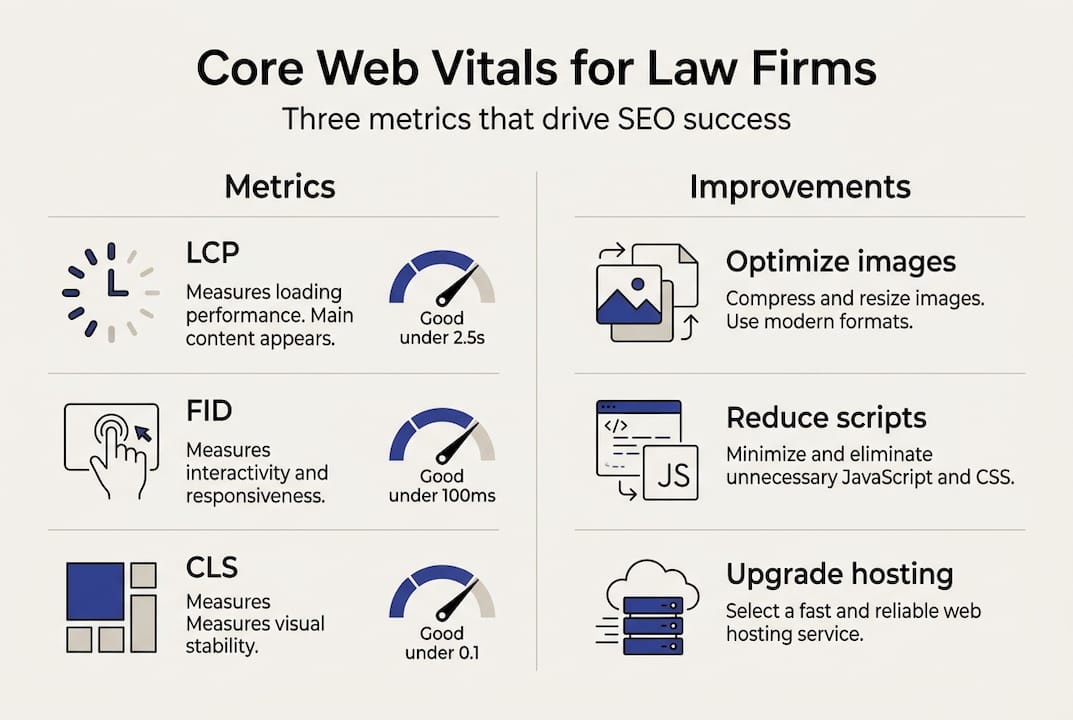
Core Web Vitals consist of three specific metrics that quantify user experience in ways Google can measure objectively. Largest Contentful Paint (LCP) tracks how quickly the main content of your page loads, with an ideal target under 2.5 seconds. This metric matters enormously for law firms because potential clients researching legal issues want immediate answers. When your practice area page takes five seconds to display its primary content, prospects leave for competitors.
First Input Delay (FID) measures the time between a user’s first interaction with your page and when the browser can actually respond to that interaction. Think of someone clicking your “Free Consultation” button and waiting while nothing happens. Good FID scores stay under 100 milliseconds. For law firms competing in high-stakes practice areas like personal injury or criminal defense, every millisecond of delay increases the chance a prospect calls someone else.
Cumulative Layout Shift (CLS) quantifies visual stability by tracking unexpected movement of page elements during loading. You’ve experienced this: clicking a phone number just as an image loads above it, shifting everything down and causing you to tap the wrong element. Law firm sites often struggle with CLS because of advertisements, embedded videos, or dynamically loaded testimonials that push content around. A good CLS score stays below 0.1.
These metrics matter more for law firms than many other industries because trust drives client acquisition. When your website feels slow, unresponsive, or unstable, prospects subconsciously question your competence. Technical SEO for lawyers encompasses Core Web Vitals as foundational elements that signal both technical excellence and user-centered design.
Google explicitly uses these metrics in ranking decisions. Sites with better Core Web Vitals scores receive preferential treatment in search results, all other factors being equal. For competitive legal keywords where ten firms might have similar content quality and backlink profiles, Core Web Vitals become the tiebreaker.
Pro Tip: Focus first on LCP improvements because this metric most heavily influences user perception of your site’s speed and responsiveness, creating the strongest first impression for potential clients.
How core web vitals impact SEO rankings and user experience for law firms
Pages with better Core Web Vitals scores tend to rank higher and keep visitors engaged longer. Google incorporated these metrics into its ranking algorithm as part of broader page experience signals in 2021, and their importance has only grown. For law firms, this creates both challenge and opportunity. Firms that optimize Core Web Vitals gain ranking advantages while simultaneously improving the actual client experience that drives conversions.
Poor Core Web Vitals correlate directly with higher bounce rates and fewer quality leads. Research shows that pages loading in one second have conversion rates three times higher than pages loading in five seconds. When your personal injury landing page takes six seconds to become interactive, prospects researching after an accident will find faster competitors. Every additional second of load time increases bounce probability by roughly 32%.
User experience shapes law firm reputation in ways that extend beyond immediate conversions. Prospects who encounter slow, janky websites associate those negative experiences with your firm’s overall professionalism. Even if they eventually convert through another channel, that initial poor impression creates hesitation and reduces perceived value.
Google’s perspective on page experience emphasizes user-centered design:
A good page experience doesn’t override having great, relevant content. However, in cases where there are multiple pages that have similar content, page experience becomes much more important for visibility in Search.
This statement reveals the strategic importance for law firms. In competitive markets where dozens of firms target identical keywords with similar content strategies, Core Web Vitals provide measurable differentiation.
Several ranking factors connect directly to Core Web Vitals performance:
- Mobile usability scores improve when pages load quickly and remain stable during interaction
- Dwell time increases when users can immediately engage with content rather than waiting for interactivity
- Return visitor rates climb when initial experiences feel fast and professional
- Social sharing rises when pages load quickly enough that users actually see shareable content
Website speed for law firms directly influences these interconnected ranking signals, creating compounding SEO benefits. Firms that invest in Core Web Vitals optimization see improvements across multiple metrics simultaneously, amplifying their competitive advantages in search results.
Common challenges law firms face with core web vitals and how to diagnose them
Many law firm sites struggle with large images and slow server response time, hurting Core Web Vitals. The most frequent culprits include hero images exceeding 2MB, unoptimized attorney headshots, and high-resolution case result graphics that look impressive but devastate loading performance. These visual elements feel necessary for establishing credibility, creating tension between design goals and performance requirements.
Heavy JavaScript frameworks present another common problem. Many law firms use website builders or themes loaded with features they never actually use. Each unused feature still requires the browser to download, parse, and execute JavaScript code. Chat widgets, analytics trackers, social media feeds, and marketing automation scripts pile onto pages, delaying interactivity and tanking FID scores.
Slow hosting environments compound these issues. Budget shared hosting plans often lack the server resources needed to deliver content quickly, especially during traffic spikes when multiple prospects visit simultaneously. Server response times exceeding 600 milliseconds guarantee poor LCP scores regardless of other optimizations.
Layout shifts plague law firm sites because of dynamically loaded elements. Advertisement spaces that reserve no height, embedded videos without defined dimensions, and web fonts that cause text reflow all contribute to poor CLS scores. Testimonial carousels and notification bars that appear after initial page load push content unexpectedly.
Pro Tip: Use Google PageSpeed Insights and Search Console Core Web Vitals report to track issues with real user data rather than just lab testing, giving you accurate insights into how actual prospects experience your site.
| Metric | Before optimization | After optimization | Improvement |
|---|---|---|---|
| LCP | 5.2 seconds | 1.8 seconds | 65% faster |
| FID | 280 milliseconds | 45 milliseconds | 84% improvement |
| CLS | 0.42 | 0.06 | 86% more stable |
| Mobile usability score | 67/100 | 94/100 | 40% increase |
Interpreting diagnostics requires understanding which issues deliver the highest impact for law firms specifically. Start by identifying pages that generate the most organic traffic and leads. These high-value pages deserve optimization priority. Structuring law firm websites for SEO includes organizing content hierarchies that facilitate efficient Core Web Vitals optimization across your most important pages.
PageSpeed Insights provides specific recommendations ranked by potential impact. Focus first on opportunities marked as high impact that require moderate effort. Eliminating render-blocking resources, properly sizing images, and reducing unused JavaScript typically deliver the best return on optimization investment.
Effective strategies for law firms to improve their core web vitals
Technical SEO improvements such as optimizing images and reducing JavaScript improve Core Web Vitals and client engagement. Implementing these strategies requires systematic approaches that balance performance gains with maintaining professional presentation standards that legal clients expect.
| Optimization tactic | Primary benefit | Implementation difficulty | Impact on Core Web Vitals |
|---|---|---|---|
| Convert images to WebP format | Reduces file sizes 25-35% without quality loss | Low | Improves LCP significantly |
| Implement lazy loading for below-fold images | Decreases initial page weight | Low | Improves LCP and FID |
| Upgrade to performance-optimized hosting | Reduces server response time | Medium | Improves all three metrics |
| Minify and defer non-critical CSS/JavaScript | Eliminates render-blocking resources | Medium | Improves LCP and FID |
| Reserve space for dynamic content | Prevents layout shifts | Low | Improves CLS dramatically |
| Use content delivery network (CDN) | Serves assets from geographically closer servers | Medium | Improves LCP |
Follow this numbered sequence to audit and implement Core Web Vitals improvements systematically:
- Run PageSpeed Insights tests on your five highest-traffic pages and document current scores for LCP, FID, and CLS along with specific recommendations.
- Audit all images on priority pages, identifying files exceeding 200KB and converting them to WebP format while implementing responsive image sizing.
- Review and eliminate unnecessary scripts, removing unused plugins, redundant analytics trackers, and non-essential third-party integrations.
- Implement lazy loading for all images and videos that appear below the initial viewport, reducing the resources browsers must load immediately.
- Add explicit width and height attributes to all images and reserve space for advertisements or dynamic elements to prevent layout shifts.
- Test server response times and upgrade hosting if initial response consistently exceeds 200 milliseconds under normal traffic conditions.
- Enable compression for text-based resources and implement browser caching with appropriate expiration headers for static assets.
- Retest all pages after implementing changes, comparing new scores against baseline measurements to verify improvements.
- Monitor Core Web Vitals monthly through Search Console to catch regressions from new content additions or design changes.
- Document your optimization process and standards to ensure future website updates maintain Core Web Vitals performance.
Balancing aesthetics and performance requires strategic decisions about which visual elements truly serve client acquisition goals. That 4MB hero video might look impressive, but does it actually increase consultation requests? Testing reveals that faster-loading pages with simpler designs often convert better than elaborate pages that frustrate users with slow performance.
Collaboration between marketing and web development teams becomes essential. Marketers understand which pages drive leads and what messaging resonates with prospects. Developers know how to implement optimizations without breaking functionality. Regular communication ensures performance improvements align with business objectives rather than just chasing arbitrary scores.
On-page SEO for lawyers guide integrates Core Web Vitals optimization with content strategy, ensuring technical performance supports rather than undermines your broader SEO initiatives. The most successful law firms treat Core Web Vitals as ongoing priorities rather than one-time projects, continuously monitoring and refining performance as their sites evolve.
Enhance your law firm’s SEO with expert guidance
Optimizing Core Web Vitals requires specialized expertise that combines technical SEO knowledge with understanding of law firm marketing dynamics. SEO for Lawyers LLC delivers comprehensive optimization services designed specifically for legal practices, addressing Core Web Vitals alongside content strategy, link building, and local SEO. Our team has helped hundreds of law firms improve their search visibility through systematic technical improvements that drive measurable client acquisition results. Explore our advanced SEO strategy for lawyers resources to understand how Core Web Vitals fit within broader optimization frameworks. Compare implementation options and tools through our top SEO platforms for lawyers guide to find solutions matching your firm’s specific needs and technical capabilities.
Frequently asked questions about core web vitals for law firms
What exactly are core web vitals and why should law firms care?
Core Web Vitals are three specific metrics Google uses to measure user experience: loading speed (LCP), interactivity (FID), and visual stability (CLS). Law firms should care because these metrics directly influence search rankings and client conversion rates, making them essential for competitive online visibility.
How long does it take to see SEO improvements after optimizing core web vitals?
Most law firms see initial ranking improvements within 4-8 weeks after implementing Core Web Vitals optimizations, though full impact may take 3-4 months as Google recrawls and reassesses pages. User experience metrics like bounce rate and time on site typically improve immediately once optimizations go live.
Can I improve core web vitals without hiring a developer?
Basic improvements like image optimization, removing unused plugins, and enabling caching can be done without developer expertise using tools and plugins. However, significant improvements to LCP and FID often require technical interventions like server upgrades, code optimization, and infrastructure changes that benefit from professional development expertise.
Do core web vitals matter more for mobile or desktop law firm visitors?
Google primarily uses mobile performance for ranking decisions, making mobile Core Web Vitals scores more important for SEO. However, many legal clients still research from desktop computers, so optimizing both experiences ensures you don’t lose prospects on either platform.
How do core web vitals relate to other technical SEO factors for law firms?
Core Web Vitals represent one component of technical SEO alongside site architecture, crawlability, structured data, and security. They work together synergistically, with improvements in one area often supporting gains in others, creating compounding benefits for search visibility and user engagement.