


A multi-office law firm has to treat each physical location as its own local SEO entity, not a satellite of the main office. That means a verified Google Business Profile, a unique location page, a local phone number, and consistent citations for every single address. Skip any one of those four and that office competes for rankings with one hand tied behind its back.
The priority order matters as much as the tasks themselves. In the first 48 to 72 hours after opening or auditing an office, focus on these four moves:
- Verify (or start verifying) the office’s Google Business Profile under its own listing, not a duplicate of headquarters
- Publish a standalone location page with a unique H1, embedded map, and attorney names
- Assign that office a local phone number rather than a routed line to a central call center
- Run a citation audit across state bar directories and legal listing sites to catch old addresses or duplicate entries
GBP verification for a new office typically takes one to four weeks depending on the verification method Google requires, and firms that treat each office as a distinct entity tend to see the location page and citation work compound faster once every profile matches. The first KPI worth watching isn’t rankings. It’s whether that office’s GBP shows up correctly in a map search from within its own city, using a device that has no search history tied to the firm.
Key Takeaways
Multi-location SEO succeeds when every office is built, verified, and maintained as its own local entity, with GBP, citations, schema, and reviews all consistent to that specific address.
| Point | Details |
|---|---|
| Verify GBP per office | Confirm real staffing, signage, and hours before submitting; never duplicate a practitioner listing. |
| Fix citation consistency first | Build a source-of-truth NAP record per office and audit tier-one legal directories quarterly. |
| Write substantive location pages | Aim for 600 to 1,200 words per page with a map, named attorneys, and local court details. |
| Nest schema by office | Use Organization to LocalBusiness to Person with @id linking and complete geo data. |
| Bring in specialized help at scale | Lawseo offers a launch audit, pilot office build, and roll-out retainer tailored to law firm compliance needs. |
What Makes Multi-Location SEO Different From Single-Office SEO?
Single-office SEO optimizes for one set of local signals. Multi-location SEO optimizes for proximity and prominence separately, office by office, and the two forces pull in different directions if you’re not careful.
Google’s local algorithm weighs three things for every query: relevance, distance, and prominence. For a single-office firm, distance is fixed and prominence accumulates in one place. For a firm with five offices, each location competes on its own distance calculation against every other law firm near it, while prominence signals (reviews, citations, links) either concentrate around one office or spread thin across all of them. Get the balance wrong and you end up with one strong office cannibalizing the visibility of the others.
Three failure modes show up constantly in multi-office campaigns:
- Content cannibalization. Near-identical location pages competing against each other for the same keywords, confusing Google about which page to rank for “personal injury lawyer near me.”
- Virtual-office suspensions. Firms list a coworking address or a P.O. box as a full office to chase rankings, and Google suspends the profile once it verifies there’s no legitimate staffed presence there.
- Shared phone number dilution. Every office routes calls to one central number, which strips away one of the clearest local trust signals Google and searchers both rely on.
The decision rule is simple, if not always comfortable: if an office has no attorney physically present during business hours, no signage, and no dedicated staff, it should not get a Google Business Profile. Use service-area settings instead and be honest about the coverage radius. Google’s own guidelines are explicit that profiles exist for real-world locations, and gaming that distinction is the single fastest way to lose every profile in the account, not just the one in question.
How Do You Set Up and Verify a Google Business Profile for Each Office?
Every legitimate office needs its own GBP, verified independently, with metadata that reflects how that specific location actually operates. “Legitimate” has a real bar: an attorney or staff member present during posted hours, visible signage identifying the firm, and a physical setup a client could walk into and be received.
Start with naming conventions. Use the firm’s real name exactly as it appears on the state bar registration and signage, adding a location descriptor only if the firm operates under different names at different offices. Do not append keywords like “Personal Injury Lawyer” to the business name; Google treats this as a policy violation and it’s one of the fastest ways to trigger a suspension review. Choose the primary category carefully, usually “Personal Injury Attorney,” “Family Law Attorney,” or “Law Firm,” and add secondary categories only when they genuinely apply to that office’s practice areas.
Phone numbers deserve more thought than most firms give them. A unique local number for each office, rather than a central line routed through an answering service, does three things: it satisfies the NAP consistency signal Google checks against citations, it gives call tracking software office-level attribution, and it reassures a searcher that they’re calling someone nearby rather than a call center. Routed numbers aren’t disqualifying on their own, but they weaken the local trust signal every citation and directory listing is trying to reinforce.
Verification itself typically runs through postcard, phone, email, or video, depending on the account’s history and Google’s own risk assessment for that listing. For firms managing several offices, a single GBP manager account with proper location grouping keeps verification organized and prevents duplicate profiles from getting created by different staff members unaware another listing already exists.
Before submitting any new profile, run through this checklist:
- Confirm the address matches signage and mail delivery exactly, including suite numbers
- Verify no existing profile already claims this address under an old firm name or a previous tenant
- Assign a unique local phone number and update it everywhere the office is already listed
- Set accurate hours, including holiday closures, and keep them synced across the firm’s Google Business Profile listings
- Add at least five real photos of the actual office, not stock imagery
Pro Tip: If two attorneys practice from the same suite under the same firm name, list one GBP for the office and add both attorneys as staff, not two separate profiles. Google’s guidelines specifically flag duplicate practitioner listings as a violation, and it’s one of the more common ways firms accidentally sabotage their own visibility.
Building Citation Consistency Across Every Office
Citation hygiene is the least glamorous part of multi-location SEO and one of the most consequential. A single office with an outdated suite number on three directories will not tank a campaign. Five offices with inconsistent name, address, and phone data scattered across forty directories will.
Start by building a source-of-truth record for every office: exact business name, address formatted the way the postal service would format it, unique phone number, website URL for that location’s page, and hours. This record becomes the reference every directory submission gets checked against, and it should live somewhere the whole team can access, not in one manager’s inbox.
- Audit existing citations for every office using the source-of-truth record as the benchmark, flagging any listing with an old address, a wrong suite number, or a merged entry from a previous tenant at that address.
- Prioritize tier-one legal directories first: Avvo, Justia, FindLaw, and Martindale-Hubbell carry more authority in the legal vertical than general business directories, and each office should have its own listing rather than sharing one firm-wide profile.
- Update state bar records for every attorney to reflect their correct office assignment, since bar directories are a citation source most firms overlook entirely.
- Submit to general business directories (Bing Places, Apple Maps, Yelp) only after the legal-specific directories are clean, since these carry less ranking weight but still need to match.
- Re-audit quarterly, because directories occasionally merge duplicate listings on their own, sometimes reviving an old address the firm thought it had corrected.
For firms running more than three offices, spreadsheet tracking stops scaling around office number four. A citation management platform that pushes updates to multiple directories from one dashboard saves hours of manual resubmission every time an office moves or a phone number changes.
Pro Tip: State bar listings are one of the most underused trust signals available to law firms. Updating an attorney’s office assignment in the state bar database costs nothing and often gets overlooked entirely while firms chase directory submissions that carry far less authority.
How Should You Structure Location Pages So Each Office Ranks?
The site architecture decision comes first: one domain with location subfolders, not separate domains or subdomains per office. A single domain consolidates domain authority and lets backlink equity from one office’s press mention lift the entire site, including offices that haven’t earned links of their own yet. Structure the folders clearly:
lawfirm.com/locations/dallaslawfirm.com/locations/fort-worthlawfirm.com/locations/plano
Avoid stacking location pages under practice-area folders in a way that buries them three clicks deep. A location page needs to sit close to the homepage in the site’s navigation, ideally linked from the main menu or footer on every page of the site.
Each location page needs enough substantive, unique content to avoid being flagged as a thin doorway page, and industry guidance points to a 600 to 1,200 word range as the practical minimum for a page that actually earns rankings rather than getting filtered out as duplicate content with a swapped city name.
| Element | Why it matters |
|---|---|
| Embedded Google Map | Confirms the exact address to both users and crawlers, reinforcing the GBP listing |
| Named attorneys at that office | Signals real staffing and supports Person schema nesting under that location |
| Local court information | Answers a genuine search need (which courthouse, filing procedures) and builds topical relevance |
| Intake process specific to the office | Differentiates the page from a template and gives visitors a clear next action |
| Parking and directions | A small detail that AI-driven answer engines increasingly surface directly in results |
The H1 should name the office plainly: “Personal Injury Lawyers in Fort Worth, Texas” reads better to both users and search engines than a generic “Our Fort Worth Office.” Local signals that help both traditional maps and AI-driven retrieval match a query to the correct office include the attorney’s name paired with the office address in the same paragraph, the courthouse name spelled out rather than abbreviated, and neighborhood or landmark references a local resident would actually use.
The doorway page trap is real and worth naming directly: a template with the city name swapped out, no unique photos, no named staff, and boilerplate copy about “serving the greater metro area” reads as duplicate content to Google’s systems even when the address is technically different. If two location pages could be merged into one by a find-and-replace on the city name, they need more unique substance, not less.
Managing Reviews Office by Office
Reviews need to live under the correct office’s GBP, not pooled under a firm-wide account, because review count and recency are location-specific ranking signals. A firm with 200 reviews concentrated at headquarters and three at a new satellite office looks, to Google’s local algorithm, like three offices with almost no trust behind them.
Generating reviews responsibly in a legal practice means respecting client confidentiality and state bar advertising rules at every step. A review request sent immediately after a case resolves, referencing general satisfaction with the outcome rather than case specifics, stays well within most jurisdictions’ ethics guidelines. Never request a review that references the client’s specific legal matter, settlement amount, or case details in a way that could identify them to someone else.
- Send review requests from a staff member at that specific office, using language that names the office by city
- Time requests for one to two weeks after case resolution, not immediately upon signing
- Embed office-specific reviews on that office’s location page rather than a firm-wide testimonials page
- Respond to every review, positive or negative, within 48 hours, and respond from someone who can plausibly speak for that office
Review cannibalization between offices happens when a firm’s central marketing team runs one generic request campcampaign across all locations using the same review link. Fix it by generating a distinct GBP review link for every office and training front-desk staff at each location to use only their own office’s link.
Pro Tip: A negative review response that mentions the office by name and offers a direct phone number for that location does double duty: it reassures the reviewer and future searchers, and it reinforces the local NAP signal every time it happens.
What Schema Should You Use for Multiple Office Locations?
Structured data is how you tell search engines and AI systems, in a format they can’t misread, exactly which attorney works at which office. The pattern that works for multi-location firms nests three schema types: Organization at the top, a LocalBusiness entry of type LegalService for each office beneath it, and Person schema for each attorney linked to their specific office through an @id reference.
Required fields on every LocalBusiness entry include postalAddress, geo coordinates, telephone (the unique local number, not a routed line), openingHoursSpecification, and areaServed. Skipping the geo coordinates is a common oversight, and it’s exactly the field that helps map-based and AI retrieval systems disambiguate two offices with similar names in the same metro area.
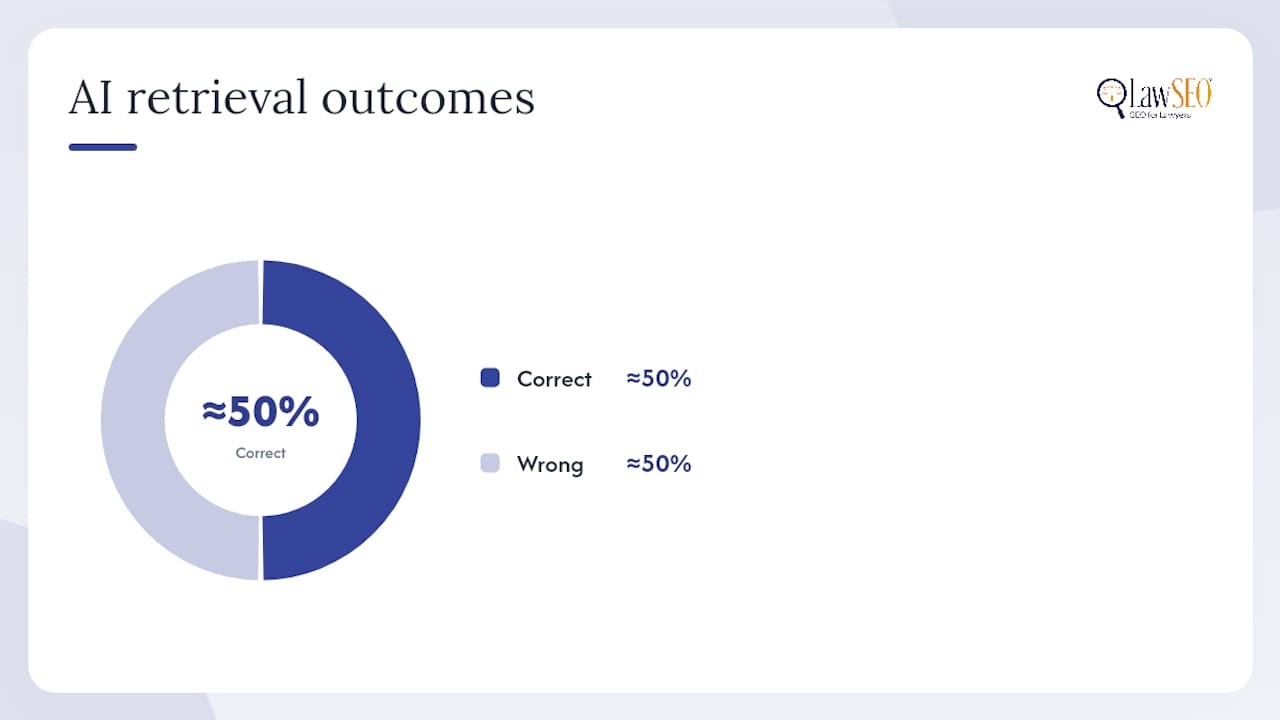
The firms that get flagged for the wrong office in an AI-generated answer almost always have one thing in common: incomplete or inconsistent schema across locations. When the structured data on the site contradicts the citation data everywhere else, the retrieval system has to guess, and it guesses wrong roughly as often as it guesses right.
Technical checks worth running quarterly, not just at launch:
- Confirm every location page is included in the XML sitemap and returns a 200 status, not a redirect chain
- Verify each location page has a self-referencing canonical tag, not one pointing back to the homepage
- Check that every location page is linked from the main navigation or footer, not just reachable through an internal search
- Validate the nested JSON-LD with Google’s Rich Results Test to confirm the Organization, LocalBusiness, and Person entities resolve without errors
- Ensure
sameAsproperties on each Person entity link to that attorney’s state bar profile, reinforcing the E-E-A-T signal with a verifiable, authoritative source
Reduced misattribution is the whole point. When schema, GBP data, and citations all describe the same office the same way, an AI answer engine pulling together a response about “family law attorneys in Plano” has a far easier time attaching the right name, address, and phone number to the right result.
What Content Actually Helps a Specific Office Rank?
Location pages carry the structural weight (map, attorneys, intake, courts), while blog content carries the depth that earns links and demonstrates real local expertise. Mixing the two creates bloated location pages that try to do everything and end up ranking for nothing in particular.
The clearest split: location pages hold the operational information a prospective client needs immediately. Blog content holds the deeper material that establishes authority, like a guide to filing procedures at a specific county courthouse or a breakdown of a recent local ordinance change.
- Court and county guides written for the specific courthouse each office serves consistently earn organic search traffic from people trying to understand a filing process, and they naturally cite that office’s location.
- Attorney bios with genuine local ties (bar admission dates, local case history, community involvement in that specific city) support the Person schema and give journalists something to reference when covering a case.
- Local legal alerts, such as a change in a specific county’s small claims threshold or a new local ordinance, attract press mentions and backlinks that a generic national blog post never will.
The editorial trap to avoid is writing forty near-identical blog posts, one per office, about “What to Do After a Car Accident in [City].” Instead, build a handful of genuinely researched pieces tied to specific courts, ordinances, or local legal quirks, and let each office’s location page link to the one or two blog posts most relevant to that jurisdiction. Quality concentrated in fewer pieces beats quantity spread across templated ones.
What’s the Right Launch Order When Opening a New Office?
Sequence matters because each step depends on the one before it holding steady. Launch in this order: GBP verification, location page publication, citation buildout, review generation, schema implementation, then localized content.
- Verify GBP first, since citations and schema both reference the address it establishes
- Publish the location page before requesting citations, so directories link to a live, substantive page rather than a placeholder
- Build citations across state bar listings and tier-one legal directories once the page is live
- Begin review requests once the office has handled its first handful of cases post-launch
- Implement schema markup after the page and NAP data are finalized, not before
- Layer in localized blog content over the following quarter to build depth
Track these KPIs per office, not in aggregate: local pack impressions and calls from GBP insights, organic sessions landing on that specific location page, review count and average rating, and the lead-to-consultation conversion rate for inquiries tagged to that office.
Run a quarterly audit that checks for citation drift, GBP suspension flags, and review count stagnation. Assign one person clear ownership of the multi-office SEO program rather than splitting it across whoever happens to manage each local office, since fragmented ownership is where NAP inconsistencies creep back in within a few months. The full local SEO checklist is worth running before and after every new office launch.
When Does a Multi-Office Firm Need a Specialist Agency?
In-house effort can handle a single office launch competently if someone owns the process end to end and follows the checklist without skipping steps. It stops being sufficient once a firm crosses three or four offices, because citation drift, schema errors, and GBP compliance risk all compound with scale, and most in-house marketing staff have other responsibilities pulling their attention elsewhere.
Lawseo works exclusively with law firms, which means every recommendation accounts for state bar advertising rules and attorney ethics constraints that a generalist agency often misses entirely. Founder Todd R. Stager, who has spent close to three decades in SEO, personally reviews strategy on every client campaign, and the firm builds in AI search optimization alongside traditional map pack visibility since generative answer engines are increasingly where new clients ask their first question.
A firm considering an agency for multi-location work should ask for three specific deliverables before signing anything: a launch audit for existing offices, a pilot build on one new or underperforming office, and a defined reporting cadence tied to office-level KPIs, not firm-wide vanity metrics.
Reasonable deliverables to contract for include a full compliance audit of existing GBP and citation data, a pilot build for one office to prove the process before rolling it out firm-wide, and an ongoing retainer that covers schema maintenance, citation monitoring, and quarterly reporting by location.
What I’ve Learned Watching Firms Get This Wrong
The most consistent mistake is treating the location page as a copy-paste exercise. Firms swap the city name, keep every other sentence identical across five pages, and wonder why none of them rank. Google’s systems are good at spotting a template dressed up as unique content, and so are the readers who land on it.
Shared phone numbers cause more quiet damage than firms realize, because the effect shows up as vague underperformance rather than an obvious error. And ignoring bar listings is a genuine missed opportunity, since it costs nothing to fix and almost nobody bothers.
On timelines: expect GBP verification within a few weeks, but meaningful movement in the local map pack usually takes three to six months of consistent citation and review activity. Anyone promising faster is either overstating the case or cutting a compliance corner that will cost you later. Stay patient, stay consistent, and resist the urge to over-optimize a new listing in the first month, since sudden, unnatural-looking changes to a fresh GBP are one of the more common triggers for a manual review.
— TODD
Get a Compliance Audit Before You Build Another Office Page
Lawseo is the direct alternative to piecing this together in-house or hiring a generalist marketing shop that treats a law firm’s fifth office like a dentist’s second location. The advantage isn’t complexity. It’s specialization: every recommendation is filtered through state bar advertising rules and attorney ethics from the start, so you’re not building a citation strategy today that a compliance review flags in six months.
The engagement path is straightforward. Lawseo starts with a launch audit of your existing offices to catch duplicate GBP listings, citation drift, and schema gaps, then builds a pilot on one office to prove the approach before rolling it out across the rest of the firm under an ongoing retainer with office-level reporting. Founder-led oversight means Todd R. Stager reviews the strategy personally, and exclusivity agreements mean Lawseo won’t take on a competing firm in the same market once you sign.
If you’re opening a new office or auditing existing ones, request a legal SEO consultation and get a clear picture of where your current locations stand before you publish another page.
Sources
Verification and compliance guidance came from Google’s own Business Profile help center and Business. Multi-office strategy detail drew on Subscribe PR’s local SEO analysis, Attorneys.Media’s GBP walkthrough, and eSEOSpace’s multi-location guide.
This article is general information, not a substitute for advice from a qualified lawyer. Consult a qualified legal professional about your own circumstances before acting on anything here.
- Guidelines for representing your business on Google – Google Business Profile Help
- Local SEO for multi-office law firms (the 2026 update) | Subscribe PR
- Local SEO for Multi-Location Law Firms: The Ultimate Guide