


Surprisingly, almost ninety percent of American law firm websites miss critical on-page SEO steps that could drive more client inquiries. For mid-sized firms aiming to stand out in a crowded market, overlooking foundational strategies means losing visibility and potential clients to competitors. This article uncovers practical SEO moves tailored for American law firm partners, focusing on what actually impacts site rankings and draws in clients ready to engage your services.
Table of Contents
- Step 1: Assess Your Law Firm Website For SEO Readiness
- Step 2: Research And Integrate Legal Keywords Strategically
- Step 3: Optimize Page Titles, Meta Descriptions, And Headers
- Step 4: Enhance Content With Authoritative Legal Information
- Step 5: Test User Experience And Mobile Compatibility
- Step 6: Verify SEO Improvements Using Performance Tools
Quick Summary
| Key Insight | Explanation |
|---|---|
| 1. Assess Website for SEO Readiness | Conduct a thorough technical audit to improve digital visibility and website performance. Focus on loading speed, mobile responsiveness, and content structure. |
| 2. Strategically Use Legal Keywords | Research and target specific legal keywords that potential clients use to enhance website visibility and attract qualified leads. |
| 3. Optimize Page Titles and Meta Descriptions | Create compelling metadata with strategic keyword placement. Ensure titles and descriptions accurately represent content and encourage client engagement. |
| 4. Enhance Content for Authority | Develop authoritative legal content with precise sources and examples. Update regularly to maintain relevance and demonstrate legal expertise to visitors. |
| 5. Monitor SEO Performance Regularly | Utilize analytics tools to track key metrics like organic traffic and conversion rates. Make data-driven adjustments to optimize your law firm’s online presence. |
Step 1: Assess your law firm website for SEO readiness
Evaluating your law firm’s website for search engine optimization is the critical first step in attracting more potential clients online. A comprehensive SEO assessment will reveal hidden opportunities to improve your digital visibility and website performance.
Start by conducting a thorough technical audit that examines multiple aspects of your website. Law firm websites require careful technical optimization across several key areas including site speed, mobile responsiveness, security, and content structure. Check your website’s loading time using Google PageSpeed Insights and ensure it loads within three seconds on both desktop and mobile devices. Verify that your site uses HTTPS encryption and has a clean, logical navigation structure that helps both users and search engines understand your content.
Review your website’s keyword strategy and content relevance. Analyze whether your practice areas, attorney bios, and service pages include targeted keywords that potential clients might use when searching for legal representation. Examine your site’s metadata including page titles, header tags, and image alt text to confirm they accurately describe your content and include strategic keywords.
Pro tip: Run a free website audit using tools like Google Search Console to identify technical issues that might be preventing your law firm from ranking effectively in search results.
Step 2: Research and integrate legal keywords strategically
Keyword research forms the foundation of an effective law firm SEO strategy. By understanding and targeting the precise language potential clients use when seeking legal services, you can dramatically improve your website’s visibility and attract more qualified leads.

Effective legal keyword research requires sophisticated tools and strategic thinking that go beyond basic search terms. Start by identifying primary practice area keywords like “personal injury lawyer” or “divorce attorney” specific to your geographic region. Then dig deeper into long-tail keywords that capture more specific client intentions such as “car accident settlement lawyer in Chicago” or “high net worth divorce attorney for business owners”. Focus on keywords with moderate search volume and lower competition that demonstrate clear user intent.
Organize your keywords into strategic clusters based on practice areas, client problems, and search intent. Create content that naturally incorporates these keywords across your website including practice area pages, blog posts, attorney profiles, and FAQ sections. Ensure each keyword placement feels organic and provides genuine value to potential clients reading your content.
Pro tip: Regularly update your keyword strategy by monitoring search trends and analyzing which terms actually drive consultation requests for your law firm.
Step 3: Optimize page titles, meta descriptions, and headers
Creating compelling and search-optimized metadata is crucial for attracting potential clients and improving your law firm’s online visibility. Your page titles, meta descriptions, and headers serve as the first point of contact between your website and potential clients searching for legal services.
Effective metadata optimization requires strategic keyword placement and compelling copywriting that speaks directly to potential clients’ needs. Craft page titles that are concise yet descriptive, typically 50 to 60 characters long, incorporating your primary practice area and geographic location. For example, a personal injury lawyer in Chicago might use “Chicago Personal Injury Lawyer | Experienced Accident Attorney”. Meta descriptions should provide a clear value proposition within 150 to 160 characters, highlighting your firm’s unique strengths and including a subtle call to action.
Structure your headers using a logical hierarchy that guides both users and search engines through your content. Use H1 tags for primary page titles, H2 tags for major sections, and H3 tags for specific subsections. Incorporate relevant keywords naturally into these headers, ensuring they directly relate to the content and address potential client questions. Each header should provide a clear preview of the information that follows, making it easy for potential clients to quickly understand your expertise and services.
Pro tip: Update your metadata regularly and track performance using Google Search Console to understand which titles and descriptions generate the most client clicks.
Step 4: Enhance content with authoritative legal information
Building credibility through authoritative content is essential for law firms looking to attract and retain potential clients online. Your website should demonstrate deep legal knowledge while providing valuable insights that address potential clients’ specific concerns and questions.
Authoritative legal content requires meticulous sourcing and precise referencing that establishes your firm’s expertise. Incorporate references to relevant legal statutes, landmark court cases, and current legal precedents that support your practice areas. Use clear language that translates complex legal concepts into understandable explanations, helping potential clients grasp the nuances of their legal challenges. Include specific examples that showcase your firm’s experience solving similar cases while maintaining professional confidentiality.
Develop comprehensive practice area pages that go beyond surface level descriptions. Each page should provide in depth analysis of legal processes, potential outcomes, and practical guidance specific to different types of legal issues. Integrate statistical data, recent legal trends, and insights that demonstrate your firm’s sophisticated understanding of the legal landscape. Regularly update your content to reflect recent legal changes, ensuring your website remains a current and authoritative resource for potential clients seeking legal information.
Here’s how content types build authority for law firm websites:
| Content Type | Authority Benefit | Typical Example |
|---|---|---|
| Statute References | Demonstrates legal knowledge | Links to current laws |
| Case Studies | Shows practical experience | Summaries of notable cases |
| Practice Area Analysis | Establishes expertise in specialties | Deep dives into legal processes |
| Legal Trends | Positions firm as informed | Commentary on recent developments |
Pro tip: Collaborate with your firm’s attorneys to review and validate content accuracy, ensuring every published piece meets the highest standards of legal expertise.
Step 5: Test user experience and mobile compatibility
Ensuring your law firm’s website provides a seamless experience across all devices is critical for attracting and retaining potential clients. A responsive, user friendly website can significantly impact your ability to convert online visitors into actual consultations.
Comprehensive user experience testing requires methodical evaluation of mobile responsiveness and accessibility across multiple devices and screen sizes. Start by testing your website on smartphones, tablets, and desktop computers to verify that all content displays correctly and navigation remains intuitive. Check that contact forms, phone numbers, and consultation request buttons remain prominent and easily clickable on smaller screens. Pay special attention to text readability, image scaling, and menu functionality to ensure potential clients can easily access information about your legal services.
Utilize professional testing tools and real world device testing to identify potential user experience barriers. Use Google Chrome Developer Tools to simulate various device sizes and screen resolutions. Conduct actual user testing with individuals representing your target client demographic, gathering feedback on navigation ease, content clarity, and overall website performance. Prioritize websites that load quickly, display information clearly, and provide smooth interaction across all platforms.
Pro tip: Schedule quarterly comprehensive website audits to continuously optimize your site’s mobile performance and user experience, staying ahead of evolving technological standards.
Step 6: Verify SEO improvements using performance tools
Tracking your law firm’s online performance is essential for understanding the effectiveness of your SEO strategies and making data driven improvements. Monitoring key metrics helps you recognize what is working and where you need to focus your optimization efforts.
Critical SEO metrics provide insights into your website’s search engine performance and client acquisition potential. Begin by setting up Google Analytics and Google Search Console to track organic traffic, keyword rankings, click through rates, and user engagement. Pay close attention to metrics such as average time on page, bounce rate, and conversion rates for consultation request forms. Compare these metrics month over month to identify trends and measure the impact of your SEO improvements.
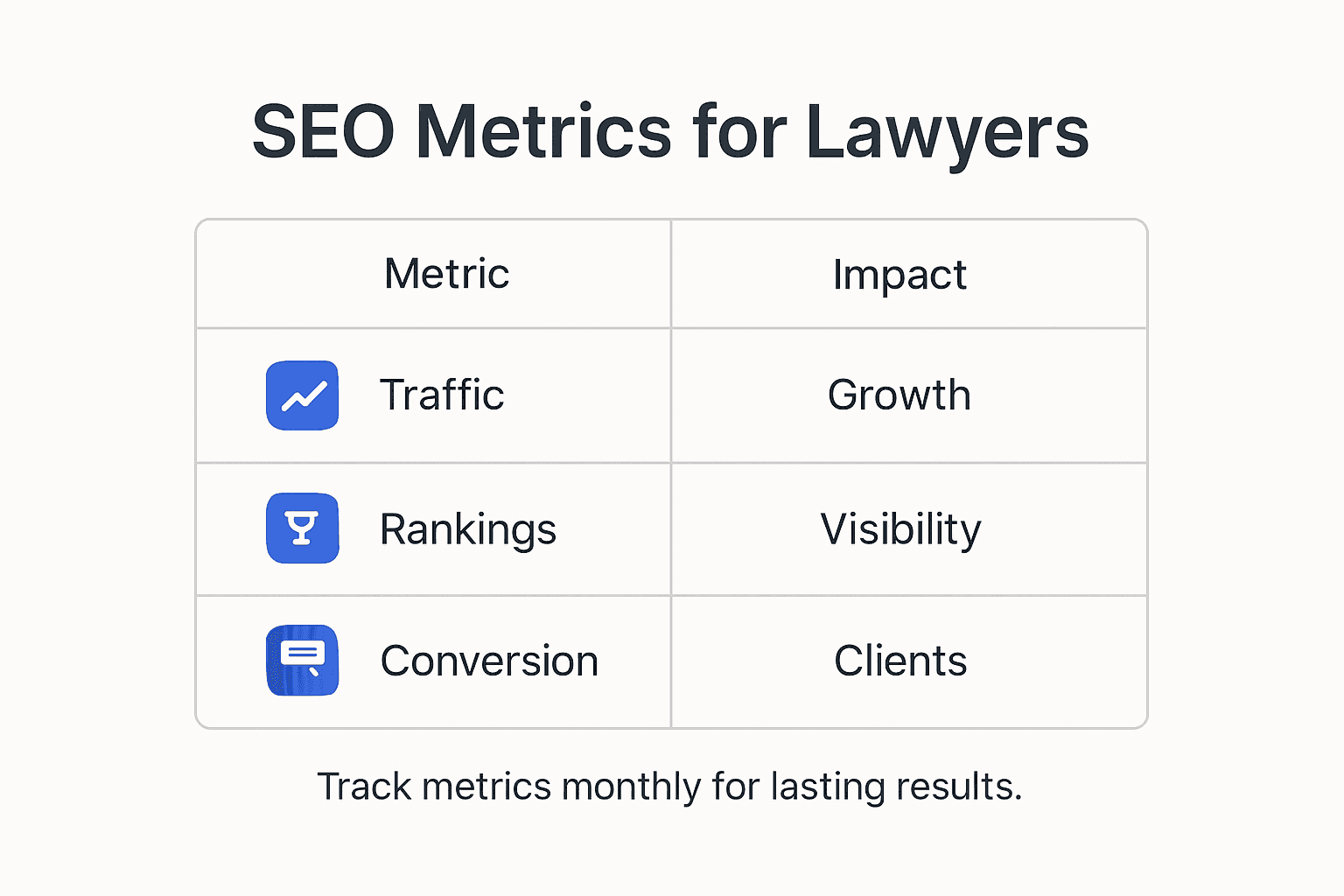
Here’s a summary of key SEO metrics for law firms and why they matter:
| Metric | What It Measures | Business Impact |
|---|---|---|
| Organic Traffic | Visitors from search engines | More potential client inquiries |
| Keyword Rankings | Search position for terms | Higher rankings boost visibility |
| Bounce Rate | Users leaving quickly | Indicates relevance and engagement |
| Conversion Rate | Actions like form submissions | Direct impact on client acquisition |
| Mobile Performance | Experience across devices | Improves user retention and trust |
Regularly analyze your website’s performance across different devices and search platforms. Use tools like PageSpeed Insights to evaluate loading times and mobile responsiveness. Review which keywords are driving the most traffic and generating potential client leads. Look for opportunities to improve underperforming pages by analyzing user behavior and search query data. Create a systematic approach to reviewing and updating your content based on these performance insights.
Pro tip: Set up automated monthly reporting to track your SEO progress consistently and identify emerging opportunities for optimization.
Elevate Your Law Firm’s Online Presence with Expert SEO Support
The article “On-Page SEO for Lawyers Guide to Attract Clients Fast” highlights the urgent challenges law firms face in mastering technical SEO, keyword strategy, metadata optimization, and authoritative content creation to win client trust online. If you are striving to improve website performance, outrank competitors in local search results, and convert visitors into consultations, you need a partner who understands the unique legal marketing landscape.
At LawSEO.com, we specialize exclusively in SEO for attorneys and law firms. Led by Todd R. Stager, an SEO veteran with nearly three decades of experience, our comprehensive services focus on advancing your firm’s visibility across Google and emerging AI-driven platforms. We tackle your critical pain points including mobile optimization, strategic keyword integration, and authoritative content that builds client confidence. Gain measurable results with a firm that also offers exclusivity in your market.
Unlock the full power of your online presence now and watch your client base grow.
Take the first step toward on-page SEO mastery with LawSEO.com. Get in touch today to develop a tailored SEO strategy that delivers rapid client attraction and sustainable growth.
Frequently Asked Questions
How can I assess my law firm website for SEO readiness?
To assess your law firm website for SEO readiness, conduct a technical audit focusing on site speed, mobile responsiveness, security, and content structure. Use tools to check your website’s loading time and ensure it adheres to best practices to enhance visibility within 30 days.
What are the best practices for integrating legal keywords into my content?
Best practices for integrating legal keywords include identifying primary practice area keywords and long-tail keywords that specify client intent. Organize these keywords into clusters and naturally incorporate them into your content, aiming for an organic flow within 30 to 60 days.
How should I optimize my page titles and meta descriptions for better visibility?
To optimize your page titles and meta descriptions, include primary keywords and descriptive language while keeping character limits in mind. Aim for concise titles and clear value propositions in your meta descriptions, refreshing them every few months to maintain relevance.
What types of content should my law firm website include to build authority?
Include authoritative content such as statute references, case studies, detailed practice area analyses, and insights on legal trends. Regularly update this content to reflect recent changes, ensuring that your website remains an up-to-date resource.
How can I test the user experience of my law firm website?
Test the user experience by evaluating your website across various devices to ensure compatibility and ease of navigation. Conduct user testing with real clients to gather feedback about their interaction with the site and improve usability within one quarter.
What key metrics should I track to verify my SEO improvements?
Track metrics such as organic traffic, keyword rankings, bounce rates, and conversion rates to evaluate your SEO performance. Regularly analyze these metrics to identify trends and make data-driven adjustments, aiming for noticeable improvements within 60 days.