

AI Overviews for law firms are Google search summaries with source links, helping readers explore legal questions before choosing a lawyer.

To improve your firm’s presence, start with a question potential clients ask, inspect the answer and its sources, and improve the existing page that should help that reader. Check that Google can use the page, make your attorneys and services easy to verify, and measure useful inquiries alongside visibility. The seven checks below show what to do and what to ask your marketing team to deliver.
Google’s guidance for generative AI search emphasizes established SEO and original, useful material. For a firm owner, the practical question is: what can our page contribute that someone cannot get from a generic summary? A specific explanation, a verified process or a useful decision aid gives you a stronger starting point than another broad rewrite.
In this guide
1. Choose a client question and the right page
Ask your intake team which questions recur before someone books a consultation. Select one that fits the work your firm wants and the jurisdictions it serves. Then find the existing page that should answer it. This avoids creating several articles that compete to explain the same thing.
Separate someone learning about a process from someone choosing a nearby lawyer. The following are planning examples, not claims that Google shows an AI Overview for each phrase:
| Example search | Reader’s immediate need | Page to review |
|---|---|---|
| What should I bring to a divorce consultation? | Prepare for an appointment | An attorney-reviewed preparation guide with the firm’s actual intake instructions |
| Probate lawyer in Portland | Find someone who handles the matter locally | A service or office page explaining location, service scope and how to contact the firm |
| Who handles appeals at this firm? | Check a lawyer’s relevant experience | A named attorney profile linked to the relevant practice |
Use our long-tail keyword guide to organize related questions. Keep natural wording variations together when they serve the same purpose. A new page should earn its place by solving a different reader problem.
2. Inspect AI Overviews for law firms in a real search
Run the search and record the date, location and device. If an AI Overview appears, expand it, open the relevant citations and read the supporting passages. Keep paid placements, ordinary organic listings, local results and AI citations separate in your notes.
You can repeat this check for a client’s question. Record the cited URL, the exact issue it explains, what remains unanswered and your proposed improvement. An unexplained deadline, an outdated office address or a vague contact instruction creates a different task from a missing citation.
3. Check whether Google can use the page
Ask your SEO lead to inspect the target URL in Search Console and retain the result. Confirm indexing, the selected canonical URL and snippet eligibility. Have the developer investigate access or rendering problems before spending time rewriting a page Google cannot properly use. Our law-firm SEO audit guide places that check within the wider site review.
Also inspect the effective Search generative AI control. Google documents included, excluded and inherited settings. Record the property, the effective choice and why it fits the firm’s policy; do not assume a parent property’s setting or change it without the responsible person’s agreement.
These checks establish eligibility, not placement. Google does not require special AI schema or an AI text file. If someone recommends a technical change, ask which documented problem it solves and how they will verify it.
4. Give readers something the summary does not
Read the competing pages as a potential client. After the basic answer, what would still prevent you from taking the next step? Ask the responsible attorney for a useful explanation of that issue: a common misunderstanding, a process distinction, or the information the intake team needs to route an inquiry.
For a consultation guide, go beyond “bring relevant documents.” Explain how the firm tells prospective clients what to prepare, what to do if an item is missing and how to send sensitive material through the approved channel. Use the firm’s actual procedure. A writer should not invent an intake policy or universal document requirement.
Put the answer early, use clear headings, and choose a table or checklist when it makes the decision easier. Cut repeated definitions and generic praise. Our guide to content’s role in law-firm SEO provides the broader planning context.
5. Verify the firm, attorney and local details
A helpful explanation still needs a trustworthy source and a usable contact path. Check the named author or reviewer, service scope, office information and contact details. Follow the links yourself. A visitor researching a local service should not land on an unrelated office or an attorney who no longer handles the work.
Compare the website with the firm’s Business Profile and relevant professional listings. Correct conflicting facts at their source. For an office page, confirm that the location and services are real; do not imply that every attorney is admitted everywhere the firm receives inquiries.
Keep original publication and substantive update dates visible and accurate. Google’s byline-date guidance explains how visible dates and structured data should agree. Updating the date without reviewing the information gives readers the wrong impression.
Connect the explanation to relevant services and attorney profiles using descriptive links. For broader AI-search planning, use our AI search optimization overview. This article concentrates on the Google-specific page review.
6. Measure AI visibility and inquiries separately
Ask for a report that tells you what changed and which decision it supports. Keep the same page, country, device and reporting period when comparing like-for-like data. Use our website analytics guide for the wider tracking plan.
| Signal | What to investigate | Evidence to request |
|---|---|---|
| AI impressions increase | Which pages gained exposure, and did their traffic or inquiries also change? | Comparable Search Console exports plus page-level analytics |
| Organic visits decrease | Was the change concentrated in a page, query, device or period? | Matched-period data, prior-year context where available, and campaign/tracking notes |
| Form or call events increase | Are these genuine, distinct inquiries from the intended audience? | Validated event definitions and deduplicated intake records |
| Qualified inquiries increase | Did more become retained clients? | A reconciled client count with an agreed attribution method |
Google’s Generative AI performance report includes AI Overview and AI Mode impressions, with page, country, date and device views. Those impressions are already included in Web performance reporting. Do not add the two totals. Low-data properties may lack the report, and recent figures can be preliminary.
A rising impression count and an unchanged inquiry count do not establish a failure. They tell you to check the pages gaining exposure and their contact experience. Likewise, a traffic decline alone does not show that an AI Overview caused lost business. Compare seasonality, demand, campaigns and tracking changes before choosing the next task.
7. Assign the work and verify completion
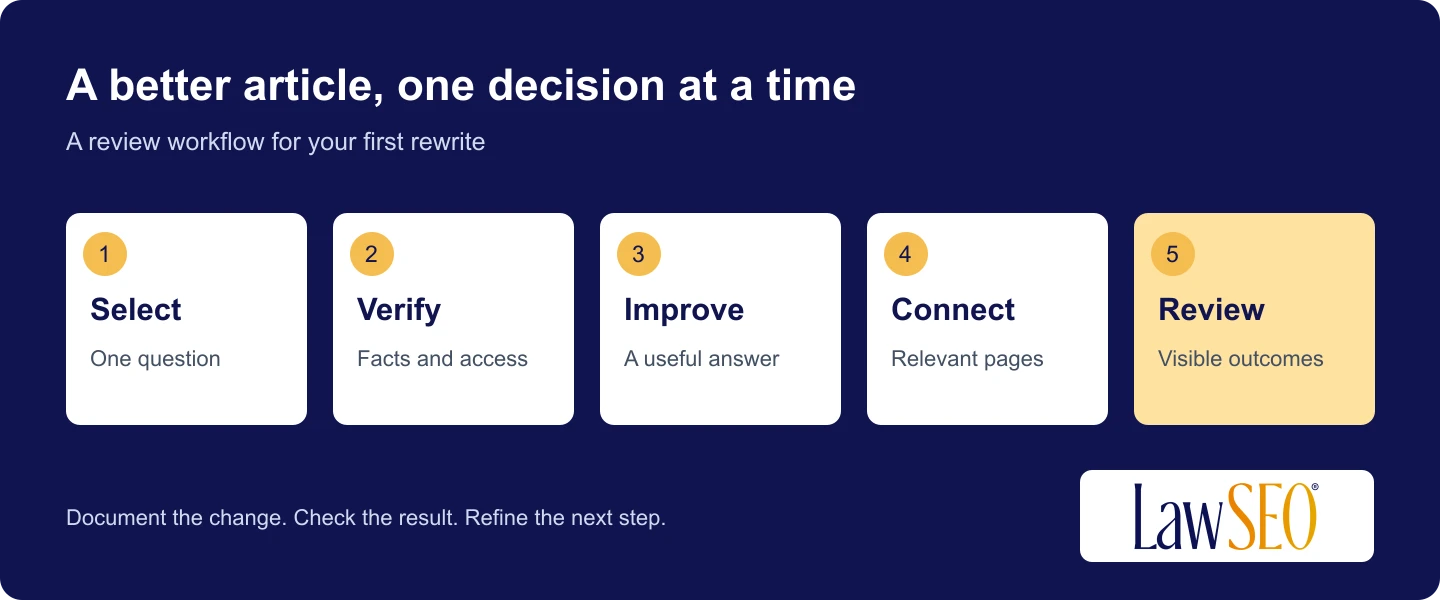
Use this checklist at the next marketing meeting. Pick one priority page, agree on the responsible people and set a review date. The roles below are suggestions; completion means that someone checked the work, not merely that it was assigned.
| Priority and action | How to check it | Suggested owner | Done when |
|---|---|---|---|
| 1 · Choose the question and page | Compare intake questions with existing pages and related search phrases | Marketing + intake lead | One audience, question and target URL are recorded |
| 2 · Save the search evidence | Record the query, conditions, answer and cited pages | SEO lead | Each proposed change points to a specific observation |
| 3 · Resolve access problems | Inspect indexing, canonical and effective AI setting | SEO lead + developer | The result or remaining issue is documented |
| 4 · Improve one meaningful gap | Add a verified explanation, example or decision aid | Writer + attorney reviewer | The reader can take a useful next step |
| 5 · Verify identity and contact paths | Check biographies, offices, links, dates and the form on mobile | Firm administrator + developer | Facts agree and a labeled test reaches the intended destination |
| 6 · Check the published page | Compare the approved copy with the live page and preserve the prior version | Editor | Text, images, links and dates render correctly |
| 7 · Review the evidence | Compare a documented baseline with later matched periods | Marketing + intake lead | The team chooses a next action or records why more data is needed |
Keep a brief change log with the URL, what changed, who checked it and when it went live. Reviewing after a month can be a useful working cadence, but the amount of available data should determine what you conclude. It is not a deadline for earning an AI citation.
Questions law firms ask about AI Overviews
Why might a competitor be cited when my page ranks higher?
Organic position and inclusion in a generated answer are different observations. Google’s related-query retrieval can bring in additional sources. Inspect what the competing passage actually answers, confirm your page’s eligibility and look for a reader need you can address more usefully. Position alone does not identify the cause.
Is a firm mention the same as a citation?
No. A mention names the firm; a linked citation points to a source. That source may be your site or a third party discussing you. Record the destination and the statement it supports so a brand mention is not counted as a website visit.
Does a Google Maps ranking mean the firm appears in AI Overviews?
No. Record local results and AI appearances separately. Verify your business details for accuracy, then inspect the actual AI answer for the specific search. Do not report a map pin as proof of an AI citation.
Which existing article should we improve first?
Choose a page relevant to the cases you want, with a meaningful, fixable gap and a clear next step for readers. Give an inaccessible page technical attention first; give a confusing page editorial attention. The checklist above helps turn that diagnosis into assigned work.
How long does it take to know whether the changes worked?
There is no guaranteed citation timetable. Verify the published changes immediately, then review search and inquiry data over comparable periods. A low-volume page may need more observation. Look for a supported improvement in the reader’s experience and business outcomes rather than declaring success from one screenshot.
 todds.ai