


Personal injury PPC is worth running if a firm can afford the cost of learning and has the intake discipline to qualify calls before they touch the ad account’s conversion data. It is not worth running as a side project someone checks once a month. The math only works when spend is tracked to signed cases, not to raw clicks or form fills.
Three things need to happen before a dollar goes to Google Ads. First, set up conversion tracking that separates a qualified lead from a curious caller. Second, commit to a minimum monthly budget that survives the platform’s learning phase rather than starving it. Third, pick one sub-vertical, auto accidents or slip-and-fall, for example, and prove the model there before spreading spend across five practice areas at once.
- Build case-qualified conversion tracking before launch, not after the first invoice.
- Set a floor budget that can absorb 60 to 90 days of algorithmic learning without panic cuts.
- Choose a single high-value sub-vertical to test rather than diluting spend across the whole practice.
Pro Tip: Signed-case acquisition costs for personal injury firms commonly land between $1,500 and $5,000, and that range shifts 4 to 6 times depending on the sub-vertical you pick. Budget accordingly before you write your first ad.
Key Takeaways
Personal injury PPC succeeds when campaigns optimize toward signed-case value, protect budget from click fraud, and track every conversion stage from click to retainer.
| Point | Details |
|---|---|
| Verify the verdict first | PI PPC works when case-value math and intake discipline both support the spend. |
| Track cost-per-signed-case | CPSR runs $1,500 to $8,000 for general PI, $1,800 to $15,000 for mass torts. |
| Fix the conversion signal | Feed Ads “case-qualified intake” or “retainer signed,” not raw calls or form fills. |
| Guard against fraud | A three-layer fraud defense recovers spend that click fraud commonly leaks. |
| Bring in Lawseo | Lawseo builds case-qualified tracking and bidding strategy so PPC spend follows signed-case economics. |
Why Personal Injury PPC Works, and Why It Backfires
The economics behind personal injury PPC are simple: a signed case can be worth tens of thousands of dollars in fees, so a firm can afford to pay far more per click than almost any other advertiser bidding on the same auction. That is why personal injury search terms are some of the most expensive in paid advertising, and why aggressive bidding on the right keywords is rational rather than reckless.
The failure mode is just as predictable. When a campaign is told to optimize for the cheapest available conversion, whether that’s a phone call, a form fill, or a chat click, Google’s algorithm does exactly what it’s told. It finds more of that cheap conversion. The problem is that cheap conversions in personal injury are almost always low-quality: wrong-state callers, workers’ comp questions, people fishing for free advice.
- Campaign optimizes toward “any conversion” rather than a qualified one.
- Smart Bidding rewards volume, so it chases users who convert easily and cheaply.
- Those users skew toward tire-kickers, not signed clients.
- Signed-case acquisition quietly declines even as the lead count looks healthy.
This pattern is well documented: when campaigns optimize for raw lead volume instead of case-qualified outcomes, the algorithm learns to favor exactly the wrong signal.
Pro Tip: Change the conversion action you feed Google Ads from “phone call” or “form submit” to “case-qualified intake” or “retainer signed.” That single change retrains Smart Bidding to chase the traffic that actually pays your invoices.
What Should a Personal Injury PPC Budget Look Like?
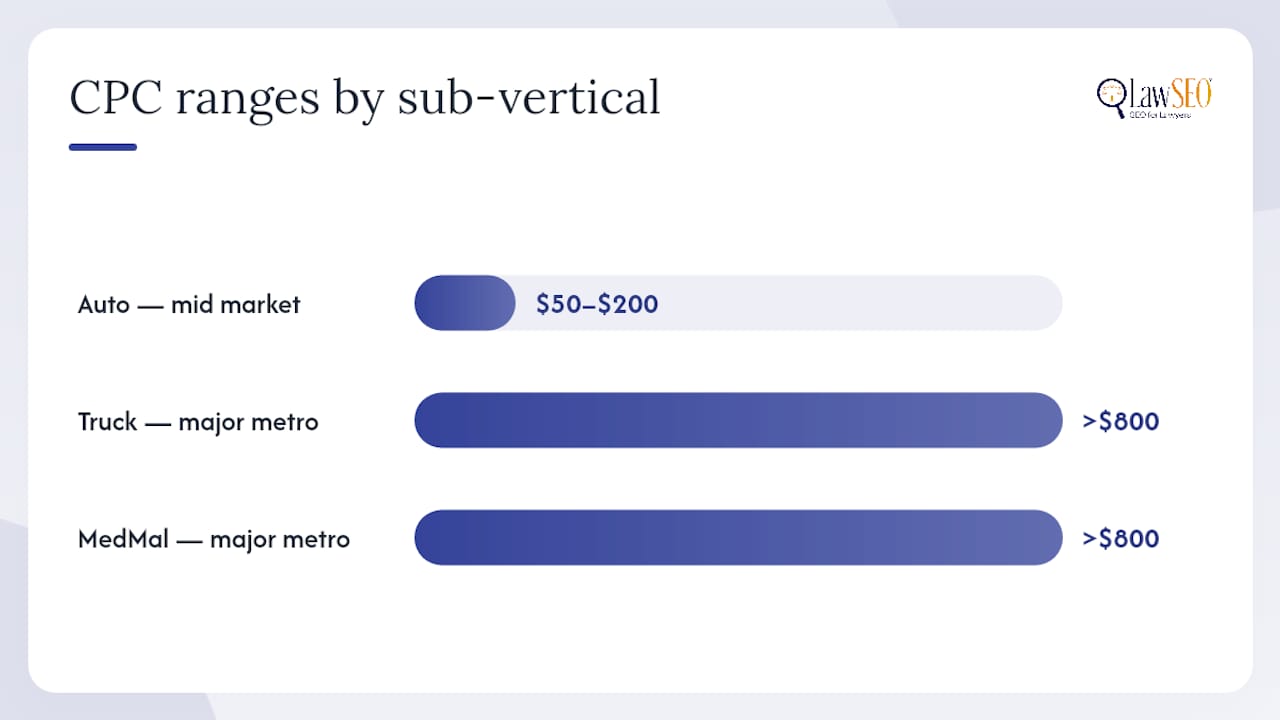
Personal injury search costs vary enormously by sub-vertical and metro competitiveness. General auto-accident keywords in a mid-size market might run $50 to $200 per click, while truck accident or medical malpractice terms in a major metro can exceed $800. Cost-per-lead (CPL) ranges from roughly $200 to $800 or more, and that figure alone tells you almost nothing about whether the campaign is working.
The number that matters is cost-per-signed-retainer (CPSR). Reported benchmarks put general PI CPSR at $1,500 to $8,000, while mass tort cases, with their longer intake cycles and stricter qualification, run $1,800 to $15,000. A firm that only watches CPL will think a $250-per-lead campaign is a bargain, right up until it discovers that one in twenty of those leads actually signs.
Here’s a worked example using conservative middle-of-range numbers:
- 500 clicks at $150 average CPC = $75,000 in spend.
- A 5% lead conversion rate produces 25 leads.
- If a third of those leads are case-qualified, that’s roughly 8 qualified leads.
- At a typical qualified-to-signed rate of 40%, that yields about 3 signed cases.
- Cost-per-signed-case: $75,000 ÷ 3 = $25,000.
That number looks alarming until you weigh it against average PI settlement fees, which is exactly the case-value math that should happen before a firm sets its maximum bid. If your average fee per case clears $25,000 with room to spare, the campaign is profitable even at that acquisition cost. If it doesn’t, the sub-vertical or the intake process needs fixing before spend increases.
For monthly budget floors, a single-metro firm testing one sub-vertical should plan for a minimum in the low five figures to gather enough conversion data within 60 to 90 days. Firms in smaller metros can often test at a lower floor; major metros with truck accident or mass tort competition need substantially more just to clear the auction’s minimum bid thresholds.
How Should You Structure Google Ads Campaigns for a PI Firm?
A clean account structure prevents budget bleed and makes attribution possible later. Separate campaigns by intent and channel rather than lumping every practice area into one sprawling account.
- Brand campaign: protects firm-name searches from competitor conquesting, low cost, high conversion rate.
- Non-brand Search, high-intent: “car accident lawyer [city],” “truck accident attorney near me,” segmented by sub-vertical.
- Google Screened / Local Services Ads, where available for your practice area and state.
- Remarketing (Display and YouTube): re-engages site visitors who didn’t convert.
- Performance Max, guarded with search-term exclusions and strong conversion signals, never launched blind.
- Microsoft Advertising (Bing): often overlooked, frequently cheaper CPCs for the same intent.
A typical campaign tree might run one campaign per sub-vertical (auto accidents, slip-and-fall, workplace injury), with ad groups inside each mapped tightly to a single landing page. An “auto accidents” campaign might have ad groups for “car accident lawyer,” “rear-end collision attorney,” and “DUI accident injury lawyer,” each pointing to a page written for that exact query rather than a generic practice-area page.
Pro Tip: Use a consistent naming convention from day one, something like [State][SubVertical][Intent]_[Channel], for example TX_Auto_HighIntent_Search. When you’re managing five practice areas across three states, that structure is the only thing standing between you and total attribution chaos.
Which Keywords Actually Bring In Qualified Personal Injury Clients?
Not every click on a personal injury ad is equal, and the keyword list should reflect that reality from the start. High-intent keywords combine a practice area, geography, and a buying signal: “car accident lawyer Dallas,” “18 wheeler accident attorney near me,” “workers comp lawyer free consultation.” These convert at the highest rates and cost the most, because everyone bidding on them knows exactly what they’re worth.
Mid-funnel and informational queries, “what to do after a car accident,” “how long do I have to file a personal injury claim,” cost less per click but need a different landing page and a longer nurture sequence. They rarely convert to a signed case on the first visit.
Match-type strategy should follow your data maturity:
- Start high-intent terms on phrase or exact match with a strong negative list, so you control exactly what triggers the ad.
- Layer in broad match only once Smart Bidding has enough case-qualified conversion data to interpret intent correctly, generally after 30 or more qualified conversions.
- Keep informational and mid-funnel terms separate, on their own budget, so they never compete with your highest-value auctions.
Negative keywords deserve a standing weekly review during launch, not a one-time setup. Build starter lists around these categories:
- Job-seeking terms (“personal injury lawyer jobs,” “paralegal hiring”).
- Free or DIY intent (“how to sue without a lawyer,” “small claims court”).
- Wrong-practice-area terms (criminal defense, immigration, family law).
- Competitor and directory names that trigger irrelevant clicks.
- Research-only terms with no local or urgency signal.
How Do You Keep PPC Spend Local and On Target?
Geography is where a lot of PI budget quietly disappears. A campaign geotargeted to an entire state instead of the counties a firm actually serves will burn spend on clicks the intake team can’t use.
- Set geotargets at the county or ZIP-code level rather than defaulting to statewide or metro-wide radius targeting.
- Exclude regions the firm doesn’t serve, including out-of-state cities that share a name with your target market.
- Exclude known lead-aggregator hubs and areas dominated by referral mills that inflate click volume without matching intent.
- Layer in audience signals, in-market segments for “legal services,” custom intent audiences built from your own site visitors, and affinity segments tied to relevant life events.
- Use ad customizers to insert the caller’s city or county directly into headlines, so “Serving Injury Victims in Fort Worth” appears only to searchers actually in Fort Worth.
Radius settings around a single office location work for smaller practices, but multi-office firms should build separate geo layers per location rather than one blended radius that dilutes local relevance.
What Ad Copy and Extensions Actually Improve Call Quality?
Message match is the whole game here. An ad for “truck accident lawyer” needs to say “truck accident lawyer” in the headline, not a generic “personal injury attorney” line that forces the searcher to guess whether you handle their case.
- Headline example: “Injured in a Truck Accident? Free Case Review Today” paired with a truck-accident-specific landing page.
- Body copy should state a concrete differentiator (no fee unless you win, 24/7 intake, decades of trial experience) rather than vague claims.
- Call extensions should be always-on for mobile, since a large share of injury searches happen from a phone in a moment of urgency.
- Callout extensions (“Free Consultation,” “No Fee Unless We Win,” “Available 24/7”) and structured snippets listing practice areas both lift click-through rate without adding cost.
- Location extensions matter for multi-office firms, showing the nearest office builds trust before the click even happens.
Every claim in the ad needs a compliance check before launch. Avoid guaranteed outcomes, results language that could mislead (“we always win”), or comparative claims that most state bars restrict. When in doubt, route copy through a bar-review workflow before it goes live, not after a complaint arrives.
What Makes a Personal Injury Landing Page Convert Qualified Leads?
A landing page’s only job is to match the ad’s promise and make it painless to take the next step. That means message match, a fast load time, mobile-first design, and a click-to-call button that’s visible without scrolling.
- Headline mirrors the ad’s exact language and practice area.
- Trust signals above the fold: verdicts, settlement amounts, bar association logos, video testimonials where compliant.
- Form fields kept to name, phone, injury type, and incident date, anything more drops completion rates.
- Load time under two to three seconds, since injury searchers on mobile abandon slow pages fast.
- Click-to-call button pinned near the top, not buried after three sections of copy.
A short intake flow can collect qualification data without hurting conversion. Ask one or two screening questions right in the form, such as “Was someone else at fault?” and “Have you already spoken with another attorney?” Those two answers alone let intake staff triage before the first call even happens.
- Lead submits form with basic contact and injury details.
- Automated scoring flags high-value signals: recent incident date, clear liability, no prior representation.
- High-score leads route to immediate attorney or senior intake staff callback, ideally within five minutes.
- Lower-score leads route to a triage queue for a qualifying call before any attorney time is spent.
- Leads that fail qualification, wrong state, no injury, already represented, get logged and excluded from future ad-optimization data.
Manual CPC or Smart Bidding: Which Should You Use First?
The right bidding strategy depends entirely on how much case-qualified conversion data your account has, not on which strategy sounds more advanced. Manual CPC is the right starting point for any new personal injury campaign, because it lets you control cost on unproven, expensive keywords while the account gathers data.
- Manual CPC: use for the first 60 to 90 days, especially on keywords over $100 per click, adjusting bids daily based on negative-keyword findings and early quality signals.
- Target CPA: switch once you have at least 30 to 50 qualified conversions in the lookback window, so the algorithm has a real pattern to learn from.
- Value-based bidding (tROAS): reserve this for accounts with mature offline conversion data tying spend directly to signed-case value, not just lead volume.
Conversion windows matter more in personal injury than in almost any other vertical, because the gap between a click and a signed retainer can stretch to weeks. Set your conversion window and lookback period to match your actual sales cycle, typically 30 to 90 days for signed-case conversions, rather than the default 30-day window meant for e-commerce.
Pro Tip: Keep manual bidding on your most expensive keyword clusters for the full 60 to 90 day learning period, updating negatives daily. Handing an unproven, high-CPC keyword set to Smart Bidding too early is the fastest way to burn a month’s budget on the algorithm’s guesswork.
How Do You Track Clicks All the Way to a Signed Case?
The measurement stack determines whether any of the above actually works. A reasonable setup pairs Google Ads and GA4 with a HIPAA-aware, call-tracking system and a CRM capable of offline conversion uploads.
- Lead: any form fill or phone call captured by call tracking.
- Intake: the lead answers screening questions from a staff member.
- Qualified: the case meets the firm’s rubric, valid injury, viable liability, correct jurisdiction.
- Retainer-signed: the client has executed a representation agreement.
- Resolved: the case settles or reaches verdict, closing the value loop.
Each stage should upload back to Google Ads on a defined cadence, weekly at minimum, so Smart Bidding sees case-qualified outcomes rather than raw lead counts.
- Google Ads + GA4 for click and session-level data.
- A call-tracking platform tied to dynamic number insertion, so every call is attributed to its source keyword.
- A CRM capable of exporting offline conversions keyed to the original click.
- A scheduled offline conversion import, ideally automated rather than manual.
Pro Tip: Uploading offline conversions keyed by gclid at the retainer-signed or resolved stage is the single most important technical step in this entire playbook. Without it, Smart Bidding is optimizing blind.
How Do You Stop Optimizing for Junk Leads?
This is the fix that changes everything else in the account. If your conversion action is “any phone call,” you are training Google to find more callers, not more clients. The correction is call-level qualification fed straight back into Ads as the conversion signal.
- Capture every call through dynamic number insertion so each one ties to its source keyword and ad.
- Score each call against a short mandatory rubric: valid injury within your statute of limitations, clear third-party liability, correct state jurisdiction, and no existing representation.
- Mark a conversion in Google Ads only when a call clears the qualification threshold, not when the phone simply rings.
- Exclude disqualified calls from the conversion action entirely rather than logging them as a lesser conversion value.
- Upload the qualified conversion back to Ads on a consistent schedule so the algorithm’s training data stays current.
A simple qualification rubric might require: injury occurred within the statute of limitations, a third party bears at least partial fault, the caller lives or was injured in a served jurisdiction, and the caller has no current attorney. Calls answering “no” to any of these get excluded from the conversion signal.
Flipping the conversion signal from raw calls to qualified intakes retrains Smart Bidding’s targeting model within one to two full conversion cycles, and firms that make this change typically see their cost-per-signed-case fall as wasted spend on disqualified traffic gets redirected. It also protects budget from the 18 to 35% spend leakage that click fraud commonly causes in this vertical, since a three-layer fraud defense paired with qualified-conversion tracking closes two leaks at once.
Can Remarketing and Display Recover Near-Miss Prospects?
Not every qualified prospect signs on the first call, and remarketing exists to bring the close ones back. The most useful audiences are landing-page visitors who never submitted a form, form-starters who abandoned partway through, callback no-shows, and high-score leads who didn’t sign after intake.
- Build display creative around trust rather than urgency: settlement history, client testimonials, straightforward “free consultation” messaging.
- Keep frequency capping tight. Aggressive remarketing on a sensitive topic like a personal injury can feel invasive and damage brand trust rather than building it.
- A simple, single CTA per ad works better than multiple competing offers.
- Cap Performance Max involvement in remarketing until you have strong conversion signals and a solid search-term exclusion list feeding it, otherwise it will spend broadly and unpredictably.
What Does a 30/60/90-Day Optimization Plan Look Like?
Structure the first quarter around three checkpoints rather than trying to perfect everything at launch.
- Days 1 to 30: verify tracking fires correctly, build the initial negative list, confirm landing pages load fast on mobile, and check that every ad group has message-matched creative.
- Days 31 to 60: validate that qualified-conversion data is flowing correctly to Ads, review call-quality scores against actual signed cases, and prune keywords producing volume but no qualified intakes.
- Days 61 to 90: make scaling decisions, increase budget on sub-verticals proving positive case-value math, and consider a shift toward tCPA bidding where conversion volume supports it.
Worthwhile A/B tests during this window include headline variants tied to different urgency framing, CTA placement and timing on landing pages, intake form length, location-specific bid adjustments, and even call-answer scripts used by intake staff.
Read results against cost-per-signed-case as the primary KPI. Track intake-to-retainer rate and speed-to-lead as secondary indicators, since a five-minute callback window consistently outperforms a same-day one for injury leads searching in a moment of urgency.
What Compliance Rules Apply to Personal Injury Advertising?
Every state bar sets its own rules for lawyer advertising, and a campaign that ignores them risks more than a wasted budget. Build compliance review into the launch checklist rather than treating it as an afterthought.
- Never guarantee a specific outcome or dollar amount in ad copy.
- Include required disclaimers where a state bar mandates them, such as “results do not guarantee a similar outcome.”
- File advertising materials with the state bar in jurisdictions that require it before the campaign goes live.
- Keep credential claims accurate, verified trial experience, real case results, and actual bar admissions only.
- Maintain a filing and approval log so every piece of ad copy has a documented compliance sign-off.
Advertising regulation generally sits within each state’s own rules of professional conduct, though the broader legal framework around market competition and advertising practices provides useful background context. Route every new ad variant through a bar-review workflow before launch, and keep that log current as campaigns scale across states.
How Does Lawseo Approach Personal Injury PPC Differently?
Most PPC vendors optimize for the metric that’s easiest to report: clicks, calls, leads. Lawseo builds campaigns around the metric that actually pays a firm’s bills, cost-per-signed-case, because a cheap lead that never signs is worse than no lead at all.
- Start every engagement with sub-vertical economics: which practice areas support the client’s target CPC given real fee data.
- Track conversions at the case-qualified stage, not the raw call or form-fill stage.
- Layer in a three-layer fraud defense to protect budget from click fraud before it ever reaches the bidding algorithm.
- Tie signed-case attribution back to the exact keyword and ad that produced it, using offline conversion uploads.
Firms that shift their reported conversion from “phone call” to “signed retainer” consistently see their real cost-per-signed-case improve within one or two full conversion cycles, because the algorithm finally has the right target to chase.
This approach reflects the same philosophy behind Lawseo’s broader work in legal marketing strategy, built under founder Todd R. Stager’s 29-plus years in SEO and search marketing, with a practice-area focus that treats every campaign’s economics as unique rather than templated.
What Usually Breaks First in a Personal Injury Campaign?
The pattern repeats across almost every account I’ve reviewed: a firm launches strong, sees a flood of calls in week one, and celebrates. By week six, the call volume is even higher, but the intake team is drowning in unqualified inquiries and the signing rate has quietly collapsed. Nobody changed the ads. What changed is that Google found the cheapest path to “a conversion,” and cheap conversions in this vertical are rarely good clients.
The fix takes one afternoon. Go into Google Ads, find the conversion action driving Smart Bidding, and swap it from “phone call” or “form submission” to “case-qualified intake” or “retainer signed.” That single change forces the algorithm to chase the traffic that actually pays your invoices, not the traffic that’s just easiest to attract.
How Lawseo Helps You Run Personal Injury PPC That Signs Cases
Running personal injury PPC well takes more than an ad account and a credit card. It takes case-level tracking infrastructure, sub-vertical economics modeling, and someone watching the account daily during the learning window, not once a month. Lawseo builds and manages that infrastructure specifically for law firms, pairing PPC management with the SEO and content work that keeps a firm visible even when paid budgets pause.
If your current campaigns are generating calls but not signed cases, that’s usually a tracking and bidding-signal problem, not a keyword problem, and it’s fixable without starting from zero. Lawseo’s team, led by founder Todd R. Stager, reviews strategy on every client account and offers exclusivity agreements so competing firms in your area aren’t bidding against your own campaigns with the same playbook.
Explore how legal SEO strategies complement paid search, or request a campaign review to see where your account’s conversion signal is actually pointing.
Frequently Asked Questions
Is personal injury PPC worth it for a small or solo firm?
It can be, provided the firm can absorb 60 to 90 days of learning-phase spend and has a real intake process to qualify calls. Without that discipline, a small budget gets consumed by high CPCs before it produces a single signed case.
How much does personal injury PPC typically cost per click?
Rates commonly run $50 to $200 for competitive auto-accident terms in mid-size markets, climbing past $800 for truck accident or medical malpractice keywords in major metros.
What’s the difference between cost-per-lead and cost-per-signed-case?
CPL measures what you pay for any lead, call, form, or chat, regardless of quality. Cost-per-signed-case measures what you actually pay to acquire a client who signs a retainer, which is the number that determines whether the campaign is profitable.
Should I use Microsoft Ads alongside Google Ads for personal injury PPC?
Many firms overlook it, but Bing’s network audience planning tools show meaningful reach at often-lower CPCs for the same search intent, making it a reasonable complement once Google campaigns are stable.
How long before Smart Bidding works well for a new personal injury campaign?
Most accounts need 30 to 50 qualified conversions in the lookback window before automated bidding has enough signal to outperform manual CPC, which typically takes 60 to 90 days for a new account.
Sources
For benchmark ranges, start with the Foundgrove lead-gen playbook and the Mass Tort Marketing Agency PPC guide, both of which break down CPL and CPSR by sub-vertical. For the technical side, mapping call-level qualification and offline conversions, the SteerAds fraud-defense breakdown and WhatConverts’ junk-lead analysis cover the mechanics in more depth. Round it out with Liens Studios’ keyword and landing-page guide for message-match examples.
- Personal Injury Lead Gen: 2026 Playbook | Foundgrove
- Why Personal Injury PPC Attracts the Most Expensive Junk Leads in Legal – WhatConverts
- Personal Injury PPC: 2026 Guide for Law Firms (Costs & Keywords) | Mass Tort Marketing Agency