


TL;DR:
- Search engine penalties, including manual actions and algorithmic suppressions, harm law firms’ rankings and client visibility.
- Diagnosis through Google Search Console and traffic analysis is essential before applying specific recovery strategies, such as reconsideration requests or content improvements.
Search engine penalties are direct ranking suppressions or search result removals imposed on websites that violate Google’s spam policies or fail algorithmic quality thresholds. For law firms, a penalty does not just mean lower rankings. It means fewer prospective clients finding your practice when they need legal help most. Understanding search engine penalties explained in full, including how they are triggered, detected, and resolved, is the foundation of any serious legal marketing strategy. Google Search Console, Google’s spam policies, and the disavow tool are the three instruments every law firm administrator must know before a penalty ever appears.
What are manual actions and algorithmic penalties in search engines?
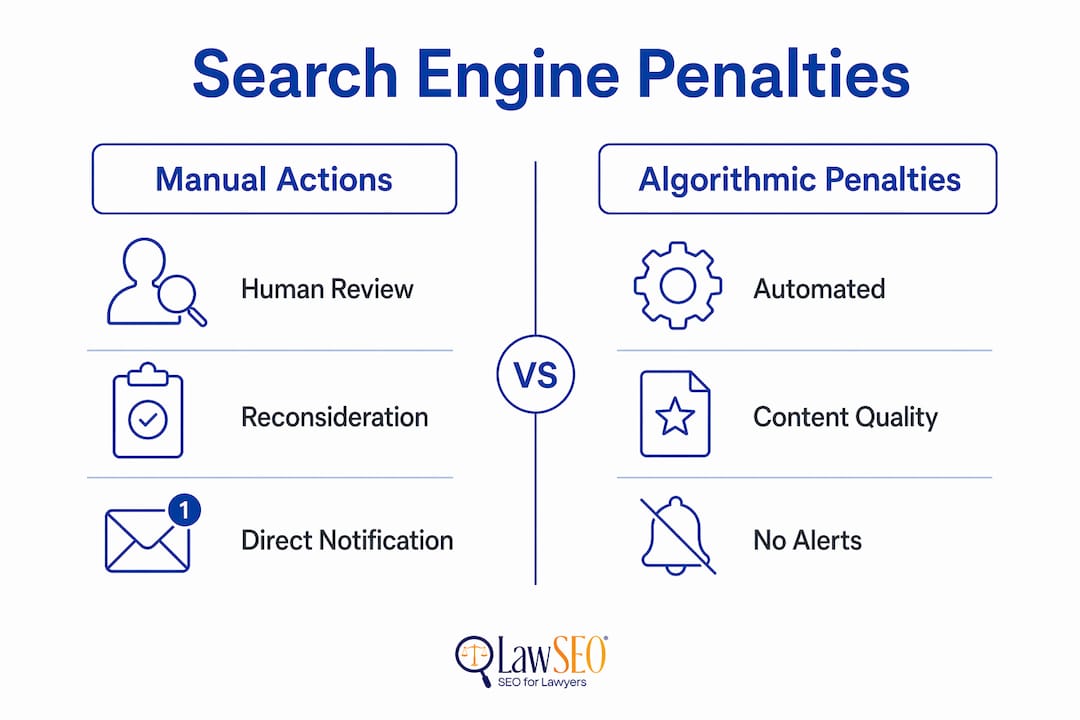
Search engine penalties include two structurally different enforcement mechanisms: manual actions and algorithmic suppressions. Knowing which type you are dealing with determines every step that follows.
Manual actions are penalties applied by a human reviewer at Google after a site is found to violate spam policies. Google notifies you directly through the Manual Actions report inside Google Search Console. The notification specifies the violation type, the scope affected (individual pages, a section of the site, or the entire domain), and the corrective action required. Once you fix the issue, you submit a reconsideration request through Search Console explaining what you did and why the problem will not recur.
Algorithmic penalties work differently. They are automated ranking suppressions triggered when Google’s systems, such as the Helpful Content system or the link spam algorithm, detect quality signals falling below acceptable thresholds. No reconsideration process exists for algorithmic penalties. You fix the underlying quality issues and wait for Google’s systems to reassess your site, typically during the next core update cycle.
The practical differences matter enormously for law firms:
- Manual actions produce a notification you can read and act on immediately.
- Algorithmic suppressions produce no notification and require diagnostic inference.
- Manual action recovery involves a formal submission process with documented evidence.
- Algorithmic recovery is structurally slower, often taking 3 to 6 months or more following core update cycles.
- Confusing the two types leads to misdirected remediation and wasted time.
Pro Tip: Open Google Search Console and navigate to Security and Manual Actions, then Manual Actions. If the report reads “No issues detected,” you do not have a manual penalty. Any ranking drop you are experiencing is algorithmic or competitive, and a reconsideration request will accomplish nothing.
Which SEO violations commonly trigger search engine penalties for legal websites?
Common SEO penalties for legal websites fall into six categories, each with specific enforcement triggers under Google’s spam policies.
Unnatural link profiles represent the most frequent manual action trigger for law firms. Buying links from legal directories, participating in link exchanges with other practices, or using private blog networks (PBNs) to build authority all constitute link spam. Google’s link spam algorithm detects these patterns algorithmically, and a human reviewer can escalate to a manual action when the pattern is egregious.
Thin or AI-generated content is a growing enforcement area. A law firm practice area page that contains 200 words of generic legal boilerplate, or a blog post generated by an AI tool with no added analysis or original perspective, qualifies as low-quality content under Google’s spam policies. The standard is not whether AI was used. The standard is whether the content provides genuine value to the reader.
Cloaking and deceptive practices involve showing Google’s crawlers different content than what users see. A law firm that shows Google a keyword-rich page but redirects visitors to a generic contact form is cloaking. This triggers some of the most severe penalties in Google’s enforcement toolkit.
Structured data abuse affects law firms that mark up content with schema to claim rich results they have not earned. Fake review schema, misleading FAQ markup, or attorney profile schema that misrepresents credentials all fall under this violation category.
Site reputation abuse, sometimes called parasite SEO, occurs when a law firm’s website hosts third-party content, such as affiliate articles or sponsored posts from unrelated industries, to exploit the firm’s domain authority. Google now treats this as a direct spam violation.
Google’s spam policies now explicitly cover AI Overviews and AI Mode in search results, meaning violations like scaled content abuse and cloaking can suppress your firm’s visibility not just in traditional rankings but in AI-generated answer layers as well.
One policy update law firms must address immediately: Google’s 2026 spam policies explicitly classify back button hijacking as a violation, with enforcement beginning June 15, 2026. If your website uses JavaScript redirects or pop-up overlays that prevent users from navigating back to search results, you are now at direct risk of a manual action.
How can law firms identify if their website has a search engine penalty?
Diagnosing a search ranking penalty requires a structured workflow, not guesswork. Follow these steps in order.
-
Check Google Search Console for manual actions. Navigate to Security and Manual Actions, then Manual Actions. A notification here confirms a manual penalty and identifies the violation type and scope. This is always the first diagnostic step.
-
Analyze traffic and ranking timelines. If Search Console shows no manual action, pull your organic traffic data from Google Analytics or Google Search Console’s Performance report. Identify the exact date the drop began.
-
Map the drop against Google update announcements. Correlate traffic declines with official Google update rollouts published on the Google Search Status Dashboard. A drop that aligns precisely with a confirmed core update points to an algorithmic suppression, not a manual penalty.
-
Distinguish normal volatility from a penalty. Rankings fluctuate by 3 to 5 positions routinely. A penalty produces a sustained, significant drop, typically 30% or more in organic traffic, that does not recover within two to three weeks on its own.
-
Identify the violation category. Once you confirm the drop is penalty-related, audit your backlink profile using Google Search Console’s Links report, review your content quality across practice area pages, and check your site’s technical behavior for cloaking or UX manipulation issues.
Pro Tip: Document everything with timestamps. Screenshot your Search Console data, export your ranking history, and log every Google update date that coincides with traffic changes. This documentation becomes the evidentiary record for a reconsideration request and is also invaluable for tracking SEO performance over time.
What are the best practices for recovering from search engine penalties?
Recovery from search penalties follows different paths depending on the penalty type. Here is the structured approach that produces results for law firms.
Recovering from a manual action
-
Read the manual action notice in full. Google specifies the violation type and scope. A site-wide unnatural links penalty requires a different fix than a thin content penalty affecting specific pages.
-
Fix every affected page or link, not just a sample. Partial fixes result in reconsideration rejection. If the penalty covers unnatural links, you must address the entire unnatural link profile, not just the most obvious offenders.
-
Use the disavow tool only when necessary. The disavow tool is appropriate when you face a manual link spam action or a clear negative SEO attack and cannot get toxic links removed through outreach. Using it proactively without a manual action risks removing legitimate authority links and harming your rankings further.
-
Write a precise reconsideration request. A strong reconsideration request documents the specific violation, the remediation steps taken, the evidence of those steps, and the measures put in place to prevent recurrence. It is not an apology letter. Google reviewers need facts, not contrition.
-
Maintain dated remediation records. Clear, dated documentation of every remediation action strengthens your reconsideration request and protects you in future audits.
Recovering from an algorithmic suppression
The comparison below clarifies the structural differences between the two recovery paths:
| Factor | Manual action recovery | Algorithmic recovery |
|---|---|---|
| Notification | Yes, via Search Console | No notification |
| Recovery mechanism | Reconsideration request | Quality improvements only |
| Timeline | Weeks after approval | 3 to 6 months or more |
| Documentation required | Formal evidence package | Internal records only |
| Submission process | Required | Not applicable |
For algorithmic recovery, the path is to improve content quality across your site, remove or consolidate thin pages, build a cleaner backlink profile through legitimate outreach, and wait for Google’s systems to reassess your site. Improving website optimization practices across your practice area pages accelerates this process by giving Google’s quality signals more positive data to evaluate.
Ongoing prevention requires monitoring Google’s spam policy announcements, auditing your backlink profile quarterly, and reviewing new content against quality standards before publication. The 2026 back button hijacking policy is a direct example of why law firms must treat Google’s policy updates as compliance obligations, not optional reading.
Key takeaways
Search engine penalties divide into manual actions and algorithmic suppressions, and each type demands a fundamentally different recovery approach that law firms must execute precisely to restore rankings.
| Point | Details |
|---|---|
| Two distinct penalty types | Manual actions require reconsideration requests; algorithmic suppressions require quality improvements and patience. |
| Diagnosis comes first | Check Google Search Console for manual actions before assuming any ranking drop is a penalty. |
| Partial fixes fail | Manual action reconsideration requests are rejected when remediation does not cover all affected pages and links. |
| Disavow tool is not routine | Use the disavow tool only for confirmed link spam manual actions or documented negative SEO attacks. |
| Policy scope is expanding | Google’s spam policies now cover AI Overviews, AI Mode, and new UX violations like back button hijacking. |
Why most law firms mishandle penalties and what to do instead
After nearly three decades working in SEO, the pattern I see most often with law firms is not that they ignore penalties. It is that they treat every ranking drop as the same problem and apply the same solution regardless of what actually caused it.
A firm loses 40% of its organic traffic in a week. The instinct is to immediately submit a reconsideration request or start disavowing links. But if the drop aligns with a Google core update and Search Console shows no manual action, neither of those steps will do anything. The real problem is content quality, and the real solution is a methodical content audit followed by months of patient improvement.
The firms that recover fastest are the ones that diagnose before they act. They map the timeline, identify the penalty type with certainty, and then execute the correct recovery path with full documentation. They also treat Google’s policy updates as standing agenda items, not one-time events. The back button hijacking policy, the expansion of spam enforcement into AI Overviews, the ongoing evolution of the Helpful Content system: these are not edge cases. They are the current enforcement environment.
My strongest advice for any law firm administrator reading this: build a diagnostic workflow before you need it. Know where your Search Console manual actions report is. Know how to pull a traffic timeline. Know which Google updates rolled out in the past six months. That preparation is what separates firms that recover in weeks from firms that spend a year wondering what happened.
— TODD
How Lawseo helps law firms avoid and recover from penalties
Lawseo works exclusively with attorneys and law firms, which means every SEO strategy we build accounts for the specific compliance requirements, competitive dynamics, and content standards that govern legal marketing. If your firm is experiencing a ranking drop or wants to audit its current SEO health before a problem develops, our law firm SEO services are built for exactly that situation. We offer detailed SEO audits for attorneys that identify manual actions, algorithmic vulnerabilities, and technical violations before they become penalties. Todd R. Stager personally reviews every client strategy, bringing 29 years of SEO experience to your firm’s specific situation. Contact Lawseo to schedule a diagnostic review.
FAQ
What is a search engine penalty?
A search engine penalty is a ranking suppression or removal from search results applied to a website that violates Google’s spam policies or falls below algorithmic quality thresholds. Penalties take two forms: manual actions notified through Google Search Console, and algorithmic suppressions with no direct notification.
How do I know if my law firm’s website has a penalty?
Check the Manual Actions report in Google Search Console first. If it reads “No issues detected,” any ranking drop is algorithmic or competitive, not a manual penalty, and requires a different diagnostic approach.
How long does penalty recovery take?
Manual action recovery can take weeks once a reconsideration request is approved. Algorithmic recovery typically takes 3 to 6 months or more because improvements are only recognized during Google’s core update cycles.
Should law firms use the disavow tool proactively?
No. The disavow tool is appropriate only when a manual link spam action is confirmed or a clear negative SEO attack is documented. Proactive disavowal without a manual action risks removing legitimate authority links and lowering rankings further.
What new penalties should law firms watch for in 2026?
Google’s 2026 spam policy updates classify back button hijacking as a violation with enforcement starting June 15, 2026. Google has also extended spam policy enforcement to AI Overviews and AI Mode, meaning violations now affect visibility in AI-generated search results as well as traditional rankings.