


TL;DR:
- Mastering search intent is crucial for law firm’s content to rank, attract qualified prospects, and convert clients effectively.
- Understanding the four primary intent categories and aligning content with Google’s SERP signals ensures better visibility and higher conversion rates.
- In the age of AI-generated responses, creating structured, intent-optimized content is essential for maintaining online prominence and client engagement.
Search intent is defined as the explicit purpose behind a user’s search query, and mastering the fundamentals of search intent is the single most important factor in determining whether your law firm’s content ranks, converts, or gets ignored. Intent classification maps into four primary categories: informational, navigational, commercial investigation, and transactional. Tools like Ahrefs and frameworks from Backlinko confirm that producing content aligned with user intent outperforms keyword-matching alone. For legal professionals and marketers, this distinction separates a page that attracts qualified prospective clients from one that generates traffic with no conversion value.
What are the main types of search intent?
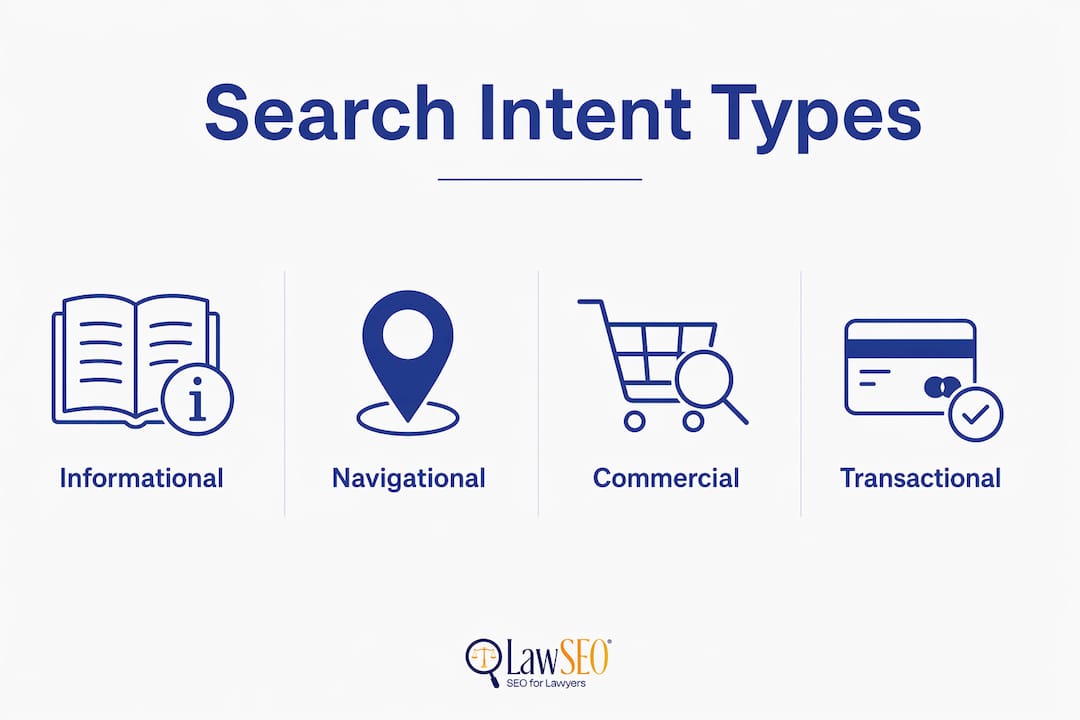
Every search query falls into one of four intent categories, and understanding each one determines what content format you should produce. The type of intent behind a query is not guesswork. It is visible in the language of the query itself.
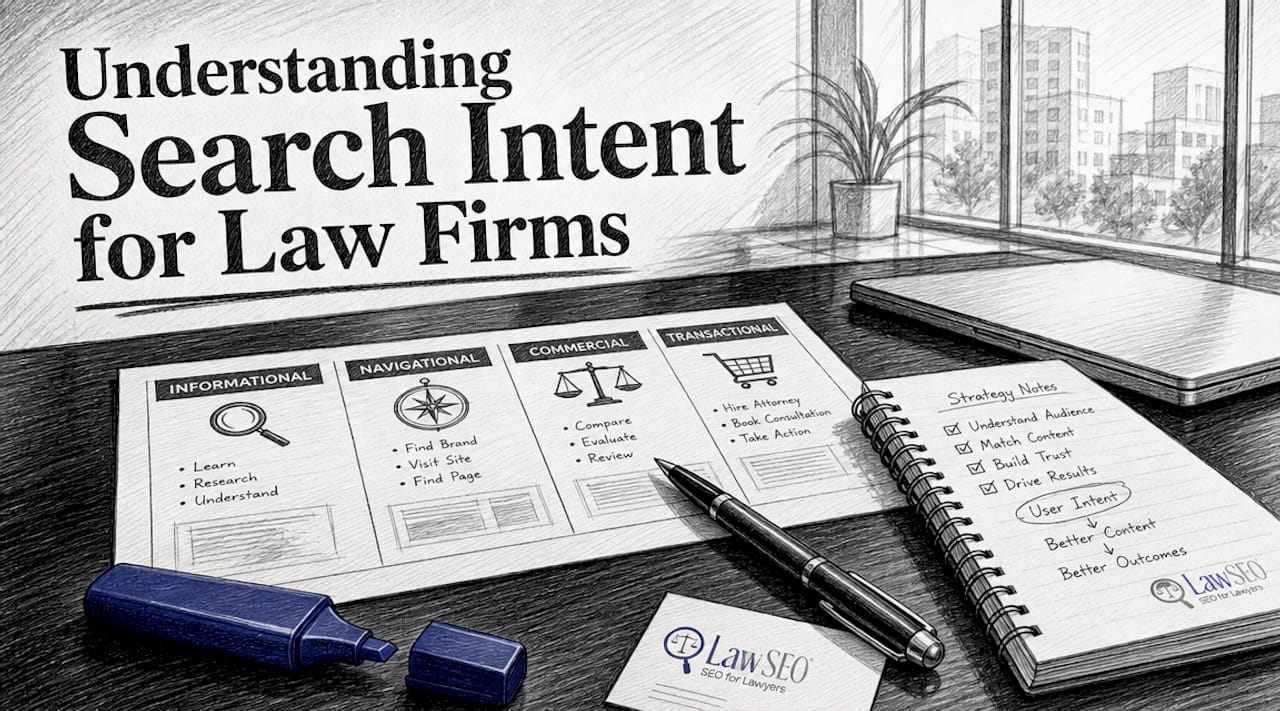
Informational intent drives queries where users want to learn something. Phrases like “how to,” “what is,” and “why does” signal this intent. A prospective client typing “what does a personal injury lawyer do” is not ready to hire anyone yet. They want education. Informational queries commonly surface guides, glossaries, and how-to content, along with featured snippets and People Also Ask boxes in the SERP.
Navigational intent describes queries where users seek a specific website or brand. “Smith & Associates law firm Chicago” or “LexisNexis login” are navigational. The user already knows where they want to go. Competing for these terms outside your own brand name is rarely productive.
Commercial investigation intent covers research-phase queries. Modifiers like “best,” “top,” “vs.,” and “review” are reliable signals. The word “best” signals commercial investigation, while “how to” signals informational format. A query like “best immigration attorney in Dallas” places the user in evaluation mode, comparing options before committing.
Transactional intent represents the highest conversion potential. Transactional intent pages include product pages, pricing pages, local packs, and direct calls to action, all optimized to reduce friction for immediate action. In legal marketing, queries like “hire a DUI lawyer near me” or “schedule a free consultation personal injury attorney” fall squarely here.
| Intent type | Query example | Best content format |
|---|---|---|
| Informational | “What is a contingency fee?” | Blog post, FAQ, guide |
| Navigational | “Johnson Law Firm Houston” | Homepage, branded landing page |
| Commercial investigation | “Best divorce lawyers in Phoenix” | Comparison page, attorney profile |
| Transactional | “Hire a DUI attorney near me” | Service page, local landing page |
How does the SERP reveal dominant search intent?
The SERP is the most reliable indicator of what intent Google expects your content to satisfy. Before writing a single word, search your target keyword and study what Google already rewards. The page layout tells you everything.
Satisfying search intent is Google’s top priority, and the SERP is direct evidence of what content format and angle satisfy a given query. If the first page for “wrongful termination attorney fees” shows blog posts and FAQ-style guides, Google has already decided this is an informational query. Publishing a service page there will not rank, regardless of how well-written it is.
Key SERP features to read before creating content:
- Featured snippets signal informational intent. Google is pulling a direct answer, so your content must provide one clearly.
- Shopping carousels indicate transactional intent. In legal contexts, this rarely appears, but local service ads serve a similar function.
- Local packs confirm transactional or navigational intent with geographic specificity. These are critical for law firms targeting city-level clients.
- People Also Ask boxes reveal related informational sub-intents. Each question is a content opportunity.
- Brand homepages dominating results confirm navigational intent. Do not compete here unless the brand is yours.
Intent mismatch causes pages to struggle with ranking and click-through even when topic coverage is strong. A law firm that publishes a 3,000-word educational guide targeting a transactional keyword will lose to a competitor’s well-structured service page every time. The format mismatch signals to Google that the page does not serve the user’s actual goal.
Pro Tip: Run a SERP audit on your top 10 target keywords every quarter. Google’s interpretation of intent shifts over time, and a keyword that rewarded guides in 2024 may now favor local service pages in 2026.
What is the significance of search intent for legal marketing?
Understanding search intent is not an academic exercise for legal marketers. It is a strategic filter that determines which keywords are worth pursuing and what content will actually convert prospective clients. Keyword intent analysis is a strategic necessity before volume or difficulty assessment, ensuring realistic conversion potential guides keyword inclusion.
Legal keywords span all four intent types, and each demands a different content response:
- Informational: “What happens at a deposition?” Produce a detailed guide or FAQ. This builds authority and captures early-stage prospects.
- Commercial investigation: “Top family law attorneys in Atlanta.” Produce a well-structured attorney profile or comparison-style landing page.
- Transactional: “Emergency custody attorney call now.” Produce a service page with a prominent phone number, contact form, and trust signals like reviews and bar certifications.
- Navigational: Your firm’s name plus city or practice area. Optimize your homepage and Google Business Profile.
The strategic error most law firms make is producing only informational blog content while neglecting transactional and commercial investigation pages. Informational content builds topical authority and attracts early-stage searchers, but it does not close clients on its own. You need intent-aligned content at every stage of the decision process, from the first research query to the final “contact us” click.
Irrelevant keywords, even if high volume, waste resources and dilute topical focus. A personal injury firm ranking for “what is tort law” attracts law students, not clients. Prioritize keywords where the intent matches your firm’s ability to serve and convert the user.
Pro Tip: Map every keyword on your content calendar to one of the four intent types before assigning it to a writer. If you cannot identify a clear intent match, the keyword does not belong in your strategy.
Integrating informational content with commercial and transactional pages through on-page SEO and internal linking creates a content architecture that guides users from awareness to conversion. This is how law firms build both authority and a steady pipeline of qualified leads.
What role does generative AI play in modern search intent?
Generative AI intent is an emerging layer in user search behavior where users specifically want AI-generated responses, appearing alongside traditional intent categories. This is not a replacement for the four-category framework. It is an additional dimension that legal marketers must account for in 2026.
Google’s AI Overviews now appear prominently for informational and mixed-intent queries. A user searching “how long does a personal injury lawsuit take” may receive an AI-generated summary before seeing any organic results. If your firm’s content is not structured to be cited within those summaries, you lose visibility at the top of the page entirely.
“Despite advances in AI search features, traditional SEO best practices and intent alignment remain essential to ranking and user satisfaction.” — Google Search Central, 2026
The practical implication for legal marketers is clear. Content that directly answers specific questions, uses structured formatting, and demonstrates expertise is more likely to be pulled into AI Overviews. This means the informational content you produce to satisfy early-stage search intent now serves a dual purpose: it ranks in traditional results and feeds AI-generated answers.
Matching content to the dominant SERP format remains critical, but supporting secondary intents with dedicated sections and internal linking is equally recommended. A service page targeting transactional intent can include an FAQ section that addresses informational sub-intents, increasing the page’s chances of appearing in both traditional results and AI-generated summaries.
Key takeaways
Aligning every piece of legal content with a specific, verified search intent is the most direct path from search visibility to client acquisition.
| Point | Details |
|---|---|
| Four intent types | Every query maps to informational, navigational, commercial investigation, or transactional intent. |
| SERP as diagnostic tool | Read the SERP before writing; the dominant format tells you exactly what Google rewards. |
| Intent mismatch kills rankings | Publishing the wrong content format for a keyword wastes effort regardless of content quality. |
| Legal content strategy | Map keywords to intent types first; build informational authority alongside transactional conversion pages. |
| AI intent is now real | Generative AI Overviews favor structured, intent-aligned content; optimize for both traditional and AI results. |
Why intent alignment is the most underrated skill in legal SEO
After nearly three decades working in SEO, with the last several years focused exclusively on law firms through Lawseo, I have seen the same mistake repeat itself constantly. Attorneys invest in content production without ever asking whether the keyword they are targeting can realistically deliver a client. They rank for informational queries, celebrate the traffic, and then wonder why the phone is not ringing.
The uncomfortable truth is that most law firm blogs are optimized for the wrong intent. They answer questions that law students and curious readers type, not questions that people in legal distress type at 11 PM before calling a lawyer in the morning. The queries with real conversion potential are transactional and commercial investigation terms, and those pages require a completely different structure than a blog post.
What I have found actually works is building a content architecture that mirrors the client decision process. Start with informational content that earns trust and topical authority. Connect it through internal links to commercial investigation pages that compare your firm’s strengths. Then make the transactional pages impossible to miss, with clear calls to action, fast load times, and trust signals that reduce hesitation. That sequence, built around verified intent at each stage, is what separates law firms that dominate their market from those that produce content and hope for the best.
The rise of AI Overviews adds urgency to getting this right. Firms whose informational content is well-structured and intent-aligned are already appearing inside AI-generated answers. Those who ignored intent alignment are invisible in both traditional and AI results.
— TODD
How Lawseo helps law firms master search intent
Lawseo builds law firm SEO strategies around verified search intent at every stage of the client acquisition process. Todd R. Stager and the Lawseo team analyze SERP data, map keyword intent across practice areas, and produce content architectures that convert, not just rank. For attorneys ready to move beyond generic blog content, the 2026 advanced SEO strategy guide covers intent-driven content planning, AI Overview optimization, and local SEO tactics built specifically for legal practices. If you are comparing platforms and tools, the top SEO platforms comparison gives you a clear picture of what each solution actually delivers for law firms.
FAQ
What are the four types of search intent?
The four types are informational, navigational, commercial investigation, and transactional. Every search query maps to one of these categories, which determines the content format most likely to rank and convert.
Why does search intent matter more than keyword volume?
A high-volume keyword with the wrong intent delivers traffic that does not convert. Keyword intent analysis must precede volume assessment to confirm that ranking for a term can realistically produce clients, not just visitors.
How do I identify the intent behind a legal keyword?
Search the keyword and study the SERP. The dominant content format, whether guides, service pages, local packs, or brand homepages, reveals the intent Google has assigned to that query.
What is intent mismatch and how does it hurt rankings?
Intent mismatch occurs when your content format does not match the dominant format Google rewards for a query. Pages with strong content but the wrong format consistently underperform in rankings and click-through rates.
How does generative AI change search intent strategy?
Generative AI Overviews now appear for informational and mixed-intent queries, pulling structured answers from well-optimized content. Legal marketers must produce intent-aligned, clearly formatted content to appear in both traditional results and AI-generated summaries.