


TL;DR:
- In 2025, SEO emphasizes brand visibility and trust through AI citations, not just clicks. AI Overviews and zero-click searches significantly reduce traditional traffic metrics, requiring firms to focus on brand mentions and topical authority. Maintaining high-quality, structured content and tracking AI-related visibility signals are essential for sustainable search success.
SEO in 2025 is defined by a fundamental shift from click volume to brand visibility and trust. Google AI Overviews, zero-click search behavior, and Generative Engine Optimization (GEO) have redrawn the rules for every digital marketer and law firm competing online. The old model of ranking for keywords and counting clicks no longer tells the full story. Users now trust brands featured in AI answers even when they never click through. Understanding these top SEO trends in 2025 is the difference between growing your firm’s online presence and watching competitors take your clients.
How AI overviews and zero-click searches are reshaping SEO strategy
Google AI Overviews now answer millions of queries directly inside the search results page. That single change has made the traditional “ten blue links” model less reliable as a primary traffic source.
Zero-click rates reached approximately 62% of all Google searches in 2025, rising from 50% in 2019. That trajectory means more than half of every search your prospective clients run never produces a click to any website. For law firms, where a single retained client can be worth tens of thousands of dollars, losing visibility at the top of the funnel is a serious business risk.
The strategic implication is clear: clicks are no longer the primary measure of SEO success. Share of voice, brand mentions in AI answers, and citation frequency inside Google AI Overviews now matter as much as traditional ranking positions. The table below shows how the measurement model has changed.
| Old Metric | New Metric |
|---|---|
| Organic click volume | Share of AI Overview citations |
| Keyword ranking position | Brand mention frequency |
| Bounce rate | Share of voice in answer engines |
| Page-level traffic | Domain-level authority signals |
| CTR from SERPs | Presence in zero-click answer features |
The shift is not theoretical. A study of 70 users across 8 search tasks found that brand trust increases when a firm appears in AI-generated answers, regardless of whether the user clicks. That trust translates directly into client inquiries for law firms.
- Track brand mentions across AI answer engines, not just Google Search Console data.
- Monitor which queries trigger AI Overviews in your practice areas.
- Measure share of voice monthly alongside traditional ranking reports.
Pro Tip: Set up Google Alerts and a tool like Brand24 or Mention to track how often your firm’s name appears in AI-generated answers and third-party content. This gives you a visibility signal that Google Analytics alone cannot provide.
Do core SEO best practices still matter in 2025?
Foundational SEO practices remain the engine behind AI visibility. Google’s own guidance confirms that no special markup is needed for AI features beyond solid technical SEO and genuinely valuable content. That is both reassuring and demanding.
What it means in practice: the same principles that drove rankings in 2022 still apply, but the bar for content quality is higher. AI extractors favor content that is structured, specific, and non-generic. A law firm blog post that restates common legal definitions without adding original analysis will not earn AI citations. A post that explains how a specific local court interprets a statute, with concrete examples, will.
Structured data is now a technical priority, not an optional enhancement. AI Overviews appear 73% more often for pages with structured data than for those without. That gap is too large to ignore. Schema markup for FAQs, legal services, attorney profiles, and local business information directly improves the probability that your content gets extracted and cited.
- Use FAQ schema on every practice area page.
- Apply LocalBusiness and LegalService schema to your firm’s location pages.
- Structure content with clear H2 and H3 headings that match the questions your clients actually search.
- Write content that answers a specific question in the first paragraph, then expands with evidence.
Pro Tip: Content distinctiveness is your primary defense against AI-generated commodity content flooding search results. Add original case outcomes, client scenarios, or jurisdiction-specific analysis that no AI tool can replicate from public data.
How should you adapt content strategy for 2025?
Google’s Helpful Content system applies a site-wide quality signal that can suppress an entire domain if a significant portion of its pages are low-value or templated. This is the most misunderstood ranking factor in 2025. A single well-written practice area page cannot rescue a site filled with thin location pages or boilerplate attorney bios.

The risk is especially acute for law firms that used scaled AI-generated content to build out city or practice area pages quickly. Google’s system does not penalize individual pages in isolation. It evaluates the overall content quality of the domain and applies that judgment across all pages. One hundred thin pages can drag down twenty strong ones.
The correct response is not a page-level rewrite. Fixing Helpful Content issues requires reducing or removing low-value content at the source, then rebuilding with people-first material. That means auditing your entire site, not just your top-performing pages.
Effective content strategy for 2025 follows these principles:
- Audit every page on your domain and classify it as high-value, improvable, or removable.
- Consolidate thin location pages into comprehensive regional guides with original local information.
- Publish content that reflects genuine legal expertise, not generic summaries available on any legal information site.
- Update existing content regularly to reflect changes in law, court decisions, or local procedure.
Pro Tip: Run a content audit using Screaming Frog or Sitebulb to identify pages with fewer than 300 words, no inbound links, and low engagement. These are your Helpful Content liabilities. Address them before adding new pages.
What kpis should you track for SEO success in 2025?
Measurement is where most law firms and digital marketers fall behind. The standard Google Analytics dashboard still shows sessions, users, and organic traffic. Those numbers are real, but they are incomplete in a zero-click environment.
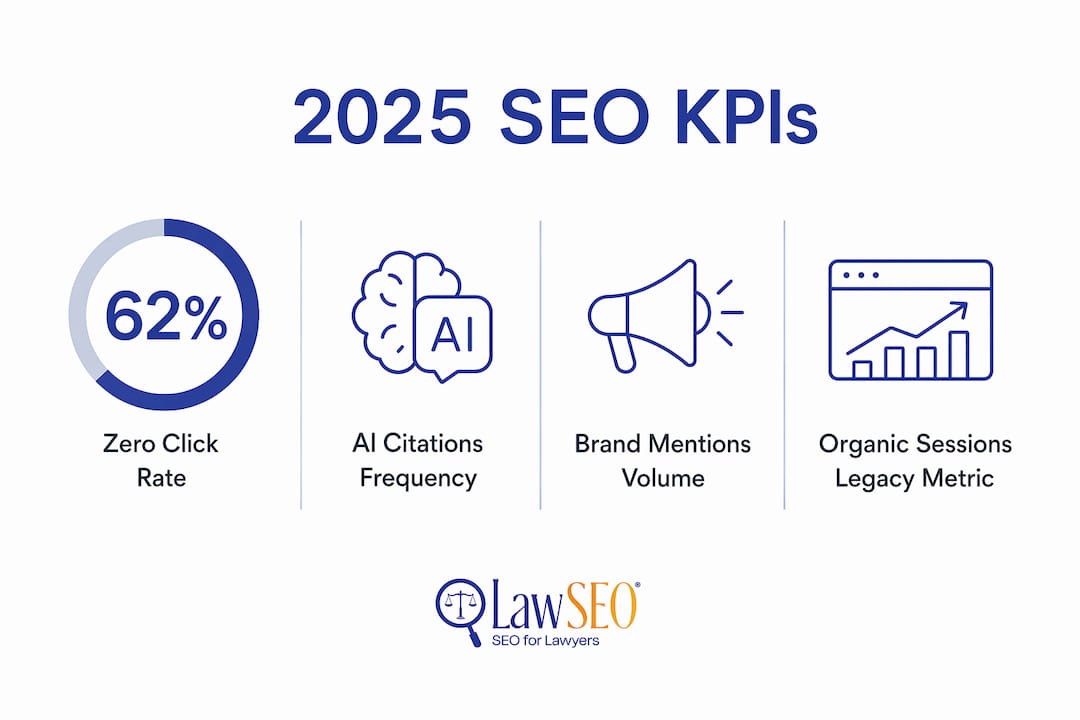
The model that fits 2025 SEO separates share of extraction from share of visits. Share of extraction measures how often your content appears in AI Overviews, featured snippets, and answer engine results. Share of visits measures how often that visibility converts to a website session. Both matter. Tracking only visits causes you to underestimate your pipeline contribution and over-invest in click-driving tactics that are becoming structurally less effective.
Community platforms like Reddit and YouTube now function as brand trust validation channels in the SEO ecosystem. Google surfaces Reddit threads and YouTube videos prominently in search results. A law firm with active, credible presence on these platforms builds trust signals that AI systems recognize and reward.
| Old KPI | New KPI |
|---|---|
| Organic sessions | AI Overview citation frequency |
| Keyword ranking | Brand mention volume |
| Page authority | Topical authority score |
| Backlink count | Trust signal diversity |
| Conversion rate from organic | Pipeline attribution from visibility |
Tracking AI citations requires new tools. Platforms like SE Ranking, Semrush, and BrightEdge have added AI Overview tracking features. Use them alongside Google Search Console to build a complete picture of your firm’s search presence.
Practical SEO tactics for law firms and digital marketers
The following steps translate the trends above into a working plan for law firms and marketing professionals managing legal SEO campaigns.
-
Build topical clusters. Topical clusters of five or more interconnected articles earn 3.2 times more AI citations than standalone pages. For a personal injury firm, this means a pillar page on personal injury law supported by articles on car accidents, slip and fall cases, medical malpractice, and wrongful death, all internally linked.
-
Prioritize brand authority signals. Earn mentions on legal directories like Avvo, Martindale-Hubbell, and Justia. Publish guest articles in bar association publications. Speak at local legal events and get those appearances documented online.
-
Optimize for AI extraction. Format content with clear question-based headings, concise answers in the first paragraph, and FAQ sections using schema markup. Review the AI optimization guide for law firms to align your content structure with how AI systems extract and cite information.
-
Use community-driven validation. Encourage satisfied clients to leave detailed Google Business Profile reviews. Participate in legal Q&A threads on Reddit and Avvo. These signals reinforce brand trust in ways that backlinks alone cannot replicate.
-
Balance visibility and click-driving tactics. Not every query needs a click. Informational queries answered by AI Overviews still build brand recognition. Focus click-driving efforts on high-intent queries like “personal injury attorney near me” or “divorce lawyer in [city]” where users are ready to contact a firm.
Pro Tip: Review your SEO ranking factors for law firms at least quarterly. The weight of individual factors shifts as Google updates its systems. What drove rankings in early 2025 may not be the primary lever by year-end.
Key takeaways
SEO success in 2025 requires law firms and digital marketers to measure brand visibility and AI citation presence alongside traditional traffic metrics, because clicks alone no longer reflect true search performance.
| Point | Details |
|---|---|
| Visibility over clicks | Over 62% of searches end without a click; brand presence in AI answers now drives trust. |
| Foundational SEO still works | Structured data, clear headings, and unique content remain the core of AI extractability. |
| Site-wide quality matters | Google’s Helpful Content system penalizes entire domains for low-value pages, not just individual ones. |
| Measure share of extraction | Track AI Overview citations and brand mentions separately from organic session counts. |
| Topical clusters win | Five or more interconnected articles earn 3.2 times more AI citations than standalone pages. |
What 29 years in legal SEO has taught me about 2025
I have been doing SEO for law firms since before Google existed. I have watched the industry shift from directory submissions to PageRank to mobile-first indexing. The shift happening now with AI Overviews is the most significant change I have seen in a decade, and most law firms are responding to it the wrong way.
The instinct is to chase the new thing: optimize for AI, add schema everywhere, build more content. That instinct is not wrong, but it misses the deeper point. AI systems are rewarding the same qualities that good SEO has always rewarded: genuine expertise, clear communication, and consistent authority. The difference is that the feedback loop is now faster and more visible.
What I tell every law firm I work with: stop treating AI Overviews as a threat to your traffic and start treating them as a brand channel. When your firm appears in an AI-generated answer about medical malpractice law in your state, that is a trust signal worth more than a third-page ranking. The user may not click, but they remember the name.
The firms that will dominate search in 2026 and beyond are the ones building genuine topical authority now. That means fewer pages, better content, and a real investment in the kind of expertise that no AI content tool can fabricate. It also means measuring your performance honestly, which requires tracking visibility metrics alongside traffic metrics.
Do not wait for a Google algorithm update to force the change. The data is already clear.
— TODD
How Lawseo helps law firms stay ahead of SEO changes
Lawseo works exclusively with attorneys and law firms, which means every strategy we develop is built for the competitive and ethical realities of legal marketing. We track AI Overview appearances, topical authority signals, and zero-click visibility for every client campaign, not just traditional ranking reports. Our legal SEO strategies for law firms are updated continuously to reflect how Google and AI-driven search platforms are evolving. If your firm is ready to build the kind of search presence that generates client inquiries in 2025 and beyond, Lawseo offers founder-led strategy with over 29 years of legal SEO experience behind every campaign.
FAQ
What is the biggest SEO trend in 2025?
The shift from click-based metrics to visibility and brand trust is the defining trend. Google AI Overviews now answer queries directly, making brand presence in AI answers as important as traditional organic rankings.
How do AI overviews affect law firm SEO?
AI Overviews reduce clicks on informational queries but increase brand recognition for firms whose content is cited. Structured data and topical authority are the primary factors that determine which firms get cited.
What does zero-click search mean for law firms?
Zero-click searches end without a visit to any website. With over 62% of searches ending this way, law firms must track brand mentions and AI citations, not just website traffic, to measure their true search presence.
Do i need special markup to appear in google AI overviews?
No. Google’s official guidance confirms that standard SEO best practices, including structured data, clear headings, and unique content, are sufficient. No proprietary AI markup exists or is required.
How many articles do i need for a topical cluster?
A topical cluster of five or more interconnected articles earns 3.2 times more AI citations than a standalone page. For law firms, this means one pillar page supported by at least four related practice area articles with internal links connecting them.