


TL;DR:
- Optimizing your Google Business Profile and maintaining NAP consistency are essential for local SEO success in law firms. Regularly updating localized content, managing citations, and implementing accurate schema markup further strengthen your online visibility. Continuous performance monitoring ensures your firm remains competitive and converts local rankings into client consultations.
Your law firm delivers excellent legal services, yet potential clients in your city are finding competitors instead of you. That gap almost always traces back to local search visibility. A well-executed step by step local SEO strategy changes that equation directly. When someone searches “divorce attorney near me” or “personal injury lawyer in Chicago,” Google surfaces firms that have earned local authority through specific, repeatable actions. This guide walks you through every stage of that process, from foundational setup to ongoing performance monitoring, with tactics calibrated specifically for law firms competing in high-stakes local markets.
Key Takeaways
| Point | Details |
|---|---|
| Start with GBP optimization | Claiming and fully completing your Google Business Profile is the single highest-impact first step. |
| NAP consistency protects rankings | Mismatched name, address, or phone data across directories actively harms your local search position. |
| Localized content drives relevance | Dedicated pages per practice area and location send strong local relevance signals to Google. |
| Schema markup closes the loop | LocalBusiness schema that matches your GBP prevents entity inconsistencies that confuse search engines. |
| Track and iterate continuously | Monitoring GBP Insights, rankings, and reviews allows you to catch and fix ranking drops early. |
Step by step local SEO: preparation and fundamentals
Before touching a single directory listing or web page, you need a clear picture of what local SEO actually is and what assets you need in place.
Local SEO is the practice of optimizing your online presence so that your firm appears prominently when people in your geographic area search for the legal services you offer. Local SEO success depends on matching local-intent queries with entity signals: the right local keywords, a strong Google Business Profile, consistent NAP data, and localized web content working together.
For law firms specifically, the three core ranking factors are your Google Business Profile, NAP consistency across the web, and the localized relevance of your website. Before you take a single optimization step, confirm you have access to these accounts and tools:
| Asset | Purpose | Where to Access |
|---|---|---|
| Google Business Profile | Controls local pack visibility | business.google.com |
| Google Search Console | Tracks organic performance | search.google.com/search-console |
| Google Analytics 4 | Measures site traffic and behavior | analytics.google.com |
| Citation audit tool | Finds NAP inconsistencies | Moz Local, BrightLocal |
| Keyword research tool | Identifies local search demand | Google Keyword Planner, Semrush |
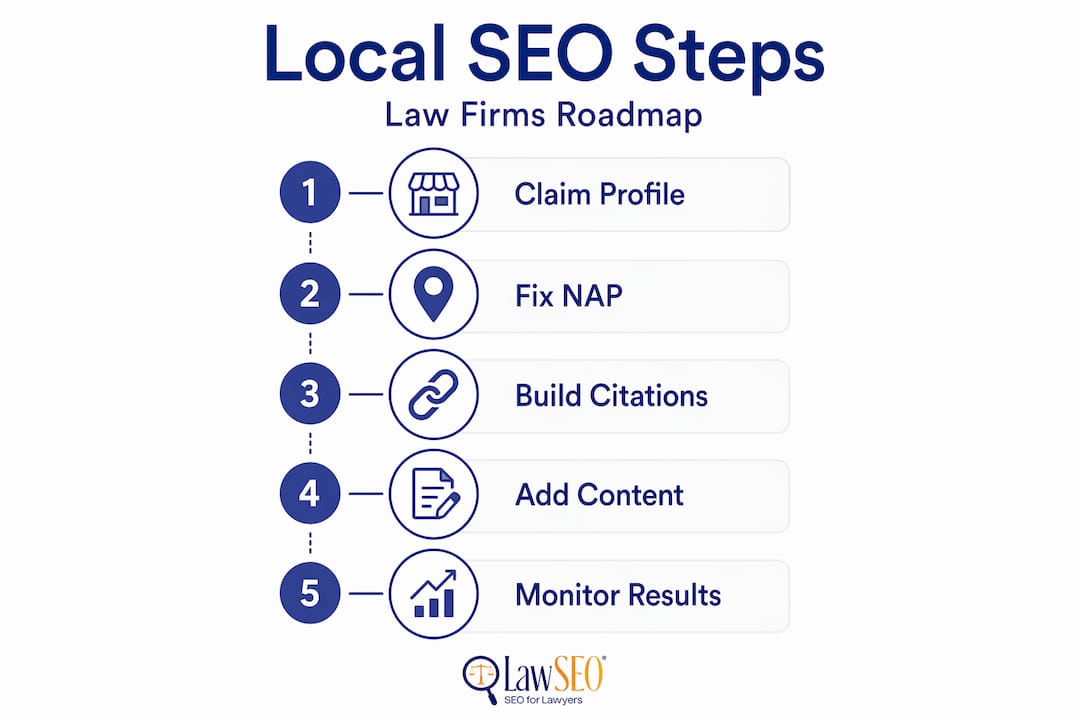
Keyword research for law firms follows a specific pattern. Build your service list first, then layer on explicit local modifiers (“in [city]”) and implicit ones (“near me”). Map each keyword combination to a specific page on your site. For example, “criminal defense attorney Houston” should map to a dedicated Houston criminal defense page, not your homepage.
Pro Tip: Start with the five practice areas that generate the most revenue, then identify two to three city or neighborhood modifiers for each. That gives you 10 to 15 targeted keyword combinations to build pages around before you scale further.
Optimizing your Google Business Profile
Your Google Business Profile is the foundation of local SEO for law firms. GBP must be claimed, verified, and fully completed to appear in local pack results. Here is the exact sequence to follow:
-
Claim and verify your profile. Go to business.google.com and search for your firm. If it exists, claim it. If not, create it. Verification usually comes via postcard, phone, or video call. Do not skip this step or attempt to optimize an unverified profile.
-
Select the right primary category. Your primary category carries the most ranking weight. “Law Firm” is a valid primary, but more specific options like “Personal Injury Attorney” or “Family Law Attorney” often outperform it when they match your core practice.
-
Add secondary categories. If you practice in multiple areas, add secondary categories for each. A firm handling both criminal defense and immigration can list both without diluting its primary signal.
-
Complete every section without exception. Write a business description that includes your city, your primary practice area, and a natural mention of your key services. Fill in hours, website URL, phone number, and attributes such as “free consultations” or “wheelchair accessible.”
-
Upload photos consistently. Law firms with professional office photos, team headshots, and even street-view images of the building see stronger engagement. Aim for a minimum of 10 photos at launch and add new ones monthly.
-
Create Google Posts regularly. Posts about recent case results (within ethical advertising rules), community involvement, or informational legal content keep your profile active and signal to Google that the business is operating.
-
Build and manage your Q&A section. Proactively add questions your clients commonly ask, then answer them yourself. This prevents inaccurate answers from the public appearing on your profile.
Reviews and reputation signals directly affect local SEO performance. Firms that systematically solicit reviews through in-person asks, SMS follow-ups, and one-click review links rank higher and convert more visitors into consultations.
Pro Tip: After a matter closes, send a two-sentence text message with a direct link to your GBP review page. Response rates for this method consistently outperform email follow-ups because the friction is lower and the ask feels personal.
NAP consistency and citation building
NAP stands for Name, Address, and Phone. Exact NAP consistency across all citations and your website builds trust with Google’s local algorithm. Even small variations, “Suite 100” versus “Ste. 100” or “LLC” versus omitting it entirely, create entity mismatches that suppress rankings.
Here is how to approach NAP management for a law firm:
- Run a citation audit first. Tools like BrightLocal or Moz Local will surface every directory listing that mentions your firm. Pull this report before you change anything.
- Establish a canonical NAP format. Decide on one exact version of your firm name, address format, and phone number. Write it down. Every listing must match this version exactly.
- Fix or remove duplicates. Duplicate listings confuse Google. Claim and merge them through each directory’s support process. Do not simply create a corrected listing and leave the old one live.
- Prioritize legal-specific directories. Beyond general directories like Yelp and Yellow Pages, submit to Avvo, Justia, FindLaw, Martindale-Hubbell, and your local or state bar association directory. These carry domain authority and topical relevance that generic sites do not.
- Target local civic citations. Your local chamber of commerce, city business directory, and community organizations provide localized link signals that reinforce your geographic relevance.
- Avoid virtual offices. Google’s guidelines prohibit listing addresses where the firm is not staffed during stated business hours. Virtual office addresses frequently trigger suspensions and create long-term verification problems.
Pro Tip: Set a quarterly calendar reminder to re-audit your citations. Aggregator databases push outdated information to directories without your knowledge, and a single bad data propagation can undo months of clean-up work.
On-site local SEO and structured data
Your website must reinforce every signal your GBP and citations are sending. Location-based keywords and dedicated landing pages for each practice area and location you serve are the two most direct ways to accomplish this.
Creating localized service pages
Each combination of practice area and location you target should have its own page. A firm serving three cities in two practice areas needs at minimum six pages. Each page should contain unique content: local court information, city-specific legal nuances, attorney bios with local ties, and client testimonials from that area. Thin pages that swap only the city name are a known ranking trap.
| Page Type | What Makes It Unique | Common Mistake |
|---|---|---|
| Practice area + city | Local court details, city-specific statutes | Copy-paste with only the city name changed |
| Attorney profile | Bar admissions, local community involvement | Generic bio with no geographic signals |
| Contact page | Embedded Google Map, local phone number | Single national number, no map embed |
For multi-location law firms, create separate dedicated pages and unique LocalBusiness schema blocks per location, linking each properly to the corresponding Google Business Profile and to your parent organization entity.
Implementing LocalBusiness schema
Schema markup tells search engines exactly what your business is and where it operates. Accurate LocalBusiness schema that matches your GBP details exactly, including name, address, phone, and opening hours, improves your chance of appearing in the Knowledge Panel and displaying “open now” status correctly.
Use Google’s Rich Results Test to validate your schema before pushing it live. The most common misconfiguration is opening hours that differ between your GBP and your schema markup. That mismatch signals an entity inconsistency and weakens both signals.
Pro Tip: Embed a Google Map on your contact page using your GBP listing URL, not just a generic address. This creates a direct association between your website and your GBP entity in Google’s understanding of your business.
Monitoring performance and troubleshooting
Optimization without measurement is guesswork. Tracking with GBP Insights, Analytics, Search Console, and rank tracking tools gives you the data to distinguish what is working from what needs adjustment.
The core metrics to watch are map pack ranking positions for your target keywords, organic click-through rate from Search Console, phone call and direction request volume from GBP Insights, and new review velocity. Review these monthly at minimum.
- Ranking drops without obvious cause often trace back to a NAP mismatch introduced by an aggregator update or a new duplicate listing. Run a fresh citation audit.
- Low GBP engagement despite solid rankings usually means your photos are outdated, your description lacks a clear call to action, or you have unanswered reviews. Address all three.
- Thin content penalties show up as pages ranking outside the top 20 despite strong backlink and citation signals. Add substantive, locally relevant content to underperforming pages.
- Mobile optimization directly affects conversion from local searches. Most people searching for local attorneys on smartphones will call or leave within seconds if the site loads slowly or lacks a click-to-call button.
Pro Tip: Use questions from client intake forms as content prompts. If ten clients asked the same procedural question during intake, that question likely has hundreds of local monthly searches attached to it. Write a page that answers it thoroughly.
My perspective on local SEO for law firms
I’ve worked with law firms on SEO for nearly three decades, and the most persistent mistake I see is treating local SEO as a one-time setup task. Attorneys claim their GBP, fill in the basic information, and then wait for clients to appear. That approach fails almost every time.
What actually works is treating your Google Business Profile like a living storefront, one that requires regular attention, fresh content, and active reputation management. The firms that dominate their local markets are the ones posting updates, responding to every review, and adding new service information as their practice evolves.
I’ve also seen law firms pour resources into advanced tactics like link building campaigns and AI optimization before they’ve secured the basics. That is backwards. A GBP with inconsistent hours and no reviews will not benefit from a sophisticated link profile. Get the foundation right first. The local SEO for law firms opportunity is enormous, but it rewards firms that execute the fundamentals consistently rather than those chasing shortcuts.
The goal is never just to rank. It is to convert that ranking into a consultation and then into a client. Every optimization decision should trace back to that outcome.
— TODD
How Lawseo can accelerate your results
Lawseo works exclusively with law firms and attorneys, which means every strategy in this guide is something the team executes daily for real legal practices. Todd R. Stager brings nearly 30 years of SEO experience to every campaign, personally reviewing strategy to confirm it fits your market and practice area.
If you want to skip the trial-and-error phase and start with a proven framework, explore the 7 proven legal SEO strategies that Lawseo has used to help law firms outrank competitors in contested markets. You can also review the advanced SEO strategy guide for lawyers to see how foundational local SEO connects to long-term organic growth. Lawseo also offers exclusivity agreements, so your direct competitors will not benefit from the same strategy.
FAQ
What is the first step in local SEO for a law firm?
Claim and fully verify your Google Business Profile before taking any other action. It is the single highest-impact asset in local search and serves as the anchor for every other optimization step.
How long does it take to see results from local SEO?
Most law firms begin seeing measurable ranking improvements within 60 to 90 days of completing foundational steps, including GBP optimization, NAP correction, and on-site localization. Competitive markets may require four to six months.
Why does NAP consistency matter so much?
Search engines use your name, address, and phone number to confirm your business entity across the web. Inconsistent data creates conflicting signals that reduce Google’s confidence in your listing and suppress your local rankings.
How many citations does a law firm need?
Quality and consistency matter more than volume. Prioritize 20 to 30 high-authority general and legal-specific directories, then add local civic citations. After that, focus on keeping existing citations accurate rather than adding more.
What is LocalBusiness schema and do I need it?
LocalBusiness schema is structured data code you add to your website that tells search engines your firm’s name, address, phone, and hours in a machine-readable format. When it matches your GBP exactly, it reinforces your local entity and improves your chances of appearing in rich search results.