


TL;DR:
- Data analytics in SEO involves systematically measuring search and user data to enhance organic visibility and connect activities to measurable business outcomes. In 2026, monitoring AI Share of Voice, impression share, and technical signals like Core Web Vitals has become essential, as traditional click-based metrics now miss most content influence due to AI-driven search features. Law firms benefit from practice-specific tracking, schema markup, and multi-touch attribution to optimize SEO efforts and drive client growth effectively.
Data analytics in SEO is defined as the systematic process of collecting, measuring, and interpreting search and user data to improve organic visibility and connect search activity to measurable business outcomes. For law firms and digital marketers, this discipline has moved far beyond tracking keyword rankings. Tools like Google Search Console, Google Analytics 4, Semrush, and ObserviX now surface metrics that tie SEO directly to client acquisition and revenue. The role of data analytics in SEO has never been more consequential: firms that measure the right signals win more clients, while those relying on outdated metrics fall behind competitors who have already adapted to AI-driven search.
Which SEO performance metrics and data sources matter most in 2026?
Traditional SEO metrics, including clicks, impressions, and keyword rankings, still provide a useful baseline. Their limitation in 2026 is that they measure only what happens after a user decides to click, which is an increasingly rare event. More than 60% of searches now end without a single click because AI Overviews and featured snippets answer the query directly on the results page. That figure means click-based reporting alone misses the majority of moments when your content actually influences a potential client.
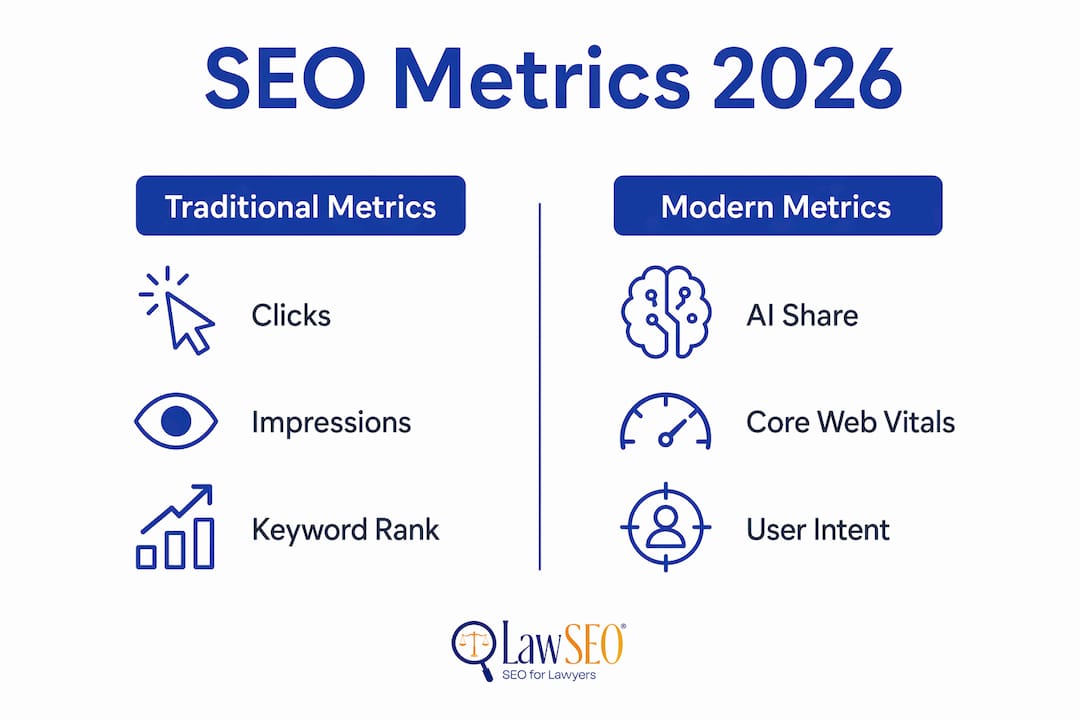
Modern SEO analytics requires a second layer of measurement built around AI visibility. AI Share of Voice tracks how often your content appears inside AI-generated answers on platforms like ChatGPT and Google’s AI Overviews. Featured snippet capture rate measures how frequently your pages occupy the zero-position result. Impression share, including zero-click exposures, gives a fuller picture of how many people your content actually reaches.
Technical indicators round out the measurement framework. Core Web Vitals, specifically Largest Contentful Paint under 2.5 seconds, Interaction to Next Paint under 200 milliseconds, and Cumulative Layout Shift under 0.1, correlate with user engagement and conversion rates even when their direct ranking impact is modest. Schema markup matters even more: FAQ and HowTo schemas increase AI citation likelihood by 3.7 times, according to the CXL AEO Study. That is not a marginal gain. It is a structural advantage in how AI systems select and surface content.
| Metric | Traditional approach | Modern approach (2026) |
|---|---|---|
| Visibility | Keyword ranking position | AI Share of Voice + impression share |
| Traffic | Organic clicks | Clicks + zero-click impressions |
| Authority | Domain Authority score | Conversion-weighted visibility |
| Technical health | Page speed score | Core Web Vitals (LCP, INP, CLS) |
| Content signals | Backlink count | Schema markup + content freshness |
Data sources for these metrics span Google Search Console, GA4, and third-party platforms. The integration challenge is real: each platform uses different attribution windows, session definitions, and sampling thresholds, which creates apparent conflicts that can mislead strategy decisions.
How does data analytics improve SEO strategy and decision-making?
The most direct improvement data analytics delivers is the retirement of vanity metrics. Domain Authority, total backlink count, and raw traffic volume all sound impressive in a report but tell a decision-maker nothing about whether SEO is generating clients. Conversion-weighted visibility and AI platform mentions provide defensible proof of ROI that partners and managing attorneys can actually evaluate.

Segmenting data by search intent is the next level of strategic improvement. A personal injury law firm tracking all organic traffic as one number will never know whether its blog posts attract researchers or whether its practice area pages attract people ready to hire. Splitting keyword data into informational clusters (what is comparative negligence?) versus transactional clusters (personal injury attorney near me) allows you to allocate content investment where it converts, not just where it ranks.
Automated dashboards accelerate this process significantly. Manual SEO reporting wastes 45% of analyst time on data preparation rather than interpretation. Platforms that unify GA4, Google Search Console, rank tracking, and backlink data into a single continuously refreshed view free analysts to focus on decisions instead of spreadsheet maintenance.
The practical workflow for improving decisions with data looks like this:
- Pull impression and click data from Google Search Console weekly, segmented by query intent
- Cross-reference landing page performance in GA4 to identify pages with high impressions but low engagement
- Flag content older than 13 weeks for a freshness audit, since content under 13 weeks old receives 67% more AI citations than older material
- Monitor AI Share of Voice monthly on ChatGPT, Gemini, and Perplexity for your core practice area terms
- Validate any significant metric change against a statistical significance threshold before acting on it
Pro Tip: Never declare a ranking drop a crisis until you have checked whether the change is statistically significant. A 15% traffic decline over one week in a low-volume niche may be normal variance. Apply a significance threshold before reallocating budget or rewriting content.
What are the challenges of using data analytics in SEO and how can they be overcome?
The most pervasive challenge in SEO analytics is data conflict between platforms. 67% of marketing teams report that conflicting metrics between Google Search Console and GA4 have undermined strategic decisions. GSC counts impressions differently than GA4 counts sessions. Sampling in GA4 can undercount traffic on high-volume sites. Neither platform is wrong. They measure different things, and treating them as interchangeable produces false conclusions.
The solution is a data validation workflow with defined thresholds. Before acting on any metric change, cross-reference the same time period across at least two independent data sources. If GSC shows a 20% impression drop but GA4 shows stable sessions, the issue is likely a SERP feature change rather than a ranking loss. Statistical significance frameworks prevent teams from making premature strategic shifts based on noise rather than signal.
Attribution is the second major challenge. Last-click attribution, still the default in many analytics setups, credits the final touchpoint before conversion with the entire sale. The result is a systematic overcount of paid search and a systematic undercount of organic SEO.
| Attribution model | How organic search is credited | Risk |
|---|---|---|
| Last-click | Only if organic is the final touch | Severe undercounting of organic value |
| First-click | Only if organic initiated the journey | Ignores mid-funnel organic assists |
| Linear | Equal credit across all touchpoints | Dilutes high-impact touchpoints |
| Multi-touch (data-driven) | Weighted by actual conversion influence | Most accurate; requires sufficient data volume |
Paid ads receive 58 to 65% of conversion credit under last-click models, while their actual contribution is closer to 22 to 24%. Multi-touch attribution corrects this distortion and often reveals that organic search’s true contribution is 40 to 60% higher than last-click models indicate. For law firms deciding whether to increase their SEO budget or shift spend to Google Ads, this difference is the entire argument.
Pro Tip: In GA4, activate the Model Comparison tool under Advertising to run last-click and data-driven attribution side by side. The gap between the two columns is the amount by which you are currently undervaluing your organic search investment.
Zero-click search behavior compounds the measurement problem. Only 7.5% of users click when an AI summary is present, compared to 14.2% without one. Measuring SEO success by clicks alone in this environment produces a systematically pessimistic view of organic performance.
How can law firms leverage data analytics to boost their SEO performance?
Law firms operate in one of the most competitive local search environments in the United States. A personal injury firm in Chicago or a family law practice in Miami competes against dozens of firms targeting identical keywords. Data analytics is the mechanism that separates firms that grow their client base through search from those that spend money without measurable return.
The starting point is tracking SEO performance at the practice area level, not just the domain level. A firm with criminal defense, DUI, and personal injury practices needs separate conversion tracking for each service line. Aggregated traffic numbers hide which practice areas are generating consultations and which are attracting irrelevant visitors.
AI citation monitoring is now a non-negotiable component of legal SEO analytics. When a potential client asks ChatGPT or Gemini “who is the best employment attorney in Dallas,” the answer that appears is determined by which firm’s content has been cited and indexed by those systems. Monitoring your AI Share of Voice on these platforms, and tracking whether your content appears in AI Overviews for high-intent legal queries, gives you early warning when a competitor is gaining ground in AI-driven search.
Specific data practices that deliver results for law firms include:
- Implementing FAQ schema and HowTo schema on practice area pages to increase AI citation probability
- Tracking conversion-weighted visibility by practice area to identify which services generate the highest revenue per organic visit
- Auditing content freshness quarterly and updating pages older than 90 days with current case law, statutes, or procedural changes
- Using multi-touch attribution in GA4 to measure how many clients first discovered the firm through organic search before converting via a phone call or contact form
- Monitoring Core Web Vitals monthly, since mobile users, who represent the majority of legal search traffic, abandon pages that load slowly
The analytics guide for law firm websites at Lawseo provides a framework specifically designed for legal practices to connect these data points to client growth outcomes. Law firms that invest in SEO with a data foundation consistently outperform those treating search as a set-it-and-forget-it expense.
Key takeaways
Data-driven SEO succeeds when firms replace vanity metrics with conversion-weighted visibility, adopt multi-touch attribution, and monitor AI citation signals alongside traditional search performance.
| Point | Details |
|---|---|
| Replace vanity metrics | Track conversion-weighted visibility and AI Share of Voice instead of Domain Authority or total backlinks. |
| Fix attribution first | Multi-touch models reveal organic search contributes 40 to 60% more than last-click data shows. |
| Schema markup is non-negotiable | FAQ and HowTo schemas increase AI citation likelihood by 3.7 times, directly impacting AI-era visibility. |
| Validate before acting | Apply statistical significance thresholds before changing strategy based on metric fluctuations. |
| Law firms need practice-level tracking | Segment analytics by service line to identify which practice areas generate the highest ROI from organic search. |
Why most SEO analytics programs fail before they start
After nearly three decades working in search, the pattern I see most often is not a lack of data. It is an excess of the wrong data presented to the wrong people. Law firm partners do not need a dashboard showing Domain Authority trends. They need to know how many consultations came from organic search last month and what it cost to acquire each one.
The firms that get the most from their SEO investment are the ones that decided early which business questions they needed to answer, then built their analytics infrastructure around those questions. They are not tracking 40 metrics. They are tracking six, and every one of them connects directly to revenue.
The shift to AI-driven search has made this discipline more urgent, not less. When a potential client’s first interaction with your firm happens inside a ChatGPT response rather than a Google results page, your traditional click data will not capture that moment at all. The firms building AI citation monitoring into their analytics programs now will have a significant advantage over those who wait until the traffic loss is already visible in their dashboards.
Data governance is the unglamorous piece that most agencies skip. Defining how sessions are counted, which attribution window applies, and how conversions are classified before you start reporting prevents the 67% data conflict problem from destroying your decision-making. Get the infrastructure right first. The insights follow automatically.
— Todd
How Lawseo helps law firms turn SEO data into client growth
Lawseo builds and manages data-driven SEO programs exclusively for law firms, with every strategy personally reviewed by Todd R. Stager, who brings 29 years of search experience to each campaign. The firm’s services include SEO audits, multi-touch attribution setup, AI citation tracking, and custom reporting dashboards built around the metrics that matter to legal practices. Lawseo also offers exclusivity agreements, meaning your firm’s competitors will not benefit from the same strategy. For law firms ready to connect their SEO investment to measurable client acquisition, the advanced SEO strategy guide for lawyers is the right starting point.
FAQ
What is the role of data analytics in SEO?
Data analytics in SEO transforms raw search and user data into strategic decisions that improve rankings, content quality, and ROI. It connects organic search activity to business outcomes like client consultations and revenue rather than stopping at traffic volume.
Which analytics tools are most useful for SEO in 2026?
Google Search Console, Google Analytics 4, Semrush, and ObserviX are the most widely used platforms for SEO analytics. Each serves a different function: GSC tracks search performance, GA4 measures on-site behavior, and third-party tools add rank tracking and AI visibility monitoring.
Why does last-click attribution undervalue organic SEO?
Last-click attribution assigns full conversion credit to the final touchpoint, which is often a paid ad or direct visit. Multi-touch models show that organic search’s actual contribution to conversions is 40 to 60% higher than last-click data indicates, making organic investment appear less effective than it truly is.
How can law firms use data analytics to improve their SEO?
Law firms should track conversions by practice area, monitor AI citation frequency on platforms like ChatGPT and Gemini, implement FAQ and HowTo schema, and use multi-touch attribution to measure organic search’s full role in client acquisition.
What is AI Share of Voice in SEO analytics?
AI Share of Voice measures how frequently a firm’s content appears inside AI-generated answers on platforms like Google AI Overviews, ChatGPT, and Perplexity. It is a critical metric in 2026 because more than 60% of searches now end without a click to any website.