


TL;DR:
- Well-constructed FAQ sections on law websites lower repetitive inquiries and build client trust before contact. They also enhance search engine visibility by targeting long-tail keywords, voice search, and featured snippets. Proper placement and ethical content practices ensure these FAQs attract qualified leads and improve organic traffic.
A well-built FAQ section is one of the highest-return content investments a law firm can make. The role of FAQs on law websites extends far beyond answering basic questions. Done right, a FAQ section qualifies leads, reduces administrative workload, builds client trust before the first phone call, and signals to Google and AI search tools exactly where your best answers live. Lawseo works with attorneys across the country, and the firms that treat FAQs as core content consistently outperform those that treat them as an afterthought.
How do FAQs improve user experience and client intake on law websites?
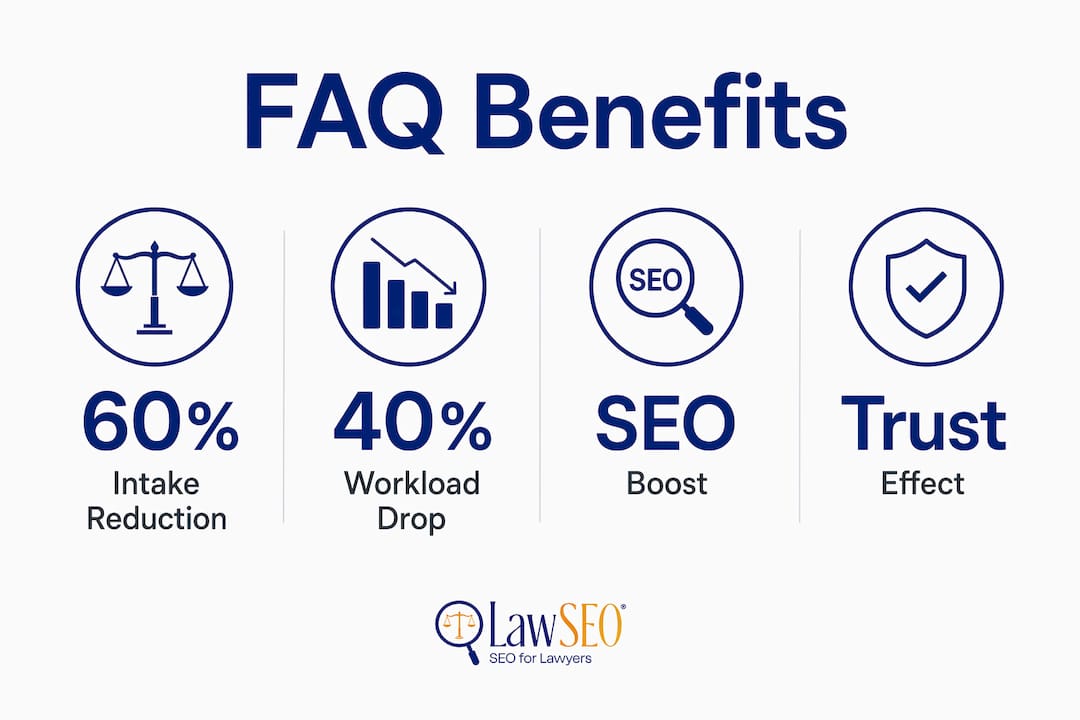
FAQs reduce repetitive intake workload by 40–60% by shifting common questions to a self-service resource. That reduction frees your staff to focus on consultations rather than answering the same phone calls about fees, timelines, and process. For a mid-size personal injury or family law firm, that efficiency gain is measurable within weeks of publishing a thorough FAQ page.
The trust benefit is equally significant. Strong FAQ content reduces client anxiety that is common before legal consultations. A prospective divorce client who reads a clear, honest answer about how asset division works arrives at the consultation calmer and better prepared. That psychological shift shortens the intake conversation and increases the likelihood of signing.
Comprehensive FAQ sections qualify leads by enabling informed visitors to self-educate before they contact you. Visitors who have read your FAQ already understand your service scope, fee structure, and process. They are more committed when they call. That is a fundamentally different lead than someone who found your number in a directory.
Strategic placement on practice area pages matters as much as the content itself. A FAQ embedded on your criminal defense page answers objections specific to that practice area. A FAQ on your estate planning page addresses entirely different concerns. Generic, site-wide FAQ pages serve a purpose, but practice-specific FAQ sections convert at a higher rate because they match the visitor’s exact context.
- Reduces phone and email volume by answering the most common pre-consultation questions in writing
- Builds pre-contact trust by demonstrating transparency about process, fees, and realistic outcomes
- Qualifies inbound leads so consultations start with informed, committed prospects
- Supports legal website user experience by reducing friction between a visitor’s question and your answer
Pro Tip: Review your intake call logs for the ten questions your staff answers most often. Those ten questions are your first FAQ entries. Real client language beats keyword-researched phrasing every time.
In what ways do FAQs enhance SEO and search engine visibility for legal sites?
FAQ schema markup directly improves your chances of appearing in Google’s featured answer boxes. Schema explicitly tags FAQs for search engines, improving snippet eligibility and helping AI-driven search tools like Google’s AI Overviews and Perplexity identify your content as a credible answer source. Law firms that implement FAQ schema on practice pages gain a structural advantage over competitors who publish plain text.
The mechanics of how FAQs capture search traffic follow a clear pattern:
- Long-tail keyword capture. Questions like “how long does a workers’ comp claim take in Texas” match exactly how real clients type into Google. A FAQ that answers this question directly ranks for that query without requiring a separate blog post.
- Voice search alignment. Voice queries are conversational and question-based by nature. Structured question-answer format signals AI and Google where answers live, making FAQ content the natural fit for voice search results.
- Featured snippet eligibility. Google’s featured snippets favor content that leads with a direct answer. A FAQ answer that opens with a one-sentence response and then expands with detail matches the format Google’s algorithm rewards.
- AI search citation. Generative AI tools pull answers from well-structured, authoritative content. FAQ pages with clear question-answer pairs are among the most frequently cited content types in AI-generated legal responses.
The FAQs impact on legal SEO compounds over time. Each question you answer creates a new entry point for organic traffic. A family law firm with 40 well-structured FAQ entries across its practice pages effectively has 40 additional indexed content assets working in parallel.
Stat to know: FAQ pages act as a self-service resource that cuts administrative intake volume by up to 60%. That same content also reduces your cost per lead by converting organic traffic without paid advertising spend.
Content quality determines whether SEO gains materialize. Thin, vague answers do not earn featured snippets. Answers that open with a clear principle, address jurisdictional nuance, and close with a consultation prompt perform best in both search rankings and user conversion.
What best practices ensure legally compliant and effective FAQ content on law websites?
Effective FAQ writing leads with clear principles, follows with jurisdictional nuances, and ends with advice for professional consultation. This structure satisfies both Google’s featured snippet algorithm and your professional responsibility obligations. It is not a compromise between SEO and ethics. It is the format that serves both simultaneously.
The most common mistake law firms make in FAQ content is overpromising. Answers that imply guaranteed outcomes or suggest a specific result without a consultation create liability and erode trust when reality differs. Visitors are more sophisticated than most attorneys assume. Honest, qualified answers build more credibility than confident-sounding ones that cannot be substantiated.
- Lead with the direct answer. State the general legal principle in the first sentence. Do not bury the answer in qualifiers.
- Add jurisdictional context. Note where state law, local court rules, or case-specific facts change the answer.
- Close with a consultation prompt. Every FAQ answer should end with a natural invitation to contact your firm for advice specific to the reader’s situation.
- Avoid specific outcome promises. Phrases like “you will win” or “you are entitled to X” create ethical exposure and set unrealistic expectations.
- Update answers regularly. Laws change. A FAQ answer about statute of limitations that was accurate in 2023 may be wrong in 2026.
Pro Tip: Have your FAQ answers reviewed by a senior attorney before publishing. SEO-optimized content that creates a professional responsibility issue costs far more than it earns.
Ethical legal FAQ content improves user trust and aligns with SEO goals, proving that transparency supports both professionalism and search rankings. The firms that treat FAQ content as a genuine client service tool, rather than a keyword insertion exercise, consistently produce content that ranks and converts.
How should law firms implement and position FAQs within their website architecture?
FAQ content placed after service explanation but before the final call to action maximizes both SEO performance and user decision-making. This placement works because the visitor has already read what you do, understands your value, and now needs their remaining objections addressed before committing to contact. The FAQ section removes that last friction point.
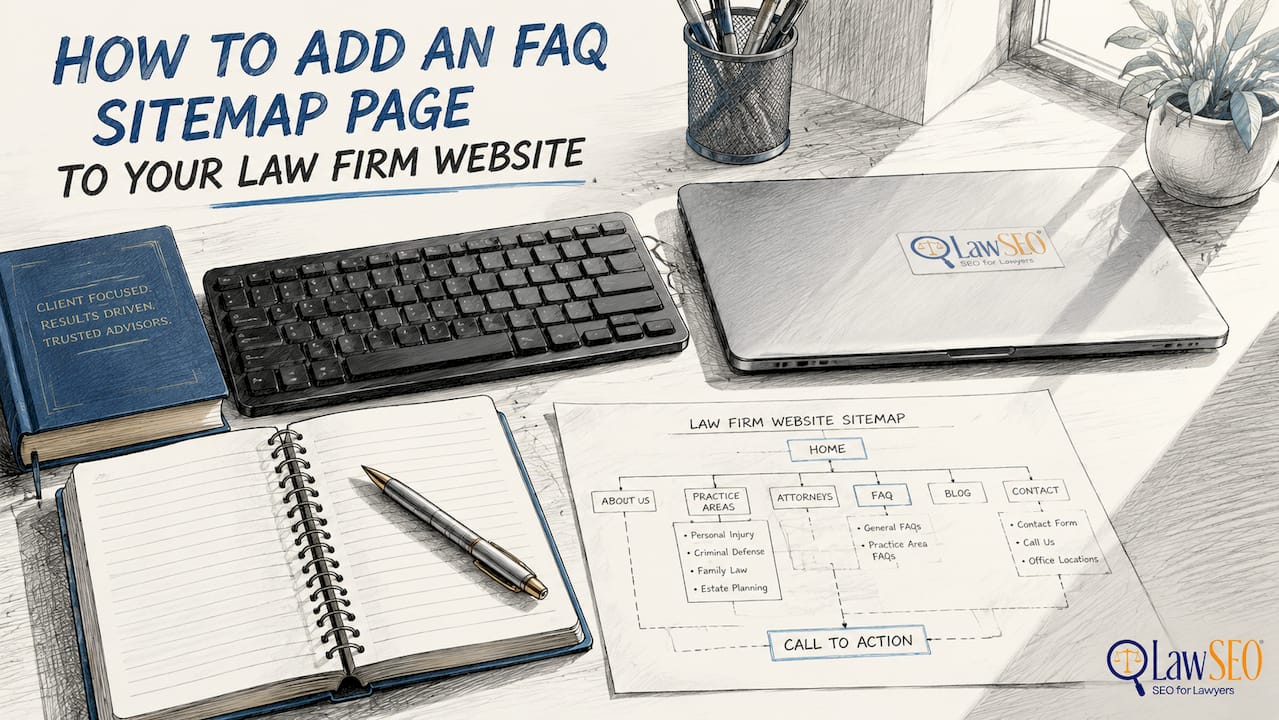
The table below compares the two primary FAQ implementation approaches law firms use:
| Approach | Best for | SEO impact | User experience |
|---|---|---|---|
| Dedicated FAQ hub page | Firms with broad practice areas and high content volume | High topical authority, strong internal linking target | Good for general research; lower conversion intent |
| Embedded practice page FAQs | Firms targeting specific practice area keywords | Direct keyword relevance per page, schema-ready | High conversion intent; answers objections at decision point |
| Combined hub plus embedded | Established firms with content teams | Maximum topical authority and conversion coverage | Best overall experience across all visitor stages |
The combined approach produces the strongest results. FAQs connect broad services with specific user questions, increasing topical authority across the entire site. A dedicated FAQ hub earns links and ranks for general legal questions. Embedded practice page FAQs convert visitors who are already evaluating your specific services.
Internal linking from FAQ answers to relevant practice pages serves a dual purpose. It guides the visitor deeper into your site and signals to Google the relationship between your FAQ content and your core service pages. A FAQ answer about child custody that links to your family law practice page passes authority and creates a logical navigation path. This is one of the key website features for law firms that most attorneys underuse.
FAQs have shifted from secondary filler to core digital infrastructure essential for first-trust interactions with potential clients. Law firms that treat FAQ architecture as a structural decision, not a content afterthought, build sites that perform consistently across both traditional search and AI-driven discovery.
Key takeaways
FAQs on law websites serve as both a client service tool and an SEO asset, and the firms that treat them as core content consistently outperform those that do not.
| Point | Details |
|---|---|
| Intake workload reduction | FAQ pages cut repetitive phone and email inquiries by 40–60%, freeing staff for higher-value work. |
| Lead qualification | Visitors who read FAQs arrive at consultations more informed and more committed to hiring. |
| SEO and AI visibility | FAQ schema markup improves featured snippet eligibility and helps AI search tools cite your content. |
| Ethical content structure | Lead with a clear principle, add jurisdictional context, and close with a consultation prompt. |
| Strategic placement | Embed FAQs after service content and before calls to action on practice pages for maximum conversion. |
FAQs are infrastructure, not decoration
After nearly three decades working in SEO, I have watched law firms treat FAQ pages as a box to check. They publish ten vague questions, add a disclaimer at the bottom, and move on. Those pages do not rank, and they do not convert.
The firms I have seen build real competitive advantages with FAQ content share one trait: they treat every question as a client service decision, not a content production task. They ask, “What does a scared, confused person need to understand before they trust us enough to call?” That question produces better FAQ content than any keyword tool.
The shift toward AI-driven search makes this even more consequential. Tools like Google’s AI Overviews and Perplexity pull answers from structured, authoritative content. Law firms with well-built FAQ sections are already appearing in AI-generated responses. Firms without them are invisible in that channel. That gap will widen through 2026 and beyond.
My honest advice: audit your current FAQ content against the structure outlined in this article. If your answers do not lead with a clear principle, address jurisdictional nuance, and close with a consultation prompt, rewrite them. The investment pays back in organic traffic, reduced intake costs, and better-qualified leads. You can also review client-centric FAQ examples from adjacent legal service providers to see what specificity looks like in practice.
— TODD
How Lawseo helps law firms build FAQ content that performs
Lawseo works exclusively with attorneys and law firms, which means every FAQ strategy we build accounts for professional responsibility rules, competitive keyword dynamics, and AI search optimization simultaneously. Our team, led by Todd R. Stager with over 29 years of SEO experience, integrates FAQ content into a complete law firm SEO strategy that covers schema markup, internal linking, and practice page architecture. If your FAQ content is not generating organic traffic or reducing intake friction, the structure and placement need work. Lawseo builds that foundation correctly from the start. Contact us to see what a properly structured FAQ program looks like for your practice.
FAQ
What is the role of FAQs on law websites?
FAQs on law websites answer common client questions before the first consultation, reduce administrative intake workload, and improve search engine visibility through structured question-answer content. They serve as both a client service tool and an SEO asset.
How do FAQs help with legal SEO?
FAQ schema markup improves eligibility for Google’s featured snippets and helps AI search tools identify your content as an authoritative answer source. Each FAQ entry also targets long-tail keywords and voice search queries that practice page copy typically misses.
Where should FAQs be placed on a law firm website?
FAQs perform best when placed after the main service description but before the call to action on practice area pages. A dedicated FAQ hub page combined with embedded practice page FAQs produces the strongest results for both SEO and user conversion.
How do FAQs reduce law firm intake workload?
A well-structured FAQ page acts as a self-service resource that answers the most common pre-consultation questions in writing, cutting repetitive phone and email volume by 40–60% according to Vida AI Agent OS.
What makes a legally compliant FAQ answer?
A compliant FAQ answer leads with a clear general principle, adds relevant jurisdictional context, avoids specific outcome guarantees, and closes with a prompt to seek professional consultation for the reader’s specific situation.