

TL;DR:
- Metadata guides search engines in classifying content, influencing rankings, and shaping user clicks. Effective use of title tags, meta descriptions, canonical URLs, structured data, and Open Graph tags enhances SEO and AI visibility in 2026. Regular review and accurate implementation of schema markup are essential to maintain competitive search presence.
Metadata is defined as the structured data layer that tells search engines what your web pages contain, who they serve, and why they deserve to rank. The role of metadata in SEO extends far beyond simple page labels. It determines how Google classifies your content, how users decide whether to click your result, and increasingly, how AI-powered search systems like Google’s Search Generative Experience retrieve and surface your pages. Organic search drives roughly 47–53% of all website traffic in 2025, which means poor metadata directly translates to lost revenue. Tools like JSON-LD for structured data and frameworks like Open Graph protocol are no longer optional additions. They are the foundation of competitive search visibility.
What are the essential metadata elements that impact SEO in 2026?
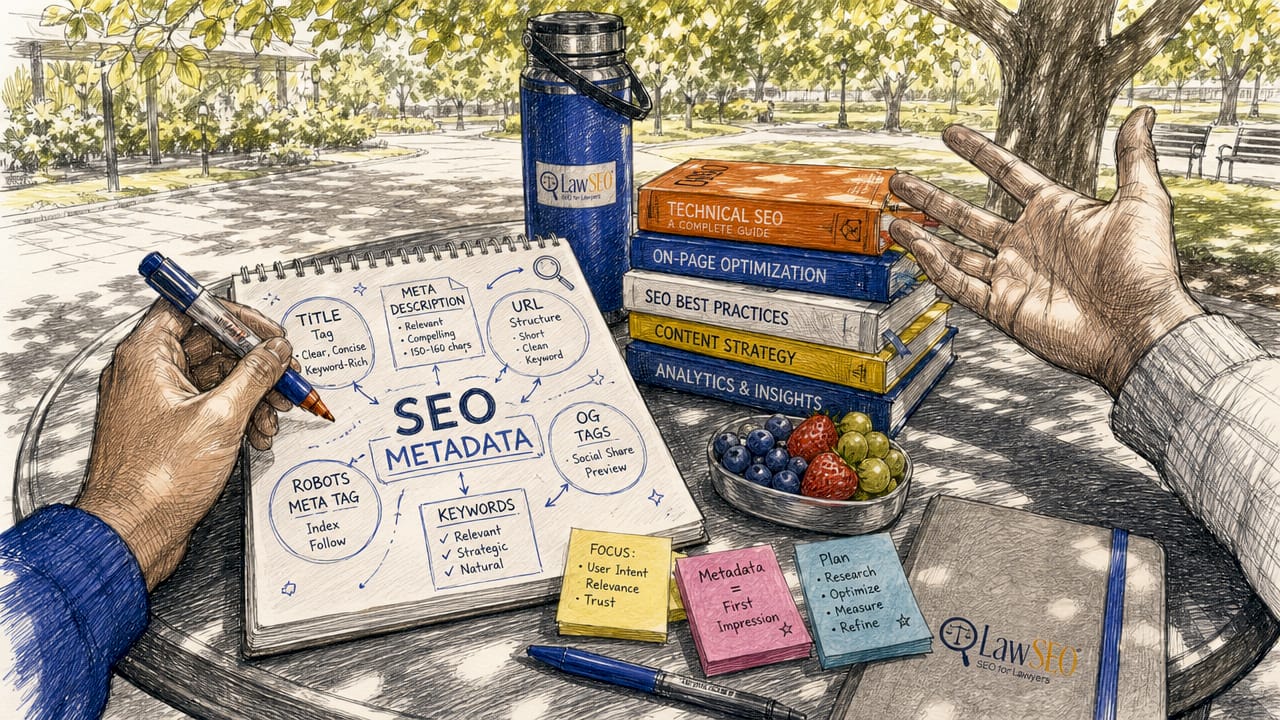
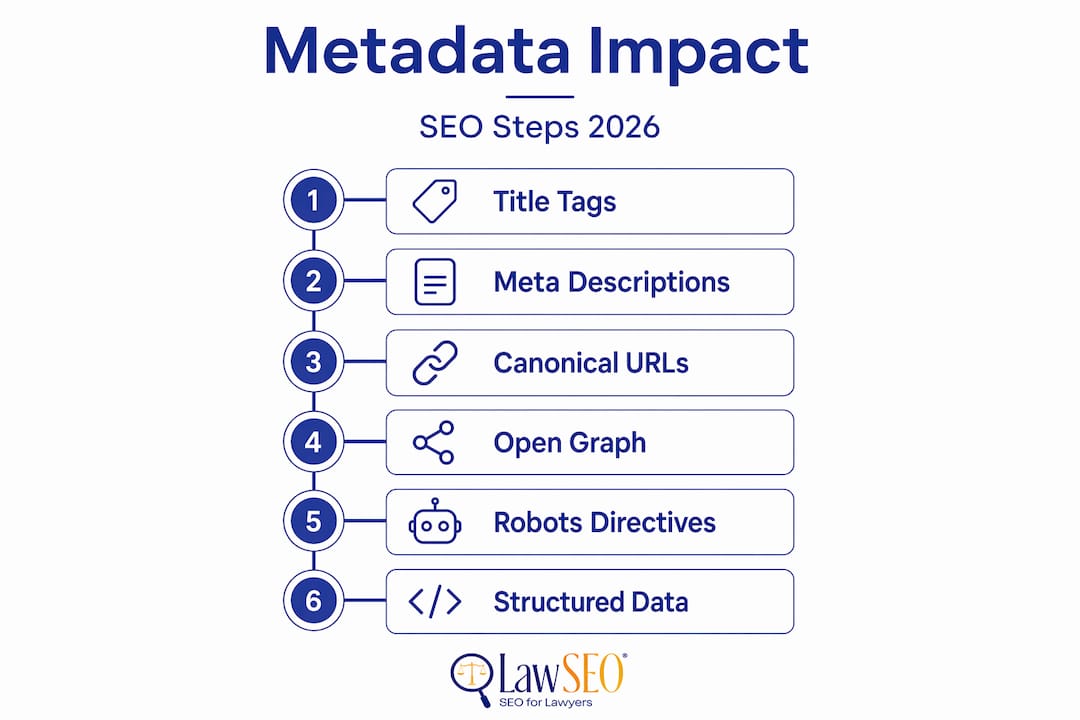
The six metadata elements that directly affect SEO performance are title tags, meta descriptions, canonical URLs, Open Graph tags, robots directives, and structured data in JSON-LD format. Each serves a distinct function. Treating them as a unified system produces compounding gains across rankings, click-through rates, and AI visibility.
Title tags carry the strongest ranking signal of any on-page metadata element. They are the first thing both Google and users read. Google truncates titles at approximately 60 characters, so every character counts. A title like “Personal Injury Lawyer in Chicago | Free Consultation” delivers the keyword, the location, and a conversion trigger within the limit.
Meta descriptions do not directly influence rankings, but optimized meta descriptions increase CTR by 5.8% over auto-generated ones. That lift compounds across hundreds of pages. Think of the description as the ad copy beneath your headline. It must answer the user’s question before they click.
Canonical URLs resolve duplicate content by telling Google which version of a page to index and assign authority to. Without them, a single piece of content published across multiple URLs splits its link equity and confuses crawlers about ranking priority.
Open Graph tags control how your pages appear when shared on LinkedIn, Facebook, and X. Pages shared without an Open Graph image receive 2 to 3 times fewer clicks than those with one. For law firms sharing case results or blog posts, this gap is significant.
Robots directives tell crawlers which pages to index and which to skip. Misconfigured robots tags are one of the fastest ways to accidentally de-index high-value pages.
Structured data (JSON-LD) is the metadata element with the highest upside in 2026. Schema markup implementation increases rich snippet eligibility by over 300%, and it serves as the primary data source for AI-generated answers. A law firm using LocalBusiness and FAQ schema is far more likely to appear in AI Overviews than one relying on plain HTML alone.
| Metadata Element | Primary SEO Function | Direct Ranking Factor? |
|---|---|---|
| Title tag | Keyword signal and first impression | Yes |
| Meta description | CTR optimization | No (indirect) |
| Canonical URL | Duplicate content resolution | Yes |
| Open Graph tags | Social click optimization | No |
| Robots directives | Crawl and index control | Yes |
| Structured data (JSON-LD) | Rich snippets and AI visibility | Yes (increasingly) |
Pro Tip: Run your site through Google’s Rich Results Test after adding JSON-LD schema. It confirms whether your structured data is valid and eligible for enhanced search features before you publish.
How does metadata influence user engagement and search engine behavior?
Metadata serves as the packaging of a website, guiding search engines toward accurate classification and guiding users toward confident click decisions. These two functions are not separate. They reinforce each other in ways that directly affect your rankings over time.
From the user’s perspective, your title tag and meta description are your only real estate in the search results page before someone decides to visit or scroll past. Well-crafted meta descriptions act as organic ad copy, communicating relevance and urgency in under 160 characters. A description that answers the searcher’s intent reduces bounce rate because visitors arrive with accurate expectations.
From the search engine’s perspective, metadata provides classification signals that complement body content. Google reads your title tag to confirm topical relevance, checks your canonical tag to determine which URL to credit, and parses your structured data to understand entities, relationships, and content type. Pages with coherent metadata across all six elements are easier to classify and more likely to rank for their target queries.
The indirect ranking benefit of strong metadata is real and measurable. Higher CTR signals to Google that your result satisfies user intent better than competitors. Lower bounce rates and longer dwell time reinforce that signal. Combined, optimized titles and descriptions can boost CTR by up to 50%, which is a compounding advantage in competitive niches like legal services.
One nuance worth understanding: Google rewrites meta descriptions approximately 63 to 70% of the time, pulling text it considers more relevant from the page body. This does not mean writing strong descriptions is wasted effort. Google still reads your original description to understand page content and intent. Write it for Google’s comprehension first, and for user persuasion second.
“Metadata optimization is not a one-time task. It is an ongoing signal management process that directly shapes how both humans and machines perceive your content’s value.”
What are common metadata mistakes and how to avoid them in 2026?
The most costly metadata errors are not technical failures. They are strategic oversights that accumulate quietly and suppress rankings across entire sites. Duplicate metadata causes keyword cannibalization, confusing Google about which page to rank for a given query and lowering performance for both. This is especially common on law firm sites where practice area pages share nearly identical titles.
The most frequent mistakes, and how to correct them, follow a clear pattern:
-
Duplicate title tags and meta descriptions. Assign unique titles and descriptions to every indexed page. Use a site crawl tool like Screaming Frog or Sitebulb to identify duplicates at scale. Prioritize practice area pages and location pages first.
-
Missing canonical tags. Every page that exists in multiple URL formats (HTTP vs. HTTPS, trailing slash vs. none, paginated versions) needs a canonical tag pointing to the preferred version. Without it, link equity fragments across variants.
-
Neglecting structured data. 83% of businesses face issues due to missing or inaccurate metadata, and schema is the most commonly skipped element. Implement at minimum LocalBusiness, FAQ, and BreadcrumbList schema on law firm sites.
-
Ignoring Open Graph tags. A page without OG tags relies on the platform to auto-generate a preview, which often pulls irrelevant images or truncated text. Set explicit OG title, description, and image for every page you intend to share.
-
Using meta keywords. Meta keywords have been deprecated since at least 2009 and are ignored by Google entirely. Time spent populating them is time taken from title tag and schema work that actually moves rankings.
-
Keyword stuffing in titles and descriptions. “Chicago Personal Injury Lawyer | Chicago Car Accident Lawyer | Chicago Slip and Fall Lawyer” is not a title tag. It is a penalty waiting to happen. Write for the user’s decision, not for keyword density.
| Mistake | Impact | Fix |
|---|---|---|
| Duplicate titles | Keyword cannibalization | Unique title per page |
| Missing canonicals | Split link equity | Canonical tag on all URL variants |
| No schema markup | Excluded from rich results | Add JSON-LD for relevant schema types |
| Meta keywords | Wasted effort | Remove entirely |
| Keyword-stuffed titles | Poor CTR and potential penalty | Write for user intent |
Pro Tip: Validate your schema implementation using Google’s Rich Results Test and Schema.org’s validator. Both tools flag errors that prevent your structured data from qualifying for enhanced search features.
How to optimize metadata for modern AI-driven SEO and search visibility?
AI-powered search systems like Google’s AI Overviews and Perplexity retrieve answers from structured, clearly labeled content. Modern AI-driven search depends heavily on structured data as the primary source for generated answers. Pages without schema are frequently skipped by these systems, regardless of content quality. This makes schema markup a foundational requirement, not an advanced tactic.
The metadata optimization approach for AI visibility differs from traditional SEO in one key way: semantic clarity matters as much as keyword relevance. AI systems parse entities, relationships, and context. A page that uses FAQ schema with questions phrased the way users actually speak is far more likely to be cited in an AI answer than a page with keyword-dense prose and no structured data.
Specific schema types that deliver the highest return for legal and professional service sites include:
- LocalBusiness and LegalService schema: Establishes geographic relevance and service category for local AI queries.
- FAQ schema: Directly feeds question-and-answer formats used in AI Overviews and featured snippets.
- BreadcrumbList schema: Improves site structure signals and enhances how pages appear in traditional results.
- Person schema: Builds entity authority for named attorneys, which strengthens E-E-A-T signals that AI systems weight heavily.
Dynamic metadata generation is the next frontier for sites with large page counts. Tools like Zoer automate metadata creation at scale, generating unique titles, descriptions, and schema markup based on page content patterns. For law firms with dozens of location pages or practice area combinations, manual metadata management becomes impractical. Automation with human review is the practical standard in 2026.
Continuous monitoring is non-negotiable. Google’s algorithm updates frequently change how metadata is interpreted. Review your meta descriptions for law firm SEO quarterly, check schema validity after any site update, and track CTR by page in Google Search Console to identify metadata that is underperforming relative to impressions.
| Optimization Target | Traditional SEO Approach | AI-Driven SEO Approach |
|---|---|---|
| Title tags | Keyword-focused, 60 characters | Entity-rich, intent-aligned |
| Meta descriptions | Keyword inclusion, 160 characters | Conversational, question-answering |
| Structured data | Nice-to-have for rich snippets | Required for AI answer inclusion |
| Open Graph | Social sharing optimization | Brand entity reinforcement |
Key takeaways
Metadata optimization is the highest-leverage on-page SEO activity available because it directly controls how search engines classify your content and how users decide to click your result.
| Point | Details |
|---|---|
| Title tags are the strongest ranking signal | Keep them under 60 characters, entity-rich, and unique per page. |
| Meta descriptions drive CTR, not rankings | Optimized descriptions increase CTR by 5.8%; treat them as ad copy. |
| Schema markup is required for AI visibility | Missing structured data causes AI search systems to skip your content entirely. |
| Duplicate metadata suppresses rankings | Keyword cannibalization from shared titles confuses Google and lowers page authority. |
| Open Graph tags multiply social traffic | Pages without OG images receive 2 to 3 times fewer social clicks than those with them. |
Metadata has changed more in two years than in the previous decade
I have been doing SEO for law firms for nearly three decades, and the shift I have watched happen with metadata is the most significant structural change in that entire time. When I started, a title tag and a keyword-stuffed description were sufficient to move rankings. Today, those elements are table stakes. The real competition happens at the schema layer.
What I tell every client now is this: if your structured data is not in place, your content does not exist for AI search. That is not hyperbole. Treating schema markup as optional is the single most expensive mistake I see law firms make in 2026. I have watched firms with genuinely excellent content get bypassed in AI Overviews because a competitor with average content had clean, complete JSON-LD markup.
The other pattern I consistently observe is that firms treat metadata as a setup task rather than an ongoing discipline. They implement titles and descriptions at launch, then never revisit them. Google Search Console data tells a different story every quarter. CTR shifts, query patterns change, and the metadata that worked eighteen months ago may now be pulling the wrong audience. Build metadata review into your monthly SEO workflow, not your annual site audit. The firms that do this consistently outperform those that do not, regardless of how strong their content or link profiles are.
For law firms specifically, the URL structure optimization that supports your metadata strategy matters as much as the metadata itself. Clean, descriptive URLs reinforce the entity signals your schema and title tags are sending.
— TODD
How Lawseo helps law firms win with metadata optimization
Lawseo works exclusively with attorneys and law firms, which means every metadata strategy the firm builds is calibrated for the competitive realities of legal search. Todd R. Stager and the Lawseo team implement the full metadata stack: title tags, meta descriptions, canonical structure, Open Graph configuration, and JSON-LD schema tailored to legal service categories. The firm’s AI optimization focus means your content is built to appear in both traditional Google results and AI-generated answer formats. If your firm’s metadata has not been audited recently, the gap between your current visibility and your potential is likely larger than you expect. Start with the 7 proven legal SEO strategies that Lawseo uses to help firms outrank competitors in their markets.
FAQ
What is the role of metadata in SEO?
Metadata defines how search engines classify your pages and how users decide to click your results. It includes title tags, meta descriptions, canonical URLs, structured data, and Open Graph tags, each influencing rankings, CTR, or AI visibility.
Do meta descriptions directly affect search rankings?
Meta descriptions are not direct ranking factors, but they significantly influence click-through rates. Pages with optimized descriptions see 5.8% higher CTR, which sends positive engagement signals that indirectly support rankings over time.
What metadata type matters most for AI search visibility?
Structured data in JSON-LD format is the primary metadata source for AI-generated answers. Pages without schema markup are frequently excluded from AI Overviews and similar AI-driven search features, regardless of content quality.
How often should metadata be reviewed and updated?
Metadata should be reviewed quarterly at minimum. Google’s algorithm updates, query pattern shifts, and CTR data from Google Search Console all signal when titles and descriptions need adjustment to maintain performance.
Are meta keywords still worth using in 2026?
Meta keywords have been ignored by Google since 2009 and provide zero SEO value. Resources are better directed toward title tag optimization, meta description quality, and structured data implementation.