


TL;DR:
- Sitemaps help search engines discover and crawl website URLs faster but do not directly affect rankings. Maintaining accurate, clean sitemaps and coordinating with internal links ensures efficient crawl coverage and indexing. Regular audits and updates are essential to prevent crawl waste and support overall SEO health.
A sitemap is defined as a structured file that lists a website’s essential URLs, giving search engines a direct path to discover and crawl content they might otherwise miss. The role of sitemaps in SEO is not to boost rankings directly. Instead, sitemaps serve as a discovery mechanism, telling Google Search Central’s crawlers which pages exist, when they were last updated, and how content is organized. XML sitemaps, the format recognized by all major search engines, are governed by the sitemaps.org protocol. For SEO professionals and webmasters, understanding this distinction between discovery and ranking influence is the foundation of any sound technical SEO strategy.
How do sitemaps accelerate content discovery and indexing?

Properly configured XML sitemaps can speed up indexation of new or updated content by 30–40%. That gap matters most when you publish time-sensitive content, such as legal updates or practice area pages, where delayed indexing means delayed visibility.
Sitemaps are especially valuable in three scenarios:
- New websites with few or no backlinks, where crawlers have no external signals pointing to your pages
- Large sites with 500 or more pages, where internal link depth alone cannot guarantee full coverage
- Orphan pages, meaning URLs that exist on the site but receive no internal links from other pages
The lastmod tag inside an XML sitemap tells Google when a page was last meaningfully changed. When this tag is accurate, crawlers prioritize revisiting recently updated pages. That is the mechanism behind faster indexation. However, sitemaps do not instruct Google to index a page. They signal that a page exists. Google still decides whether to crawl and index it based on quality signals.
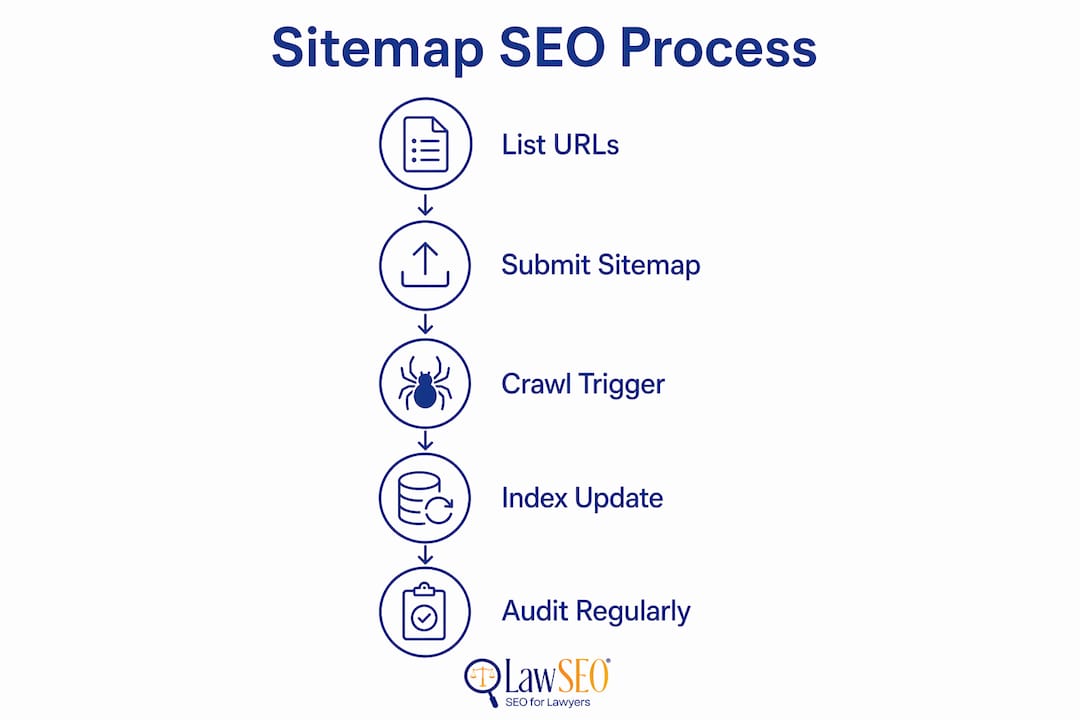
Pro Tip: Submit your sitemap directly through Google Search Console after publishing new content. This triggers a crawl request faster than waiting for Googlebot to discover the URL organically.
What are common misconceptions about sitemaps and SEO impact?
The most persistent myth in technical SEO is that sitemaps directly influence keyword rankings. Sitemaps have zero direct impact on ranking algorithms. They are discovery hints, not indexing directives. Google reads a sitemap the same way a librarian reads a catalog. The catalog tells you what books exist. It does not tell you which books are worth reading.
Several other misconceptions cause real damage to site performance:
- Priority and changefreq tags are ignored by Google. Only the
locand accuratelastmodtags influence crawl scheduling. Spending time tuning priority values is wasted effort. - Sitemaps do not fix poor site architecture. A sitemap cannot compensate for weak internal linking or thin content. It surfaces pages to crawlers. It does not make those pages worth indexing.
- Including redirect, noindex, or 404 URLs in a sitemap wastes crawl budget. Non-canonical and error URLs confuse crawlers and dilute the quality signal your sitemap sends.
- A sitemap is not a substitute for internal links. If your site relies solely on a sitemap for indexing, that indicates a failure of internal linking strategy, which is the stronger crawl signal.
Pro Tip: Audit your sitemap quarterly. Remove any URL returning a non-200 status code. A clean sitemap acts as a controlled inventory of your best content.
How to create and maintain an effective sitemap for SEO
Creating an effective sitemap requires more than generating a file and submitting it once. Sitemap maintenance is an ongoing technical discipline. The steps below reflect current best practices for 2026.
-
Include only canonical, indexable URLs. Every URL in your sitemap must return a 200 status code, carry no noindex directive, and be the canonical version of that page. Excluding redirects and 404 pages protects your crawl budget.
-
Update
lastmodonly on real content changes. Many CMS platforms auto-update thelastmodtimestamp every time a page is touched, even for minor formatting edits. This causes Google to distrust yourlastmodaccuracy entirely, which removes the crawl scheduling benefit. -
Segment large sitemaps with sitemap index files. Google enforces a limit of 50,000 URLs and 50MB per sitemap file. Sites exceeding this limit must use a sitemap index file that references multiple child sitemaps, segmented logically by content type.
-
Use specialized sitemaps where relevant. Image sitemaps, video sitemaps, and hreflang sitemaps for multilingual content each serve distinct crawl purposes. A law firm with video content on practice area pages benefits from a dedicated video sitemap.
-
Confirm your sitemap is not blocked in robots.txt. A disallow rule on your sitemap file prevents crawlers from reading it entirely. This error is more common than it should be.
-
Automate sitemap generation. Static sitemaps go stale. Use CMS plugins or server-side scripts that regenerate your sitemap whenever content is published or removed.
-
Monitor sitemap health in Google Search Console. The Coverage report shows how many submitted URLs were indexed versus rejected. A high rejection rate signals sitemap quality problems that need immediate attention.
The table below summarizes the sitemap elements that matter versus those that do not:
| Sitemap element | Impact on crawling |
|---|---|
loc (URL) |
Required; tells crawlers which pages exist |
lastmod (accurate) |
Influences crawl scheduling for updated content |
priority |
Ignored by Google; no crawl impact |
changefreq |
Ignored by Google; no crawl impact |
| Non-200 URLs | Wastes crawl budget; weakens sitemap quality |
How do sitemaps complement internal linking and site architecture?
Sitemaps and internal linking are not interchangeable. Internal links and canonical tags are stronger crawl signals than sitemaps. Google treats internal links as editorial votes for a page’s importance. A sitemap entry carries far less weight than a contextual link from a high-traffic page on the same domain.
The relationship between sitemaps and internal linking for law firm sites works as follows:
- Internal links tell crawlers which pages are most important by the volume and quality of links pointing to them
- Sitemaps fill the gap for pages that internal links do not reach, such as newly published content or isolated resource pages
- Contradictory signals, where a page appears in the sitemap but is excluded by a canonical tag or blocked by robots.txt, weaken the overall SEO foundation
- A sitemap that lists pages your internal link structure ignores sends a mixed message to crawlers
The practical takeaway is direct. Build a strong internal link structure first. Use your sitemap to catch what internal links miss. Treat the two as complementary systems, not alternatives. For law firms managing URL structure across practice areas, this coordination between sitemap and internal links is what separates efficient crawl coverage from wasted budget.
Ignoring sitemap maintenance causes index bloat and wastes crawl budget, reducing site quality signals over time. The set-and-forget approach is the most common and most costly mistake in technical SEO.
Key Takeaways
XML sitemaps accelerate content discovery and protect crawl budget, but only when maintained as accurate, clean inventories of your site’s canonical, indexable URLs.
| Point | Details |
|---|---|
| Sitemaps are discovery tools | They help search engines find URLs faster but do not directly influence keyword rankings. |
Accurate lastmod matters |
Only loc and a truthful lastmod tag affect crawl scheduling; priority and changefreq are ignored by Google. |
| Clean sitemaps protect crawl budget | Exclude all redirects, noindex pages, and 404 URLs to avoid wasting crawl allocation. |
| Internal links outrank sitemaps | Strong internal linking is a more powerful crawl signal; sitemaps support discovery of orphan pages. |
| Maintenance is non-negotiable | Quarterly sitemap audits and automated updates prevent index bloat and stale URL inclusion. |
Sitemaps in 2026: what I’ve learned from 29 years of technical SEO
Most SEO professionals treat sitemaps as a one-time setup task. That is the wrong frame entirely. A sitemap is a living document. The moment you stop updating it, it starts working against you. Stale URLs, redirected pages left in the file, and auto-updated timestamps that Google no longer trusts. These are not minor issues. They are signals that tell Google your site is not well-maintained.
The insight I keep coming back to is this: your sitemap is a direct reflection of how well you understand your own site. If you cannot produce a clean, accurate sitemap on demand, you do not have full control of your crawl coverage. That is a problem that compounds over time, especially for large sites with hundreds of practice area pages, blog posts, and location-specific content.
The other mistake I see constantly is treating sitemaps as a fix for weak site architecture. They are not. If your pages are not connected by a logical internal link structure, a sitemap entry will not save them. Google will discover those pages and then deprioritize them because nothing else on your site points to them. Fix the architecture first. Then use your sitemap to cover the edges.
In 2026, with AI-driven search platforms reading site structure signals more aggressively, a clean and accurate sitemap is table stakes. It is not a differentiator. But a broken or bloated sitemap is a liability that shows up in your coverage data and, eventually, in your rankings.
— TODD
Technical SEO for law firms: where Lawseo fits in
Law firm websites face specific crawl challenges. Practice area pages, attorney profiles, location pages, and blog content all compete for crawl budget. Lawseo specializes exclusively in legal SEO strategies that address these technical layers, including sitemap audits, internal link architecture, and crawl budget management. Todd R. Stager and the Lawseo team review every client’s technical SEO foundation personally, with over 29 years of experience applied directly to law firm visibility. If your firm’s site structure is not working efficiently for search engines, Lawseo provides the technical depth to fix it.
FAQ
What is the primary role of XML sitemaps in SEO?
XML sitemaps serve as a discovery mechanism, listing a site’s essential URLs so search engines can find and crawl them faster. They do not directly influence keyword rankings.
Do sitemaps improve search rankings?
Sitemaps have no direct impact on ranking algorithms. They help search engines discover pages more efficiently, which can lead to faster indexation of quality content.
How often should you update your sitemap?
Sitemaps should update automatically whenever content is published or removed, with a manual audit conducted at least quarterly to remove non-200 status URLs.
What URLs should be excluded from a sitemap?
Exclude all URLs that return 404 errors, redirect to another page, carry a noindex directive, or are non-canonical versions of a page. Including these wastes crawl budget.
Are priority and changefreq tags worth using in a sitemap?
Google ignores both priority and changefreq tags entirely. Only the loc and an accurate lastmod tag have any influence on how Google schedules crawls.