


Yes, TV advertising still works for law firms, and it works best when a firm treats it as a reach engine feeding a digital harvest system, not a standalone bet. Personal injury, mass tort, DUI, and workers’ comp practices see the strongest returns. The immediate move: build a TV-equivalent flight (broadcast, CTV, or bar TV), point it at a dedicated landing page, and layer in call tracking before the first spot airs.
TL;DR:
- Running TV ads without a digital lead-generation system, including landing pages and call tracking, leads to wasted advertising budget and poor case conversion rates.
- Effective lawyer commercials focus on emotional storytelling, a single clear message, repetitive branding, and a specific, compliant call to action.
- Campaign success depends heavily on proper pre-flight planning, timing with practice-area intake patterns, and post-flight measurement of call volume and search lift.
- Budget tiers vary from pilot testing in one market to year-round multi-market campaigns, with mid-market firms often combining bar TV, CTV, and programmatic DOOH for lower CPMs.
- Compliance rules require clear disclaimers, honest messaging, and careful visual choices, with scripts needing approval before production to avoid costly re-edits.
What Makes TV Advertising for Lawyers Actually Effective?
The best lawyer commercials share a short list of traits, and none of them are expensive to execute. They pick one idea, they make you feel something before they ask for anything, and they repeat the firm’s name enough times that it sticks after the TV is off. Below are examples worth studying, drawn from national campaigns and local spots that punch above their market size.
1. The injury firm that leads with a client, not a lawyer. Many top-performing PI spots open on the injured person, not the attorney, describing the moment their life stalled. The lawyer appears second, as the person who fixed it. This ordering matters: viewers connect with the victim first, which makes the firm’s intervention feel earned rather than salesy.
- Takeaway: Structure the first five seconds around the client’s problem, not the firm’s name.
2. The jingle-driven firm that turns a phone number into a melody. A handful of long-running regional injury firms have built recognition almost entirely on a sung phone number repeated at the open and close of every spot. It is unglamorous, but recall studies on jingle-based ads consistently show they outperform spoken-only numbers for unaided recall.
- Takeaway: If your firm’s name or number is long or generic, a simple audio hook can do more than another line of dialogue.
3. The mass tort ad that leads with a statistic, not a story. Mass tort campaigns often open with a hard number, like the count of people affected by a defective product or drug, because urgency drives response better than narrative in this category.
- Takeaway: For mass tort, front-load the scale of the problem; save the emotional beat for the middle.
4. The DUI defense spot that uses fear sparingly and authority heavily. Effective DUI ads tend to avoid scare tactics and instead lean on the attorney’s credentials, courtroom footage, or a direct-to-camera monologue that signals competence under pressure.
- Takeaway: Authority cues (bar admissions, years in practice, case results where compliant) work better than fear-based hooks for this audience.
5. The workers’ comp spot built around a simple visual metaphor. A recurring pattern in workers’ comp advertising is the “David vs. Goliath” framing, a small worker against a large employer or insurer, resolved by the firm stepping in as an equalizer.
- Takeaway: A single, repeatable visual metaphor travels better across cutdowns than a complex plot.
6. The firm that treats its vanity URL as part of the brand. Several high-performing campaigns pair the TV spot with a short, spoken, easy-to-spell URL (think three syllables or fewer) displayed for the full duration of the ad, not just the final frame.
- Takeaway: A vanity URL only works if it stays on screen long enough to be written down or remembered.
7. The national brand that treats every local market as a separate flight. Instead of running one national cut, some large firms produce regional variants with local court references or city names, which measurably lifts response over generic versions.
- Takeaway: Localize at least one line of copy, even in an otherwise national creative.
8. The firm that repurposes the 30-second spot into three different assets. Repurposing TV creative across CTV, YouTube, and paid social often multiplies the return on a single production, especially when the team cuts a 15-second CTV version, a 6-second bumper, and a subtitle-ready square crop for social feeds from the same footage.
- Takeaway: Budget for repurposing at the production stage, not as an afterthought.
The pattern across all eight: analyses of high-performing lawyer commercials consistently point to emotional storytelling, aggressive brand repetition, and a single clear call to action as the traits that separate memorable spots from forgettable ones. Firms that try to cram case results, multiple practice areas, and three phone numbers into one spot tend to see weaker recall than firms that pick one message and repeat it.
Why Does TV Still Work for Law Firm Marketing?
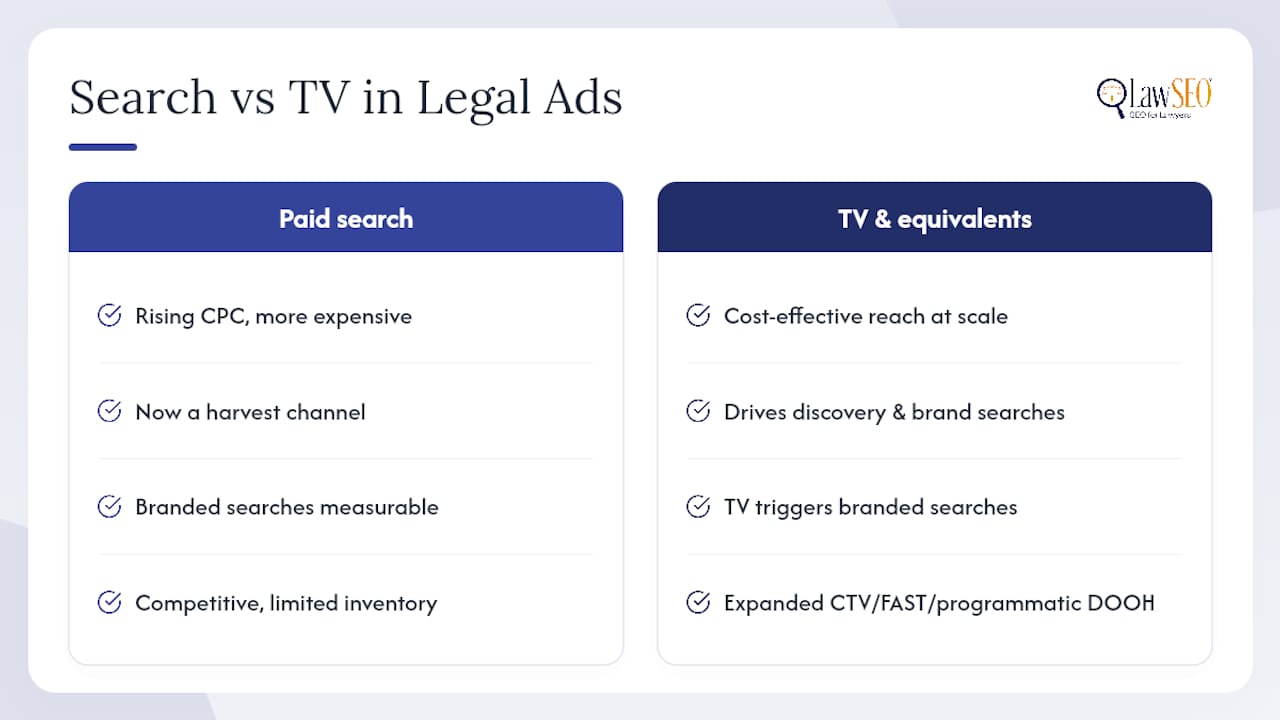
Digital advertising got more expensive, not less, and that shift alone explains a lot of the renewed interest in television. Paid-search cost per click for competitive legal terms like “car accident lawyer” has climbed for years, compressing the return on search-only strategies for high-value practice areas. TV, by comparison, still delivers cost-effective reach at scale, especially now that “TV” no longer means only broadcast.
The channel-mix shift in one number: Highfloor’s State of Legal Advertising 2026 report documents that U.S. law-firm advertising remains a multi-billion-dollar category, with TV and TV-equivalent formats, broadcast, cable, CTV, and curated bar TV, still functioning as core awareness channels for personal injury, mass tort, DUI, and workers’ comp firms.
Two structural changes explain why TV isn’t fading the way some marketers assumed it would a decade ago. First, paid search has become a harvest channel rather than a discovery channel; people who see a TV ad often search the firm’s name minutes later, and that branded-search activity is now measurable. Second, TV-equivalent inventory has exploded. Connected TV and free ad-supported streaming services now accept legal advertising at a fraction of broadcast CPMs, and programmatic digital out-of-home lets smaller firms buy geographically targeted screen time without a national media buyer.
Timing matters as much as the medium. Intake patterns vary sharply by practice area: personal injury calls tend to cluster on Tuesday through Thursday afternoons, while DUI inquiries spike late on Friday and Saturday nights. A firm that runs a flat, all-week flight ignoring these windows is paying for impressions that rarely convert into calls. Dayparting around actual intake behavior, not just around what inventory happens to be cheap, is one of the more underused levers in legal TV buying.
How Much Should a Law Firm Budget for TV Ads?
Budgeting for TV breaks into three rough tiers, and the right one depends on market size, practice area, and how much digital infrastructure the firm already has to catch the demand a TV flight generates.
- Pilot tier: A single mid-size market test flight, often combining bar TV or CTV with a modest broadcast buy, lets a firm validate creative and measurement before committing to a longer run.
- Mid-market tier: A sustained quarterly flight across broadcast and CTV in one or two metro markets, typically the entry point for firms that have outgrown pilot testing but aren’t ready for a full regional buy.
- Enterprise tier: Multi-market, year-round flighting with broadcast anchoring the buy and CTV/bar TV filling gaps, usually reserved for firms with established intake teams that can absorb call volume spikes.
CPM (cost per thousand impressions) is the core math behind every tier. Broadcast CPMs in competitive metro markets tend to run highest, cable sits below that, CTV typically undercuts both, and curated bar TV, screens placed in bars, gyms, and waiting rooms, often delivers the lowest CPM of the group because the inventory is less contested. Mid-market PI firms can often achieve comparable reach without any broadcast spend at all by combining bar TV, programmatic DOOH, and CTV, which materially lowers blended CPM while preserving the brand-recall effect that makes TV valuable in the first place.
GRP (gross rating points) measures cumulative reach against a target market and helps translate a raw budget into an expected frequency. A firm buying 100 GRPs per week in a given market is roughly reaching the equivalent of that market’s population once, though actual unique reach varies with overlap. Use GRP targets, not just dollar totals, when comparing quotes across media reps.
- Choose broadcast when the goal is maximum reach in a single defined metro and the budget supports it.
- Choose CTV or bar TV when the goal is efficient frequency in a specific submarket or when testing a new creative concept before a bigger commitment.
- Daypart against practice-area intake windows rather than against generic “prime time” assumptions.
- Negotiate makegoods (free replacement airtime for missed spots) into every broadcast contract; most reps will offer them if asked directly.
- Test remnant inventory, unsold airtime sold at a discount close to air date, as a low-risk way to add frequency without inflating the base buy.
Pro Tip: Ask your media rep for last-minute remnant availability in the week before a flight starts. Firms that keep 10 to 15 percent of budget uncommitted until then often pick up extra frequency at a steep discount.
What Creative and Compliance Rules Apply to Lawyer TV Ads?
Every effective lawyer commercial follows a small set of creative rules, and every one of them has to survive a compliance check before it airs.
- Commit to a single idea. One message, one emotion, one takeaway. Spots that try to cover three practice areas or four case types in 30 seconds dilute all of them.
- Build in emotional resonance early. The client’s problem, not the firm’s credentials, should open the spot; credentials can close it.
- Repeat the brand relentlessly. Name, number, and URL should appear at least twice, ideally through both audio and visual channels, since viewers rarely watch with full attention.
- End on one clear call to action with a vanity URL. A single instruction (“Call now” or “Visit [URL] today”) beats a menu of options.
- Plan the repurposing cut before production, not after. Shoot with a CTV 15-second cut and a social square crop in mind so the same footage covers multiple formats.
Compliance is where creative ambition has to meet legal reality. The 1977 Supreme Court decision in Bates v. State Bar of Arizona established that truthful advertising by lawyers is protected commercial speech, and that advertising routine legal services is not inherently misleading. That ruling opened the door to lawyer advertising broadly, but it didn’t erase state bar oversight. Each state bar still enforces its own rules on outcome promises, testimonials, and required disclaimers, and those rules vary enough that a script cleared in one state can violate another state’s advertising rules outright.
A workable compliance checklist for any legal TV script:
- Avoid stating or implying a guaranteed outcome (“We’ll win your case” is a red flag in most jurisdictions).
- Use “may recover” or “may be entitled to” language instead of definitive results language.
- Include required disclaimers (often “results may vary” or “not a guarantee of similar outcome”) without letting them dominate the visual frame; a bottom-third text overlay held for two to three seconds usually satisfies both legibility and legal requirements.
- Route every script through a compliance review before production, not after the ad is cut, since re-editing a finished spot is far more expensive than flagging language at the script stage.
Pro Tip: Keep a one-page, state-specific disclaimer library on file. Reusing pre-approved disclaimer language across scripts saves weeks of back-and-forth with compliance counsel on every new flight.
How Do You Measure TV Advertising’s Impact on Case Volume?
TV has a reputation for being unmeasurable, but that reputation is mostly outdated. A workable measurement plan rests on a handful of concrete KPIs: total call volume during the flight window, qualified-lead rate from those calls, landing-page visits, branded-search lift, and, ultimately, cost per signed case. That last number is the one that actually justifies or kills a renewal decision.
The tactical setup is straightforward:
- Build a dedicated landing page (something as simple as a “/TV” URL) so every visitor arriving from the campaign is trackable separately from organic or paid-search traffic.
- Use a vanity phone number paired with call tracking so inbound calls during flight windows are attributable to the TV buy specifically, not lumped in with general intake.
- Monitor branded search daily during the flight; same-day branded-search spikes of 15 to 40 percent are common during active TV windows and confirm the ad is driving awareness even when it doesn’t generate an immediate call.
- Run geo holdouts when budget allows, meaning you flight the ad in some markets and withhold it in comparable markets, then compare call and search volume between the two to isolate TV’s actual lift.
Short-term signals (call spikes, branded-search jumps) confirm the ad is being seen and remembered. Long-term signals (cost per signed case, retention of cases originated through the TV landing page) confirm the ad is actually profitable. Treat the first two weeks of a new flight as a signal-gathering period, not a verdict. Most firms need at least one full flighting cycle, typically four to six weeks, before drawing conclusions strong enough to act on.
How Do You Launch a TV Ad Campaign From Scratch?
A TV campaign moves through three phases, and skipping steps in any of them is where most first-time flights go wrong.
- Pre-flight. Define objectives (calls, signed cases, or brand awareness), lock a budget tier, run every script through compliance review, produce creative variants for repurposing, and set up landing pages and call tracking before a single dollar is committed to media.
- Buy and flight. Select the platform mix (broadcast, CTV, bar TV, or a blend), set dayparts around practice-area intake windows, negotiate makegoods and remnant inventory with media reps, and confirm creative has been technically ingested and tested by every platform before air date.
- Post-flight. Pull call logs and cross-reference against the flight calendar, run branded-search lift analysis or geo holdout comparisons, and document what worked so the next flight starts from evidence instead of guesswork.
The full cycle, from brief to first optimization report, typically runs six to ten weeks depending on production timelines and market size. Firms that rush the pre-flight phase, especially compliance review, are the ones most likely to need a costly re-cut mid-flight.
Who Backs This TV Advertising Guidance?
This guide draws on more than 29 years of legal marketing experience from Todd R. Stager, founder of Lawseo, who personally reviews strategy across the firm’s client campaigns. That includes TV, alongside the digital channels TV is meant to feed.
Lawseo’s relevant capabilities for a TV campaign include:
- Campaign strategy that aligns TV flighting with existing digital lead-generation infrastructure.
- Pre-flight compliance review support to catch state-bar issues before production.
- Landing-page and call-tracking setup so TV-driven traffic and calls are measurable from day one.
- Post-flight measurement, including branded-search lift analysis and cost-per-case reporting.
Firms interested in case studies, verified campaign metrics, and client results from past TV-plus-digital engagements can request the full case-study packet directly through Lawseo.
Who Is the Right Audience for a Legal TV Campaign?
TV works differently depending on who is actually watching, and legal advertisers who skip audience segmentation tend to overspend on reach that never converts. Personal injury and mass tort campaigns generally perform best against adults 35 to 64, a demographic still watching more linear and cable TV than younger cohorts, and one more likely to know someone who’s had a serious accident or injury. DUI defense skews younger, often 21 to 40, and pairs well with late-night dayparts and CTV inventory on services popular with that age range.
Workers’ comp campaigns tend to perform best in blue-collar-heavy markets, where local news and daytime cable programming reach shift workers and hourly employees more efficiently than streaming-only buys. Estate planning and elder law, by contrast, skew toward viewers 55 and older, a group still disproportionately reachable through traditional broadcast and early-evening news blocks.
Geographic targeting compounds these age and behavior patterns. A firm running a statewide DUI campaign wastes significant budget if it can’t exclude counties outside its actual practice radius, which is one reason bar TV and programmatic DOOH have grown; both allow tighter geographic control than a full-market broadcast buy. Matching creative tone to the audience matters as much as matching the media buy: a workers’ comp spot aimed at hourly workers should sound different, visually and tonally, than an estate planning spot aimed at retirees.
What Advertising Pitfalls and Restrictions Go Beyond State Bar Rules?
State bar compliance is the floor, not the ceiling, and several pitfalls trip up firms even after a script clears ethics review. Overpromising through implication is the most common one: a script that never says “guaranteed win” but shows a triumphant courtroom scene and a check being handed over can still read as an implied promise, and some bars scrutinize visual implication as closely as spoken language.
Trademark and comparative-advertising issues are another blind spot. Naming a competing firm, even indirectly (“unlike other firms who settle fast”), can trigger both bar complaints and potential defamation exposure if the claim isn’t demonstrably true. Firms operating across state lines face a separate layer of risk: a spot airing in a media market that crosses state borders, common in metro areas near state lines, may need to satisfy two different bars’ advertising rules simultaneously.
Federal Communications Commission rules also apply in ways some legal marketers overlook, particularly around sponsorship identification and political-adjacent content if a firm’s advertising touches on tort reform or ballot measures. And production shortcuts create their own liability: using stock courtroom footage that implies a specific case outcome, or actors described in ways that blur the line between spokesperson and testimonial, can violate both bar rules and general advertising law. The safest posture treats every visual choice with the same scrutiny as the script’s language.
How Should TV Advertising Work With Digital and Social Channels?
TV performs best as the top of a funnel that digital channels are built to catch, not as an isolated bet. The mechanism is straightforward: a viewer sees a TV spot, doesn’t call immediately, but searches the firm’s name on their phone minutes or hours later. If paid search isn’t ready to catch that branded query with a strong ad and landing page, the firm has paid for awareness it can’t convert.

That’s why pairing TV with a functioning digital marketing foundation matters more than most firms initially assume. Search engine optimization and paid search should be treated as a harvest layer running underneath every TV flight, ready to absorb the branded-search spike a good spot generates. Social media plays a complementary role: cutdowns of the TV spot, run as short-form video on the platforms a firm’s target demographic actually uses, extend the creative’s life well past the media buy’s end date. A broader view of legal marketing channels helps clarify where TV fits relative to SEO, paid search, and content, rather than treating each channel as a competing budget line.
The firms getting the most from TV treat the landing page as an extension of the ad itself, using the same visual language, headline promise, and call to action shown on screen. A mismatch between the ad’s tone and the landing page’s design creates enough friction that some viewers abandon before calling or filling out a form.
What Makes a Legal TV Ad’s Call to Action Actually Work?
The call to action is where most legal TV ads either close the deal or lose the viewer’s attention entirely, and the difference usually comes down to specificity, not creativity. “Call now” works better than “contact us today” because it implies urgency and a direct action rather than a vague next step. Pairing the spoken CTA with an on-screen phone number and vanity URL held for at least three full seconds gives viewers time to actually write it down or remember it, something a fast-cut, five-frame flash of contact information rarely accomplishes.
Simplicity beats cleverness in this specific moment. A CTA with two options (“call or visit our website”) often performs worse than one with a single, unambiguous instruction, because viewers deciding between two actions frequently choose neither. The strongest legal spots repeat the CTA twice, once in the middle of the spot and once at the close, using identical phrasing both times so the message doesn’t require re-processing.
Urgency language needs careful calibration against compliance rules. Phrases like “time may be limited to file your claim” work because they’re generally true (statutes of limitations are real) without implying a guaranteed outcome. Avoid CTAs that imply exclusivity or scarcity that isn’t real, “only a few spots available” has no place in legal advertising and invites bar scrutiny for good reason. The best-performing CTAs sound like a direct, human instruction from someone who wants to help, not a marketing tagline dressed up as urgency.
Editorial Take: What the Data Says About TV That Most Guides Miss
Most guidance on legal TV advertising treats it as a binary decision, worth it or not, when the research actually points somewhere more specific: TV’s value depends almost entirely on whether the digital harvest layer is built before the flight airs, not after. Firms that buy media first and figure out landing pages and call tracking later are essentially burning the branded-search lift that TV generates, since that 15 to 40 percent spike doesn’t wait for a firm to catch up.
The conventional advice also overweights production polish and underweights dayparting discipline. A firm can spend heavily on a beautifully shot spot and still underperform because it aired uniformly across a week instead of concentrating in the hours its practice area actually gets calls. That’s a targeting failure dressed up as a creative failure, and it’s one of the more fixable mistakes in this entire channel.
If you’re prioritizing one thing before the next TV dollar gets spent, make it measurement infrastructure, not creative concepts. A mediocre ad with a working landing page and call tracking will teach you more than a great ad with neither.
— TODD
Get a Managed TV and Digital Campaign Built for Your Practice
Running TV without a digital harvest system in place is the single most common way firms waste flight budget, and it’s exactly the gap Lawseo is built to close. The team coordinates campaign strategy, pre-flight compliance review, landing-page setup, and post-flight measurement so a TV buy actually converts into tracked calls and signed cases, not just impressions. Founder Todd R. Stager personally reviews strategy on every client engagement, and Lawseo works under exclusivity agreements, meaning it won’t take on a competing firm in the same market once you’re a client. If your firm is weighing a TV flight and wants the digital infrastructure built correctly before the first spot airs, Lawseo to start the conversation.
Sources
- Bates v. State Bar of Arizona — Cornell LII
- State of Legal Advertising 2026 — Highfloor
- Analyzing the 5 Best Lawyer Commercials: Tips and Examples — Clio