


TL;DR:
- Long-tail keywords are specific, low-volume search queries with clear intent that offer quick, measurable rankings, especially for new or authority-building sites. They cover niche questions, local searches, and decision-ready queries that attract high-converting traffic. Emphasizing long-tail strategies allows firms to rank faster and capitalize on AI-driven search advances.
A long-tail keyword is a specific, low-volume search query with clear intent — and for smaller sites or conversion-focused campaigns, it’s usually the fastest route to measurable rankings. WordStream defines them as longer, more specific phrases used closer to a point of purchase, where the searcher already knows what they want. Three things to know immediately: prioritize long-tail phrases when your domain is new or your authority is still building; expect higher conversion rates because the searcher’s intent is explicit; and on low-difficulty phrases, realistic ranking timelines run a few months rather than many months typical for broad head terms.
Two quick examples: an e-commerce searcher typing “best waterproof hiking boots for wide feet” is far closer to buying than someone typing “hiking boots.” On the legal side, “personal injury attorney in Austin Texas free consultation” tells you exactly what that prospect needs — and it’s the kind of query a law firm can realistically own.

What are long-tail keywords, exactly?
The phrase “long-tail keyword” gets misused constantly. Word count is a guideline, not the definition. Semrush’s knowledge base describes long-tail terms as those with lower competition and higher conversion intent, generally three or more words. But the real distinguishing factor is low individual search volume paired with high specificity. A five-word phrase that gets 50,000 monthly searches is not a long-tail keyword. A three-word phrase that gets 200 searches per month with a precise intent very much is.

Neal Schaffer clarifies that volume and intent define long-tail status, not length alone. This distinction matters because it changes how you prioritize. You’re not hunting for long phrases; you’re hunting for specific queries where the searcher has already narrowed their decision.
Long-tail queries tend to cluster around a few recognizable use-cases:
- Product detail searches: “buy organic dog food for senior dogs online”
- Local modifier searches: “estate planning lawyer near downtown Chicago”
- Question-based troubleshooting: “how to file a workers comp claim without a lawyer in Florida”
- Comparison queries: “LLC vs S-corp for freelance consultants tax advantages”
- Symptom or situation searches: “what happens if I miss a court date for a traffic ticket”
- Service + qualifier: “immigration attorney free consultation same day appointment”
Each of these reveals a searcher who has moved past general curiosity. That specificity is precisely what makes long-tail phrases valuable.
How do long-tail keywords compare to short-tail and mid-tail?
Understanding where long-tail fits in the keyword spectrum helps you allocate effort correctly. Head terms, mid-tail terms, and long-tail phrases serve different goals at different stages of a site’s authority.
| Keyword Type | Typical Length | Monthly Search Volume | Competition | Conversion Intent |
|---|---|---|---|---|
| Short-tail (head) | 1–2 words | high search volume | Very high | Low |
| Mid-tail (body) | 2–3 words | moderate search volume | Moderate | Moderate |
| Long-tail | 3+ words | low search volume | Low | High |
Head terms like “lawyer” or “SEO” drive brand awareness but rarely convert directly. The searcher is browsing, not deciding. Mid-tail terms like “personal injury lawyer” or “keyword research” sit in the middle: meaningful volume, real competition, moderate intent. Long-tail phrases are where the buyer or client-ready searcher lives.
For a new site or a firm entering a competitive local market, chasing head terms without strong backlinks is a losing strategy. Semrush’s classification confirms that long-tail terms offer the most accessible entry point for sites still building authority. The practical rule: use head terms to define your topic pillars, mid-tail to build topical authority, and long-tail to capture conversion-ready traffic and earn early rankings.
Why do long-tail keywords matter for SEO, PPC, and AI search?
The aggregate volume argument is the most compelling case for long-tail strategy. According to keyword research data, 70% of all search traffic comes from long-tail keywords. No single long-tail phrase drives that number; the collective volume of thousands of specific queries adds up to the majority of organic traffic across the web.
70% of all search traffic comes from long-tail keywords, and 91.8% of long-tail keywords have lower search volume but higher click-through rates than their broad counterparts.
The benefits extend across three distinct channels:
Organic SEO: Lower competition means a well-optimized page can rank on page one within months, not years. For a new law firm site with limited backlinks, a phrase like “how to choose a DUI attorney in Phoenix” is a realistic target. “DUI attorney” is not.
PPC advertising: Long-tail phrases carry lower cost-per-click because fewer advertisers bid on them. A legal PPC campaign targeting “affordable family law attorney free consultation Denver” will spend less per click and convert at a higher rate than a campaign targeting “family lawyer.”
AI and generative search: This is where long-tail strategy is becoming critical in 2026. AI engines like Google’s AI Overviews, ChatGPT, and Perplexity favor precise, citable answers. When a user asks a specific question, the AI pulls from content that answers that exact question directly. Structuring answers to how-to and question-form long-tail queries with a concise 40–60 word lead answer followed by supporting detail significantly increases the chance of being cited. For law firms, this means a well-structured FAQ answering “what is the statute of limitations for personal injury in Texas” can surface in AI answers, not just traditional search results.
Pro Tip: For law firms and service businesses, optimizing for AI-driven search is no longer optional. AI engines are becoming the first point of contact for prospective clients, and long-tail queries are the entry point those engines use most.
How do you find long-tail keywords that are worth targeting?
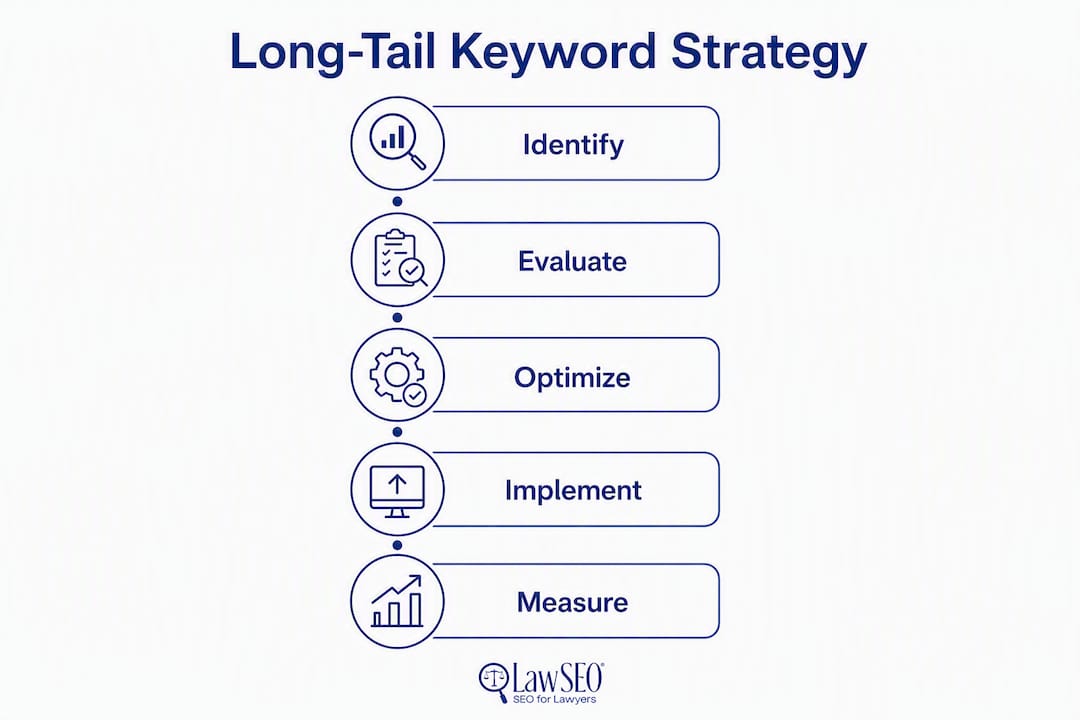
Discovery is a process, not a single tool. Follow this sequence to build a defensible list:
Key tools for long-tail research:
- Semrush: — Keyword Magic Tool filters by question-type queries and shows keyword difficulty scores. Best for building large, organized keyword lists with intent labels.
Pro Tip: Volume is a secondary filter, not the primary one. Prioritize topical relevance and intent clarity first. A phrase with 80 monthly searches that maps directly to a client-ready decision is worth more than a phrase with 800 searches and ambiguous intent. Advanced SEO approaches consistently emphasize intent alignment over raw volume.
How do you use long-tail keywords in your content strategy?
Finding keywords is the easy part. Deploying them without creating a fragmented, thin-page mess requires a clear framework.
The most effective structure treats long-tail keywords at two levels: those that deserve their own page and those that belong as sections or FAQs within a larger page. This approach prevents the common mistake of building dozens of near-identical pages that cannibalize each other and dilute authority.
Content planning framework:
- Pillar pages target your mid-tail body terms (e.g., “personal injury attorney Los Angeles”) and serve as the authoritative hub.
- Supporting pages target topical long-tail phrases with distinct intent (e.g., “how much does a personal injury attorney cost in Los Angeles”) that warrant their own URL.
- On-page sections and FAQs handle supporting long-tail variants (e.g., “do I need a lawyer for a minor car accident in California”) that don’t justify a separate page but strengthen the pillar.
On-page checklist for long-tail optimization:
- Place the long-tail phrase in the H1 title tag, naturally worded
- Use a close variant in the first H2 subheading
- Answer the query directly in the first 40–60 words of the page (this is the structure AI engines pull from)
- Include the phrase in the meta description
- Add schema markup (FAQ schema, HowTo schema) where the content format supports it
- Link the supporting page back to its pillar page
Do/don’t summary:
- Do group 3–5 related long-tail variants into a single page with sections addressing each
- Do write a direct answer at the top of every long-tail page before expanding into detail
- Don’t create one thin page per minor phrasing variation — this fragments authority
- Don’t stuff the phrase into every paragraph; one natural use per major section is sufficient
Original, intent-matched content consistently outperforms keyword-dense pages that treat long-tail phrases as fill-in-the-blank slots. The phrase should feel like the natural answer to the question, not a label inserted for ranking purposes.
How do you measure whether your long-tail strategy is working?
Measurement for long-tail content requires a different lens than head-term tracking. Individual query volumes are small, so you measure clusters, not single phrases.
Primary KPIs to track:
- Impressions by cluster: Group related queries in Search Console and track total impressions for the cluster, not each phrase individually
- Click-through rate (CTR): Long-tail phrases should produce CTRs above the site average because the query matches the page title closely
- Ranking velocity: Track how quickly new long-tail pages move from position 20–50 to the top 10; low-difficulty phrases should show movement within 60–90 days
- Conversions by content cluster: Use Google Analytics 4 to attribute form submissions, calls, or chat initiations to the traffic source and landing page
- Organic traffic to supporting pages: A supporting long-tail page that drives zero traffic after 90 days needs either a content revision or consolidation into the pillar
Reporting cadence:
- Weekly: Check ranking velocity for newly published long-tail pages; flag any that have dropped or stalled
- Monthly: Review Search Console query clusters for new low-volume phrases entering the top 50; these are emerging long-tail opportunities
- Quarterly: Audit conversion attribution by cluster; reallocate content effort toward clusters producing leads or sales
Using a 90-day look-back window in Search Console gives you enough query data to identify clusters that justify a dedicated page or content hub, even when individual phrase volumes appear too small to act on alone.
What do real long-tail keyword examples and templates look like?
Examples organized by intent:
Transactional:
- “hire a workers compensation attorney in Houston no upfront fee”
- “buy standing desk with monitor arm under $400”
- “book same-day appointment immigration lawyer Miami”
Local:
- “estate planning attorney near me accepting new clients”
- “DUI lawyer in Nashville free case evaluation”
- “slip and fall attorney downtown Los Angeles”
Troubleshooting / how-to:
- “how to respond to a debt collection lawsuit in Texas”
- “what to do after a car accident that wasn’t your fault in Georgia”
- “how to appeal a denied workers comp claim in Ohio”
Research / comparison:
- “LLC vs sole proprietorship for freelance graphic designer taxes”
- “difference between chapter 7 and chapter 13 bankruptcy for homeowners”
Fill-in-the-blank templates:
- “how to [action] for [situation] in [location]”
- “[service] attorney [city] [qualifier: free consultation / no fee unless you win]”
- “what happens if [legal event] in [state]”
- “[product/service] for [specific audience] under [price or condition]”
Law firm example — mapping long-tail variants to page sections:
A pillar page targeting “personal injury attorney Chicago” might include these long-tail sections:
- H2: “How much does a personal injury attorney cost in Chicago?” (fee structure section)
- H2: “What is the statute of limitations for personal injury claims in Illinois?” (FAQ section)
- H2: “Do I need a lawyer for a minor car accident in Illinois?” (supporting FAQ)
- H2: “How long does a personal injury case take in Chicago?” (process section)
Each H2 targets a distinct long-tail query while strengthening the pillar page’s topical authority. No separate thin pages required.
What are the most common long-tail keyword mistakes?
Myth: More words = long-tail. A five-word phrase with 50,000 monthly searches is a head term. The defining characteristic is low individual volume and high specificity, not word count. Chasing long phrases without checking volume and competition wastes content budget.
Myth: Aggregate volume makes any long-tail cluster worth targeting. Clustering is powerful, but only when the queries in the cluster share the same intent. Grouping “DUI attorney” and “how to beat a DUI charge yourself” onto one page serves two incompatible audiences and satisfies neither.
Myth: One page per long-tail phrase scales content. Building 200 thin pages, each targeting a single phrasing variation, is one of the fastest ways to trigger a quality review. Practitioners consistently recommend treating supporting long-tail variants as on-page sections or FAQs rather than standalone URLs.
Myth: Keyword stuffing helps long-tail pages rank. Repeating a phrase six times in 400 words signals manipulation, not relevance. One natural use in the title, one in the opening paragraph, and one per major section is the practical ceiling.
Pro Tip: Don’t over-index on long-tail at the expense of authority-building. Long-tail content earns traffic, but backlinks and topical authority are what allow you to eventually compete for mid-tail and head terms. Treat long-tail as the foundation, not the entire structure.
How should law firms apply long-tail keyword strategy?
Law firms operate in one of the most competitive local search environments in the United States. For legal practices, keyword research should focus on the middle and long tail where commercial intent is high and competition is lower than for generic head terms like “lawyer” or “attorney.”
The implementation sequence for a law firm looks like this:
- Audit existing content: Pull Search Console data for all queries the site currently ranks for. Identify long-tail phrases in positions 11–30 — these are the fastest wins, requiring content improvement rather than new page creation.
- Cluster by practice area: Group long-tail phrases under each practice area pillar. A personal injury pillar might have 15–20 supporting long-tail queries; a family law pillar might have 12.
- Create or revise content: For each cluster, build or update the pillar page to include sections addressing the top long-tail queries. Use the 40–60 word direct-answer format at the top of each section for AI citation eligibility.
- Optimize Google Business Profile: Local long-tail queries (“personal injury attorney near me”) surface GBP listings prominently. Ensure the GBP description, services, and posts use the same long-tail language as the website.
- Add FAQ schema: Mark up the FAQ sections with structured data so Google and AI engines can parse and cite individual answers.
- Measure by cluster: Track impressions, CTR, and conversions for each practice-area cluster monthly.
One ethical consideration specific to legal content: informational pages that answer long-tail questions like “what is the penalty for a first DUI in Texas” must clearly distinguish general information from legal advice. A brief disclaimer on each informational page protects the firm and maintains compliance with bar association guidelines.
For a deeper look at how long-tail keywords drive client leads for law firms, Lawseo has published a dedicated resource covering practice-area mapping and local modifier strategy. The keyword selection guide for law firms walks through the full process from audit to cluster build.
Key Takeaways
Long-tail keywords are the most reliable path to early rankings and high-intent traffic — and for law firms, they are the primary lever for converting search visibility into client inquiries.
| Point | Details |
|---|---|
| Definition and length | Long-tail keywords are specific, low-volume queries (typically 3+ words) defined by intent and low competition, not word count alone. |
| Volume and traffic share | 70% of all search traffic comes from long-tail queries; their collective volume exceeds head terms. |
| Ranking timeline | New sites targeting low-difficulty long-tail phrases can rank within 2–6 months, compared to 18–36 months for head terms. |
| Measurement approach | Track impressions, CTR, and conversions by cluster in Search Console and GA4, using a 90-day look-back window. |
| Lawseo for law firms | Lawseo builds practice-area keyword clusters, optimizes GBP signals, and structures content for AI citation to drive client-ready traffic. |
Why long-tail strategy is the right starting point for most law firms
The conventional SEO advice for law firms has long been to target the biggest, most competitive keywords in their market. Rank for “personal injury attorney Los Angeles” and the clients will follow. That logic made more sense when the first page of Google was the only game in town.
The search environment has shifted. AI Overviews, ChatGPT, and Perplexity now answer specific legal questions directly, pulling from pages that address those questions precisely. A law firm that has built 30 well-structured long-tail pages answering specific client questions is far more likely to appear in those AI-generated answers than a firm with one generic practice-area page optimized for a single competitive head term.
There’s also a practical reality about legal SEO budgets. Most firms cannot outspend the largest personal injury or criminal defense practices in their market on head-term link building. Long-tail strategy is not a consolation prize; it’s a smarter allocation of the same budget. You earn rankings faster, you convert at higher rates, and you build topical authority that eventually supports mid-tail and head-term rankings.
The firms that win in 2026 are the ones treating every specific client question as a content opportunity, not just a keyword to stuff into a page title.
Lawseo builds the long-tail content infrastructure law firms need
Knowing the strategy is one thing. Executing it across a full practice-area site, with proper clustering, schema, GBP alignment, and AI optimization, is where most firms stall. Lawseo handles the entire process: keyword audit, cluster architecture, content creation, on-page optimization, and monthly performance reporting. Every campaign is reviewed personally by Todd R. Stager, and the firm’s exclusivity model means your local competitors won’t benefit from the same strategy. If you’re ready to build a content program that earns rankings within months and positions your firm for AI-driven search, start with Lawseo’s law firm SEO services or review the 2026 advanced SEO strategy guide to see the full approach.
Useful sources
- Long-Tail Keywords: What They Are & How to Use Them | WordStream — Foundational definition and examples of long-tail keyword usage, including conversion intent and PPC applications.
- What are Long Tail Keywords? | Semrush Knowledge Base — Semrush’s classification of long-tail characteristics, including competition and intent benchmarks.
- Longtail Keywords: How to Find and Use Them | NealSchaffer — Clarifies the volume-over-word-count definition and covers clustering and content strategy.
- Long-Tail Keywords in 2026: Complete Strategy + Free Tool | SEOSMOHUB — Covers AI citation structure, ranking timelines, and the topical vs. supporting long-tail framework.
- Keyword Research Statistics | Keyword Kick — Data on long-tail traffic share (70%) and click-through rate advantages.
- SEO keywords for lawyers: the head, body, and long-tail that actually convert | Local Owl — Law-firm-specific guidance on mapping long-tail variants to practice-area pages and local modifiers.
- Long-Tail Keywords for Law Firms | Lawseo — Lawseo’s dedicated resource on long-tail strategy for legal practices, including client lead generation tactics.
- How to Select Keywords for Law Firms | Lawseo — Step-by-step keyword selection process tailored to law firm practice areas and local search.