


TL;DR:
- Outdated legal content poses professional liability, risks client misinformation, and damages search rankings. Regular updates ensure legal accuracy, protect reputation, and enhance SEO visibility in competitive markets. Implementing scheduled audits, versioning, and human review helps law firms maintain current, authoritative online content.
Outdated legal content is a professional liability, not just a publishing oversight. Law firms that fail to prioritize the importance of updating legal content expose themselves to client misinformation, search ranking penalties, and in some cases, unenforceable contracts. The reasons why update old legal content matters go beyond basic housekeeping. Regulatory content volatility means that as little as 12 hours of staleness can render guidance legally inaccurate, creating a reliability gap between what your website says and what the law actually requires. For law firms competing in AI-driven search environments, stale content is both a compliance risk and a competitive disadvantage.
Why update old legal content: the core case for law firms
The professional standard for legal publishing is accuracy at the time of reading, not accuracy at the time of writing. A blog post explaining FMLA leave requirements, a practice area page describing state tort thresholds, or a FAQ on LLC formation rules can all become misleading within months of publication. Evergreen legal content is a misconception. Effective firms treat all published legal content as subject to regulatory triggers and scheduled revision.

Law firm websites function as a secondary law library for clients and prospects. Kevin O’Keefe, a recognized voice on law firm digital publishing, frames this directly: digital content preserves professional reputation and public trust only when it reflects current law. A firm that publishes accurate content in 2023 but ignores it through 2026 has not maintained a library. It has created an archive that looks authoritative but misleads.
The AI dimension adds a new layer of risk. Generative AI tools like ChatGPT, Perplexity, and Google’s AI Overviews frequently cite law firm content as source material. When that content is outdated, the error propagates. Clients receive AI-generated summaries built on superseded guidance, and the originating firm bears reputational exposure without ever knowing the citation occurred.
What risks does outdated legal content pose to law firms?
Outdated legal content creates three distinct categories of risk: professional liability, client harm, and contractual unenforceability.
Professional liability arises when a client acts on published guidance that no longer reflects current law. Courts have increasingly scrutinized the currency of legal advice, and a firm’s own website can be introduced as evidence of what that firm represented to the public.
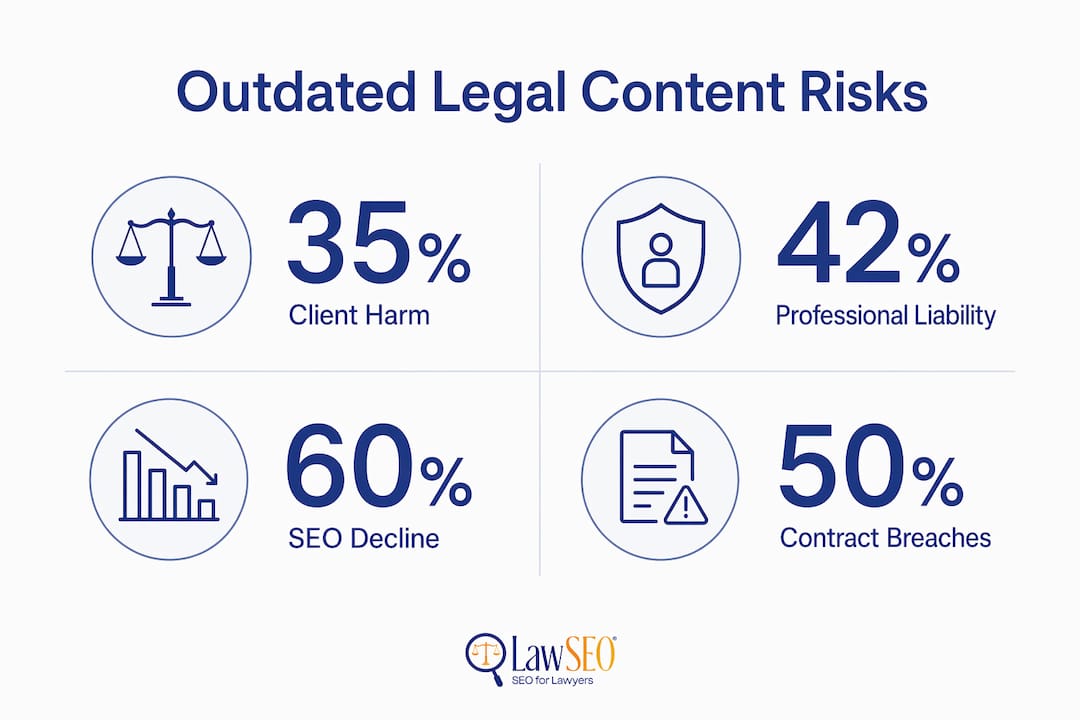
Client harm and trust erosion follow directly. A prospective client researching their rights under a recently amended statute who finds your 2021 article will either receive wrong information or, if they catch the discrepancy, lose confidence in your firm entirely. Neither outcome serves your practice.
Contractual unenforceability is the most technically specific risk. Courts have ruled that “change at any time” clauses in Terms and Conditions, without proper notice and affirmative consent, are illusory and unenforceable. A firm that updates its engagement terms on a webpage without notifying existing clients and obtaining re-acceptance has not legally updated those terms.
“Technically readable but legally unsafe advice is the most dangerous kind, because it inspires confidence while creating exposure.” — Exadvize on AI-generated legal content reliability
Additional risks worth tracking include:
- Silent errors from temporal drift. AI-assisted content generation can introduce plausible but outdated citations without flagging the discrepancy.
- Broken monitoring infrastructure. Regulatory website redesigns can break internal links and update alerts even when the underlying text appears unchanged, creating invisible gaps in your awareness program.
- Inconsistent enforcement exposure. Policies that exist on paper but no longer reflect firm practice create contradictions that opposing counsel can exploit.
How does updating legal content improve SEO and online visibility?
Content freshness is a confirmed ranking factor for Google, and its impact on law firm SEO is direct and measurable. Search engines interpret regular updates as a signal that content is trustworthy, current, and worth surfacing to users. A practice area page that was last modified in 2020 competes poorly against a competitor page updated in 2026, even if the original writing quality was superior.
The SEO benefits of refreshing legal articles extend beyond raw rankings:
- Improved keyword relevance. Laws change, and so does the language people use to search for legal help. Updating content allows you to incorporate current terminology, new statute names, and emerging search queries that did not exist when the original article was written.
- Higher engagement metrics. Users who find current, accurate information stay longer and bounce less. Google’s ranking systems factor in these behavioral signals.
- AI citation eligibility. Generative Engine Optimization (GEO) requires that your content be both accurate and recent. AI tools deprioritize stale sources when constructing answers, meaning outdated content loses citation opportunities in AI-driven search results.
- Local SEO authority. For law firms targeting specific jurisdictions, content that references current state statutes and recent local court decisions signals geographic and topical authority to search engines.
Pro Tip: When you update a practice area page, change the published date only if you have made substantive legal or factual revisions. Search engines and readers both penalize cosmetic date changes with no corresponding content improvement.
The connection between content maintenance and SEO strategy is not theoretical. Law firms that implement quarterly content audits consistently see improvements in organic traffic to their core practice area pages, particularly in competitive markets like personal injury, family law, and employment litigation.
What are the best practices for updating and maintaining legal content?
A reliable content maintenance program requires governance, not just good intentions. The following process applies to law firms of any size.
-
Schedule content audits on a fixed calendar. Quarterly reviews for high-traffic practice area pages, annual reviews for evergreen guides, and immediate reviews triggered by legislative changes or major court decisions. Treat the audit calendar as a professional obligation, not an optional task.
-
Implement versioning and immutable snapshots. Immutable raw snapshots with timestamps create an audit trail proving which version of content was live at any given time. This protects firms in disputes where a client claims reliance on a specific piece of published guidance.
-
Use change detection tools. Services that monitor source regulatory websites for text changes alert your team when a statute, rule, or agency guidance document is amended. This eliminates the manual burden of tracking every relevant source.
-
Apply the stale-while-revalidate workflow. This technical approach, borrowed from content delivery architecture, allows existing content to remain accessible to users while a background process fetches and validates updated information. It minimizes downtime and prevents gaps in content availability during revision cycles.
-
Require human review before publication. AI-assisted drafting tools accelerate content production, but a lawyer-in-the-loop review step is non-negotiable for legal accuracy. No automated system should publish substantive legal content without attorney sign-off.
The table below compares two common approaches to legal content maintenance:
| Approach | Strengths | Weaknesses |
|---|---|---|
| Ad hoc updates (as needed) | Low overhead, flexible | Misses silent regulatory changes, no audit trail |
| Scheduled audit program | Consistent coverage, defensible process | Requires dedicated time and governance structure |
Pro Tip: Build your content audit into your firm’s existing matter management calendar. Assigning content review to a specific attorney or paralegal with a quarterly deadline treats it with the same seriousness as a filing deadline.
Current awareness programs that lack formal audits or measurable outcomes fail to protect firms from content staleness and liability. Knowledge teams should document specific instances where monitoring caught a needed update, both to justify the program’s budget and to demonstrate due diligence.
What legal nuances apply to employee handbooks and terms and conditions?
Employee handbooks and Terms and Conditions documents carry higher legal stakes than standard web content, and the process for updating them requires additional procedural care.
Outdated employee handbooks expose employers to liability and inconsistent enforcement risks. A handbook that references a leave policy superseded by state law, or an at-will employment clause that conflicts with a subsequent arbitration agreement, can be introduced as evidence against the employer. Courts have used handbook language to establish implied contracts, making accuracy a direct financial risk.
Key considerations for high-liability content updates include:
- Explicit re-acceptance for Terms and Conditions. Clickwrap agreements requiring active user consent are legally stronger than passive acceptance or email notification alone. The Safeway case established that failure to notify users conspicuously of material changes can result in multimillion-dollar losses.
- Policy-to-practice alignment. A handbook that describes a progressive discipline process your firm no longer follows creates an inconsistent enforcement record. Update the document to reflect actual practice, or update the practice to match the document.
- AI and remote work policy inclusion. Handbooks written before 2022 almost certainly lack provisions for generative AI tool use, remote work security protocols, and hybrid attendance expectations. These are no longer optional additions. They are standard employment law risk management.
- Documented notification records. When you update Terms and Conditions or handbook provisions, retain records of when notices were sent, to whom, and what acknowledgment was received. This documentation is your defense in any subsequent dispute.
- Digital notary and authentication trends. As digital document practices evolve, firms should consider how authentication requirements affect the enforceability of electronically updated agreements.
The legal content creation guide from Lawseo addresses these structural concerns in detail, including how to build update workflows into your firm’s content production process from the start.
Key takeaways
Updating old legal content is a professional obligation that directly protects law firms from liability, maintains client trust, and drives measurable SEO performance gains.
| Point | Details |
|---|---|
| Staleness creates liability | Content as little as 12 hours out of date can render legal guidance inaccurate and expose firms to professional risk. |
| Freshness drives rankings | Search engines treat regular content updates as a trust signal, improving organic visibility for practice area pages. |
| Contracts require re-acceptance | Updated Terms and Conditions are only enforceable when users provide active, documented consent to the new version. |
| Governance beats good intentions | Scheduled audits, versioning, and human review create a defensible content maintenance record. |
| Handbooks carry special risk | Outdated employee handbooks can be used as evidence against employers in litigation and regulatory proceedings. |
The evergreen myth is costing law firms more than they realize
I have worked with law firms for nearly three decades, and the single most persistent mistake I see is treating legal content as a one-time investment. A firm spends real money producing a thorough guide to, say, non-compete enforceability in their state. It ranks well. It generates leads. And then it sits untouched for three years while the legislature amends the statute twice and a circuit court issues a significant ruling.
The firm does not lose the ranking immediately. That is the dangerous part. The page continues to attract traffic, continues to be cited by AI tools, and continues to represent the firm’s authority on the topic. But the advice it contains is wrong. The firm is building its reputation on a foundation that has quietly cracked.
What I recommend to every firm we work with at Lawseo is a simple reframe: stop thinking of content as an asset and start thinking of it as a responsibility. Assets depreciate silently. Responsibilities demand attention. The firms that treat their legal content strategy as an ongoing professional obligation, not a marketing project with a completion date, are the ones that build durable authority in both search results and client relationships.
The competitive advantage is real and underutilized. Most firms are not doing this well. The ones that do stand out immediately, both to search engines and to the clients who are comparing their options.
— TODD
How Lawseo helps law firms stay current and competitive
Lawseo builds and maintains content programs specifically for law firms, combining legal accuracy with the SEO performance your practice needs to grow. Todd R. Stager and the Lawseo team audit existing content, identify outdated pages, and implement structured update workflows that keep your site current with both search engine requirements and current law. From law firm SEO services to content production and AI optimization, every service is designed for the legal sector. If your firm’s content has not been reviewed in the past 12 months, the risk is already accumulating. Explore how Lawseo’s advanced SEO strategy can protect your firm’s reputation and improve your rankings.
FAQ
Why does legal content become outdated so quickly?
Laws, regulations, and court interpretations change continuously, and content written under prior rules becomes inaccurate without any visible warning. Regulatory content volatility means guidance can become legally unsafe within hours of a statutory amendment.
How often should law firms update their legal content?
High-traffic practice area pages warrant quarterly review, while evergreen guides should be audited annually at minimum. Any major legislative change or significant court ruling in your practice area should trigger an immediate review of affected content.
Does updating old content actually improve Google rankings?
Content freshness is a confirmed Google ranking factor, and updated pages consistently outperform stale competitors in organic search results. Firms that refresh practice area pages with current legal information also benefit from improved user engagement metrics, which reinforce rankings over time.
What makes updated Terms and Conditions legally enforceable?
Courts require active user re-acceptance, typically through a clickwrap mechanism, for updated Terms and Conditions to be binding. Passive methods like email notification or a simple webpage update without affirmative consent have been ruled unenforceable in multiple cases.
Can outdated content affect AI search results for my firm?
Generative AI tools like ChatGPT and Perplexity cite law firm content when constructing answers, and they deprioritize outdated sources. Firms with current, accurate content are more likely to be cited in AI-generated responses, making content updates a direct factor in AI-driven client acquisition.