

Over half of American adults turn to search engines first when seeking legal guidance, so your law firm’s website is now your most powerful first impression. In a profession where trust and reputation drive success, an effective online presence is no longer optional. Discover what sets high-performing attorney websites apart, from intuitive design choices to the critical features that transform visitors into clients.
Table of Contents
- Defining Effective Website Design For Law Firms
- Core Features Of Legal Practice Websites
- Website Accessibility And Ethical Obligations
- SEO Integration And Client Acquisition Power
- Common Pitfalls In Attorney Web Design
Key Takeaways
| Point | Details |
|---|---|
| Effective Website Design | A law firm website must create a professional appearance, enhance user experience, and instill trust to convert visitors into clients. |
| Importance of SEO | Law firms should optimize their websites for search engines with targeted content strategies to attract and engage potential clients. |
| Accessibility Compliance | Ensuring website accessibility for all users is both an ethical duty and a legal requirement that expands the firm’s client base. |
| Common Design Pitfalls | Avoid overcomplicated designs, outdated aesthetics, and slow loading times to enhance client engagement and professional credibility. |
Defining Effective Website Design for Law Firms
Website design for attorneys represents far more than aesthetic appeal—it serves as a critical digital gateway for attracting potential clients and establishing professional credibility. A strategically crafted law firm website must communicate expertise, build trust, and facilitate seamless user interactions that transform website visitors into actual legal consultations.
The foundation of effective legal website design centers on several core principles, starting with visual hierarchy and professional presentation. Modern web design best practices emphasize creating a clean, authoritative interface that immediately signals competence and reliability. This means selecting color palettes that reflect professionalism, utilizing high-quality imagery of attorneys and legal environments, and organizing content in a manner that guides potential clients intuitively through their decision-making process.
Key elements of successful law firm website design include:
- Responsive mobile compatibility
- Fast page loading speeds
- Clear navigation paths
- Prominent contact information
- Professional attorney profiles
- Client testimonial integration
- Secure and accessible contact forms
Technical performance represents another crucial dimension of effective website design. Law firms must prioritize website speed, ensuring pages load quickly across all devices. Google’s research indicates that 53% of mobile users abandon websites that take longer than three seconds to load, making optimization critical for maintaining potential client engagement. This requires implementing efficient coding practices, compressing images, and leveraging modern web technologies that enhance performance.
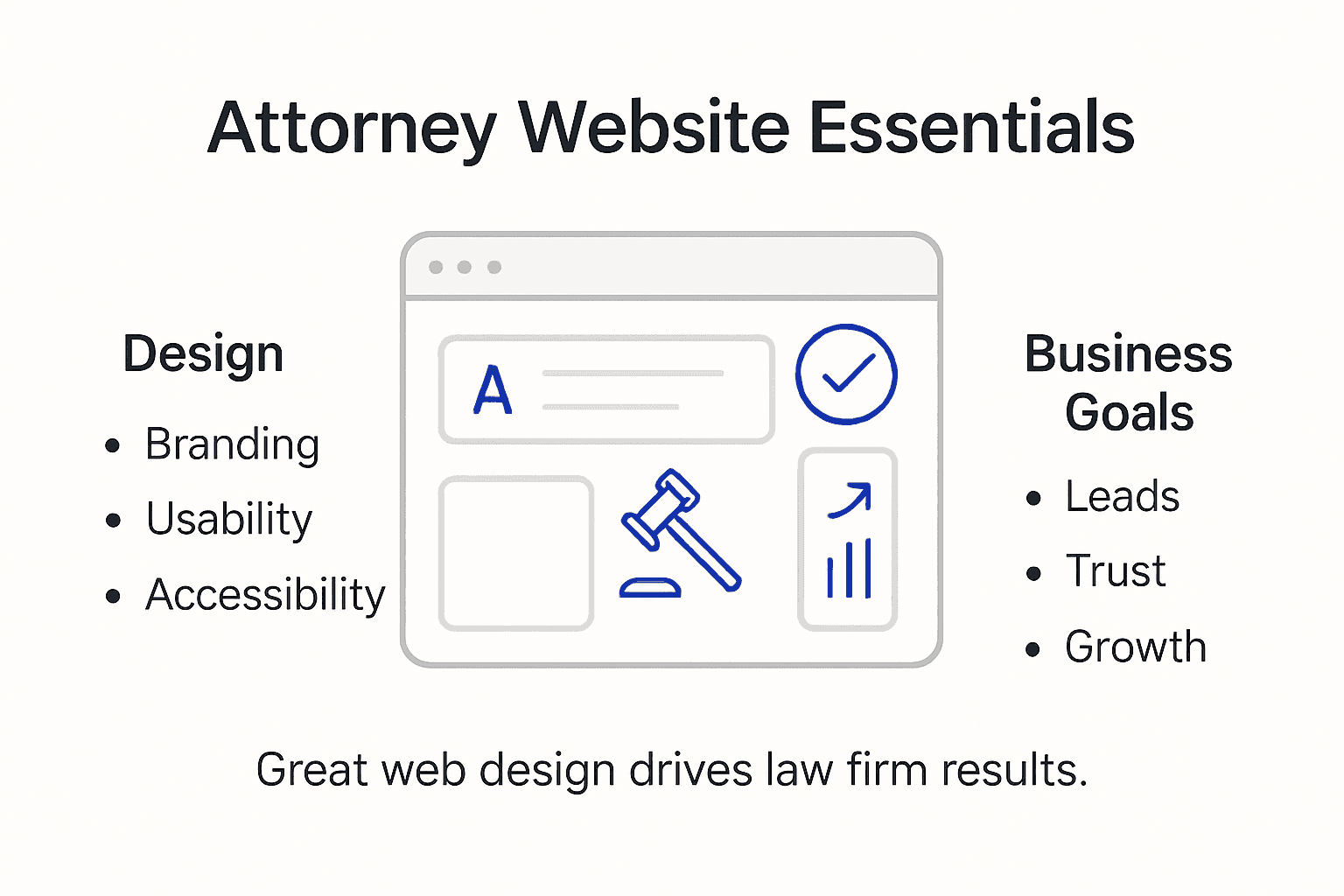
Pro Tip – Design Audit: Conduct a comprehensive website design audit every six months, analyzing user experience metrics, page loading times, and mobile responsiveness to ensure your digital presence remains competitive and client-focused.
Core Features of Legal Practice Websites
A high-performing legal practice website transcends basic online presence, serving as a sophisticated marketing tool designed to attract, engage, and convert potential clients. The digital landscape demands more than static information—it requires a strategic, user-centric approach that communicates professional expertise and builds immediate trust.

Leading web design best practices for law firms emphasize the critical importance of presenting a clear, compelling value proposition that distinguishes a law firm from its competitors. This means crafting a homepage that instantly communicates the firm’s unique strengths, practice areas, and professional commitment through strategic visual and textual elements.
Core features that define an exceptional legal practice website include:
- Intuitive Navigation: Seamless menu structures
- Practice Area Specificity: Detailed sections for each legal specialty
- Attorney Profiles: Comprehensive professional backgrounds
- Client Testimonial Integration: Authentic success story representations
- Mobile Responsiveness: Adaptive design across all devices
- Fast Loading Performance: Optimized page speed
- Secure Contact Mechanisms: Easy-to-use consultation request systems
Technical functionality represents another paramount consideration for legal websites. Modern law firms must implement robust security protocols, ensure GDPR and privacy compliance, and provide multiple communication channels. This includes encrypted contact forms, clear privacy policies, and responsive design that accommodates potential clients accessing the site through smartphones, tablets, and desktop computers.
Pro Tip – Content Strategy: Develop a dynamic content strategy that regularly updates practice area information, publishes informative legal insights, and demonstrates the firm’s expertise through targeted blog posts and resource libraries.
Here’s how key law firm website features support business goals:
| Core Feature | Function for Users | Business Impact |
|---|---|---|
| Responsive Design | Ensures easy browsing on any device | Expands potential client reach |
| Attorney Profiles | Builds personal connection and trust | Increases consultation requests |
| Secure Contact Forms | Safeguards sensitive information | Enhances client confidence |
| Fast Load Times | Reduces wait and frustration | Lowers bounce rate, boosts SEO |
| Client Testimonials | Demonstrates proven success | Strengthens reputation, drives leads |
Website Accessibility and Ethical Obligations
Website accessibility represents a critical ethical and legal responsibility for law firms, extending far beyond conventional design considerations. Attorneys must recognize that their digital platforms serve as essential communication channels that must be inclusive and navigable for all potential clients, regardless of individual physical capabilities or technological constraints.
Legal professionals must carefully address Americans with Disabilities Act (ADA) compliance when developing their digital presence. This requirement means creating websites that can be effectively accessed and understood by individuals with visual, auditory, motor, and cognitive disabilities. Implementing comprehensive accessibility standards ensures that every potential client can engage with legal services without unnecessary technological barriers.
Key accessibility considerations for law firm websites include:
- Screen Reader Compatibility: Ensuring all content is interpretable by assistive technologies
- Keyboard Navigation: Full website functionality without mouse dependency
- High Color Contrast: Readable text for visually impaired users
- Alternative Text for Images: Descriptive text for graphics and visual elements
- Closed Captioning: Video content accessibility
- Simple, Clear Navigation: Intuitive site structure
- Resizable Text: Font scaling without layout disruption
Technical implementation of these accessibility features requires collaboration between web designers, accessibility experts, and legal professionals. Law firms must conduct regular accessibility audits, test their websites with various assistive technologies, and remain proactively committed to removing potential digital barriers. This approach not only demonstrates professional ethics but also expands the firm’s potential client base by ensuring inclusive digital communication.
Pro Tip – Accessibility Audit: Invest in professional accessibility testing annually, using both automated tools and human testers with diverse disabilities to comprehensively evaluate and improve your website’s inclusive design.
SEO Integration and Client Acquisition Power
Search engine optimization represents a critical strategic lever for law firms seeking to transform their websites from passive digital brochures into dynamic client acquisition engines. Modern legal practices must view their online presence not merely as information repositories, but as sophisticated marketing platforms designed to attract, engage, and convert potential clients through intelligent digital strategies.
Modern web design best practices for law firms emphasize the critical importance of creating service pages that are meticulously optimized for specific legal keywords. This approach goes beyond simple keyword insertion, requiring a nuanced strategy that aligns content with potential clients’ search behaviors, intent, and complex legal information needs.
Key SEO integration strategies for law firm websites include:
- Keyword-Optimized Practice Area Pages: Detailed, specific content for each legal specialty
- Local SEO Targeting: Geographic optimization for regional client acquisition
- Rich Snippet Implementation: Enhanced search result visibility
- Mobile-First Indexing: Responsive design for search engine ranking
- Authoritative Content Development: Thought leadership through comprehensive legal resources
- Technical SEO Optimization: Fast loading speeds and clean site architecture
- Schema Markup: Structured data for improved search understanding
Successful SEO implementation requires a holistic approach that combines technical optimization, content strategy, and user experience design. Law firms must create content that not only ranks well in search engines but also provides genuine value to potential clients. This means developing in-depth practice area guides, addressing common legal questions, and presenting complex legal information in an accessible, engaging manner that builds trust and credibility.
Pro Tip – Content Optimization: Develop a quarterly content audit process that analyzes website performance, updates keyword strategies, and refreshes existing content to maintain maximum search engine visibility and client engagement.
Below is a comparison of website accessibility and SEO priorities for law firms:
| Aspect | Accessibility Focus | SEO Optimization Focus |
|---|---|---|
| Primary Goal | Inclusive access for all users | Higher search engine rankings |
| Key Methods | Screen reader compatibility, alt text | Keyword-rich content, schema markup |
| Legal Implication | Compliance with ADA requirements | Compliance with search best practices |
Common Pitfalls in Attorney Web Design
Web design for law firms represents a complex strategic challenge that extends far beyond aesthetic considerations. Many attorneys unknowingly undermine their digital marketing efforts by perpetuating design mistakes that actively discourage potential client engagement and diminish professional credibility.
Law firm website design best practices highlight critical pitfalls that can significantly impact a firm’s online performance. The most destructive errors often stem from misunderstanding user experience principles and failing to prioritize clear, intuitive digital communication strategies that transform websites from static information repositories into dynamic client acquisition platforms.
Most prevalent web design pitfalls for attorneys include:
- Overcomplicated Navigation: Confusing menu structures that frustrate potential clients
- Outdated Visual Design: Unprofessional aesthetics that undermine credibility
- Lack of Mobile Responsiveness: Poor performance on smartphones and tablets
- Excessive Technical Jargon: Complex legal language that alienates potential clients
- Weak Call-to-Action Elements: Unclear consultation request mechanisms
- Inconsistent Branding: Misaligned visual identity across website sections
- Slow Page Loading Times: Performance issues that drive away impatient users
Successful attorney websites require a strategic approach that balances professional presentation with user-friendly design. This means creating digital experiences that feel simultaneously authoritative and approachable, with clear navigation paths, compelling visual storytelling, and seamless interaction mechanisms. Law firms must view their websites as sophisticated marketing tools that communicate expertise, build trust, and simplify the client engagement process.
Pro Tip – Design Review: Conduct biannual comprehensive website audits using both professional design experts and actual potential clients to identify and address emerging user experience challenges.
Elevate Your Law Firm’s Website Design and Drive Client Growth Today
Is your law firm’s website truly designed to convert visitors into clients? The article highlights key challenges such as achieving fast load times, ensuring mobile responsiveness, creating intuitive navigation, and integrating secure contact forms. These pain points can hold your firm back from gaining the trust and attention potential clients deserve. Effective design also means optimizing for accessibility and search engines to stay compliant and visible.
At LawSEO.com, we specialize in solving these exact challenges exclusively for attorneys. Our founder-led team brings over 29 years of legal SEO experience and delivers comprehensive services including cutting-edge web design tailored for law firms. We help you implement client-focused features that build trust, accelerate page speed, and enhance accessibility while optimizing your site to rank higher on Google and AI-driven platforms.
Don’t let overlooked website pitfalls stunt your firm’s growth. Take control with expert support that transforms your online presence into a powerful client acquisition engine. Visit LawSEO.com now to learn how our specialized SEO and design solutions can position your firm for lasting online dominance. Your next clients are searching for you today—make sure they find you first.
Frequently Asked Questions
What are the essential elements of effective website design for law firms?
Key elements include responsive mobile compatibility, fast page loading speeds, clear navigation paths, prominent contact information, professional attorney profiles, client testimonial integration, and secure contact forms.
How does website design impact client acquisition for attorneys?
A well-designed website communicates professionalism and builds trust, which can encourage visitors to become actual clients. Features like intuitive navigation and optimized content improve user experience and engagement, ultimately leading to higher consultation requests.
Why is website accessibility important for law firm websites?
Website accessibility is essential for ensuring all potential clients, regardless of disabilities, can access legal services. It reflects the firm’s commitment to inclusivity and can expand the client base by removing technological barriers to engagement.
How can SEO practices enhance a law firm’s website performance?
SEO practices improve visibility on search engines by optimizing content with relevant keywords, enhancing local search targeting, and implementing structured data. This strategic approach helps attract more qualified leads and strengthens the firm’s online presence.