

Over eighty percent of American law firms now view digital branding and ethical compliance as top priorities for growth. Defining these needs at the start shapes every aspect of your website, from client trust to search visibility. This guide highlights actionable strategies for strengthening your American firm’s online presence and reveals how AI-driven approaches can support both compliance and client acquisition.
Table of Contents
- Step 1: Define Branding And Ethical Compliance Needs
- Step 2: Select Legal-Focused Website Platform And Tools
- Step 3: Craft Authoritative And AI-Optimized Content
- Step 4: Integrate Local SEO And Client Acquisition Features
- Step 5: Test User Experience And Search Performance
Quick Summary
| Key Insight | Explanation |
|---|---|
| 1. Understand Ethical Guidelines | Familiarize yourself with legal marketing ethics to ensure compliance and integrity in your website design. |
| 2. Choose Appropriate Website Platform | Select a platform that balances ease of use with legal-specific features like security and compliance. |
| 3. Create High-Quality Content | Focus on producing authoritative content that answers client questions while optimizing for AI search algorithms. |
| 4. Implement Local SEO Strategies | Use local business schema and client engagement features to enhance visibility and client acquisition effectiveness. |
| 5. Test User Experience Regularly | Conduct audits and gather feedback to refine site navigation, performance, and overall user satisfaction. |
Step 1: Define branding and ethical compliance needs
Successfully designing a lawyer website requires thoughtfully establishing your professional brand while maintaining strict ethical standards. This crucial first step ensures your online presence reflects both your legal expertise and professional integrity.
Start by understanding the core ethical guidelines governing legal marketing. Legal ethics form the backbone of professional representation, demanding transparency, accuracy, and respect for client confidentiality. Your website should communicate your practice’s values while adhering to the American Bar Association’s professional conduct rules. This means carefully crafting content that highlights your expertise without making unsubstantiated claims or violating advertising regulations.
When developing your brand strategy, focus on authenticity and professionalism. Consider how AI technologies can support ethical marketing practices, but remember that human oversight remains critical. You want a digital presence that builds trust, demonstrates your unique legal perspective, and connects with potential clients through clear, honest communication.
Practical Advice: Conduct a comprehensive review of your state bar association’s specific marketing guidelines before finalizing your website design to ensure full compliance.
Step 2: Select legal-focused website platform and tools
Choosing the right website platform is critical for creating a professional online presence that effectively represents your law practice. Your goal is to select a tool that balances technical functionality with legal marketing requirements.
Look for platforms that offer robust legal technology integration with built-in security features. Key considerations include user-friendly content management systems, SEO optimization capabilities, and compliance with professional ethics guidelines. Code-free website builders can simplify the process for attorneys who are not technical experts. Prioritize platforms that allow easy customization of practice area descriptions, attorney profiles, contact forms, and blog functionality.
When evaluating options, confirm the platform supports critical legal website elements such as secure client communication portals, HIPAA-compliant forms, and integration with practice management software. Consider platforms that offer specialized legal themes, responsive design for mobile devices, and built-in analytics to track website performance.
Pro Tip: Request a demonstration or free trial of any website platform to thoroughly test its legal-specific features and compatibility with your firm’s unique marketing needs.
Here’s how leading legal website platforms compare on key features:
| Platform Type | Customization Level | Security Features | Legal Integrations |
|---|---|---|---|
| Code-free website builder | Moderate | Basic SSL, two-factor | Limited legal add-ons |
| Custom legal CMS | High | Advanced encryption | Practice management tools |
| Generic CMS (e.g., WordPress) | High | Plugin-based solutions | Third-party integrations |
Step 3: Craft authoritative and AI-optimized content
Designing an effective lawyer website requires creating content that demonstrates your legal expertise while strategically optimizing for both human readers and AI search algorithms. Your goal is to develop compelling, trustworthy content that attracts potential clients and ranks well in search results.

AI-powered content creation tools can help streamline your writing process, but remember that human oversight remains crucial. Focus on producing authoritative content that answers specific legal questions, highlights your firm’s unique expertise, and provides genuine value to potential clients. Incorporate targeted keywords naturally, use clear headings, and structure your content with concise paragraphs that make complex legal information accessible.
When developing content, prioritize responsible AI usage in legal marketing. Verify all information for accuracy, ensure proper citations, and maintain your professional ethical standards. Consider creating practice area guides, FAQ sections, and informative blog posts that showcase your legal knowledge while remaining compliant with professional guidelines.
Pro Tip: Always have a human legal professional review AI-generated content to confirm accuracy, tone, and compliance with professional standards before publishing.
Step 4: Integrate local SEO and client acquisition features
Transforming your law firm’s website into a powerful client acquisition tool requires strategic implementation of local SEO and conversion-focused features. Your objective is to create a digital platform that not only attracts potential clients but also makes connecting with your firm seamless and intuitive.
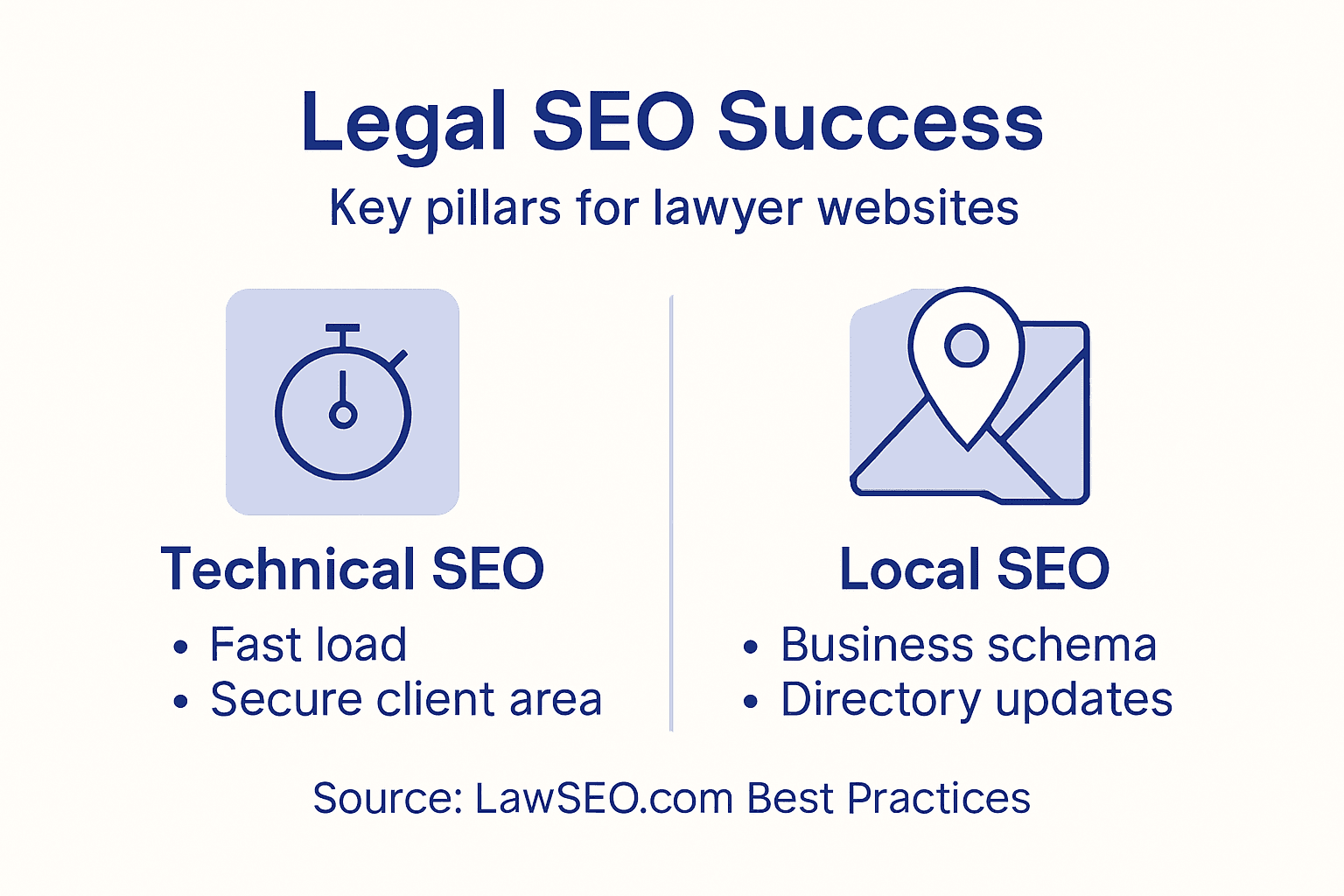
Implement local business schema markup to enhance your firm’s visibility in Google search and map results. This technical optimization helps search engines understand your law practice’s specific location, practice areas, and contact information. Integrate key conversion features like prominent contact forms, click-to-call buttons, live chat functionality, and online appointment scheduling tools that make it easy for potential clients to reach out.
Focus on developing client engagement strategies that demonstrate your firm’s expertise and accessibility. Include detailed practice area pages with location-specific keywords, client testimonials, attorney profiles with local credentials, and clear calls to action. Track your website’s performance using integrated analytics to understand user behavior and continuously refine your client acquisition approach.
Pro Tip: Regularly update your local business listings across Google, Yelp, and industry directories to maintain consistent contact information and improve local search rankings.
Step 5: Test user experience and search performance
Validating your law firm’s website requires a comprehensive approach to testing both user experience and search engine optimization. Your mission is to ensure your digital platform provides a seamless, intuitive experience that attracts and converts potential clients while meeting technical search requirements.
Conducting a comprehensive SEO audit involves multiple critical evaluations. Review your website’s indexing, resolve any crawl errors, analyze backlink quality, optimize mobile responsiveness, assess page loading speed, and verify keyword integration. Examine site navigation, accessibility features, and overall user interface to confirm the website meets both search engine algorithms and client expectations.
Gather detailed insights by implementing user experience surveys that capture qualitative and quantitative feedback. These surveys help identify potential pain points, navigation challenges, and areas for improvement. Use tools like heatmaps, user session recordings, and direct client feedback to understand how visitors interact with your website and make data driven refinements to your design and content strategy.
Pro Tip: Schedule quarterly user experience and SEO performance reviews to stay ahead of technical changes and maintain a competitive digital presence.
Review this checklist to validate your legal website’s user experience and SEO readiness:
| Area to Audit | Key Task | Business Impact |
|---|---|---|
| SEO Performance | Check crawl errors | Boosts site visibility |
| Mobile Usability | Test design on smartphones | Ensures all-device access |
| Navigation | Simplify menus | Increases client inquiries |
| Accessibility | Enable screen reader tools | Expands client reach |
Elevate Your Lawyer Website for SEO and Ethical Success
The challenge of designing a lawyer website that meets strict ethical standards while achieving outstanding SEO performance is clear. This article highlights the vital need to blend authoritative, AI-optimized content with local SEO strategies and robust user experience testing. Law firms face the pressure of ensuring their websites offer transparency and professionalism, maintain client trust, and capture qualified leads through optimized search visibility. Ethical compliance and specialized technology integration add layers of complexity, requiring expertise dedicated solely to the legal sector.
At LawSEO.com, we understand these pain points intimately. Our founder-led team leverages over 29 years of SEO experience exclusively for law firms ensuring your website not only complies with professional guidelines but also dominates search results on Google and emerging AI platforms. We specialize in crafting compelling, AI-friendly content, integrating advanced local SEO tactics, and enhancing user experience to turn visitors into clients. Our comprehensive digital marketing services cover everything from content production to paid advertising giving you a competitive edge without risking ethical missteps.
Ready to transform your law firm’s digital presence with proven strategies tailored for legal professionals Explore how our specialized approach can build trust, boost your online visibility, and accelerate client acquisition. Visit LawSEO.com today and take the first step towards legal SEO success that respects your professional integrity and drives measurable growth.
Frequently Asked Questions
What are the key ethical guidelines for designing a lawyer website?
To design a lawyer website, ensure you adhere to ethical guidelines that emphasize transparency, accuracy, and client confidentiality. Review your state bar association’s specific marketing rules to ensure your content communicates your professional values without making unsubstantiated claims.
How can I ensure my lawyer website complies with legal marketing standards?
Verify compliance by conducting a thorough review of applicable legal advertising regulations before finalizing your website. Focus on crafting content that highlights your expertise while adhering to the American Bar Association’s professional conduct rules.
What platform should I choose for my lawyer website?
Select a website platform that integrates legal technology and has built-in security features. Prioritize options that offer user-friendly content management, local SEO capabilities, and customization of key legal elements such as practice area descriptions and contact forms.
How do I write AI-optimized content for my lawyer website?
Create AI-optimized content by focusing on authoritative topics that answer specific legal questions while incorporating targeted keywords naturally. Strive to maintain clarity and structure in your writing, ensuring that complex legal information is accessible to potential clients.
What steps should I take to implement local SEO on my lawyer website?
To implement local SEO, use local business schema markup to enhance your visibility in search results. Ensure that your website includes location-specific keywords in practice area pages and features clear contact information to facilitate potential client inquiries.
How can I evaluate the user experience of my lawyer website?
Evaluate user experience by conducting an SEO audit that assesses navigation ease, mobile responsiveness, and overall design. Gather feedback through user experience surveys and tools like heatmaps to identify areas for improvement and enhance client interaction on your site.