


Roughly eighty percent of American clients search online before contacting a law firm. For solo practitioners and small firms, mastering legal SEO means more than just ranking higher in search results—it’s the difference between appearing invisible or becoming the trusted choice in your community. Unlocking these specialized strategies gives you a clear edge, helping you attract clients while respecting legal marketing rules and professional ethics.
Table of Contents
- Legal SEO Defined For Law Firms
- Essential Types Of Legal SEO Strategies
- How Legal SEO Works In Practice
- Ethics, Compliance, And Unique Bar Rules
- Common Mistakes And Legal SEO Risks
- AI Optimization And Emerging Search Trends
Key Takeaways
| Point | Details |
|---|---|
| Specialized Approach | Legal SEO is tailored for law firms, focusing on ethical marketing and unique client needs in the legal sector. |
| Strategic Implementation | A successful legal SEO strategy combines technical optimization, content marketing, and local SEO to enhance online visibility. |
| Ethical Compliance | Law firms must adhere to professional ethical standards while optimizing their digital marketing efforts to maintain client trust. |
| Continuous Adaptation | Ongoing content updates and monitoring of search trends are essential for law firms to stay relevant and competitive in the digital landscape. |
Legal SEO Defined for Law Firms
Legal SEO represents a specialized digital marketing strategy designed specifically for law firms to enhance their online visibility and attract potential clients through strategic search engine optimization techniques. Unlike generic digital marketing approaches, legal SEO focuses on the unique challenges and ethical considerations of promoting legal services in a competitive digital landscape.
At its core, legal SEO involves carefully crafting online content and website infrastructure to improve search engine rankings for law firm websites. This process includes optimizing legal website strategies that align with how potential clients search for legal assistance. Key elements include targeted keyword research, creating informative content that addresses specific legal queries, and ensuring technical website performance meets search engine standards.
The strategic implementation of legal SEO requires a nuanced understanding of both digital marketing principles and professional legal ethics. Law firms must balance aggressive online marketing with maintaining professional ethical standards, ensuring that all digital marketing efforts respect client confidentiality and professional integrity. This means developing content that provides genuine value, answers potential client questions, and demonstrates legal expertise without making unrealistic promises or compromising professional conduct.
Pro tip: Develop hyper-local content targeting specific legal needs in your geographic area to improve search rankings and connect more effectively with potential clients in your community.
Essential Types of Legal SEO Strategies
Legal SEO encompasses a multifaceted approach to digital marketing that requires law firms to implement strategic techniques across different optimization domains. Comprehensive SEO techniques involve a sophisticated blend of technical, on-page, and off-page strategies specifically tailored to legal service marketing.
The primary categories of legal SEO strategies include technical SEO, on-page optimization, content marketing, and local SEO. Technical SEO focuses on website infrastructure, ensuring fast loading speeds, mobile responsiveness, and smooth search engine crawlability. On-page optimization involves strategically using practice-specific keywords, crafting compelling meta descriptions, and structuring content to enhance search engine understanding. Targeted keyword research remains crucial for identifying the precise language potential clients use when seeking legal services.
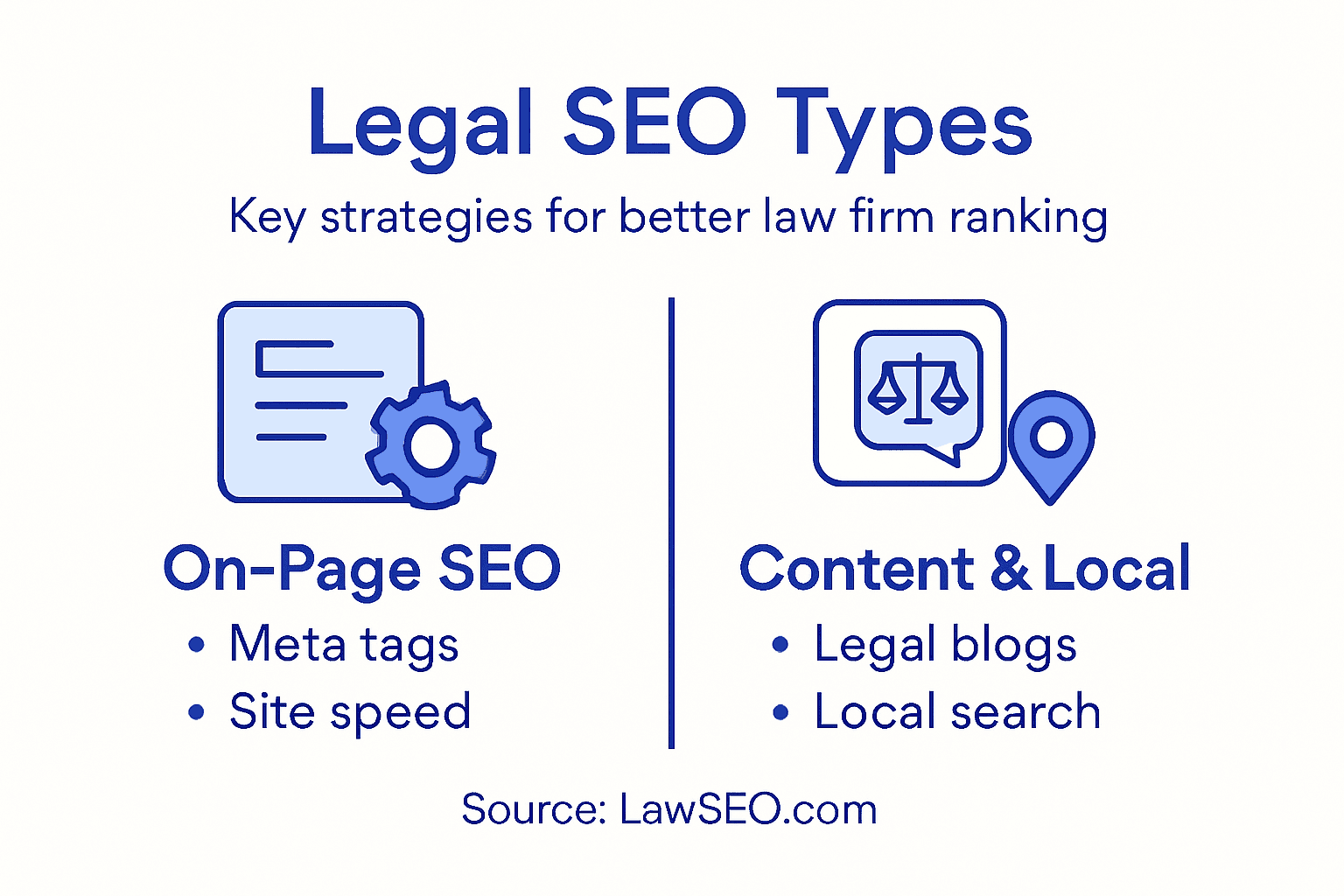
Content marketing represents another critical dimension of legal SEO, where law firms develop informative, authoritative content that addresses potential client questions and demonstrates legal expertise. This approach includes creating practice area blogs, FAQ sections, case study compilations, and educational resources that not only improve search rankings but also establish the firm’s credibility and trustworthiness. Off-page SEO strategies like building high-quality backlinks from reputable legal directories and professional associations further enhance a law firm’s online authority.
Pro tip: Develop a consistent content calendar focusing on hyper-local legal issues and practice area insights to systematically improve your website’s search engine relevance and client engagement.
Here’s a summary of the main types of legal SEO strategies and their distinct focus areas:
| SEO Strategy Type | Main Focus | Business Impact |
|---|---|---|
| Technical SEO | Website infrastructure & speed | Improves ranking, user experience |
| On-Page Optimization | Keyword use & page structure | Boosts relevance, increases traffic |
| Content Marketing | Informative, expert content | Establishes authority, builds trust |
| Local SEO | Location-specific optimization | Attracts local clients, increases leads |
| Off-Page SEO | Backlinks & reputation | Enhances online authority |
How Legal SEO Works in Practice
Legal SEO transforms digital marketing for law firms by strategically aligning online content with potential clients’ search behaviors and needs. Practical SEO optimization requires a comprehensive approach that goes beyond traditional marketing techniques, focusing on creating targeted, location-specific content that resonates with individuals seeking legal assistance.
In practice, legal SEO involves a multifaceted process of website optimization, content development, and strategic keyword targeting. Law firms must carefully analyze their target audience’s search patterns, developing content that directly addresses specific legal questions and concerns. This includes creating practice area-specific pages, developing informative blog posts, and ensuring that website metadata accurately reflects the services offered. Technical elements like site speed, mobile responsiveness, and clear navigation become critical components of effective website design that both search engines and potential clients appreciate.

The implementation of legal SEO requires continuous monitoring and adaptation. Law firms must regularly update their content, track keyword performance, and analyze user engagement metrics to refine their online strategy. This involves understanding local search trends, incorporating location-specific keywords, and developing content that demonstrates the firm’s expertise while remaining compliant with professional ethical standards. Successful legal SEO bridges the gap between technical optimization and genuine, value-driven communication with potential clients.
Pro tip: Create a monthly content audit process to systematically review and update your law firm’s online content, ensuring ongoing relevance and search engine optimization.
Ethics, Compliance, and Unique Bar Rules
Legal marketing operates within a complex framework of professional ethical standards that distinguish it from traditional business promotion. Legal ethics guidelines mandate that law firms maintain an exceptionally high standard of transparency, accuracy, and professional integrity when developing online marketing strategies, including search engine optimization (SEO) approaches.
The American Bar Association’s professional conduct rules create unique constraints for legal SEO practices. Lawyers must carefully navigate marketing regulations that prohibit misleading statements, guarantee client confidentiality, and prevent potential conflicts of interest. Professional responsibility standards require that every piece of online content, from website metadata to blog posts, accurately represent the firm’s capabilities without making exaggerated claims or promising specific legal outcomes.
Each state’s bar association may impose additional restrictions on legal marketing, creating a complex compliance landscape for law firms developing SEO strategies. These regulations often require nuanced approaches to content creation, such as using carefully worded disclaimers, avoiding comparisons with other attorneys, and ensuring that all marketing materials maintain the profession’s fundamental ethical principles. Successful legal SEO demands a delicate balance between effective digital marketing techniques and strict adherence to professional conduct standards that protect both the legal profession’s reputation and potential clients’ interests.
Pro tip: Develop a comprehensive compliance checklist that reviews all online marketing content against your state bar association’s ethical guidelines before publication.
Common Mistakes and Legal SEO Risks
Legal SEO demands precision and strategic understanding to avoid potentially career-damaging pitfalls. Common SEO mistakes can compromise a law firm’s online reputation, leading to reduced client trust, diminished search rankings, and potential ethical violations that extend beyond digital marketing consequences.
The most critical risks in legal SEO emerge from unintentional breaches of professional conduct and search engine optimization missteps. Keyword stuffing, creating duplicate content, and using misleading meta descriptions can trigger significant penalties from search engines and state bar associations. Legal marketing risks include potential malpractice claims if marketing materials misrepresent the firm’s capabilities or create unrealistic client expectations. Law firms must carefully navigate these challenges by maintaining transparency, avoiding aggressive marketing tactics, and ensuring all online content meets both technical SEO standards and professional ethical guidelines.
Technical SEO mistakes can be equally damaging. Neglecting mobile optimization, failing to implement proper local SEO strategies, and ignoring website performance metrics can significantly reduce a law firm’s online visibility. These errors not only impact search rankings but can also create barriers for potential clients trying to access legal information. Successful legal SEO requires a comprehensive approach that balances technical optimization, content quality, and strict adherence to professional marketing standards.
Below is a comparison of legal SEO mistakes and their consequences for law firms:
| Mistake Type | Example | Possible Consequence |
|---|---|---|
| Keyword Misuse | Keyword stuffing | Search penalties, lower rankings |
| Ethical Violation | Misleading claims | Bar complaints, legal action |
| Technical Neglect | Slow site, no mobile support | Poor client access, lost visibility |
| Duplicate Content | Repeating website pages | Reduced trust, ranking drops |
Pro tip: Conduct a quarterly comprehensive audit of your law firm’s online marketing materials, cross-referencing content against both search engine guidelines and your state bar association’s ethical standards.
AI Optimization and Emerging Search Trends
Artificial intelligence is radically transforming legal marketing and search strategies, creating unprecedented opportunities for law firms to enhance their digital presence. Legal AI innovation represents a sophisticated evolution in how legal professionals approach online visibility, client engagement, and content optimization.
The emergence of Generative Engine Optimization (GEO) marks a critical shift in search strategy, requiring law firms to adapt their content for AI-driven search platforms. Generative engine optimization demands a nuanced approach that goes beyond traditional SEO, focusing on creating content that AI algorithms can efficiently parse, understand, and reproduce in search results. This means developing clear, authoritative content that answers potential client questions directly, uses structured data, and provides comprehensive yet concise information about legal services and practice areas.
Law firms must now balance technical optimization with AI-friendly content strategies. This involves understanding how large language models interpret and rank content, implementing schema markup, developing FAQ-style content, and ensuring that website structures are compatible with AI crawling and indexing. The goal is to create digital assets that not only rank well in traditional search results but also perform effectively in AI-generated responses, voice searches, and emerging conversational search interfaces.
Pro tip: Regularly audit your content using AI tools to assess how generative search platforms might interpret and potentially reproduce your legal information.
Elevate Your Law Firm’s Online Presence with Expert Legal SEO
Navigating the complex world of legal SEO is challenging. The article highlights key problems law firms face such as balancing ethical marketing standards, avoiding common SEO mistakes, and adapting to emerging AI-driven search trends. If you are striving to optimize your website’s technical performance, produce authoritative content, and comply with strict ethical guidelines all while standing out in local searches, you are not alone in this pursuit.
At LawSEO.com, we specialize exclusively in SEO for lawyers and law firms. Our founder-led team understands the unique demands of legal marketing and brings over 29 years of experience to your strategy. We help you avoid pitfalls like keyword stuffing and misleading claims while driving more leads through advanced local SEO, compelling content production, and tailored AI optimization strategies. Don’t let ethical concerns or search engine complexities hold your law firm back from online dominance.
Ready to turn legal SEO challenges into your greatest advantage Take the first step toward higher Google rankings and AI visibility by partnering with experts who know the legal industry inside and out Explore our proven approach at LawSEO.com and learn how to achieve lasting client attraction and sustainable growth today.
Frequently Asked Questions
What is legal SEO?
Legal SEO is a specialized digital marketing strategy designed to enhance a law firm’s online visibility and attract potential clients through search engine optimization techniques tailored specifically to legal services.
Why is content marketing important for legal SEO?
Content marketing is crucial for legal SEO as it involves creating informative and authoritative content that addresses potential client questions, showcasing legal expertise while improving search engine rankings.
How can law firms ensure compliance with ethical standards in their SEO practices?
Law firms can ensure compliance by adhering to professional ethical guidelines, maintaining transparency, avoiding misleading statements, and regularly reviewing marketing content against state bar association rules.
What are common mistakes to avoid in legal SEO?
Common mistakes in legal SEO include keyword stuffing, neglecting mobile optimization, creating duplicate content, and making misleading claims, all of which can harm a law firm’s online reputation and search rankings.