


More than 90 percent of American clients rely on online searches when choosing a legal service. Staying visible in this crowded digital market matters to every law firm aiming for steady growth. Strategic legal content not only drives higher search rankings but also transforms site visitors into trusted clients by showcasing expertise and genuine insight tailored for their needs.
Table of Contents
- Defining Content’s Role in Law Firm SEO
- Essential Content Types for Legal Firms
- AI-Driven Optimization and Content Structure
- Building Trust, Authority, and Local Visibility
- Legal, Ethical, and Compliance Risks in Content
Key Takeaways
| Point | Details |
|---|---|
| Content is Fundamental for SEO | High-quality legal content enhances visibility and attracts potential clients by addressing their needs and demonstrating expertise. |
| Diverse Content Types are Essential | Law firms should utilize various content types, like practice area pages and blog articles, to build trust and improve search rankings. |
| AI Optimization is Key | Adapting to AI-driven content strategies is crucial for enhancing discoverability and delivering precise legal information. |
| Ethics and Compliance in Content | Maintaining legal ethics and compliance is necessary to prevent risks and establish professional integrity in published materials. |
Defining Content’s Role in Law Firm SEO
Content serves as the foundational infrastructure for law firm search engine optimization, acting as a critical mechanism for attracting potential clients through strategic digital communication. By developing authoritative legal content, attorneys can demonstrate expertise, answer client questions, and improve website visibility across search platforms.
At its core, legal content marketing goes beyond simple keyword insertion. Effective SEO content requires understanding user search intent, creating comprehensive resources that directly address potential clients’ legal concerns, and establishing credibility through substantive, well-researched information. This means developing materials that not only rank well in search results but genuinely help individuals navigating complex legal challenges.
Law firms must recognize that modern search engine optimization demands high-quality, targeted content that speaks directly to specific client needs. Search algorithms increasingly prioritize websites offering genuine value, meaning attorneys must focus on creating strategic, user-focused content that comprehensively addresses legal questions, explains practice areas, and provides clear, actionable guidance.
Pro tip: Develop a content strategy that focuses on answering the most common questions potential clients have about your specific legal practice areas, using clear, accessible language that demonstrates expertise without overwhelming readers.
Essential Content Types for Legal Firms
Law firms must strategically develop multiple content types to effectively communicate expertise, attract potential clients, and improve search engine visibility. Legal writing encompasses diverse document formats that serve critical communication and marketing objectives, ranging from informative blog posts to comprehensive practice area guides.
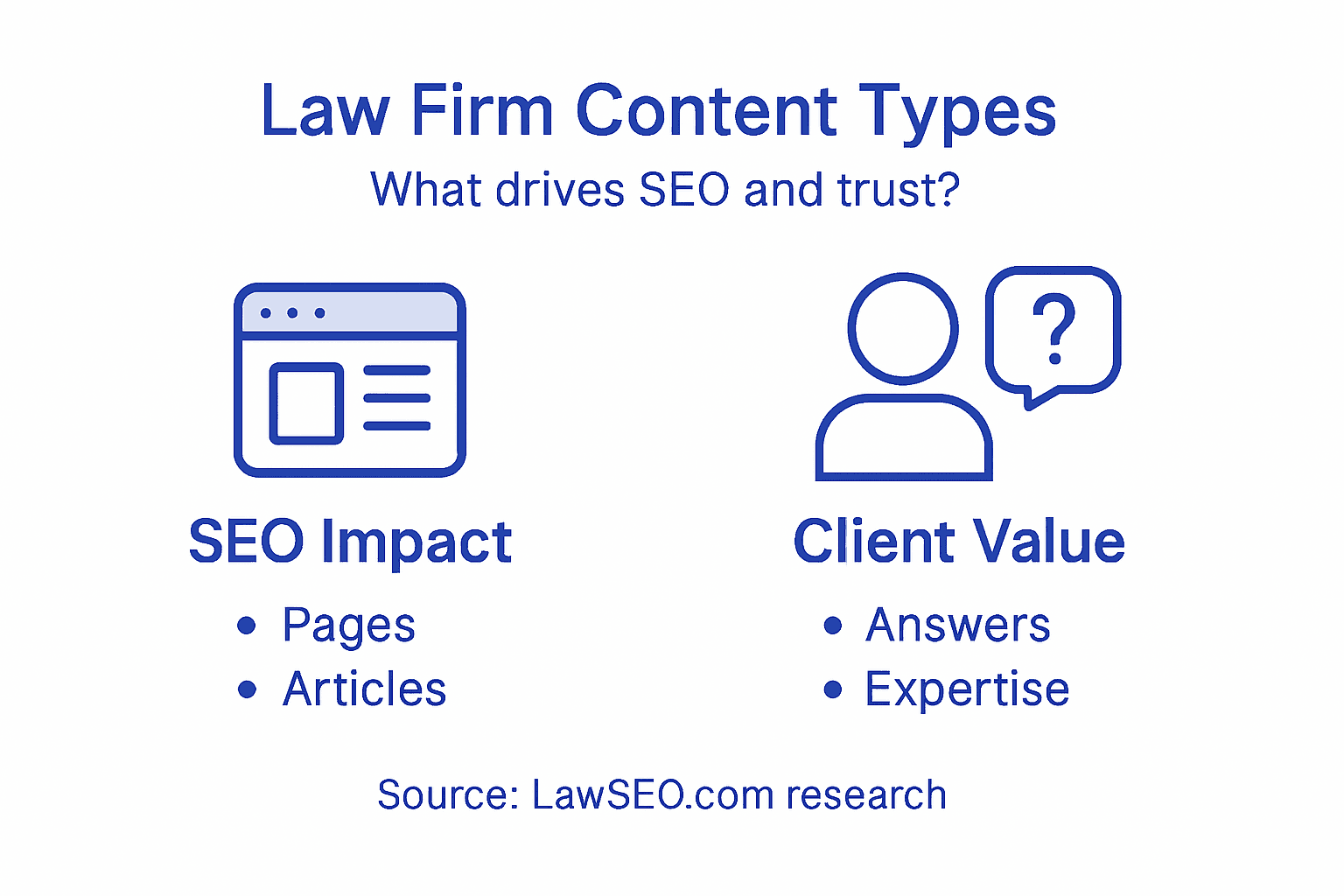
The primary content types law firms should prioritize include practice area pages, which provide detailed explanations of specific legal services, client-focused blog articles addressing common legal questions, informative FAQ sections, case studies demonstrating successful outcomes, and attorney profile pages that highlight professional expertise and credentials. Each content type serves a unique purpose in building trust, demonstrating knowledge, and improving search engine rankings through targeted, relevant information.

Professional legal content must adhere to strict standards of clarity, precision, and authoritative presentation. Legal writing requires specialized communication strategies that balance technical accuracy with accessibility, ensuring that potential clients can understand complex legal concepts while simultaneously establishing the firm’s credibility and competence. This means creating content that is both search engine optimized and genuinely helpful to readers navigating legal challenges.
Here’s a summary of key legal content types and their impact on law firm SEO:
| Content Type | Purpose | SEO Benefit | Trust Factor |
|---|---|---|---|
| Practice Area Pages | Explain legal services | Improve keyword visibility | Showcase specialization |
| Blog Articles | Address legal questions | Attract targeted search traffic | Display expertise |
| Case Studies | Share success stories | Demonstrate unique outcomes | Build credibility |
| Attorney Profiles | Feature credentials | Rank for professional names | Establish authority |
Pro tip: Create a content matrix that maps different content types to specific client personas and their corresponding legal needs, ensuring your website provides targeted, relevant information for each potential client segment.
AI-Driven Optimization and Content Structure
Law firms must adapt to emerging artificial intelligence optimization strategies that fundamentally transform how digital content is discovered and consumed. Unlike traditional SEO approaches, AI optimization focuses on creating content that can be seamlessly processed and understood by advanced language models, requiring a more nuanced and sophisticated content development strategy.
The core principles of AI-driven content optimization involve structuring information with exceptional clarity, providing comprehensive context, and ensuring high semantic relevance. This means developing content that goes beyond keyword matching and instead focuses on delivering precise, authoritative answers to complex legal queries. Law firms need to craft content that demonstrates deep expertise, uses precise technical language, and provides clear, structured explanations that AI systems can readily interpret and reference.
Generative Engine Optimization techniques are becoming increasingly critical for law firms seeking to maximize their digital visibility. These strategies involve creating content that not only ranks well in traditional search results but can also be directly cited by AI-powered search assistants and chatbots. This requires a multi-dimensional approach that considers how information might be extracted, summarized, and presented by intelligent systems that prioritize accuracy, comprehensiveness, and contextual understanding.
This table compares traditional SEO and AI-driven optimization for law firm content:
| Approach | Content Focus | Technology Adaptability | Citation Source |
|---|---|---|---|
| Traditional SEO | Keywords and relevance | Basic algorithm based | Search engine results |
| AI-Driven Optimization | Semantic and contextual | Advanced language models | AI assistants, chatbots |
Pro tip: Develop a content strategy that breaks complex legal topics into modular, easily digestible sections with clear headings, allowing AI systems to efficiently parse and extract key information from your website.
Building Trust, Authority, and Local Visibility
Building trust and establishing authority are fundamental strategies for law firms seeking to attract clients and differentiate themselves in a competitive digital landscape. Legal content that demonstrates transparency and expertise serves as a powerful mechanism for connecting with potential clients and building credibility in local markets.
Local visibility requires a multifaceted approach that extends beyond traditional marketing techniques. Law firms must strategically develop content that speaks directly to regional legal challenges, showcases community involvement, and provides clear, authoritative insights into complex legal topics. This involves creating location-specific content, maintaining consistent business citations, optimizing Google Business Profile listings, and developing resources that address the unique legal needs of the local population.
Trust in professional legal services hinges on demonstrating transparency, accountability, and genuine commitment to client success. This means going beyond generic marketing materials and creating substantive content that showcases the firm’s depth of knowledge, ethical standards, and proven track record of solving complex legal challenges. Client testimonials, detailed case studies, and informative practice area guides become critical tools for establishing credibility and building trust with potential clients.
Pro tip: Develop a comprehensive content strategy that includes location-specific legal resources, community engagement stories, and transparent explanations of your firm’s approach to client service, ensuring each piece of content reinforces your local expertise and professional integrity.
Legal, Ethical, and Compliance Risks in Content
Law firms must navigate a complex landscape of ethical considerations when developing digital content, ensuring that every published piece adheres to strict professional standards. Legal ethics govern professional conduct and demand extraordinary care in how legal information is presented, communicated, and distributed across digital platforms.
Comprehensive compliance requires more than simply avoiding direct ethical violations. Law firms must implement robust content review processes that prevent potential risks such as unauthorized practice of law, misleading statements, client confidentiality breaches, and inadvertent creation of attorney-client relationships through online materials. This involves carefully crafting content that provides general information without creating the impression of specific legal advice, maintaining clear disclaimers, and ensuring all published materials align with jurisdiction-specific professional conduct rules.
Regulatory compliance extends beyond traditional ethical considerations, requiring law firms to implement sophisticated risk management strategies in their content development processes. This includes conducting thorough due diligence, maintaining transparent client screening procedures, and developing content that demonstrates professional integrity while protecting against potential legal and financial risks associated with improper information disclosure.
Pro tip: Develop a comprehensive content compliance checklist that includes legal review, ethical screening, and ongoing monitoring to ensure all published materials meet professional standards and minimize potential regulatory risks.
Unlock Your Law Firm’s Full SEO Potential with Strategic Content
Understanding the critical role of content in law firm SEO means recognizing how authoritative, well-structured legal information can attract clients fast and build lasting trust. If you struggle to create content that addresses client questions clearly while navigating complex ethical standards and emerging AI-driven search algorithms you are not alone. Effective content requires precision, clarity, and a strategy tailored to legal professionals — key challenges that many firms face when aiming to boost their visibility in competitive local markets.
At LawSEO.com, we specialize exclusively in legal SEO, helping law firms like yours rise above the noise with a founder-led approach focused on AI optimization and ethical, authoritative content development. Our comprehensive services including local SEO, targeted content production, and strategic link building ensure your practice stands out both on traditional search engines and the next generation of AI-powered platforms. Don’t settle for mediocre content that fails to connect with your ideal clients or risks compliance issues. Visit LawSEO.com today and discover how our proven strategies can transform your online presence and drive new clients quickly. Take the first step toward online dominance now.
Frequently Asked Questions
What is the role of content in law firm SEO?
Content serves as the foundational element in law firm SEO, attracting potential clients by demonstrating expertise, answering legal questions, and improving website visibility through targeted digital communication.
How can a law firm improve its content strategy for SEO?
To improve its content strategy, a law firm should focus on creating high-quality, user-focused content that addresses common legal questions, showcases practice areas, and establishes credibility through well-researched and clear information.
What types of content should law firms prioritize for better SEO results?
Law firms should prioritize practice area pages, informative blog articles, client FAQs, case studies, and attorney profile pages to effectively communicate expertise, build trust, and enhance search engine visibility.
How does AI impact the optimization of legal content for SEO?
AI impacts legal content optimization by emphasizing the need for structured information and semantic relevance, allowing content to be more easily processed by advanced language models, and enabling higher visibility in AI-powered search results.