


Nearly 75 percent of American legal clients start their search for representation online. That simple fact means your law firm’s meta descriptions are more than technical details—they are the first chance to stand out in crowded search results. Crafting compelling, compliant snippets makes a direct impact on click-through rates and client inquiries, helping you capture attention and position your firm as the go-to choice for legal expertise.
Table of Contents
- Meta Descriptions Defined For Law Firms
- Crafting Compelling Snippets For Lawyers
- SEO Impact And Best Practices Explained
- Legal Industry Challenges And Compliance
- Common Pitfalls In Legal Meta Descriptions
Key Takeaways
| Point | Details |
|---|---|
| Effective Meta Descriptions Are Crucial | Meta descriptions serve as a law firm’s first impression online, impacting potential client click-through rates significantly. |
| Strategic Composition Required | Descriptions must balance technical SEO and persuasive language, clearly communicating the firm’s unique value. |
| Compliance with Legal Standards | Crafting meta descriptions should adhere to ethical guidelines, ensuring clarity without misleading information. |
| Common Pitfalls to Avoid | Law firms should avoid generic language and keyword stuffing, focusing on specific calls-to-action in their descriptions. |
Meta Descriptions Defined for Law Firms
Meta descriptions represent concise summaries that communicate a webpage’s core content directly within search engine results. For law firms, these brief text snippets serve as critical marketing real estate that can attract or deter potential clients at the crucial moment of search discovery. Meta page descriptions are vital metadata elements that help users and search engines understand webpage content, functioning as a strategic preview of legal services.
In the competitive digital landscape of legal marketing, meta descriptions act as your firm’s first impression. These 150-160 character summaries appear beneath the webpage title in search results, providing a snapshot of your legal expertise, practice areas, and unique value proposition. Well-crafted meta descriptions can significantly improve click-through rates by precisely targeting potential clients’ search intent and communicating the specific legal solutions your firm provides.
Effective meta descriptions for law firms require strategic composition. They must balance technical SEO requirements with compelling, human-readable language that speaks directly to potential clients’ legal needs. Key elements include incorporating relevant practice area keywords, highlighting the firm’s unique strengths, and creating a clear, action-oriented message that encourages searchers to click. These concise summaries serve as a preview that encourages potential clients to engage with your legal services, making them a critical component of your digital marketing strategy.
Pro tip: Always treat your meta description as a targeted advertisement for your legal services, using precise language that speaks directly to potential clients’ specific legal challenges and your firm’s unique problem-solving capabilities.
Crafting Compelling Snippets for Lawyers
Designing meta descriptions for law firm websites requires a strategic approach that balances technical precision with persuasive marketing language. Crafting compelling snippets involves creating descriptions that accurately summarize page content and include relevant keywords, transforming these brief text blocks into powerful client acquisition tools. Successful meta descriptions must quickly communicate a firm’s legal expertise, practice areas, and unique value proposition within the limited character space of search results.
The technical parameters for effective meta descriptions are precise. Lawyers should aim for snippets between 150-160 characters that include targeted keywords potential clients might use when searching for legal services. These descriptions must be unique for each webpage, reflecting the specific content and practice area. Critical elements include mentioning geographic service areas, highlighting specialized legal expertise, and incorporating a subtle call-to-action that encourages potential clients to click and learn more about the firm’s services.

Meta descriptions serve as key user engagement tools in competitive search results, functioning as a concise marketing pitch for legal services. Effective snippets should address potential client pain points, showcase the firm’s problem-solving capabilities, and differentiate the practice from competitors. This means moving beyond generic descriptions and crafting language that speaks directly to specific legal challenges, whether addressing personal injury concerns, business litigation needs, or family law complexities.
Pro tip: Treat your meta description like a mini-elevator pitch for your law firm, using precise, action-oriented language that demonstrates your legal expertise and immediately communicates the unique value you offer potential clients.
Here is a summary of key elements for effective law firm meta descriptions:
| Element | Description | Business Impact |
|---|---|---|
| Targeted Keywords | Use relevant legal practice keywords | Attracts ideal client searches |
| Unique Value Proposition | Showcase firm strengths | Differentiates from competitors |
| Geographic Location | Specify service area | Reaches local potential clients |
| Call-to-Action | Include an inviting phrase | Increases click-through rates |
SEO Impact and Best Practices Explained
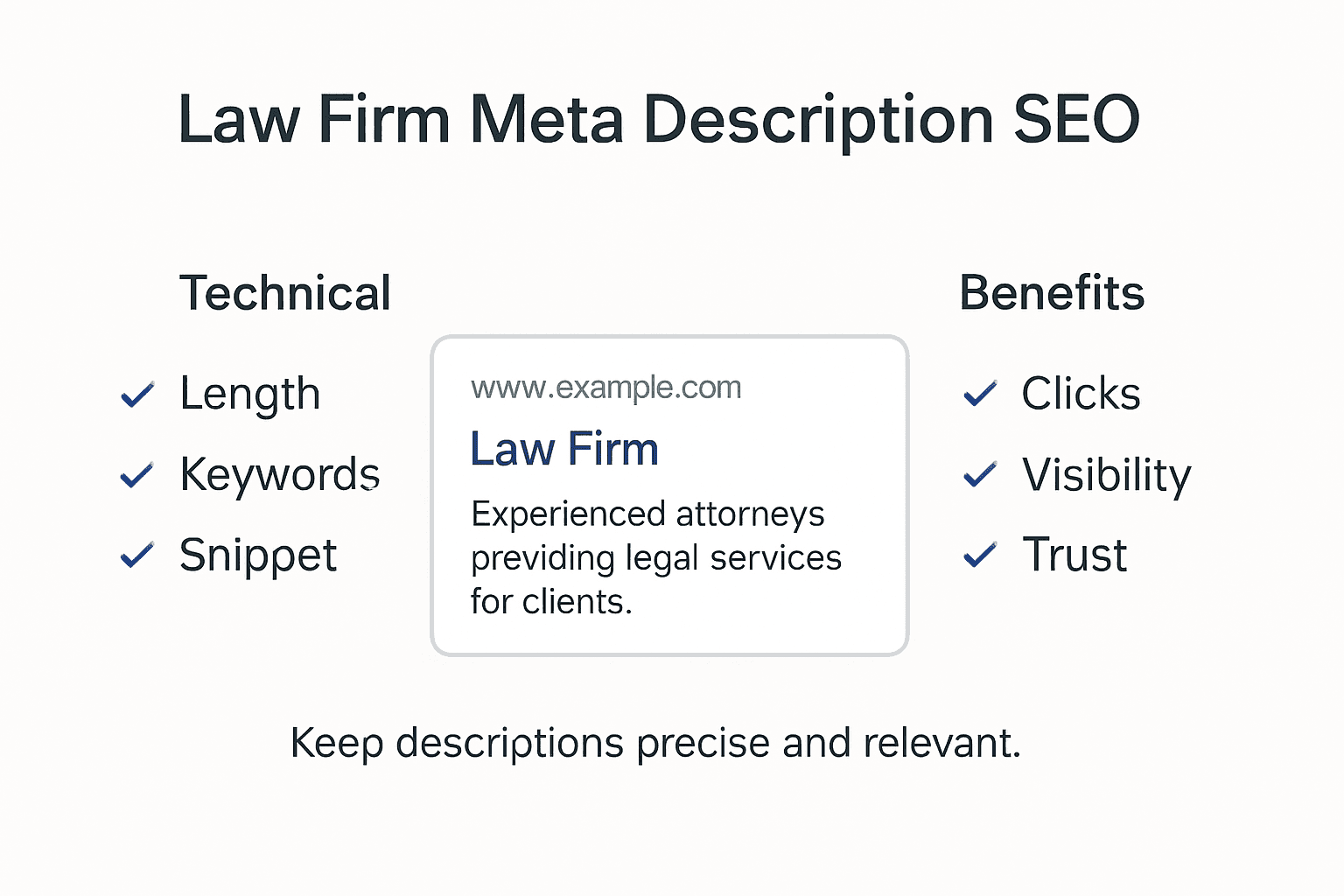
SEO for law firms represents a critical digital strategy that directly impacts client acquisition and online visibility. Most potential clients now begin their legal service search online, making search engine optimization an essential tool for law practices seeking to attract and engage new clients. The meta description plays a pivotal role in this digital marketing approach, serving as the critical interface between search results and potential client engagement.
Effective SEO strategies for law firms require a comprehensive approach that combines technical optimization, content relevance, and strategic keyword targeting. This means developing meta descriptions that are not just technically compliant, but strategically crafted to address potential clients’ specific legal needs. Meta descriptions should be carefully constructed to improve click-through rates and search engine rankings, with a precise focus on maintaining an optimal length between 50 and 160 characters to ensure maximum visibility and impact.
The technical nuances of SEO for law firms extend beyond simple keyword insertion. Successful optimization involves creating unique meta descriptions for each practice area page, incorporating location-specific keywords, and developing content that demonstrates the firm’s expertise and unique value proposition. This approach requires a deep understanding of potential clients’ search behaviors, legal service needs, and the competitive digital landscape in which law firms operate.
Pro tip: Conduct quarterly audits of your meta descriptions to ensure they remain current, relevant, and aligned with your firm’s evolving service offerings and client communication strategies.
Legal Industry Challenges and Compliance
SEO professionals supporting law firms must adhere to a strict code of ethics that goes far beyond typical digital marketing guidelines. The legal industry presents unique compliance challenges that demand a nuanced approach to search engine optimization, particularly when crafting meta descriptions and website content. Ethical SEO practices require maintaining absolute transparency, avoiding misleading claims, and ensuring that every digital representation of a law firm meets both search engine guidelines and legal advertising regulations.
The complex regulatory landscape for legal marketing demands meticulous attention to detail in digital content presentation. Compliance involves creating unique, accessible meta descriptions that summarize key content clearly and avoid overly technical jargon. Law firms must navigate a delicate balance between search engine optimization techniques and professional conduct rules that govern legal advertising. This means developing meta descriptions that are not just algorithmically effective, but also ethically sound and professionally representative of the firm’s expertise and values.
White-hat SEO strategies for law firms require a comprehensive understanding of both digital marketing principles and legal industry standards. Critical considerations include maintaining client confidentiality, avoiding claims that could be construed as guarantees of legal outcomes, and ensuring that all digital content maintains the highest standards of professional representation. This approach demands continuous monitoring and updating of meta descriptions and website content to remain compliant with evolving legal marketing regulations and search engine guidelines.
Pro tip: Develop a comprehensive compliance checklist for your law firm’s digital marketing materials, including specific guidelines for meta description creation that align with both SEO best practices and legal professional standards.
The table below compares white-hat and risky SEO approaches for law firm meta descriptions:
| Approach | Description | Risk Level | Best Use Scenario |
|---|---|---|---|
| White-Hat SEO | Ethical, compliant, clear | Low | Ongoing law firm marketing |
| Risky SEO | Aggressive, misleading | High | Not recommended for legal |
Common Pitfalls in Legal Meta Descriptions
Common pitfalls in legal meta descriptions can significantly undermine a law firm’s digital marketing efforts, creating barriers to potential client engagement and search engine visibility. These critical errors range from technical oversights to strategic miscalculations that can render an otherwise well-designed website ineffective. Understanding and avoiding these common mistakes is essential for law firms seeking to maximize their online presence and attract potential clients through strategic search engine optimization.
One of the most prevalent issues in legal meta descriptions is the tendency to use generic, non-specific language that fails to differentiate the firm’s unique services. Poorly written or missing meta descriptions can negatively impact a website’s accessibility and search engine discoverability, creating a missed opportunity to communicate the firm’s specialized expertise. Law firms frequently fall into traps such as keyword stuffing, using duplicate descriptions across multiple pages, or creating descriptions that exceed recommended character limits, resulting in truncated and ineffective search result previews.
Navigating the complex landscape of legal meta description optimization requires a nuanced approach that balances technical SEO requirements with professional communication standards. Critical pitfalls include using overly complex legal terminology that might confuse potential clients, failing to include clear calls-to-action, and neglecting to highlight the firm’s unique value proposition. Successful meta descriptions must strike a delicate balance between being search engine friendly and genuinely informative, providing potential clients with a concise yet compelling preview of the legal services offered.
Pro tip: Implement a quarterly meta description audit process that systematically reviews and updates your law firm’s website descriptions, ensuring they remain current, compliant, and strategically optimized for both search engines and potential clients.
Elevate Your Law Firm’s SEO with Powerful Meta Descriptions
The article highlights common challenges law firms face in crafting effective meta descriptions to boost search visibility and client engagement. Many attorneys struggle with creating targeted snippets that balance technical SEO demands with clear, action-oriented language that truly speaks to potential clients’ legal needs. Pain points include avoiding generic language, managing character limits, and ensuring compliance with legal advertising standards—all while driving higher click-through rates in a competitive market.
At LawSEO.com, we specialize in helping law practices overcome these hurdles by delivering customized SEO strategies focused exclusively on lawyers. Our founder-led team understands the critical role of meta descriptions in improving Google rankings and emerging AI-driven search platforms. We provide comprehensive solutions that optimize not just individual snippets but entire digital marketing efforts including local SEO, content creation, and ethical compliance.
Unlock the full potential of your law firm’s online presence today
Tap into expertise that transforms your meta descriptions from overlooked text to powerful client acquisition tools
Ready to leave ineffective and generic meta descriptions behind? Visit LawSEO.com now to start a tailored SEO campaign designed specifically for attorneys and experience measurable growth in qualified leads. Don’t miss this opportunity to dominate your local market with proven, compliance-focused SEO strategies that get results.
Learn more about optimizing your law firm’s digital presence with LawSEO.com and take control of your search engine visibility today.
Frequently Asked Questions
What is a meta description for a law firm?
A meta description is a concise summary that provides a snapshot of a webpage’s content, appearing under the webpage title in search results. For law firms, it highlights legal services and expertise to attract potential clients.
Why are meta descriptions important for law firm SEO?
Meta descriptions are crucial for SEO as they serve as marketing tools that influence click-through rates. A well-crafted meta description can attract the right audience by effectively communicating the firm’s unique value proposition and practice areas.
How long should a meta description be for a law firm?
A meta description for a law firm should ideally be between 150-160 characters long. This length ensures it is fully visible in search results and effectively conveys the necessary information to potential clients.
What elements should be included in law firm meta descriptions?
Effective meta descriptions should include targeted keywords relevant to the legal practice, a unique value proposition, geographic location, and a compelling call-to-action. These elements help differentiate the firm and encourage clients to engage further.