

LAWSEO · Practical guide

Law firm marketing strategies connect your services with the people you help. Choose a clear audience, a working inquiry route, accountable owners and channels you can maintain and measure.

A busy publishing calendar can hide an unfinished contact form or a practice page that never explains whom the firm helps. Start with a decision about the work you want, the work you can accept and the evidence you need. This guide includes a capacity planner and a deliberately modest example you can adapt.
Write the decision before the calendar
Complete this sentence: “For the next 90 days, we will help this audience understand this service, in this actual service area, through these selected channels.” Then name the person who will review the copy and the person who will respond to inquiries. Ninety days is a planning window here, not a promise about SEO results.
Use anonymized intake categories to identify recurring questions. You need patterns such as “unclear service eligibility” or “wrong geographic area,” not client names, case documents or confidential facts in a marketing worksheet. Ask whether the website can resolve those questions before someone contacts the firm.
Make truthful descriptions a condition of the plan. The ABA Model Rule on Communications About Legal Services prohibits misleading communications; the rules applicable to your firm’s jurisdictions control. Have the responsible lawyer review claims, credentials, results and offers. Our Ethical SEO Checks for Attorneys can help organize that review.
Give each channel a job
Choose a channel because it addresses a documented gap. A firm with an unreliable contact route has a different first task from one with a sound site but little useful information for referral sources. The following matrix is a planning aid, not a ranking of universal winners.
| Work | Useful when | Deliverable and completion check |
|---|---|---|
| Website and intake | Visitors cannot tell whether the service fits or how to contact you. | A clear service page and a tested inquiry route; confirm a test reaches its owner. |
| Local search | The firm serves a real local market and qualifies for a profile. | Verified business facts, suitable categories and a working website link. |
| Search content | Prospective clients ask a recurring question the site answers poorly. | One substantive answer, its source review and relevant internal links. |
| Professional relationships | People already introduce suitable prospects but lack clear information about the firm. | An accurate service brief and a lawful, documented relationship process. |
| Paid search | The firm can fund a bounded test and respond to suitable inquiries. | A reviewed landing page, budget limit, tracking check and pause criteria. |
| Email or social | A defined audience already uses the channel or has agreed to receive relevant updates. | A useful adaptation of reviewed material with a channel-specific next step. |
Choose between two plausible priorities
Suppose the firm receives suitable professional introductions but its service page leaves people unsure what to ask for. Clarify that page and give referral sources an accurate service brief before adding a new social channel. If the firm instead serves a local market but its verified business details are wrong, correcting those details may be the first task. These are decision examples, not evidence that one channel always produces better clients.
For local discovery, Google’s Local Ranking Guidance identifies relevance, distance and prominence. Accurate information helps Google understand a business; it does not buy a position. Check eligibility and ownership with our Google Business Profile Guide for Law Firms.
Relationships need their own review. Do not turn a marketing checklist into an unreviewed payment-for-referrals program. The ABA Model Rule on Specific Advertising Rules addresses recommendations, referral arrangements and related exceptions. Review the applicable jurisdiction’s rules before making an arrangement.

A six-hour weekly plan: an illustrative example
Imagine a small firm that has set aside six staff hours each week for marketing. Its service page is accurate, but its contact form has not been tested recently. The team also has one recurring intake question worth explaining. These are invented planning inputs, not a LAWSEO client case study.
| Task | Hours | Owner and evidence |
|---|---|---|
| Test the inquiry route and review intake categories | 1 | Intake lead; test receipt and an anonymized issue list. |
| Develop one answer over the month | 2 | Writer; source notes, draft and exact revision record. |
| Review accuracy and advertising claims | 1 | Responsible lawyer; approved wording or specific corrections. |
| Adapt the approved answer for one channel | 1 | Marketing owner; saved full copy, image and destination. |
| Maintain business facts and review performance | 1 | Marketing owner; changes, comparable observations and next decision. |
The allocation uses all six hours. Adding a two-hour video task creates an eight-hour plan, which exceeds capacity by two hours. The practical choice is to replace or defer something, increase confirmed capacity, or simplify the proposed task. Calling everything a priority does not create the missing time.
Use the Law Firm Marketing Capacity Planner to try your own allocation. It adds the hours and flags missing information. It does not estimate revenue, recommend an advertising budget or certify that the plan will work.
Use 90 days to build a repeatable process
Days 1–30: establish the baseline and remove the immediate obstacle. Confirm the service page, contact route and accountable owners. Keep a dated copy of the starting page and available performance data. If inquiry delivery fails, fix it before increasing promotion. Our Website Design Decision Guide separates a page problem from a larger rebuild.
Days 31–60: finish one useful resource and distribute it deliberately. Answer the selected question, complete the legal and editorial review, publish the final version and verify the live page. Adapt the material for the chosen channel rather than copying an entire article into a caption. The Content Marketing Guide for Lawyers offers a way to choose the resource and keep its scope manageable.
Days 61–90: review what actually happened. Compare the planned work with the completed work, then examine relevant search and inquiry evidence. Keep the next cycle small if the first one still has unresolved delivery or measurement problems. A longer SEO observation period may be necessary; a calendar deadline is not evidence of a failed or successful channel.
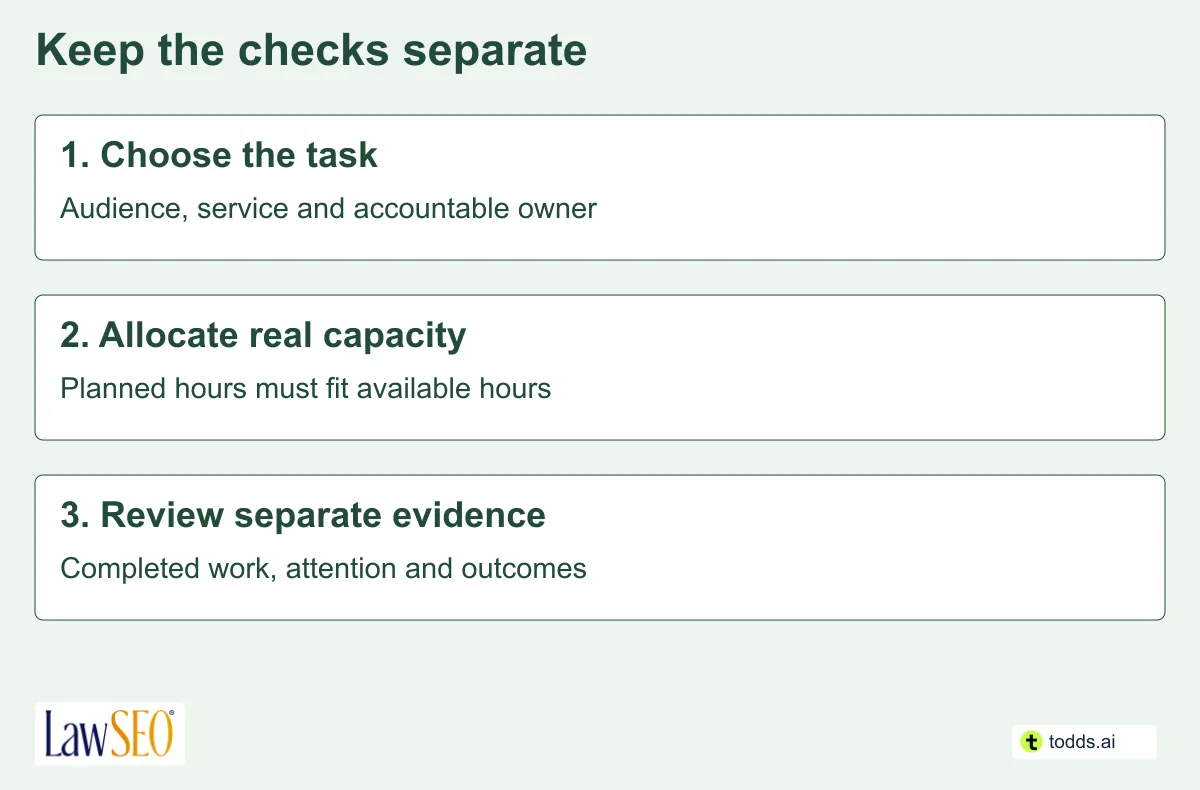
Separate delivery, attention and business outcomes
Use three columns in the monthly review: work completed, audience response and qualified business outcomes. A published article belongs in the first. Search impressions or a social click belong in the second. A screened inquiry or confirmed engagement belongs in the third. Do not rename one as another to make a report look stronger.
Give every test a pause criterion before it starts. Examples include an unavailable intake owner, a broken contact route, a claim awaiting legal review or spending beyond the owner’s authorized limit. Weak or incomplete data calls for investigation. It does not justify attributing every new matter to the latest article.
Keep Google review requests neutral and based on real experiences. Google’s Maps Contribution Policy prohibits fake engagement and incentives. Do not offer incentives, ask only people expected to leave positive reviews, or turn “get more reviews” into a quota for positive ratings. Review replies also need to respect client confidentiality.
Questions about law firm marketing strategies
Should a small firm use every channel?
No. Start with the channels that fit a defined audience and can be maintained. Keep a short list of deferred ideas so they do not silently consume the current plan’s time.
Does a 90-day plan mean SEO should pay off in 90 days?
No. This example organizes work and review dates. It does not predict rankings, leads or revenue. Check delivery and data quality before interpreting the results.
Can one article support several channels?
Yes, when each version is useful in its destination. A short practical takeaway may suit social; an email may explain why the change matters to its particular audience. Keep the claims, images and links consistent with the reviewed source.
What should we do first if we cannot measure inquiries?
Verify the inquiry route and agree on a small set of intake categories. The Law Firm SEO Decision Guide helps separate the investment question from the evidence needed to answer it.
 Created with todds.ai
