

Ethical SEO for attorneys helps people find accurate legal information while respecting state advertising rules and Google’s search and review guidelines.

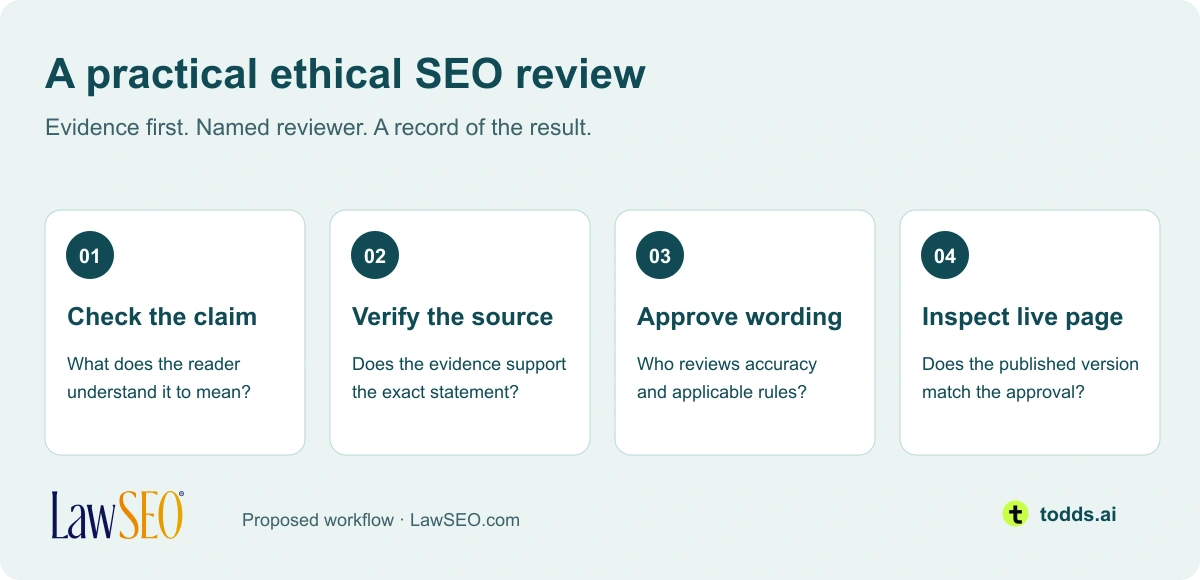
A useful test is whether your marketing team can explain and support what it publishes: the claims on a practice page, the address on a business profile, the way reviews are requested and the results in an SEO report. Use the seven checks below to make review part of your law firm SEO strategy.
- Check professional rules and platform policies separately.
- Keep evidence behind claims about experience, recognition and results.
- Review the finished page, listing or response before it goes live.
1. Separate professional rules from platform policies
The American Bar Association’s Model Rule 7.1 addresses false or misleading communications about a lawyer’s services, including material omissions. It is a model rule: the rules adopted in the relevant jurisdiction govern the firm’s conduct. An SEO checklist cannot establish compliance in every state.
Google applies its own requirements. A marketing practice can raise a professional-responsibility issue, a Google policy issue, both or neither. Keep those reviews separate so a platform approval is never mistaken for an attorney’s legal approval.
| Question | What to check | Who should review |
|---|---|---|
| Does this claim accurately describe the firm? | Applicable advertising rules, credentials, permissions and necessary context | The firm’s responsible attorney |
| Does this tactic follow Google’s requirements? | Search spam policies, Business Profile eligibility and review policies | The SEO or profile manager, escalating legal questions |
| Does the published result match the approved version? | The actual page, image, snippet settings and listing | The publisher and assigned reviewer |
Agree on this division before delegating content or outreach. The people described here are suggested roles; a small firm may assign several responsibilities to one person.
2. Support every important marketing claim
Open your highest-priority practice page and highlight statements a prospective client might rely on: years of experience, past outcomes, credentials, awards, fees and availability. For each, ask what proves it and whether a missing qualification changes its meaning.
Prefer a specific, documented description over an unsupported superlative. A badge should identify the organization and relevant year; a result needs the context and permissions the firm determines are required. A disclaimer cannot substitute for making the main statement accurate. This discipline should carry through your law firm branding, not stop at the website.
The ABA’s Model Rule 7.2 includes conditions on claiming certification as a specialist. That does not establish a universal ban on describing a practice focus. Have the responsible attorney check the exact wording against the applicable jurisdiction’s rules.
Check the title tag, description and featured image too. An unsupported claim in a graphic or search description deserves the same attention as one in the body text.
3. Request and respond to reviews responsibly
Google’s Maps content policy prohibits incentives for reviews and selectively soliciting positive reviews. A neutral request for feedback is different from directing only happy clients to Google or offering a gift for a five-star rating.
- Use a consistent, attorney-approved process for deciding when a request is appropriate.
- Keep participation voluntary; do not prescribe a rating or write the client’s review.
- Check the policy of each destination. A process acceptable on one review site may not be acceptable on another.
- Send difficult responses for review before posting.
Confidentiality matters even when someone criticizes the firm publicly. ABA Model Rule 1.6 protects information relating to representation, subject to its stated conditions and exceptions. A public complaint is not a general permission to disclose case details. Use the applicable rule and qualified judgment before responding.
Catch the less obvious problem: “Leave an honest review for a gift card” still involves an incentive, even without a five-star condition. For Google, remove the reward and avoid filtering recipients by expected sentiment. Do not copy a review request from another platform without checking its rules.
4. Represent offices and services accurately
Google’s Business Profile guidelines say an address rented for mail, where the business does not operate, is ineligible. A co-working office must meet specific conditions, including signage, receiving customers and staffing by the business during business hours. Disclosing that an address is virtual does not make it eligible.
Compare your website, business profile and directory entries. Use the actual business name, describe services accurately and distinguish a real office from an area you serve. A city page can explain service availability without pretending an office exists there.
For a multi-office firm, maintain one verified information sheet per eligible location: address, hours, phone, staffed services and responsible owner. Check the website’s location page against that sheet before copying it into a listing. Resolve conflicting details at the source rather than spreading another version across directories.
5. Publish useful, verifiable content—including AI-assisted drafts
Give readers a direct answer, then explain the facts and choices that affect their next step. Use relevant jurisdictional sources for legal statements, identify the author accurately and ask a qualified reviewer to check material legal claims. Credit research at the point where you use it.
Google’s people-first content guidance emphasizes accuracy and clear authorship. It also says E-E-A-T is not itself a specific ranking factor. A byline or a plugin score cannot certify expertise or promise a ranking.
AI can help organize a draft, but it cannot be the evidence for a statistic, case citation or claim about a firm’s experience. Open the original source, check that it supports the sentence and retain necessary qualifications. If support is missing, remove or narrow the statement.
Google’s spam policies address large-scale production of low-value content intended to manipulate rankings, regardless of how it is produced. Review the value of the page rather than assuming that either human-written or AI-assisted content automatically passes.
Risky SEO tactics and more useful alternatives
The examples below apply Google’s keyword-stuffing, doorway-abuse and link-spam policies. The alternatives are editorial recommendations, not a promise of rankings or automatic compliance.
| Risky tactic | Better approach | What to verify |
|---|---|---|
| Repeating “Dallas injury lawyer” unnaturally throughout a page. | Explain the service and location in clear, useful language. | Read the copy aloud; remove repetitions that add no meaning. |
| Near-identical city pages built to funnel visitors to one destination. | Retain pages that provide distinct, accurate local value; consolidate those that do not. | Check each page’s usefulness, service claims and navigation. |
| Buying links specifically to pass ranking credit. | Earn editorial references; qualify paid advertising links appropriately. | Inspect the placement, payment relationship and link attributes. |
Have a proposed tactic you cannot verify? Ask LawSEO to review the plan.
Our AI Overviews guide for law firms shows how to inspect a search answer and its cited pages. Use that process to find questions worth answering, then verify the substance independently.
6. Review link building and agency work
Ask an agency to show where a link will appear, why that site’s readers would find it useful, whether money or another benefit changes hands and who controls the placement. Evaluate the actual page and relationship, not just a third-party authority score.
Google’s spam policies distinguish links intended to manipulate rankings from advertising or sponsorship links with appropriate qualifications. Paid placements should use rel="sponsored" or rel="nofollow" as Google describes. Professional rules governing recommendations and payments are a separate check for the firm.
Keep a placement record with the source page, destination, anchor text, relationship, date and approval. LawSEO’s link-building overview introduces common placement types; use the current Google policy when evaluating a proposed tactic.
Ask who owns the website, content, analytics and business profiles, and how the firm receives changes and reports. Our LawSEO team information helps identify who you are working with. Any provider should be able to explain its responsibilities without promising a particular position in search.
7. Measure results and keep a review record
Track the result that matters to the firm while keeping the measurements distinct. Search visibility, website visits, inquiry events and retained matters describe different stages. A click or repeated form event does not establish a new client.
For example, suppose an illustrative report records 20 form events. That does not prove 20 people contacted the firm, that all inquiries came from organic search or that 20 matters were retained. Check duplicate submissions, channel attribution and the intake record before making those claims. Compare the same periods, locations and definitions; mark any missing evidence explicitly.
Keep a monthly record of the changes made and the evidence reviewed. Start with the practice pages that matter most to the firm’s goals, then address unresolved claims or inaccurate listing details. Set the review frequency around your work and applicable requirements rather than assuming one universal retention or review schedule.
| Item | Action | Suggested owner | Evidence of completion |
|---|---|---|---|
| Marketing claim | Check support, context and applicable rules | Responsible attorney | Approved wording and supporting record |
| Review request | Check selection, incentives and confidentiality | Attorney and intake lead | Approved template and process |
| Office listing | Verify eligibility and current details | Office manager and SEO lead | Dated listing review |
| Article or link | Read the source and inspect the finished page | Editor and SEO lead | Source, approval and live URL |
| Performance report | Separate visibility, inquiries and clients | Analyst and intake lead | Definitions and reconciled totals |
For each row, add a due date and a status: needs evidence, ready for review, approved or verified live. Keep the approved wording and final URL together so a later revision can be checked against the record.
Questions about ethical law firm SEO
Can a lawyer target a phrase containing “best”?
A query people type is different from a claim your firm makes about itself. Assess the wording readers actually see and the support behind it. Do not turn keyword research into an unsupported superiority claim; ask the firm’s reviewer how the applicable rules treat the proposed language.
Can an agency handle the firm’s SEO?
Yes, but agree on responsibilities, access and review before work starts. Give the agency accurate inputs and retain a clear path for the responsible attorney to review legal claims. Outsourcing the writing does not itself verify the content.
Should every suspicious backlink be disavowed?
No. Google’s disavow guidance says most sites do not need the tool and warns that incorrect use can harm performance. Investigate against Google’s criteria rather than treating a tool’s risk label as an automatic removal instruction.
Does following these checks guarantee rankings?
No. They provide a way to improve accuracy, accountability and usefulness. Evaluate search performance separately with comparable data, and investigate changes before attributing them to any one edit.
This guide addresses general marketing practices. The responsible attorney should confirm the rules and required disclosures for the firm’s jurisdictions.
 Created with todds.ai
