


Most American law firms overlook a crucial shift in how AI tools find and recommend legal expertise online. The competition for client attention now hinges on whether your content is structured for AI discovery, not just traditional search engines. By focusing on actionable strategies, you can unlock better online visibility and demonstrate authority in your practice areas, creating more opportunities to attract clients who rely on cutting edge AI search platforms.
Table of Contents
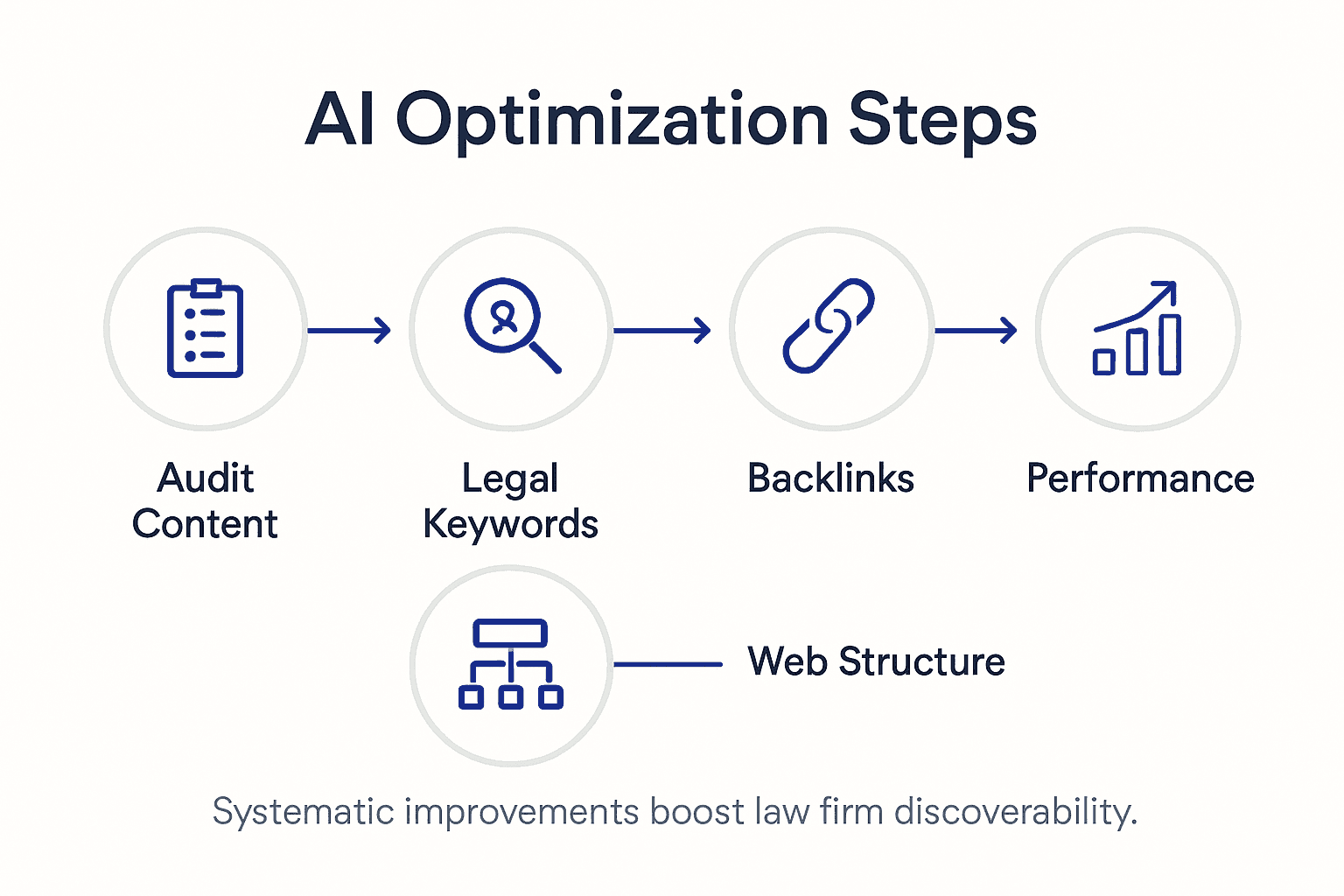
- Step 1: Assess Firm Content for AI Discoverability
- Step 2: Identify Legal Keywords for AI Search Platforms
- Step 3: Optimize Web Pages for Generative AI Tools
- Step 4: Strengthen Online Authority with AI-Friendly Backlinks
- Step 5: Verify Indexing and Performance in AI Search Results
Quick Summary
| Key Point | Explanation |
|---|---|
| 1. Transform Content for AI | Simplify legal documents into digestible formats like FAQs and how-to guides for better AI understanding. |
| 2. Enhance Metadata for Discoverability | Use author credentials, captions, and schema markup to improve the discoverability of your legal content. |
| 3. Use Specialized Legal Keywords | Identify and employ domain-specific legal keywords to align with AI systems and client inquiries. |
| 4. Optimize Web Page Structure | Organize web content with clear headings and semantic HTML for easier AI retrieval and indexing. |
| 5. Build High-Quality Backlinks | Focus on acquiring editorial backlinks from credible legal sources to establish online authority. |
Step 1: Assess Firm Content for AI Discoverability
Mastering AI discoverability requires a strategic audit of your law firm’s existing content. You need a systematic approach to determine how effectively AI search tools like ChatGPT and Gemini can understand and recommend your legal resources.
Start by analyzing your content structure through the lens of AI comprehension. AI-powered tools prioritize content that provides clear, structured information. This means transforming dense legal documents into easily digestible formats. Convert lengthy paragraphs into concise FAQ sections, create step by step how-to guides, and ensure your HTML markup is clean and semantic. Metadata becomes critically important here metadata such as author credentials, precise captions, and schema markup can significantly improve your content’s AI visibility.
Implement a metadata enhancement strategy that automates and refines your content’s searchability. Leveraging large language models can help generate more precise and comprehensive metadata, which acts as a bridge between AI retrieval systems and your firm’s valuable legal insights. Focus on creating rich, contextual descriptions that highlight your expertise and make your content more discoverable across emerging AI platforms.
Pro tip: Use structured data markup like JSON-LD to help AI tools quickly understand the context and relevance of your legal content.
Here’s how key metadata types impact AI discoverability of law firm content:
| Metadata Type | Purpose | Impact on AI Visibility |
|---|---|---|
| Author Credentials | Establishes expertise and authority | Boosts trustworthiness |
| Captions | Adds context to visuals and documents | Improves content relevance |
| Schema Markup | Provides structured data for AI parsing | Enhances content indexing |
| Rich Descriptions | Summarizes page content and expertise | Supports accurate recommendations |
Step 2: Identify Legal Keywords for AI Search Platforms
Successfully optimizing your law firm’s content for AI search platforms requires a precise approach to keyword selection. You will develop a strategic keyword framework that enables AI tools to understand and prioritize your legal expertise.
Legal keywords must capture the complex and specialized terminology of the legal profession, targeting domain specific language that reflects your firm’s unique practice areas. This means moving beyond generic legal terms and diving deep into practice area specific jargon. For intellectual property lawyers, keywords might include terms like patent prosecution, trademark registration, or copyright infringement. Criminal defense attorneys should incorporate phrases like constitutional rights, criminal procedure, or case dismissal strategies. Focus on creating keyword clusters that demonstrate your technical knowledge and align with how potential clients and AI search platforms conceptualize legal challenges.
Generative AI platforms increasingly demand specialized keywords that reflect legal ethics, technology adoption, and precise legislative terminology, helping AI systems filter and present authoritative legal information. This approach transforms your content from simple text into an intelligent, discoverable resource that AI platforms can confidently recommend to users seeking legal guidance.
Pro tip: Regularly update your keyword strategy by analyzing the actual search queries AI platforms use to surface legal content in your specific practice area.
Step 3: Optimize Web Pages for Generative AI Tools
Transforming your law firm’s web content for generative AI search platforms requires a strategic approach to content design and technical optimization. Your goal is to make your legal resources easily discoverable and digestible by advanced AI search technologies.

Generative Engine Optimization represents a revolutionary approach to content visibility, focusing on structuring your web pages to maximize retrieval and summarization by large language models. This means reimagining your content beyond traditional search engine optimization. Create clear, concise sections with descriptive headings that directly answer potential client questions. Break complex legal concepts into digestible chunks, using semantic HTML that provides clear context for AI systems to understand your expertise.
Effective AI optimization demands clean HTML structure, rapid page loading, and comprehensive metadata, with special attention to schema.org tags and semantic markup. Ensure your robots.txt file allows AI crawlers full access, and minimize JavaScript heavy elements that might impede content indexing. Your web pages should function like precision instruments design to communicate expertise quickly and clearly to both human readers and AI search platforms.
Pro tip: Periodically test your web pages using AI search platforms to verify how your content appears and is interpreted by generative AI tools.
Step 4: Strengthen Online Authority with AI-Friendly Backlinks
Building strategic backlinks requires a sophisticated approach that goes beyond traditional link-building tactics. Your law firm must develop a nuanced strategy that resonates with both human readers and AI search platforms.
In the era of AI search environments, backlink quality matters more than mere quantity, with Generative Engine Optimization prioritizing contextual brand mentions from authoritative sources. Focus on securing editorial links from reputable legal publications, industry blogs, and professional associations. Target platforms that discuss complex legal topics and can provide meaningful context about your firm’s expertise. Consider platforms like specialized legal forums, academic law blogs, and professional networking sites that offer substantive discussions about legal practice.
Link building remains crucial for establishing website authority through high quality editorial backlinks, with AI systems evaluating the relevance and trustworthiness of your sources. Develop content that naturally attracts citations from respected legal resources, such as comprehensive research guides, landmark case analyses, or innovative legal technology insights. Engage in strategic outreach with legal thought leaders and create content that demonstrates your firm’s unique perspective and deep industry knowledge.
Pro tip: Monitor your backlink profile quarterly and prioritize links from sources with demonstrable expertise in your specific legal practice areas.
This table summarizes the most effective backlink sources for establishing online authority in legal AI search:
| Backlink Source | Typical Content Provided | Authority Value |
|---|---|---|
| Legal Publications | Editorial articles, analysis | Highest credibility |
| Industry Blogs | Practice insights, trends | Strong niche relevance |
| Academic Law Blogs | Case studies, research | Deep sector expertise |
| Legal Forums | Practitioner discussions | Meaningful professional context |
Step 5: Verify Indexing and Performance in AI Search Results
Verifying your law firm’s visibility in AI search platforms requires a systematic approach to tracking and analyzing your content’s digital performance. You will develop a comprehensive strategy to monitor how AI tools discover and present your legal resources.
The Stanford AI Index Report provides critical insights into understanding AI indexing and search performance, revealing the sophisticated mechanisms behind content discovery. Begin by conducting regular searches across multiple generative AI platforms like ChatGPT, Google Bard, and Claude to understand how your content appears. Track key metrics such as citation frequency, contextual accuracy, and the comprehensiveness of AI generated summaries about your legal expertise. Pay special attention to how AI platforms synthesize your content and the specific keywords or phrases they extract.
Abstracting and Indexing databases play a crucial role in verifying content performance in AI search environments, offering sophisticated tools for monitoring digital visibility. Use professional tracking services that provide detailed analytics about your content appearances across AI platforms. Document instances where your firm is referenced, analyze the context of these mentions, and assess whether the AI generated descriptions accurately represent your legal capabilities and expertise.
Pro tip: Create a spreadsheet to track AI search appearances and systematically record how different platforms interpret and present your law firm’s content.
Unlock Your Law Firm’s Potential with Expert AI Search Optimization
The challenge of making your legal content easily discoverable by generative AI tools like ChatGPT and Gemini is real and growing more urgent every day. You understand the importance of refining metadata, targeting specialized legal keywords, and structuring your web pages for AI discoverability. Yet turning these complex strategies into measurable client leads can feel overwhelming.
That is where LawSEO.com steps in. We specialize exclusively in legal SEO with expert strategies designed to enhance your firm’s authority and visibility on both traditional search engines and emerging AI-driven platforms. Our founder-led team uses proven techniques like AI metadata enhancement and generative engine optimization to position your content at the forefront where potential clients are searching. By combining our deep understanding of legal marketing with advanced AI optimization, we empower your firm to attract new clients and stay ahead of the competition.
Ready to transform your law firm’s AI search presence today?
Explore how our comprehensive legal SEO services can help you build rich, authoritative content that AI tools trust and recommend. Visit LawSEO.com now and take the first step toward dominating AI search results and accelerating client growth.
Frequently Asked Questions
How can I assess my law firm’s content for AI discoverability?
To assess your law firm’s content for AI discoverability, start by conducting a systematic audit of existing materials. Focus on simplifying your legal documents into structured formats like FAQ sections and how-to guides, ensuring clear HTML markup and rich metadata to enhance visibility.
What legal keywords should I use for AI search platforms?
Use specialized legal keywords that reflect your firm’s unique practice areas and the specific terminology of your field. Create keyword clusters around complex legal phrases relevant to your services to improve how AI search platforms recognize and recommend your content.
How do I optimize my web pages for AI search engines?
Optimize your web pages by structuring content with clear headings, concise sections, and semantic HTML. This includes using descriptive titles and ensuring fast loading times to make your legal resources more accessible and discoverable by AI tools.
What kind of backlinks should I focus on to strengthen my online authority?
Focus on obtaining high-quality backlinks from reputable legal publications, industry blogs, and academic law resources. Aim for a strategy that emphasizes the contextual relevance of these links to enhance your firm’s authority in AI search environments.
How can I verify my law firm’s performance in AI search results?
Conduct regular checks on multiple AI platforms to track how your content appears, noting citation frequency and contextual accuracy. Create a monitoring system, perhaps using a spreadsheet, to document appearances and analyze how effectively AI tools interpret your firm’s expertise.