


TL;DR:
- Link building is a crucial but often overlooked foundation for legal marketing success, requiring strategic acquisition of authoritative backlinks. High-quality links from reputable legal directories, industry publications, and media significantly boost search rankings and client credibility. Sustainable progress depends on genuine relationship-building, ongoing audits, and adherence to ethical practices rather than shortcuts or low-value link schemes.
Link building remains one of the most misunderstood and underutilized tools in legal marketing. While many law firms invest heavily in website design and paid advertising, they often overlook the foundational role that backlinks play in establishing search authority. When potential clients search for a personal injury attorney or estate planning lawyer in their city, the firms ranking at the top of those results share one common trait: a strong, authoritative backlink profile. Understanding what link building actually means, how to execute it strategically, and what pitfalls to avoid can be the difference between a firm that dominates its local market and one that stays invisible online.
Key Takeaways
| Point | Details |
|---|---|
| Quality trumps quantity | Law firms should focus on relevant, authoritative links instead of chasing numbers. |
| Editorial placement matters | Links that are naturally included by trusted sources have more impact on search authority. |
| Avoid risky shortcuts | Spammy tactics and unnatural link patterns can harm your website’s rankings. |
| Measure and improve | Track link building results and conduct regular audits to ensure ongoing growth and safety. |
| Law-specific approach wins | Targeting legal directories and industry publications works best for law firms seeking top search visibility. |
Understanding link building: What it means for law firms
Now that we’ve introduced why search presence is mission-critical for law firms, let’s clarify exactly what link building means and why it’s more than just listing your website around the internet.
Link building is the process of acquiring hyperlinks from other websites that point back to your law firm’s site. Search engines like Google treat these inbound links as votes of confidence. Each link from a credible, relevant source signals that your site is trustworthy and authoritative. Over time, a strong collection of quality backlinks elevates your rankings in organic search results, driving more prospective clients to your practice.
For law firms, this process carries unique weight. The legal sector is competitive, highly regulated, and trust-dependent. Clients selecting an attorney are making a significant decision, often during a stressful life event. Search engines mirror this dynamic by rewarding sites that demonstrate genuine expertise, authority, and trustworthiness. This is sometimes called E-E-A-T (Experience, Expertise, Authoritativeness, Trustworthiness), and your backlink profile directly supports how search engines assess those signals.
“For law firms, effective link building commonly targets reputable legal directories, industry publications and legal blogs, and earned media opportunities that create editorially placed citations and referral traffic.”
Quality links for law firms typically come from:
- Reputable legal directories such as Avvo, FindLaw, Martindale-Hubbell, and Justia
- Bar association websites at the state and local level
- Legal publications and industry blogs that cover practice area topics
- Local news outlets that cite an attorney as a source or expert
- Community organizations and non-profit boards where partners serve
- Academic institutions referencing published legal work or commentary
Not all links carry equal weight. A backlink from a recognized legal news publication carries far more authority than one from a generic business directory with no topical relevance. Context matters enormously. A link embedded naturally within an article about personal injury law signals much more relevance to Google than a bare citation in a random footer. Understanding this distinction is the first step toward building a lawyer link building workflow that actually moves the needle on rankings.
Types of links: Which matter most for law firms?
With a foundational understanding in place, let’s compare the actual types of links your law firm’s website might acquire and make sense of which are truly worth pursuing.
Not all backlinks are created equal. The type, source, and context of each link affects how much value it delivers to your site. Here is a clear breakdown of the main categories:
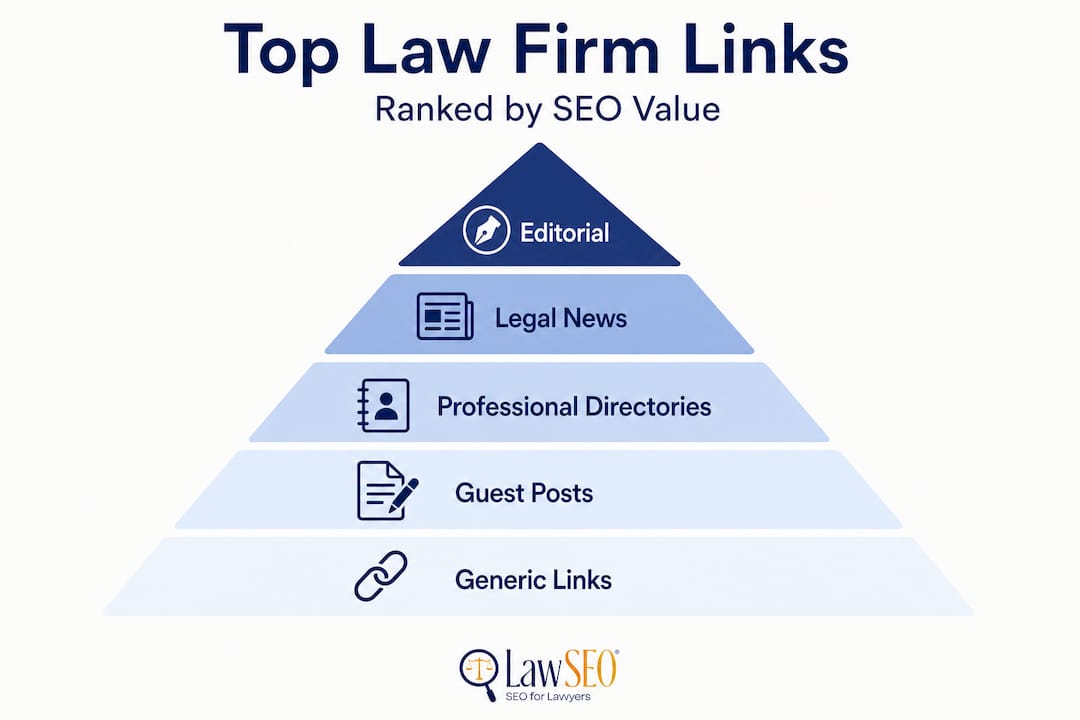
| Link type | Value level | Description |
|---|---|---|
| Editorial links | Very high | Earned organically when a credible source cites your content or expertise |
| Directory links | Moderate | Listed in reputable legal or local directories |
| Guest post links | Moderate to high | Placed within quality content you contribute to a relevant publication |
| Reciprocal links | Low | Exchanged between two sites solely for SEO purposes |
| Spammy/paid links | Harmful | Purchased or placed on unrelated, low-quality sites |
Quality backlink signals depend on factors like relevance, natural anchor text, whether the link is editorially placed, and whether it’s dofollow and indexed. Unnatural patterns can harm rankings or simply be ignored by Google.
There are several critical factors that determine how much value a link actually provides:
- Domain authority of the linking site: A link from a high-authority legal publication outperforms dozens of links from low-quality directories.
- Topical relevance: Links from legal websites, local news outlets, and professional associations are more relevant than links from unrelated niches.
- Anchor text: The clickable text of a link should read naturally. Exact-match keyword anchors like “best personal injury lawyer Los Angeles” used repeatedly raise red flags.
- Editorial placement: Links embedded within meaningful content rather than site footers or sidebar widgets carry more weight.
- Dofollow vs. nofollow: Dofollow links pass ranking signals. Nofollow links still provide some traffic and brand exposure but do not directly pass authority.
Pro Tip: Audit the anchor text distribution across your existing backlinks. If more than 15 to 20 percent of your links use exact-match keyword anchors, take steps to diversify by earning more brand-name and contextual links.
Firms that rely on internal linking strategies alongside their external link acquisition effort also tend to see stronger results. Internal links guide search engines through your site’s structure, amplifying the authority your backlinks bring in.
Risky link patterns to avoid include participating in private blog networks, purchasing mass link packages, or exchanging links with other law firms purely for SEO purposes. These tactics may produce short-term gains but often lead to algorithmic penalties that can devastate a firm’s rankings.
Proven link building strategies for law firms
Understanding types of links is crucial, but the next step is knowing how to systematically secure high-value links that help your firm outrank competitors.
Law firms have several natural advantages in link building that other industries do not. Your attorneys are credentialed experts. You serve local communities. You handle matters that regularly intersect with news cycles, legislative changes, and public interest. These attributes, when leveraged correctly, create genuine opportunities to earn authoritative backlinks.
Here are the most effective strategies your firm should be executing:
-
Claim and optimize all reputable directory profiles. Start with your state bar directory, then move to trusted legal directories. Complete every field including bio, practice areas, and geographic focus. Earned media and reputable directory citations provide both referral traffic and lasting link equity.
-
Contribute thought leadership to legal publications. Write guest articles, practice area guides, or case commentary for legal blogs and industry news sites. Well-crafted content positions your attorneys as authorities and earns natural editorial links.
-
Pursue media and podcast features. Journalists frequently need attorney commentary on legal news, court decisions, and policy changes. Responding to journalist queries through platforms like Help a Reporter Out (HARO) can earn valuable placements in regional and national news outlets.
-
Leverage professional and community networks. Speaking at bar association events, contributing to law school symposiums, or serving on nonprofit boards creates natural opportunities for authoritative organizations to link to your firm’s website.
-
Publish original research or surveys. Law firms that publish data-driven content, such as analyses of local court statistics or consumer legal surveys, attract links from journalists and academics who cite original sources.
Pro Tip: When pursuing media coverage, create a press page on your firm’s website with attorney bios, headshots, and topic pitches. Journalists and podcast hosts often visit these pages before reaching out, and a well-organized media hub increases your chances of being featured.
For a deeper look at how these tactics fit into a broader strategy, explore off-page SEO for law firms and consider working with specialists who offer legal link building services with a track record in the legal sector.
How search engines evaluate links (and common mistakes to avoid)
Equipped with strategies, it’s time to look at how search engines really evaluate your links and the costly mistakes to sidestep.
Google’s algorithms have grown increasingly sophisticated at distinguishing genuine editorial links from manufactured ones. Understanding the criteria search engines apply helps you build a link profile that earns lasting rankings rather than temporary boosts that collapse after the next algorithm update.
| Evaluation factor | What search engines look for | Why it matters for law firms |
|---|---|---|
| Linking domain authority | Age, trust score, inbound links of the source | High-authority legal sites carry more weight |
| Contextual relevance | Topic alignment between the source and your content | Legal publications outperform generic blogs |
| Anchor text distribution | Variety of branded, topical, and URL anchors | Over-optimized anchors trigger penalties |
| Link velocity | Consistency and pace of new link acquisition | Sudden spikes suggest manipulation |
| Indexation status | Whether the linking page is indexed by Google | Unindexed pages pass no value |
“Unnatural link patterns can harm or be ignored by search engines, making quality and editorial placement the two most critical factors in backlink evaluation.”
Common mistakes law firms make include:
- Over-relying on low-quality directories. Submitting to hundreds of generic or irrelevant business directories produces negligible benefit and dilutes your profile’s quality signals.
- Using aggressive exact-match anchor text. Repeatedly linking to your site with keyword-heavy anchors like “best DUI attorney Dallas” raises unnatural signals that can suppress rankings.
- Reciprocal link schemes with other firms. Exchanging links purely for SEO purposes, without genuine editorial context, is a practice Google has specifically penalized.
- Ignoring toxic backlinks. If your firm has acquired bad links through past vendors or purchased packages, leaving them unaddressed can drag down your overall authority score.
- Neglecting link velocity. Acquiring 200 links in a single week followed by no activity for months looks unnatural. Steady, consistent acquisition is what sustainable growth looks like.
For a complete picture of how these principles apply in competitive legal markets, review the proven legal SEO strategies that experienced practitioners deploy.
Measuring link building success: KPIs, audits, and next steps
Building and maintaining strong links is ongoing. Let’s cover how to evaluate, measure, and continually strengthen your efforts.

Too many law firms treat link building as a one-time project. They build a batch of directory citations, write a few guest articles, and then move on. That approach misses the compounding nature of a well-managed backlink program. Consistent measurement and regular audits are what separate firms that maintain their rankings from those that slip back after initial gains.
Key performance indicators to track include:
- Domain authority or domain rating scores from tools like Ahrefs, Moz, or Semrush to monitor the overall strength of your backlink profile over time
- Referring domains count which measures how many unique websites link to your firm, a more meaningful metric than total backlinks
- Organic referral traffic from backlinks, tracked in Google Analytics to see which links actually drive visitors to your site
- Keyword ranking changes particularly for competitive practice area and location-specific terms that reflect the impact of link acquisition
- New vs. lost links to identify any partners or publications that have removed your links, allowing you to address them proactively
Conducting a backlink audit every quarter is a sound practice. Export your full backlink profile, evaluate each domain’s relevance and quality, flag low-quality or suspicious links, and use Google’s Disavow Tool if toxic links are causing concern.
Effective link building includes not just acquiring links, but monitoring quality and steady patterns over time. Setting a benchmark of earning four to eight high-quality linking domains per month is realistic for most mid-size firms. Larger firms targeting national rankings may need to invest more aggressively.
Link building must be integrated into your broader law firm marketing strategies rather than treated in isolation. Content marketing, public relations, social media, and SEO all reinforce each other. A well-cited article earns links. A media appearance generates referral traffic. A strong backlink profile elevates every piece of content your firm publishes.
Why most law firms get link building wrong (and what actually works)
Here is a candid observation from years of working exclusively in legal marketing: most law firms that struggle with link building are not failing because they lack resources. They are failing because they are chasing the wrong outcomes.
The firms that see the most durable gains share a specific mindset. They treat link building as relationship development and reputation building, not as a technical checkbox. When an attorney publishes a genuinely insightful analysis of a recent court ruling, or contributes meaningfully to a bar association committee, or speaks at a community legal clinic, links follow naturally. Those links stick. They carry weight. They do not disappear when an algorithm updates.
Conversely, the firms that rely on bulk directory submissions, link exchanges with unrelated businesses, or low-cost offshore link packages often experience a cycle of short-term gains and painful setbacks. After each major Google algorithm update, we see firms scrambling to recover rankings that evaporated overnight because their link profiles were built on sand.
The uncomfortable truth is that sustainable link building in the legal industry is slow. It requires actual expertise, consistent publishing, genuine outreach, and patience. But that slowness is also what makes it defensible. Once a reputable legal publication, a state bar association website, or a respected local news outlet links to your firm, that asset compounds in value over time.
What distinguishes elite legal marketers is their understanding that every link is not just an SEO signal but a trust signal visible to actual human beings. Clients often research law firms across multiple sources before making contact. Seeing your firm cited in a respected legal publication or featured on a bar association page reinforces the credibility they need to reach out. That dual function, for algorithms and for people, is what makes quality link building worth the investment.
Firms ready to build a scalable, ethical, and high-performing approach should examine the advanced link building workflows that systematize this process from outreach to publication to monitoring.
Take your law firm’s SEO further
Ready to strengthen your firm’s visibility and authority? At LawSEO.com, we work exclusively with law firms to design and execute link building programs that align with ethical marketing standards and deliver measurable ranking improvements. Our founder-led approach means every campaign benefits from nearly three decades of SEO experience applied specifically to the legal sector. From auditing your current backlink profile to securing placements in authoritative publications, we handle the full workflow. Explore our resources on top SEO platforms for lawyers and see how advanced SEO for lawyers can position your firm for long-term dominance.
Frequently asked questions
What makes a backlink “high quality” for law firms?
A high-quality backlink comes from a relevant, authoritative source with natural anchor text and is editorially placed. Quality link signals also depend on whether the link is dofollow and properly indexed by search engines.
How do law firms avoid penalties from bad links?
Law firms should avoid buying links, using spammy directories, or over-optimizing anchor text. Unnatural patterns can harm rankings or cause search engines to discount your entire link profile.
Which directories should law firms use for link building?
Use only reputable legal directories or bar association listings that are verified by the legal community. Reputable legal directories like Avvo, Martindale-Hubbell, and Justia are trusted starting points for most practice areas.
How fast should a law firm build new links?
Aim for steady, quality growth rather than sudden large increases in backlinks. Monitoring quality and steady patterns is as important as the total number of links acquired over any given period.
Can law firms do link building in-house or should they outsource?
Firms can start in-house with directory claims and content contributions, but many benefit significantly from expert guidance. A specialist with legal sector experience helps maximize results, avoid costly penalties, and execute strategies at a scale most in-house teams cannot sustain alone.