


Nearly 90 percent of American legal clients start their search for representation online. For mid-sized law firms, a strong SEO strategy directly shapes how easily potential clients find your website and choose your services over competitors. This guide outlines proven steps for assessing, optimizing, and enhancing your law firm’s online presence so you reach more clients and build lasting authority in a competitive digital market.
Table of Contents
- Step 1: Assess Current Website Performance And SEO
- Step 2: Optimize Site Structure And Technical Elements
- Step 3: Enhance Content For Legal Relevance And AI Discoverability
- Step 4: Build Authority With Strategic Links And Citations
- Step 5: Verify Improvements And Monitor Ongoing Performance
Quick Summary
| Key Point | Explanation |
|---|---|
| 1. Conduct a comprehensive website audit | Use tools like Google Analytics to evaluate traffic, user engagement, keywords, and conversion metrics for better client attraction. |
| 2. Optimize website structure and technical elements | Implement a clear site hierarchy and improve technical SEO aspects like page speed and mobile responsiveness for user experience and search engine visibility. |
| 3. Enhance legal content for AI and SEO | Focus on creating authoritative, relevant content and use structured data to improve discoverability in both AI-generated and traditional search results. |
| 4. Build authority through strategic linking | Acquire high-quality backlinks from reputable sources and maintain precise citations to enhance your firm’s credibility and online presence. |
| 5. Regularly monitor and verify improvements | Establish key performance indicators and regular audit schedules to assess your digital marketing efforts and make necessary adjustments for growth. |
Step 1: Assess current website performance and SEO
Assessing your law firm’s website performance requires a systematic approach to understanding your current digital marketing effectiveness. By conducting a comprehensive audit, you can identify strengths, weaknesses, and opportunities for optimization that directly impact your ability to attract potential clients.
Start by leveraging powerful analytics tools like Google Analytics and Google Search Console to evaluate website metrics that reveal your site’s current performance. Look beyond surface level traffic numbers and dig into critical indicators such as organic search rankings, user engagement rates, bounce rates, and conversion metrics specific to legal service inquiries. Pay special attention to how potential clients interact with your site tracking user paths from initial landing pages through contact form submissions or consultation requests.
Complement your technical analysis by examining your content’s quality and relevance. Legal websites must demonstrate authoritative and current information that establishes credibility and expertise. Review each practice area page for accuracy, comprehensiveness, and alignment with potential client search intent. Analyze your keyword strategy ensuring you target specific legal service queries potential clients are using when seeking representation.
Pro tip: Create a spreadsheet tracking key performance indicators monthly to visualize your website’s progress and identify trends in your SEO improvements.
Here’s a summary of key website performance metrics and their business impact for law firms:
| Metric | What It Measures | Why It Matters for Law Firms |
|---|---|---|
| Organic Search Traffic | Number of visitors from search | Indicates online visibility |
| Bounce Rate | Percentage leaving after 1 page | Reveals engagement and page relevance |
| Lead Conversion Rate | Visitors turning into inquiries | Directly impacts client acquisition |
| Keyword Rankings | Position for target keywords | Shows SEO success and reach |
Step 2: Optimize site structure and technical elements
Optimizing your law firm’s website structure and technical elements is crucial for improving search engine visibility and user experience. This strategic process involves creating a logical, easily navigable site that helps potential clients find information quickly while simultaneously meeting search engine crawling and indexing requirements.
Begin by implementing strategic site hierarchy and navigation that provides clear pathways for users and search engines. Develop a logical menu structure that organizes your practice areas, attorney profiles, and service pages in a manner that reflects how potential clients search for legal assistance. Ensure your URL structure is clean and descriptive, using keywords that accurately represent each page’s content. Technical SEO optimization requires attention to critical elements like page loading speed, mobile responsiveness, secure HTTPS connections, and comprehensive XML sitemaps that help search engines understand your website’s architecture.

Focus on creating a technically sound website that balances user experience with search engine requirements. This means minimizing unnecessary code, compressing images, implementing schema markup for legal services, and ensuring fast loading times across all devices. Regular technical audits will help you identify and quickly resolve potential issues that could impact your website’s performance and search rankings.
Pro tip: Use Google’s PageSpeed Insights and Mobile Friendly Test tools monthly to track and improve your website’s technical performance and user experience.
Step 3: Enhance content for legal relevance and AI discoverability
Transforming your law firm’s content to meet the evolving landscape of AI search requires a strategic approach that balances technical optimization with substantive legal expertise. Your goal is to create content that not only ranks well in traditional search results but also becomes discoverable and credible in AI generated search overviews.
Start by understanding AI search optimization for legal content that goes beyond traditional keyword strategies. Focus on developing comprehensive, authoritative content that directly answers potential client questions with precision and depth. Implement structured data markup to help AI systems better understand and contextualize your legal information, ensuring your practice areas and services are accurately represented in AI search results. Create content that demonstrates expertise by providing clear explanations of legal concepts, potential case scenarios, and jurisdiction specific insights that showcase your firm’s unique knowledge.
Prioritize responsible AI content integration that maintains professional standards and ethical guidelines. This means rigorously reviewing AI generated or assisted content to verify accuracy, remove potential biases, and ensure alignment with legal professional responsibilities. Develop content that speaks directly to client concerns while maintaining the nuanced understanding that distinguishes professional legal advice from generic information.
Pro tip: Conduct quarterly content audits to verify your legal content remains current, accurate, and optimized for both human readers and AI search algorithms.
Compare traditional SEO with AI-focused optimization for legal websites:
| Approach | Core Focus | Unique Advantage | Main Challenge |
|---|---|---|---|
| Traditional SEO | Keywords & link building | Improves traffic from web search | Highly competitive landscape |
| AI Optimization | Structured data & context | Enhances visibility in AI results | Requires ongoing adaptation |
Step 4: Build authority with strategic links and citations
Building online authority for your law firm requires a sophisticated approach to creating credible digital connections that signal expertise and trustworthiness to both search engines and potential clients. Strategic linking and precise citation practices will elevate your website’s reputation and improve search engine visibility.
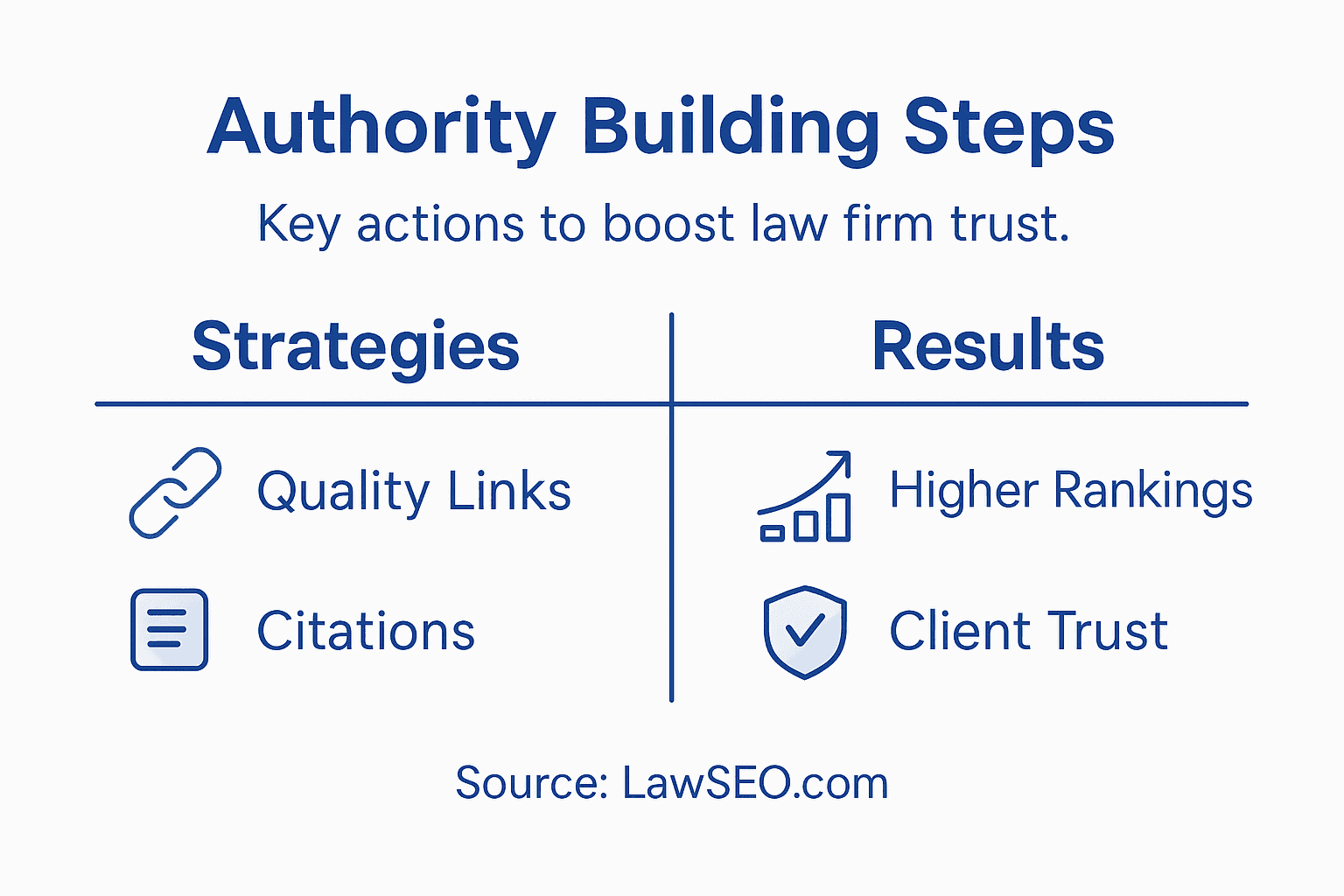
Focus on acquiring authoritative links through strategic networking with respected legal organizations, professional associations, and relevant industry resources. Seek out opportunities for high quality backlinks from university law school publications, state bar associations, legal research centers, and professional journals. These authoritative sources provide significant credibility signals that demonstrate your firm’s professional standing. Develop content that naturally attracts editorial links by producing comprehensive legal guides, research papers, and thought leadership articles that offer genuine value to the legal community.
Implement precise citation standards that showcase your firm’s commitment to accuracy and professional documentation. Use structured data markup to help search engines understand the context and credibility of your references. Include clear attribution for legal research, case studies, and statistical information, ensuring that every citation reinforces your expertise and reliability. Systematically audit your external and internal links to maintain a clean, authoritative link profile that supports your firm’s digital reputation.
Pro tip: Create a tracking system to monitor the quality and relevance of your external links quarterly, removing broken or low quality connections that could negatively impact your website’s authority.
Step 5: Verify improvements and monitor ongoing performance
Tracking and verifying the effectiveness of your law firm’s digital marketing strategy requires a systematic approach to measuring website performance and SEO outcomes. This critical step transforms raw data into actionable insights that help you continuously refine and optimize your online presence.
Establish comprehensive performance metrics and KPIs that provide a holistic view of your website’s success. Focus on key indicators such as organic search traffic, lead conversion rates, average time on page, bounce rates, and keyword ranking improvements. Use advanced analytics tools to create custom dashboards that track these metrics consistently, allowing you to understand how potential clients interact with your website and identify areas for strategic enhancement.
Conduct regular website performance audits to maintain and improve your digital marketing effectiveness. These comprehensive evaluations should examine technical SEO elements, content quality, link health, and user experience. Look beyond surface level metrics to understand deeper trends like client acquisition costs, practice area engagement rates, and the correlation between specific content pieces and lead generation. Develop a quarterly review process that allows you to systematically adjust your strategy based on empirical performance data.
Pro tip: Create automated reporting templates that compile your key performance metrics into a concise monthly dashboard, enabling quick strategic decision making.
Take Your Law Firm Website to the Next Level for Maximum Leads
The challenges of assessing website performance, optimizing site structure, and enhancing legal content for AI discoverability are critical for gaining an edge in today’s competitive legal market. If you are facing low organic search traffic, poor lead conversion rates, or struggling to build authoritative backlinks, you are not alone. These pain points directly impact your ability to attract and convert new clients. At LawSEO.com, we specialize exclusively in SEO for lawyers and understand the unique ethical and strategic demands law firms face. Our founder-led team focuses on proven techniques designed to improve rankings on both traditional search engines and emerging AI-driven platforms.
Discover how our comprehensive services can transform your website’s visibility and credibility. From targeted local SEO and expert content production to strategic link building and cutting-edge AI optimization, LawSEO.com offers tailored solutions that drive measurable results. Benefit now from a trusted partner with over 29 years of SEO experience dedicated solely to legal marketing.
Ready to dominate your market and bring in more qualified leads? Visit LawSEO.com today and start optimizing your law firm website for the future of legal client acquisition.
Frequently Asked Questions
How can I assess my law firm’s current website performance?
To assess your law firm’s website performance, conduct a comprehensive audit using tools like Google Analytics and Google Search Console. Focus on key metrics such as organic search traffic, bounce rates, and lead conversion rates to identify areas for improvement, and make this a monthly task to track your progress.
What are the essential technical elements to optimize for a law firm website?
Essential technical elements to optimize include site structure, loading speed, mobile responsiveness, and secure HTTPS connections. Ensure to regularly audit these elements to keep your website functioning efficiently and user-friendly, aiming for improved site speed within 30-60 days.
How should I enhance the content on my law firm’s website for better leads?
Enhance your website content by focusing on relevant and authoritative information that answers potential client questions clearly. Regularly conduct content audits and aim to update your most important pages quarterly to keep them current and engaging.
What strategies can I use to build authority for my law firm’s website?
To build authority, focus on acquiring high-quality backlinks from reputable legal sources and implementing precise citation practices. Actively engage in networking opportunities and produce valuable content that naturally attracts these links, and check your link profile quarterly to ensure ongoing credibility.
How do I verify the improvements made to my website’s SEO?
You can verify improvements in your website’s SEO by establishing key performance indicators and regularly tracking them with advanced analytics tools. Set up automated reporting monthly to review metrics such as organic traffic, keyword rankings, and user engagement to identify trends and areas needing attention.